
Alcohol & Health 2025: Whats a Moderate Pour?
Alcohol & Health 2025: What’s a Moderate Pour?
Table of Contents
🧭 What counts as “moderate” in 2025?
“Moderate” isn’t the same worldwide. Public-health agencies increasingly emphasize less is better, with some stating there’s no safe level for cancer risk. Still, countries publish “low-risk” limits to guide decisions. World Health Organization
-
United States (Dietary Guidelines 2020–2025): If you drink, limit to ≤2 drinks/day for men and ≤1/day for women; some adults should not drink at all (e.g., pregnancy, certain meds, AUD, under 21). rethinkingdrinking.niaaa.nih.gov
-
United Kingdom (CMO): Keep to ≤14 units/week on a regular basis, spread across several days. GOV.UKUK Government Publishing
-
Australia (NHMRC 2020): To reduce risk, ≤10 standard drinks/week and ≤4 on any day. nhmrc.gov.au+1
-
Canada (2023 Guidance): 0–2 drinks/week = lower risk; risk increases from 3–6/week and more sharply at ≥7/week. ccsa.ca
Bottom line: Set your limit at the lowest of these thresholds or lower—especially if you have additional risk factors. World Health Organization
📏 Standard drink sizes & UK “units”
To compare across drinks, use “standard drink” (US) or “units” (UK).
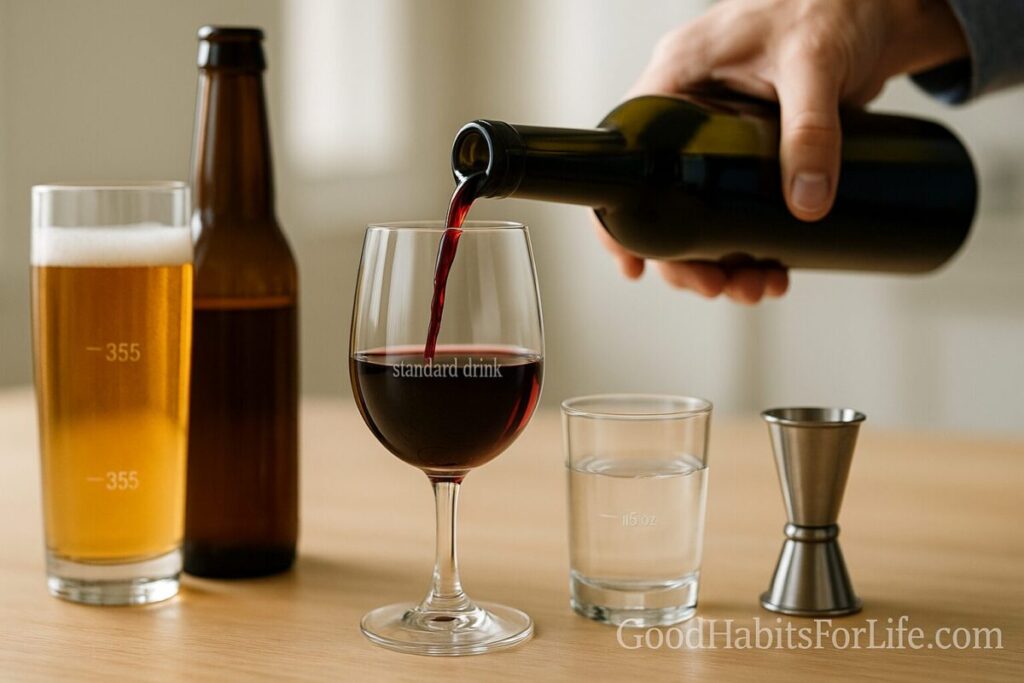
US standard drink (≈ 14 g pure alcohol ≈ 0.6 fl oz):
-
Beer: 355 ml (12 oz) at 5% ABV
-
Wine: 150 ml (5 oz) at 12% ABV
UK unit: 1 unit = 10 ml (8 g) pure alcohol. Units = (ABV × ml) ÷ 1000.
A 175 ml glass of 12% wine ≈ 2.1 units; a 568 ml pint of 4% beer ≈ 2.3 units. nhs.ukAlcohol Change UK
Tip: Big glasses and high-ABV craft beers can hide 2–3 “drinks” in one serving—measure once with a jigger and keep the jigger by your bar.
✅ Quick-start: Check your pour today
-
Count last week. Convert each drink to standard drinks/units. (Use the unit formula above.) nhs.uk
-
Set a cap. Choose alcohol-free days (e.g., Mon–Thu) and set a per-occasion limit (e.g., max 2).
-
Swap smarter. Pick ≤4–5% ABV beer, 125–150 ml wine, or alcohol-free (0.0–0.5% ABV) options.
-
Track it. Use NIAAA “Rethinking Drinking” worksheets or apps below. rethinkingdrinking.niaaa.nih.gov
-
Plan scripts. Decide how you’ll decline the third round (see scripts).
-
Sleep, food, water. Eat before drinking; alternate water after each drink.
🛠️ 30-60-90 Day Moderation Plan
Goal: Keep risk low, improve sleep/energy, and make moderation automatic.
Days 1–30 (Stabilize)
-
Audit: Log baseline week; identify “auto-pour” moments.
-
Caps: Choose 2–4 alcohol-free days/week; limit ≤2 drinks on any day (or ≤1 if you’re aiming for extra-low risk). ccsa.canhmrc.gov.au
-
Replace: Stock NA beer/wine, bitters & soda, or mocktails.
-
Measure: Use a 44 ml (1.5 oz) jigger and 150 ml wine line on a glass.
-
Track & reflect: Daily check-in: Why did I drink? Did it help? Use an app. drinkaware.co.uk
Days 31–60 (Strengthen)
-
Shrink occasions: Move alcohol to the last part of an event; set a start time (e.g., after 8 pm) to reduce total.
-
Swap ABV: Choose lower-ABV alternatives; keep servings at standard-drink size. NIAAA
-
Implementation intentions: If I’m offered a top-up, then I switch to sparkling water.
Days 61–90 (Lock-in)
-
Raise the bar: Add one more alcohol-free day or cut weekly total by 20–30%.
-
Plan edges: Holidays, weddings, travel—pre-decide your caps and ride-home plan.
-
Review health wins: Sleep, morning focus, HRV/steps; stay with what works.
🧠 Techniques & frameworks that work
-
Pre-commitment: Decide limits before events; put cash in a separate “drinks” envelope.
-
Urge surfing: Notice the urge (it peaks and falls within ~20 min).
-
HALT check: Hungry, Angry/Anxious, Lonely, Tired—treat the state, not with a drink.
-
Friction hacks: Keep alcohol out of sight; chill NA options at eye level.
-
Social defaults: Start with NA; never accept “mystery” pours.
👥 Variations by audience
-
Parents & professionals: Protect sleep and next-day performance—prefer weekday alcohol-free nights; limit to ≤1 if drinking on work nights.
-
Students (of legal age): Avoid rounds; buy your own drink and pace with water.
-
Seniors: Greater sensitivity to alcohol and drug interactions—confirm with your clinician; consider stricter caps or abstinence. rethinkingdrinking.niaaa.nih.gov
-
People with specific risks: Pregnancy or trying to conceive: no known safe amount; some meds/conditions mean don’t drink. ccsa.carethinkingdrinking.niaaa.nih.gov
⚠️ Mistakes & myths to avoid
-
“Wine is heart-healthy.” Any alcoholic beverage increases several cancer risks; health groups now emphasize less is better. CDCcancer.gov
-
“I pour light at home.” Home pours often equal 1.5–2+ standard drinks—measure once. NIAAA
-
“I can ‘save’ drinks for the weekend.” Binge patterns spike injury and health risks even if weekly totals are low. CDC
-
“Guidelines = safe.” They’re low-risk, not no-risk; the WHO states there’s no safe level. World Health Organization
💬 Real-life examples & scripts
-
At a party: “I’m pacing tonight—starting with a 0.0 beer.”
-
At dinner: “I’m good with a 150 ml pour, thanks.”
-
Second round pressure: “Not tonight—I want an early start tomorrow.”
-
Host top-ups: “I’ll finish this water first.”
-
Weekend brunch: “NA spritz for me—driver duty.”
🧰 Tools, apps & resources
-
NIAAA Rethinking Drinking (self-checks, printable trackers). rethinkingdrinking.niaaa.nih.govNIAAA
-
MyDrinkaware (unit & calorie tracker). drinkaware.co.uk
-
Try Dry (Alcohol Change UK) (dry month or “damp” goals). Alcohol Change UKAppleGoogle Play
-
US CDC alcohol pages (facts, risks, cancer info). CDC+1
📚 Key takeaways
-
A standard drink is smaller than most home pours—know your measure. NIAAA
-
Low-risk ≠ safe; WHO and cancer agencies highlight no safe level for some harms. World Health Organizationcancer.gov
-
Choose a personal cap below national limits, add alcohol-free days, and track. rethinkingdrinking.niaaa.nih.govGOV.UKnhmrc.gov.auccsa.ca
-
For best health, drink less—or not at all. World Health Organization
❓ FAQs
What’s a “moderate pour” at home?
About 150 ml (5 oz) wine, 355 ml (12 oz) 5% beer, or 44 ml (1.5 oz) spirits equals one US standard drink; many wine glasses hold 2+ when filled generously. NIAAA
Is any alcohol “safer,” like red wine?
No. Cancer risk rises with any alcoholic beverage; drink type doesn’t cancel that risk. CDC
Why do men and women have different US daily limits?
On average, body composition and alcohol metabolism differ, so equal drinks produce higher blood alcohol in women; hence the lower daily cap in US guidance. rethinkingdrinking.niaaa.nih.gov
How do UK “units” compare with US “standard drinks”?
1 US standard drink (~14 g) ≈ 1.75 UK units (since 1 unit = 8 g). nhs.uk
What if I only drink on weekends?
Avoid “saving up” drinks; heavy episodic drinking spikes accident and health risks even if your weekly total looks similar. CDC
I’m pregnant or trying to conceive—what’s safe?
Health agencies advise no alcohol; there’s no known safe amount. ccsa.ca
Are there benefits to cutting down even if I don’t quit?
Yes—sleep, weight, blood pressure, and cancer risk all trend better as intake falls. CDC
Which country’s limit should I follow?
Use the strictest guideline that applies to you—or go lower, especially with other risk factors. World Health Organizationccsa.canhmrc.gov.auGOV.UK
📚 References
-
NIAAA. “What’s a Standard Drink?” (standard sizes/14 g). NIAAA
-
NIAAA. Rethinking Drinking (US guideline summary). rethinkingdrinking.niaaa.nih.gov
-
WHO/Europe. “No level of alcohol consumption is safe for our health.” (2023). World Health Organization
-
UK Chief Medical Officers. Low Risk Drinking Guidelines (2016). GOV.UKUK Government Publishing
-
NHMRC (Australia). Australian Guidelines to Reduce Health Risks from Drinking Alcohol (2020). nhmrc.gov.au+1
-
CCSA (Canada). Canada’s Guidance on Alcohol and Health (2023, public summary). ccsa.ca
-
CDC. Alcohol & Cancer Risk; Alcohol Facts & Stats (2024–2025). CDC+1
-
IARC/WHO. Monographs, Volume 100E (Alcoholic Beverages = Group 1 carcinogen). publications.iarc.who.intpublications.iarc.fr
-
CDC. “About Moderate Alcohol Use” (context & cautions). CDC
-
NHS (UK). “Calculating alcohol units” (unit definition/equation). nhs.uk
Disclaimer: This article is for general education, not medical advice; please consult your healthcare professional for personal guidance.