
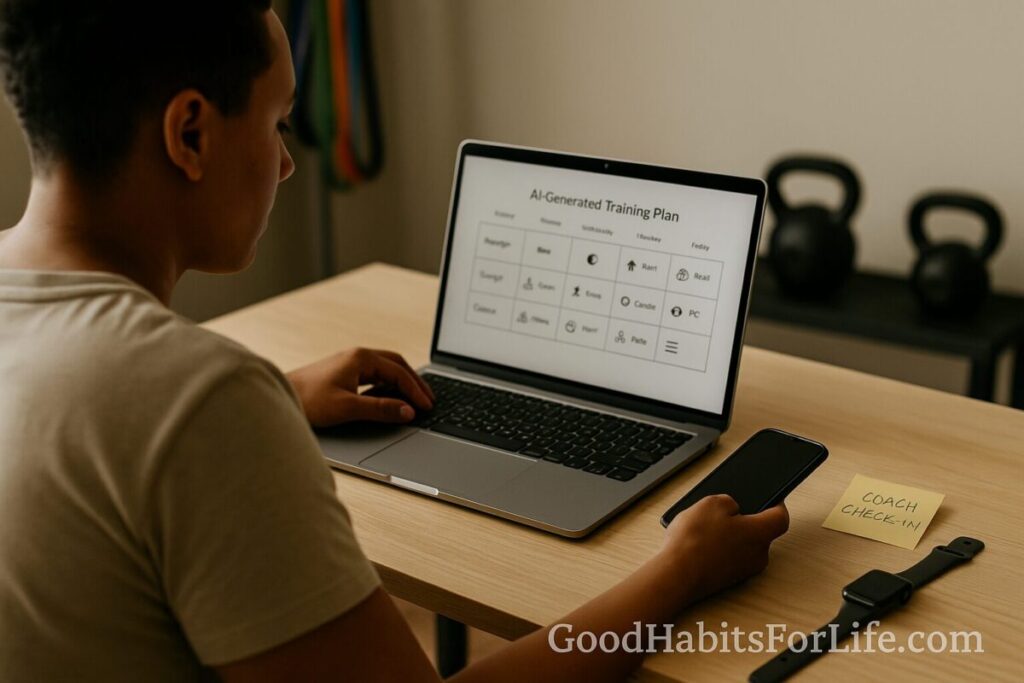
AIGenerated Training Plans: Use, Dont Abuse
AIGenerated Training Plans: Use, Dont Abuse
Table of Contents
🧭 What “AI-Generated Training Plans” Are (and Why Use Them)
AI-generated plans are workout schedules drafted by large language models (LLMs) or fitness apps using your inputs (e.g., goals, time, equipment). They’re fast, convenient, and can spark ideas you might not consider.
Upsides
-
Speed: get a structured plan in minutes.
-
Breadth: AI can suggest varied modalities (strength, mobility, cardio).
-
Consistency: templates help you show up.
Downsides
-
Incomplete context: AI can miss nuanced medical history, movement quality, and recovery needs; studies show many responses are accurate but insufficient. Use AI to draft, humans to decide. ScienceDirect
-
No real-time eyes: AI can’t see your squat depth, gate your return-to-run, or spot pain compensation.
-
Ethical/safety considerations: Health-sector guidance stresses human oversight, transparency, and risk management when using LLMs. World Health Organization
Baseline you still need regardless of goal
-
Hit public-health minimums: ~150–300 min/week moderate aerobic activity (or 75–150 min vigorous) plus ≥2 strength days; reduce sitting. WHO Appswww.heart.org
-
Pass a quick readiness screen (PAR-Q+). If you answer “yes” to anything or have conditions, see a clinician before ramping up. HFJC Library
✅ Quick-Start: A Safe, Smart First 7 Days
Goal: Turn the AI draft into a human-safe plan you can actually follow.
Day 0 (10–15 min): Safety & setup
-
Complete PAR-Q+. If flagged, get medical clearance. HFJC Library
-
Pick one main goal for the next 30 days (e.g., “3 full-body sessions/week” or “run 10 km/week”).
-
Choose 2–3 modalities you enjoy (e.g., full-body strength, brisk walking, yoga). Enjoyment improves adherence.
Day 1–2: First sessions (low-to-moderate load)
-
Keep sessions to 30–45 min.
-
Use RPE 5–6/10 for most sets/intervals (comfortable-challenging, able to talk). PubMed
-
Stop if you feel sharp pain, dizziness, unusual shortness of breath.
Day 3: Easy move + mobility
-
20–30 min light cardio (walk, cycle) + 10 min mobility.
Day 4: Full-body strength (technique focus)
-
5 movements: squat/hinge, push, pull, carry, core. 2–3 sets of 8–12 reps @ RPE 5–7.
-
Log what you did (sets-reps-RPE).
Day 5: Rest or gentle activity
Day 6: Repeat strength/cardio mix
Day 7: Review & adjust
-
Note soreness, sleep, stress; adjust next week’s loads accordingly.
-
If the AI plan felt too hard or too easy, tweak via RPE, sets, or rest.
🧠 Make It Yours: FITT + RPE + Goals
AI drafts tend to be generic. The FITT framework and RPE scale personalize safely.
FITT (ACSM cornerstone)
-
Frequency: sessions/week (e.g., 3× strength, 2× cardio).
-
Intensity: how hard (RPE, %1RM, pace).
-
Time: minutes/session.
-
Type: modality (e.g., intervals, long run, push-pull-legs). ACSM
RPE (Borg) quick guide
-
RPE 3–4: warm-up / recovery
-
RPE 5–6: aerobic base / technique work
-
RPE 7–8: working sets / tempo pieces
-
RPE 9–10: very hard / near-max—use sparingly
The classic Borg scale correlates with physiological effort and is practical for day-to-day coaching. PubMed
Progression (the smart way)
-
Favor small, steady increases; avoid big spikes in weekly load, which elevate injury risk. PMC
-
For strength, both adding load or adding reps over time can build muscle and strength. PMCPubMed
-
Novices do well with 2–3 full-body sessions/week on non-consecutive days. NSCA
🛠️ 30-60-90 Day Habit Plan (With Checkpoints)
Days 1–30 (Foundation)
-
Target: 150–210 min/wk moderate cardio + 2 full-body strength days. WHO Apps
-
Strength template (3×/wk option):
-
A: Squat, Push, Row, Carry, Plank
-
B: Hinge, Press, Pull-down, Lunge, Anti-rotation
-
2–3 sets × 8–12 reps @ RPE 6–7; finish feeling you could do 2–4 more reps.
-
-
Cardio mix: 2 steady sessions (30–40 min) + 1 short intervals day (e.g., 6×1-min @ RPE 7, 1-min easy).
-
Checkpoint (Day 30): Consistency ≥80%? Soreness manageable? If yes, advance.
Days 31–60 (Build)
-
Strength: 3×/wk; progress one variable at a time—either +2.5–5 kg on key lifts or +1–2 reps/set over last month’s best. PMC
-
Cardio: keep two steady sessions; progress one of them by ~10–15 min; keep one intervals session.
-
Add 1 mobility block (10 min) to every session.
-
Checkpoint (Day 60): RPE logs trending 6–8? No pain? Sleep ≥7 h? Advance or hold.
Days 61–90 (Peak & Personalize)
-
Choose a focus: Performance (heavier strength, longer intervals) or Body Comp (slight volume uptick, more steps).
-
Optional deload in week 9 (reduce volume by 30–40%).
-
If you hit a wall (sleep, appetite, motivation), hold or deload—don’t force progression.
⚠️ Myths, Risks & Red Flags
Myths to drop
-
“AI knows me better than I do.” → It doesn’t know your joints, job stress, or last night’s sleep. Keep a human in the loop. World Health Organization
-
“The more I add each week, the faster I’ll improve.” → Spikes raise injury risk; steady load wins. PMC
-
“Only heavier weights build muscle.” → Reps-based progression also works when effort’s high. PMC
Red flags (pause and reassess)
-
Chest pain, dizziness, or unusual shortness of breath.
-
Sharp joint pain that alters form.
-
Persistent fatigue, sleep disruption, or mood changes.
-
Any PAR-Q+ “yes” that hasn’t been medically cleared. HFJC Library
🎯 Audience Variations
Students
-
30–40 min blocks; campus walking as NEAT; backpack-friendly strength (bands + bodyweight).
Parents
-
Micro-workouts (2×15 min) during naps/school runs; stroller walks; weekend family hike.
Busy Professionals
-
3×/wk full-body (40–45 min); cycle meetings on foot; intervals on the rower/bike for joint-friendly intensity.
Seniors
-
Prioritize balance, strength, and mobility; RPE 4–6 for most work; consult clinician if you have chronic conditions before higher intensities. WHO Apps
Teens
-
Skills and fun over volume; supervised strength is safe and beneficial; avoid maximal loads without coaching (follow school/club guidance). WHO Apps
💬 Real-Life Scripts & Prompts
Prompt to generate a first draft plan (then you edit):
“Create a 4-week full-body program for a healthy adult with dumbbells and a pull-up bar, 3 sessions/week, 45 minutes, goal = get stronger and improve cardio. Use RPE targets, list sets/reps, and include one interval day. Add a short warm-up and mobility finisher.”
Follow-up prompts to personalize
-
“Rewrite Week 2 with RPE 6–7 and one extra rest day.”
-
“Swap lunges for split squats; knees feel cranky.”
-
“Turn the long run into a brisk walk (8 km) and add hills.”
-
“I sleep 6 hours—reduce volume by 20% and add mobility.”
Check-in script with yourself/coach (weekly)
-
What felt too easy / too hard (RPE log)?
-
What got in the way (schedule, soreness, stress)?
-
What’s one tweak for next week (sets, reps, rest, exercise choice)?
🧩 Tools, Apps & Data Hygiene
-
General trackers: Apple Health/Google Fit (steps, heart rate), Strava (social/accountability), Garmin/Coros/Polar (training load metrics).
-
Strength logs: Strong, Hevy, JEFIT (templates, PR tracking).
-
Planning & review: Notion/Obsidian/Sheets for weekly retro and habit streaks.
-
Data hygiene:
-
Keep health data private; use strong authentication.
-
If using AI chat for coaching notes, strip identifiers and avoid sharing medical details unless the platform is health-compliant.
-
Favor transparency—apps that show how they calculate training load and allow manual overrides.
-
📚 Key Takeaways
-
AI is a great planner’s assistant—not a replacement for professional advice or your own body’s feedback. World Health Organization
-
Anchor every plan in public-health minimums, FITT, and RPE to make it safe and personal. WHO AppsACSMPubMed
-
Build with gradual progression; avoid sudden spikes in volume or intensity. PMC
-
For strength, load or reps can progress gains—pick one variable at a time. PMC
-
Keep a weekly review loop: log → reflect → adjust.
❓ FAQs
1) Are AI-generated plans safe for beginners?
They can be—with screening (PAR-Q+), conservative RPE targets, and gradual progression. If you have health conditions, get medical clearance first. HFJC Library
2) How much should I train each week to see benefits?
Aim for ~150–300 min moderate aerobic activity (or 75–150 min vigorous) plus ≥2 strength days; reduce sedentary time. WHO Appswww.heart.org
3) Do I need heart-rate zones, or is RPE enough?
RPE works well for most people and correlates with physiological effort; pair with simple pace or talk-test if you don’t use HR devices. PubMed
4) How fast can I progress without getting injured?
There’s no magic number; avoid large week-to-week spikes and let soreness, sleep, and RPE guide you. A steady load history is protective. PMC
5) Can AI help me lift heavier or run faster?
Yes—by organizing work and offering variations. But adaptation comes from consistent, appropriate stress and recovery, not from fancy prompts alone. ACSM
6) What if the AI plan conflicts with my physio’s advice?
Defer to your clinician/coach; AI is a planning aid, not a medical authority. World Health Organization
7) Is 3 days of strength training enough?
For many novices, yes—2–3 non-consecutive full-body days work well. Layer cardio and mobility around them. NSCA
8) I don’t like running—what else counts?
Brisk walking, cycling, rowing, swimming, dance, circuits—variety helps adherence; the best plan is the one you’ll do. WHO Apps
References
-
World Health Organization. Guidelines on Physical Activity and Sedentary Behaviour (2020). WHO Apps
-
American Heart Association. Recommendations for Physical Activity in Adults (2024). www.heart.org
-
American College of Sports Medicine. Guidelines for Exercise Testing and Prescription. ACSM
-
Borg GA. Psychophysical Bases of Perceived Exertion (1982). PubMed
-
National Strength & Conditioning Association. Determination of Resistance Training Frequency (novice 2–3×/wk). NSCA
-
Plotkin D et al. Progressive overload via load or reps (2022). PMC
-
Chaves TS et al. Overload progression by load or reps—strength/hypertrophy gains (2024). PubMed
-
Warburton DER et al. PAR-Q+ 2023—official version. HFJC Library
-
WHO. AI Ethics & Governance Guidance for LMMs in Health (2024). World Health Organization
-
Zaleski AL et al. Comprehensiveness & Accuracy of AI-generated exercise recommendations (2024). PMC
-
Gabbett TJ. The Training-Performance Puzzle: Past Workloads and Injury Risk (2020). PMC
Disclaimer: This article provides general fitness information and is not medical advice. Consult a healthcare professional before starting or intensifying any exercise program, especially if you have medical conditions or PAR-Q+ flags.