
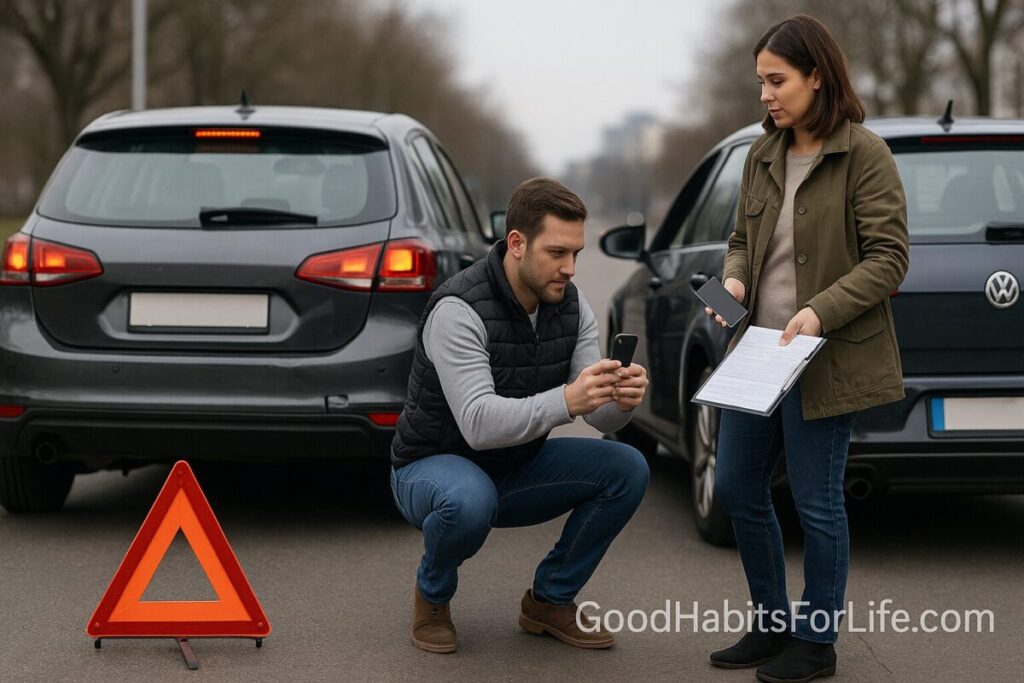
After a Minor Crash: Safety, Photos, Exchange
After a Minor Crash: Safety, Photos & Info Exchange
Table of Contents
🧭 What “minor crash” means—and why a calm process matters
A minor crash usually means low-speed contact with limited damage (e.g., bumper, fender, lights) and no obvious injury. Even “minor” knocks can escalate—traffic hazards, hidden injuries (whiplash), or disputes later. A consistent, evidence-based process protects health, legal requirements, and insurance outcomes. Research shows attention under stress narrows; lists and mnemonics reduce errors and make recall easier. Following the steps below gives you the facts your insurer (and, if needed, police) will rely on.
✅ Quick safety checklist (first 5 minutes)
-
Stop and secure: Pull to a safe spot if vehicles are drivable. Turn on hazard lights; on fast roads place a warning triangle 50–150 m behind your car (150–200 m on motorways) where legal.
-
Check injuries: Self, passengers, and others. Call emergency services if anyone is hurt, a vehicle can’t be moved, fuel is leaking, or traffic is obstructed.
-
Stay visible: High-vis vest if you have one; stand well off the roadway (behind a barrier if available).
-
Breathe + orient: Two slow breaths; note the time, location, direction of travel, weather, and road condition.
-
Don’t argue: Be courteous, don’t admit fault or assign blame. Focus on safety and facts.
-
Document and exchange: Photos first, then info exchange (details below).
-
If the other driver leaves: Record the plate, vehicle description, direction, and witnesses; call police.
Rule of thumb: Safety → Photos → Exchange → Report.
📸 Photographing the scene: the shots insurers need
Order matters: wide → mid → close.
Wide/Context (4–6 shots)
-
Both vehicles in frame, positions on the road, skid marks/debris.
-
Traffic lights/signs, lane markings, speed limit signs.
-
Wider environment: junctions, bends, parked cars.
Mid-range (6–10 shots)
-
Each side of each vehicle.
-
Overlap shots around the impact area.
-
Interior if airbags deployed or items fell.
Close-ups (8–12 shots)
-
Damage with a reference (your key, hand, or a ruler).
-
Number plates of all involved vehicles.
-
VIN if visible (dashboard/door jamb).
-
Road surface (gravel, pothole, oil), weather (wet/ice).
-
Any injury signs (e.g., bruising, seatbelt mark) if the person consents.
Extras
-
A note photo: write date/time, location (e.g., “M.G. Road at 14:10, light rain”) and snap it.
-
Short video walking the scene narrating what you see (“My car was stopped at red…”).
-
Witness info: photograph their business card (with permission).
Tip: Shoot before moving cars if safe; if you must move, mark tyre positions with chalk or a phone screenshot map pin.
🪪 What to exchange (and what not to say)
Exchange only facts. Use this checklist:
-
Full name and phone number
-
Address and email
-
Driver’s licence number (and state/country)
-
Vehicle: make, model, colour, plate
-
Insurance: company, policy number, expiry
-
Owner’s details if driver ≠ owner
-
Location/time of crash
-
Brief description (“Rear bumper scuff at low speed; both cars driveable”)
Avoid: Apologies, admissions (“It was my fault”), speculation (“I didn’t see you because…”), or promises (“I’ll pay cash”). Those can be misinterpreted. Stick to observable facts.
If the other party refuses: Photograph the plate, vehicle, and driver (from a safe distance), note their behaviour, and call police.
⚖️ When to call police or file a report
Call police or file an official report if:
-
Anyone is injured or complains of pain.
-
A vehicle is undriveable, fuel/fluids are leaking, or traffic is blocked.
-
The other driver is uninsured, unlicensed, or leaves.
-
You suspect impairment (alcohol/drugs) or aggression.
-
Local law requires reporting above a damage threshold or within a time limit.
Keep a local note in your phone of the non-emergency police number and your region’s reporting window (often 24–72 hours).
📲 Contacting your insurer and starting a claim
-
Notify promptly—many policies require “as soon as reasonably possible.”
-
Share photos, a one-page incident summary, and witness details.
-
Ask about preferred repairers, tow authorisation, and courtesy car eligibility.
-
Keep a claim log: dates/times, who you spoke to, claim number, repair estimates.
-
Save receipts (towing, taxis, medical checks). You may be reimbursed.
🗓️ A 7-Day Follow-Up Plan
Day 0–1
-
File any police report required.
-
Visit a doctor if you feel pain later (common with soft-tissue injuries).
-
Back up photos and notes to cloud/storage.
Day 2–3
-
Obtain two repair estimates.
-
Provide insurer with additional documents they request.
-
If a dashcam recorded the event, export and save clips (front + rear).
Day 4–7
-
Confirm repair booking or total-loss process.
-
If another party’s insurer contacts you, forward to your insurer; don’t negotiate alone.
-
Update your personal vehicle maintenance checklist (e.g., get alignment checked).
🧠 Techniques & frameworks that help under stress
-
SAFE-PICS-EXCHANGE mnemonic
-
SAFE: Stop & secure, Assess injuries, Flag hazards, Emergency call if needed.
-
PICS: Photos—wide/mid/close, Intersection/signs, Conditions, Skid/debris.
-
EXCHANGE: Details list above.
-
-
Box breathing (4-4-4-4) to steady your voice and judgement.
-
Cone/triangle placement: on fast roads aim 150–200 m (500–650 ft) back; on urban roads 50–100 m (160–330 ft)—only where legal and safe.
-
Single source of truth: one shared note (phone) that both drivers can photograph.
👥 Variations: teens/new drivers, seniors, company cars, rental, hit-and-run
-
Teens/New drivers: Keep the glovebox card (see kit). Call a parent/guardian and insurer from the scene.
-
Seniors: If balance is unstable, stay seated away from traffic; ask a bystander to take photos.
-
Company vehicles: Follow your fleet policy—there may be an internal hotline and approved repairers.
-
Rental cars: Call the rental company immediately; follow their accident pack; never authorise repair yourself.
-
Hit-and-run: Don’t chase. Capture plate/description/direction, seek witness CCTV, and report to police and insurer at once.
⚠️ Mistakes & myths to avoid
-
“It’s only a scratch, we can skip photos.” → Always document; damage can be internal.
-
Signing a handwritten settlement on the spot. → Can void rights; use formal claims.
-
Moving injured people unnecessarily. → Wait for medical guidance unless there’s immediate danger.
-
Posting on social media about the crash. → Can be used against you; keep it private.
-
Switching versions of events in later calls. → Stick to the same factual description each time.
💬 Real-life examples & ready-to-use scripts
To the other driver:
“Are you okay? Let’s move to a safe spot and turn on hazards. I’ll take some photos and then we can exchange details.”
If they push for blame:
“I’d prefer we let insurance handle fault. I’ll share the facts and photos.”
Witness request:
“Could I record your name and phone in case the insurer needs a statement? Thank you.”
Calling insurer:
“Low-speed rear-end at 10:10 near [Location]. No injuries, both cars driveable. I have wide/mid/close photos, plate numbers, and a sketch of the junction.”
🧰 Tools, apps & a glovebox kit
Apps (check your region)
-
Your insurer’s app (claim upload, tow request).
-
Emergency number app (e.g., 112/911/999) with location sharing.
-
Notes + camera; optional dashcam app.
Glovebox kit
-
Disposable warning triangle, hi-vis vest, nitrile gloves.
-
Phone charger and small power bank.
-
Notepad/pen, small ruler (for scale).
-
Pre-printed exchange card with blank fields.
-
First-aid basics (bandages, antiseptic wipes).
Pros/Cons
-
Dashcam: great evidence; manage privacy and storage.
-
Insurer app: faster claim; you’re within their ecosystem.
-
Paper kit: works with a dead phone; needs replacement if used.
🔑 Key takeaways
-
Safety first, facts over feelings, and photos before you move.
-
Exchange only objective details; don’t admit fault at the scene.
-
Report and claim promptly; keep a tidy document trail.
-
Prepare a glovebox kit so the process is second nature.
❓ FAQs
1) Do I have to call police for a minor fender-bender?
Only if required in your jurisdiction or if there are injuries, hazards, an impaired or uninsured driver, or a hit-and-run. Otherwise, a self-report or insurer report may suffice.
2) What if the other driver refuses to share details?
Photograph their plate and vehicle, note the time/location, seek a witness, and contact police. Tell your insurer immediately.
3) Should I move my car before photographing?
If safe, photograph first. If you must move (to avoid danger), mark tyre positions, then take photos after moving.
4) Can we handle it privately without insurance?
It’s risky. Hidden damage and injuries can appear later. Many policies require reporting even if you don’t claim.
5) What about minor injuries that show up tomorrow?
Seek a medical check and update your insurer. Soft-tissue symptoms often appear hours later.
6) How many photos are “enough”?
Aim for 20–30: wide (scene), mid (vehicle sides), close (damage, plates, road conditions).
7) Are dashcam recordings acceptable evidence?
Often yes; provide original files. Keep timestamps synced and back up clips.
8) Do I need the other driver’s licence photo?
You don’t need a photo if they provide licence number and issuing state/country—but a photo (with consent) can help confirm identity.
9) What if we disagree about what happened?
Stick to your factual account with photos, sketch, and witness details. Insurers (and police if involved) will determine liability.
10) Should I sign anything at the scene?
Other than a police or official form, avoid signing; send everything through insurers.
📚 References
-
National Highway Traffic Safety Administration (NHTSA). What to Do After a Crash. https://www.nhtsa.gov
-
AAA (American Automobile Association). Crash scene checklist & safety guidance. https://www.aaa.com
-
Insurance Information Institute (Triple-I). Auto accidents: what to do at the scene. https://www.iii.org
-
GOV.UK. Report a road traffic accident. https://www.gov.uk/reporting-accidents-to-police
-
Transport for NSW (Australia). After a crash. https://roadsafety.transport.nsw.gov.au
-
Insurance Europe. European Accident Statement (Constat Amiable). https://www.insuranceeurope.eu
-
World Health Organization (WHO). Road traffic injuries: key facts. https://www.who.int
-
Government of India — Emergency Response Support System (ERSS 112). https://112.gov.in
-
Canadian Automobile Association (CAA). What to do after a collision. https://www.caa.ca
Disclaimer: This guide is for general safety, insurance, and legal information; it is not legal advice—follow the laws and reporting rules in your jurisdiction and your policy terms.