
Adventure Jar: MicroDates Youll Actually Do
Adventure Jar: Micro-Dates You’ll Actually Do
Table of Contents
🧭 What Is an Adventure Jar & Why It Works
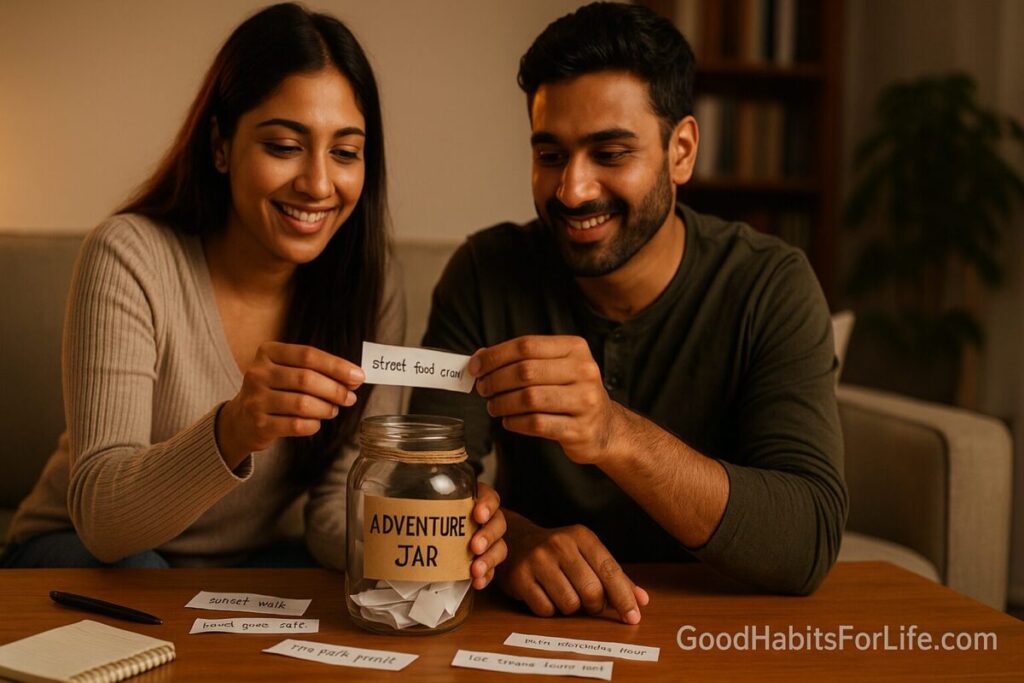
An adventure jar is a low-friction system for regular, bite-sized dates. You and your partner brainstorm easy activities, write each one on a slip, put them in a jar (or digital equivalent), and draw one for your next micro-date (60–120 minutes, sometimes less).
Why it works
-
Novelty & arousal: Doing new or exciting activities together increases relationship quality via self-expansion—you see yourselves as more capable and interesting as a couple. Classic experiments show that couples who try novel, arousing tasks report higher satisfaction than those doing pleasant but familiar tasks.
-
Positive ratio: Regular small positives help maintain a healthier “positivity–negativity” balance in relationships.
-
Capitalization: Sharing and savoring good moments (even tiny ones) strengthens bonds.
-
Habit science: Pre-deciding cues and actions (implementation intentions) and repeating them weekly helps turn “we should go out” into a reliable ritual.
-
Brain candy: Novel experiences activate reward pathways tied to motivation and learning—great for breaking ruts.
Translation: small, new experiences—done consistently—beat rare, elaborate dates.
✅ Quick Start: Build Yours in 20 Minutes
Supplies: jar (or mug), 30–50 slips, pen, timer; or a digital “wheel”/list app.
Step-by-step
-
Pick your slot: Choose a default weekly window (e.g., Fridays 7–9 pm).
-
Set guardrails: Budget (₹0–₹1,000), travel radius (≤5 km), time (60–120 min), accessibility needs.
-
Brainstorm 30 ideas (timer: 7 minutes): See ideas section below; aim for a mix of indoors/outdoors, home/out-of-home, active/chill.
-
Code the slips: Add tags (₹, ⏱, 🏠/🚶) so you can filter quickly.
-
Create if-then: “If it’s Friday 6 pm, then we draw a slip and book it.” Put it on your shared calendar.
-
Do it this week: Draw one now, make any quick bookings, and prep (download map, pack snacks, charge phones).
-
Savor & log: Snap one photo, rate the date (1–5), drop the slip in a “done” envelope. Keep favorites.
Micro-rituals that help
-
A 10-second “ceremony”: shake the jar, drumroll, pull, cheer.
-
“Swap once” rule: either partner can veto one draw per week; the second draw is final.
-
Post-date toast: one sentence each: “My favorite 60 seconds were…”
🛠️ 30-60-90 Day Habit Plan
Days 0–30 (Start)
-
Build jar; commit to 4 weekly micro-dates.
-
Use calendar holds + reminders.
-
Track simple metrics: completed (Y/N), mood before/after (1–5), cost.
Days 31–60 (Stabilize)
-
Add theme weeks (e.g., “₹0 month,” “try a new food,” “mini-adventures within 2 km”).
-
Introduce roles: one plans logistics, one handles snacks/playlist.
-
Add 10 more slips from things you noticed around your city.
Days 61–90 (Expand)
-
Add “stretch” dates (mild novelty or challenge).
-
Invite another couple once for a social spark.
-
Do a quarterly review: top 5 favorites, 5 to retire, 10 to add.
Checkpoints
-
4/4 dates done = reward (homemade certificate, selfie wall, or small treat).
-
If you miss two weeks, schedule a micro-reset: coffee walk + redraw.
🧠 Techniques & Frameworks That Make It Stick
-
Self-Expansion Theory: Prioritize activities that are new, challenging, or learning-oriented together.
-
Implementation Intentions: Pre-decide cue, time, and action (“If it’s Friday 6 pm, then…”).
-
Friction Audit: Pack a “date go-bag” (water, scarf, umbrella, ₹200 cash, transit card). Save locations in a map list.
-
Temptation Bundling: Pair a chore with fun (fold laundry while doing a spicy trivia game).
-
Default Calendar Slot: Treat it like a class—only move it, never delete it.
-
Tiny Rewards: 30-second celebration after each date keeps motivation high.
-
Safety & Comfort: Share locations with a trusted contact when exploring new areas; carry basics; follow local guidelines.
🎒 Micro-Date Ideas (by Time, Cost & Mood)
(Mix and match. Tag each slip with ⏱ and ₹ to fit your week.)
₹0–₹200, ≤60 minutes
-
Sunset or dawn terrace tea + two-question check-in.
-
Monochrome photo walk: capture only one color.
-
Library dash: 15 minutes to find a book your partner would love.
-
Memory swap: each tells a story from age 10, 20, 30…
-
Street-food taste test: pick 3 stalls, share half portions.
-
Stargaze (or city-lights gaze) with one song each.
₹0–₹500, 60–90 minutes
-
Local history loop: follow one plaque/statue trail.
-
Market micro-challenge: ₹200 cap; buy each other a surprise.
-
Board-game cafe quick round; or home version with a 45-min timer.
-
Plant-shop safari: choose a tiny plant and name it.
-
Mini sport: frisbee, badminton, table tennis.
Home-friendly
-
Cook-off: 30-minute pantry meal, blind taste rating.
-
YouTube workshop: learn a 3-move dance or basic calligraphy.
-
Audio theater: act a 3-minute script (use AI to generate a scene).
-
Puzzle + playlist: album you’ve never heard while puzzling.
-
Travel roulette: drop a pin on the map, learn 5 facts about that place.
Stretch (occasional)
-
Beginner class: pottery, salsa, archery (one session).
-
Kayak/paddleboat if available; or bike rental for 60 minutes.
-
Night at the museum (late hours) or local astronomy club meet.
-
Volunteering sampler: 60 minutes at a community kitchen or animal shelter.
Conversation slips (quick intimacy)
-
“What tiny act of love did you notice this week?”
-
“What would ‘10% more adventure’ look like next month?”
-
“What’s a risk you’d like us to take safely?”
-
“Which friend should we invite for a double micro-date?”
👥 Variations for Different Couples
-
Students: ultra-budget (₹0–₹200), campus-based walks, club drop-ins, peer-led classes.
-
Parents with young kids: at-home micro-dates after bedtime; trade babysitting with another family; mid-day coffee walks during nap windows.
-
Professionals with long hours: lunch-break micro-dates near office; meeting-free Friday slot; 20-minute “commute detour” walk.
-
Seniors: accessibility-friendly routes, quiet events, early-evening timings, museum benches, gentle stretching class together.
-
Long-distance: ship each other identical jar slips; draw the same theme and do it over video; co-watch a short documentary and discuss.
⚠️ Mistakes & Myths to Avoid
-
“It has to be grand to count.” False. Research shows novel and shared beats expensive.
-
“Spontaneity > planning.” Without a default slot, dates get skipped.
-
“We’re too busy.” You likely have 60 minutes; schedule it like medication.
-
“We must agree on everything.” Use the swap-once rule and respectful vetoes.
-
“If we love each other, it should be easy.” Good systems make love easier.
💬 Real-Life Scripts & Examples
Invite your partner
-
“I miss doing new things with you. Can we try a weekly 60-minute micro-date? I’ll set up an adventure jar so it’s easy.”
When the jar gives a ‘meh’ idea
-
“I’m not feeling this one—using my one swap. Let’s redraw!”
After the date (capitalization)
-
“My favorite part was… It made me feel… Next time, let’s try…”
Handling budget constraints
-
“Let’s do a ₹0 month and rank free ideas by fun potential.”
🧰 Tools, Apps & Resources
-
Shared calendar (Google/Apple) — recurring slot; reminders.
-
Wheel of Names / Tiny Decisions — spin from a list when you’re indecisive.
-
Google Maps lists — save “Future Micro-Dates” places.
-
Notes/Notion — log slips, ratings, photos; duplicate your list each quarter.
-
Timer app — time-box setup and activities so it stays micro.
Pros: free/low-cost, reduces decision fatigue, easy to share. Cons: needs one organizer at first; novelty fatigue if you never revisit favorites.
📌 Key Takeaways
-
Small, novel dates are scientifically linked to higher satisfaction.
-
A jar system + default slot + if-then rule removes friction.
-
Start with 30 ideas, do 4 weeks, review, and expand.
-
Keep it safe, simple, and budget-aware—celebrate small wins.
❓ FAQs
1) How many ideas should we start with?
30–50 is ideal: enough variety without paralysis.
2) What if one of us is introverted?
Include low-stimulus options (quiet cafes, nature walks, home projects) and use the swap-once rule.
3) We can’t leave home—does this still work?
Yes. Use home-based slips: cooking challenges, balcony stargazing, learning a 3-move dance, documentary + discussion.
4) How long should a micro-date be?
Aim for 60–120 minutes. Even 30 minutes counts if it’s protected and novel.
5) Is repeating favorites OK?
Absolutely—keep 70% novel, 30% favorite to balance comfort and growth.
6) How do we avoid decision fights?
Draw, allow one swap, second draw is final. Or use a spinner app to randomize.
7) Any safety tips?
Daylight for new neighborhoods, share your live location, carry essentials, respect local regulations.
8) What if we miss a week?
Do a quick reset date (coffee walk + one meaningful question) and re-commit to your default slot.
9) How do we keep costs low?
Use ₹0–₹200 ideas, public events, free museums days, parks, home challenges, library resources.
10) Can this help long-term marriages?
Yes—novel, shared activity boosts closeness across stages of life.
📚 References
-
Aron, A., Norman, C. C., Aron, E. N., McKenna, C., & Heyman, R. E. (2000). Couples’ shared participation in novel and arousing activities and experienced relationship quality. Journal of Personality and Social Psychology, 78(2), 273–284. https://doi.org/10.1037/0022-3514.78.2.273
-
Reissman, C., Aron, A., & Bergen, M. (1993). Shared activities and marital satisfaction: Causal direction and self-expansion as a mediator. Journal of Social and Personal Relationships, 10(2), 243–254. https://doi.org/10.1177/026540759301000205
-
Gable, S. L., Reis, H. T., Impett, E. A., & Asher, E. R. (2004). What do you do when things go right? The interpersonal and intrapersonal benefits of sharing positive events. Journal of Personality and Social Psychology, 87(2), 228–245. https://doi.org/10.1037/0022-3514.87.2.228
-
Gollwitzer, P. M. (1999). Implementation intentions: Strong effects of simple plans. American Psychologist, 54(7), 493–503. https://doi.org/10.1037/0003-066X.54.7.493
-
Lally, P., Van Jaarsveld, C. H. M., Potts, H. W. W., & Wardle, J. (2009). How are habits formed: Mapping habit formation in the real world. European Journal of Social Psychology, 40(6), 998–1009. https://doi.org/10.1002/ejsp.674
-
Bunzeck, N., & Düzel, E. (2006). Absolute novelty is processed in the human substantia nigra/VTA. Neuron, 51(3), 369–379. https://doi.org/10.1016/j.neuron.2006.06.021
-
Wilcox, W. B., & Dew, J. (2012). The Date Night Opportunity. National Marriage Project, University of Virginia. https://nationalmarriageproject.org/reports/date-night-opportunity
-
Gottman, J. (1994–2015). Research on positive–negative interaction ratios and relationship stability. The Gottman Institute (summary articles). https://www.gottman.com
(No medical/financial/legal advice.)