
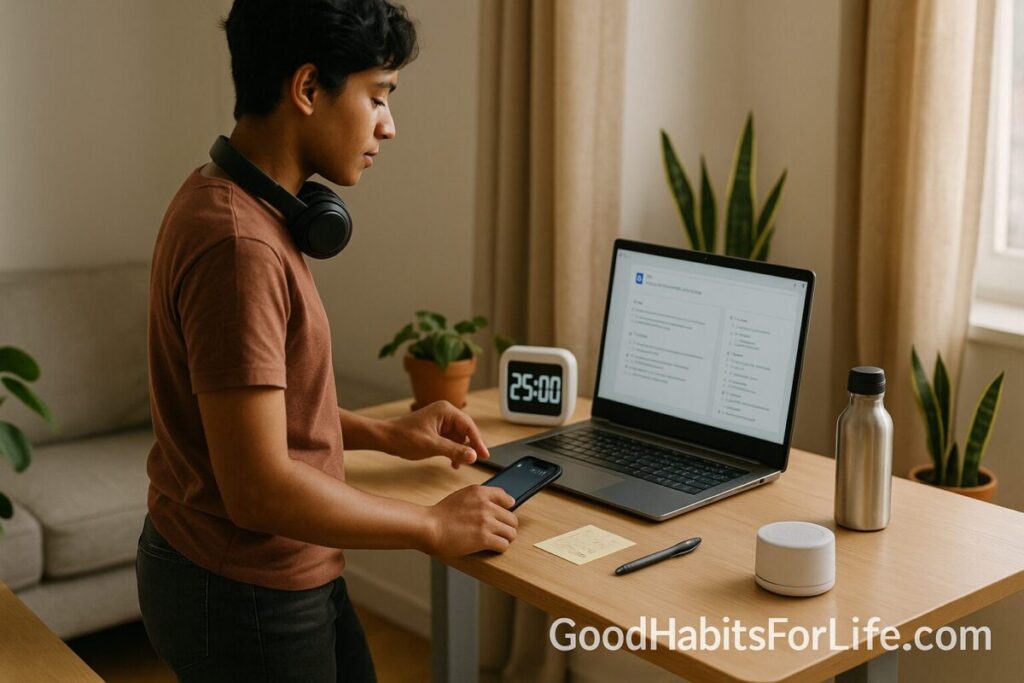
ADHD-Friendly Focus Stack: Movement Noise Timers: AI workflows (2025)
ADHD-Friendly Focus Stack 2025: Movement, Noise, Timers, AI
Table of Contents
🧭 What & Why
What is a “focus stack”?
A focus stack is a deliberate combo of small, repeatable supports you layer together to reduce friction and sustain attention: movement, sound, timers, and AI workflows. For ADHD brains, stacking multiple modest boosts often beats chasing a single silver bullet.
Why these four?
-
Movement (short, purposeful bursts) is linked to reductions in ADHD symptoms and better working memory/executive function in youth; benefits generalize to adults as aerobic fitness improves arousal regulation. PMC+1
-
Auditory white noise can improve cognitive performance in people with ADHD via “stochastic resonance” (a little noise stabilizes signal processing). Evidence is strongest for white noise, not music; effects vary by person. PubMed+1
-
Visual timers and time-anchored prompts externalize time for those with impaired time perception/prospective memory—well-described challenges in ADHD across ages. PMC+1
-
AI workflows translate intentions into actions: chunking tasks, creating micro-deadlines, and generating prompts or draft outlines to overcome initiation friction.
Where do clinical guidelines fit?
Behavioral/educational strategies sit alongside clinical care. For children and adolescents, professional guidelines (AAP, NICE) emphasize multimodal care; clinicians may recommend medication, behavioral interventions, and school supports. Adults benefit from tailored psychoeducation and accommodations. Use this stack as skills training—not a replacement for care. PubMed+2NICE+2
✅ Quick Start: Do This Today
-
Define a 50-minute study mission.
-
Example: “Draft methods section outline; capture 5 key references.”
-
-
Prime with 2–5 minutes of movement.
-
Options: 30 bodyweight squats + brisk stair loop; or a 3-minute brisk walk. PMC
-
-
Set sound: start with white noise at a comfortable low-moderate level (~50–70 dB). If you prefer, try pink/brown noise—but note evidence is strongest for white noise. PMC
-
Make time visible:
-
Start a 25-min visual countdown (e.g., Time Timer or a phone timer you can see at a glance).
-
Park a second timer at 50 minutes to end the session. Time visibility matters for ADHD. PMC
-
-
Use AI as a co-pilot (2 minutes):
-
Prompt: “Break my mission into 5 micro-steps, each ≤5 minutes, and a one-line ‘definition of done’.”
-
Copy steps to your notes. Start.
-
-
Micro-break (3–5 minutes):
-
Shake out, sip water, reset white noise, re-run a 25-minute timer.
-
🛠️ 30-60-90 Day Focus Stack Plan
Days 1–30: Installation
-
Movement habit: 3–5 daily “attention snacks” (2–5 minutes each). Keep it friction-free: marching, stair loop, brisk hallway walk. Log when you move relative to study blocks. PMC
-
Noise baseline: Test white noise across intensities and tasks; note subjective focus & output. If music, choose instrumental only. Evidence favors white noise for ADHD. PMC
-
Timer discipline: Always show a countdown; end every session with a chime. Use one block timer (25) and one session timer (50–60). PMC
-
AI workflows: Create reusable prompts: “Turn chapter 3 reading into a 5-question quiz,” “Generate a bullet outline + 3 study problems,” “Draft a 150-word abstract from these notes.”
Checkpoint @ Day 30:
-
You’ve paired at least 70% of study blocks with movement + visible timers + sound.
Days 31–60: Optimization
-
Calibrate blocks: Some learners do better with 15/5 or 40/10. Keep the visual element. PMC
-
Task staging: Use AI to pre-stage tomorrow’s blocks (links, doc templates, question list).
-
Prospective memory supports: Add start/stop cues (e.g., analog clock hand at “:25” means start typing conclusions). ADHD shows deficits in time-based prospective memory; concrete cues help. Nature+1
-
Movement variety: Alternate brisk walk, dynamic stretch, light stairs; aim for ≥60–90 minutes/week of moderate activity overall to support cognitive benefits. PMC
Checkpoint @ Day 60:
-
Consistent daily stack; you know your best block length, noise level, and movement combo.
Days 61–90: Generalization
-
Different contexts: Library, cafeteria, home—bring the stack.
-
Higher-stakes tasks: Lab report, client deck—script AI to create quality criteria and a definition of done.
-
Self-monitoring: End sessions with a 30-second score (Focus 1–5; Output 1–5; Notes).
-
Build automaticity: Default calendar holds with stack prepared (headphones charged, analog clock visible, timer preset).
Checkpoint @ Day 90:
-
The stack runs on autopilot; you adjust ingredients (sound, movement, timers) for the task.
🧠 Techniques & Frameworks
1) Movement “Attention Snacks”
-
2–5 minutes of brisk, rhythmic movement before and between blocks (stairs, marching, jumping jacks). Meta-analyses show small-to-moderate improvements in symptoms and working memory with physical activity programs. PMC+1
2) White Noise Protocol
-
Start at 50–70 dB (phone at low-mid volume; you should still hear your surroundings).
-
Prefer steady white noise; avoid unpredictable lyrics. Evidence supports white noise benefits for ADHD; outcomes differ by individual. PubMed+1
-
If noise bothers you, try ear-safe lower volume or pink noise; document results for one week.
3) Visual Timer + Time Anchors
-
Use a countdown you can see without switching apps.
-
Pair with time anchors (e.g., “When minute hand hits :15, I review sources”). Time perception and time-based prospective memory are frequently impaired in ADHD; visible time and explicit cues mitigate the gap. PMC+1
4) AI Workflows (Examples)
-
Initiation: “Turn this vague task into 5 steps (≤5 minutes each) + a 1-sentence ‘done’.”
-
Reading to recall: “Create 7 flashcards from these notes; add one ‘trick question’.”
-
Writing: “Outline an intro with 3 claims + references to check; add a checklist.”
-
Review: “Generate a 10-item self-test from the outline; include answer key.”
-
Planning: “Estimate how long each step will take and schedule 25-min blocks with 5-min breaks.”
🎓 Audience Variations
-
Students (school/college): Use campus walking routes for movement snacks; store headphones + analog clock in backpack; ask accessibility services about timer-visible test accommodations. NICE
-
Professionals: Convert meetings into stand-walk-talk where possible; use notepad timers during calls; pre-stage AI prompts for client deliverables.
-
Parents: Pair kids’ homework with white noise + kitchen timer they can see; practice 15/5 cycles; coordinate with teachers using school-friendly versions of the stack. CDC
-
Seniors/Returning learners: Favor gentler movement (marching in place); use large-face analog clocks; voice-to-text AI for note capture.
-
Teens: Gamify with streaks; AI to turn notes into quizzes; keep volume safe.
⚠️ Mistakes & Myths to Avoid
-
Myth: “Music always helps me focus.” Lyrics and fluctuating dynamics often distract; white noise has stronger ADHD-specific evidence. Test both. PMC
-
Mistake: Using timers you can’t see. Hidden timers don’t counter time-perception gaps. Use visible countdowns. PMC
-
Myth: Brown noise is proven for ADHD. Data are limited; white noise has the clearest evidence base so far. PMC
-
Mistake: Over-relying on reminders without practice. External reminders help, but skill growth (estimating time, checking clocks) matters too. PubMed
-
Myth: If this stack works, I don’t need clinical care. Skills complement—not replace—evidence-based treatment. PubMed+1
💬 Real-Life Examples & Scripts
Script: Starting a session
-
“Set 25-minute visual timer. Start white noise. Do 3-minute stair loop. Open doc. Type the heading and first sentence.”
Script: AI kickoff
-
“You are my study coach. Break this task into 5 micro-steps (≤5 min each). Add a ‘definition of done’ and a 10-minute review step.”
Script: Mid-block wobble
-
“Pause typing → 60 seconds of marching in place → resume with the next micro-step.”
Script: End-of-session audit (30 seconds)
-
“Focus 1–5, Output 1–5, What blocked me? What to pre-stage for tomorrow?”
Script: Parent-child homework
-
“We’ll do 15 minutes on, 5 off. Timer where we can see it. White noise on. After two cycles, dance break.”
🧩 Tools, Apps & Resources (quick pros/cons)
-
Visual Timers: Time Timer, analog desk clock, iOS/Android countdown
-
Pros: Makes time visible; reduces “time blindness.” Cons: Needs habit to reset. PMC
-
-
Noise Generators: Built-in phone noise, white-noise apps, browser loops
-
Pros: Consistent; evidence-aligned. Cons: Too loud can distract; test levels. PMC
-
-
AI Study Co-pilots: Chat-based planners, note-to-quiz converters
-
Pros: Breaks inertia; fast checklists. Cons: Fact-check; protect privacy.
-
-
Movement Prompters: Step counters, hourly stand alerts
-
Pros: Nudge to move; better working memory with regular activity. Cons: Easy to ignore alerts. PMC
-
📌 Key Takeaways
-
Stack movement + white noise + visible timers + AI for a reliable attention routine. PMC+1
-
Keep movement short and frequent to lift arousal and working memory. PMC+1
-
Use white noise first; log your personal response. PubMed
-
Make time visible—countdowns and analog clocks beat hidden timers for ADHD. PMC
-
Treat the stack as skills training that complements clinical care. PubMed+1
❓ FAQs
1) Is white, pink, or brown noise best for ADHD focus?
Evidence primarily supports white noise for improving cognitive performance in ADHD; results vary by person. Pink/brown noise are less studied—experiment cautiously. PMC
2) How long should my study blocks be?
Start with 25 minutes on / 5 minutes off and adjust to 15/5 or 40/10 based on output and how you feel. Keep a visible countdown to counter time-perception gaps. PMC
3) Can movement really help if I only have a few minutes?
Yes—2–5 minute movement snacks before or between blocks can help; structured programs show symptom and working-memory benefits over weeks. PMC+1
4) Do timers and reminders replace learning time management?
No. External reminders help performance but don’t build skill by themselves; pair them with deliberate time-monitoring practice. PubMed
5) Should I change medications if the stack works?
No—do not change meds without your clinician. Stacks are adjuncts to care; guidelines recommend multimodal support. PubMed+1
6) Is there evidence that ADHD involves time-perception differences?
Yes. Reviews and naturalistic tasks (including VR) report impairments in adult and child ADHD for time perception and time-based prospective memory. PMC+1
📚 References
-
NICE Guideline NG87: Attention deficit hyperactivity disorder: diagnosis and management (last reviewed May 7, 2025). https://www.nice.org.uk/guidance/ng87 NICE
-
Wolraich ML, et al. Clinical Practice Guideline for the Diagnosis, Evaluation, and Treatment of ADHD in Children and Adolescents. Pediatrics. 2019. https://pubmed.ncbi.nlm.nih.gov/31570648/ PubMed
-
CDC. Clinical Care of ADHD. Updated Oct 15, 2024. https://www.cdc.gov/adhd/hcp/treatment-recommendations/index.html CDC
-
Søderlund G, et al. Noise is beneficial for cognitive performance in ADHD. J Child Psychol Psychiatry. 2007. https://pubmed.ncbi.nlm.nih.gov/17683456/ PubMed
-
Söderlund GBW, et al. Sensory white noise in clinical ADHD: Who benefits from auditory noise? 2024. https://pmc.ncbi.nlm.nih.gov/articles/PMC11585357/ PMC
-
Zheng R, et al. Therapeutic effects of physical activity on children with ADHD: meta-analysis. 2025. https://pmc.ncbi.nlm.nih.gov/articles/PMC12014039/ PMC
-
Cheng G, et al. Impact of physical activity on working memory in children with ADHD: meta-analysis. 2025. https://pmc.ncbi.nlm.nih.gov/articles/PMC12133843/ PMC
-
Mette C, et al. Time Perception in Adult ADHD: A Decade-A Review. 2023. https://pmc.ncbi.nlm.nih.gov/articles/PMC9962130/ PMC
-
Seesjärvi E, et al. A naturalistic virtual reality task reveals difficulties in time-based prospective memory in children with ADHD. Sci Rep. 2025. https://www.nature.com/articles/s41598-025-08944-w Nature
-
Shrestha M, et al. Non-pharmacologic management of ADHD. Transl Pediatr. 2020. https://pmc.ncbi.nlm.nih.gov/articles/PMC7082245/ PMC
-
Guo Y, et al. External reminders and time-based prospective memory. Int J Psychol. 2022. https://pubmed.ncbi.nlm.nih.gov/34958456/ PubMed
Disclaimer: This guide is educational and does not replace personalized medical or mental-health advice. Consult your clinician for diagnosis and treatment decisions.