
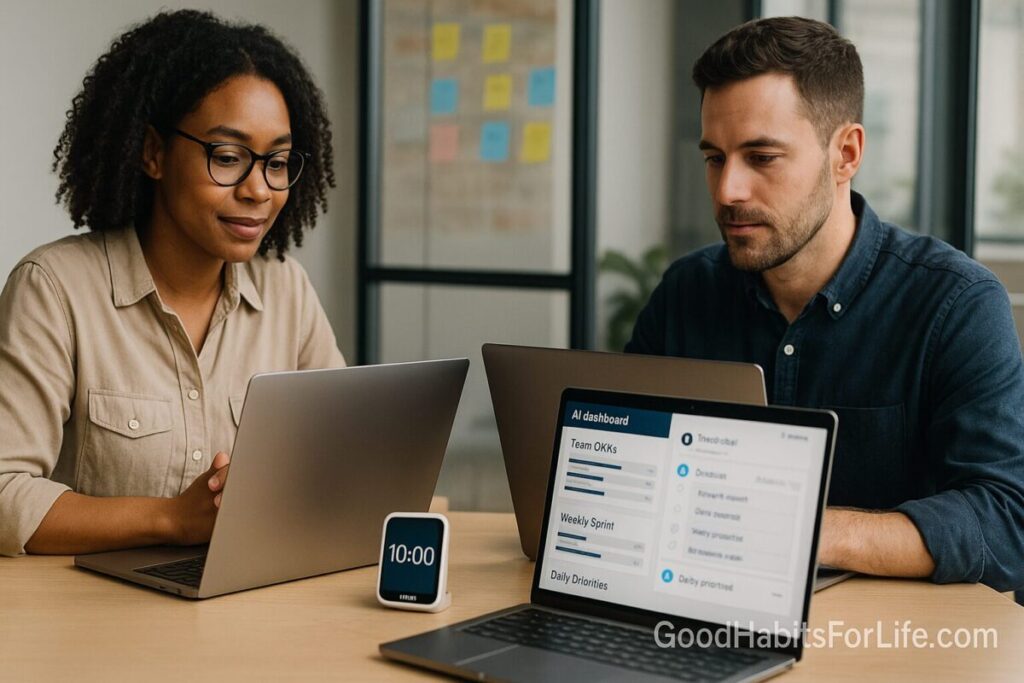
Accountability Buddies at Work: AI workflows (2025)
Accountability Buddies at Work: AI Workflows (2025)
Table of Contents
🧭 What Is an Accountability Buddy at Work?
An accountability buddy is a peer you regularly check in with to set goals, share progress, and troubleshoot roadblocks. Unlike a manager, it’s a horizontal relationship built on mutual support, brief rituals, and clear commitments. In 2025, the best buddy systems combine human support with AI workflows—automated reminders, meeting notes, draft summaries, and dashboards—so you spend more time doing work, not managing it.
Core elements
-
Shared outcome goals (team OKRs or personal quarterly goals)
-
Process commitments (weekly sprints, daily priorities)
-
Time-boxed check-ins (10–20 minutes)
-
Lightweight tracking (one page board + AI summaries)
-
Psychological safety (data for learning, not blame)
🎯 Why It Works (Evidence & Benefits)
-
Goals drive performance. Clear, specific goals with feedback improve results significantly (Goal-Setting Theory).
-
Implementation intentions (“If it’s 9:00 Mon, then I start task X”) increase follow-through.
-
Habits compound over time. Repetition in a stable context automates behavior; typical formation windows vary (weeks to months).
-
Peer support boosts adherence and resilience. Structured social support helps people stick to plans and manage stress.
-
AI boosts knowledge-work productivity. Field and lab studies show meaningful gains for writing, analysis, and support tasks; AI narrows performance gaps and reduces time to quality.
Bottom line: Pair accountability (motivation + feedback) with AI (speed + structure) and you get a reliable, low-friction system for progress.
🚀 Quick Start: Do This Today
-
Pick a buddy you already collaborate with.
-
Agree on a 4-week pilot (renewable).
-
Define 1–3 outcomes (e.g., “Ship v1 of feature X by 30 Oct”).
-
Choose two rituals:
-
Daily async: post 3 priorities + 1 blocker in a shared chat thread.
-
Weekly 15-minute live check-in (calendar-blocked).
-
-
Set up a single source of truth: one Notion/Doc page or Kanban board.
-
Automate basics with AI: reminder nudges, meeting notes → action items, weekly progress digest.
-
Decide success metrics: e.g., tasks completed, cycle time, quality score, stakeholder feedback.
🗺️ 30–60–90 Day Rollout Plan
Days 1–30 (Pilot & Proof)
-
Scope: 2 people, 1 project.
-
Cadence: daily async + weekly 15-min live.
-
AI: auto-reminders, notes → tasks, weekly digest.
-
Measure: throughput (done items), blocker resolution time, subjective focus (1–5 rating).
Days 31–60 (Standardize & Share)
-
Add a second duo or make a trio if needed.
-
Document a Buddy Operating Manual: meeting checklist, templates, escalation rules.
-
AI: add drafting workflows (status emails, stand-up summaries), simple dashboards.
-
Retros: 30 minutes at Day 45 and Day 60.
Days 61–90 (Scale & Sustain)
-
Expand to a buddy network (pods of 4–6).
-
Create a quarterly OKR alignment ritual.
-
AI: integrate project tool (Asana/Jira/Trello) with auto-reports to Slack/Teams; add quality checks (PRD linting, writing style guides).
-
Governance: rotate pairings each quarter; publish anonymized learning notes.
🛠️ AI Workflows to Make It Friction-Free
1) Daily Priorities Bot (2 minutes/day)
-
Input: “Top 3 for today + 1 blocker.”
-
AI does: logs to a table, nudges at 16:00 for wrap-up, posts a mini summary next morning.
-
Output: searchable history + streaks.
2) 15-Minute Check-In Assistant
-
Calendar event → AI auto-preps agenda from tasks, PRs, and yesterday’s notes.
-
Live call → AI captures decisions, assigns owners, sets due dates.
-
After call → AI posts “Next 7 Days” action list.
3) Progress Digest (Fri 16:30)
-
AI compiles: shipped items, metrics, blockers unresolved >3 days, and next week’s focus.
-
Auto-email to stakeholders; archive in team hub.
4) Draft-First Workflows
-
Writing: AI produces first drafts for updates, specs, recap notes; you edit.
-
Analysis: AI turns raw data or transcripts into bullet insights + tasks.
-
Support: AI creates templates, checklists, and check-step prompts.
5) Review & QA Automations
-
PRDs/specs: AI checks for missing pieces (problem, success criteria, dependencies).
-
Code/docs: AI linting for style and clarity (human approves).
6) Dashboarding
-
Pulls from tracker (Asana/Jira/Trello/Sheets) into a single weekly chart: done, in-progress, overdue, confidence score, and risk tags.
🧠 Techniques & Frameworks
-
SMART Goals: Specific, Measurable, Achievable, Relevant, Time-bound.
-
If-Then Plans (Implementation Intentions): “If I finish stand-up, then I spend 60 minutes on deep task A.”
-
WOOP: Wish → Outcome → Obstacle → Plan (great for naming blockers).
-
Timeboxing & Pomodoro: 25–50-minute focus sprints + short breaks.
-
Checklists: Prevent “skipped steps” on repeatable tasks.
-
Peer Coaching Loop (GROW): Goal → Reality → Options → Way forward.
-
RACI for shared work: Responsible, Accountable, Consulted, Informed.
The 10-Minute Buddy Agenda
-
Wins since last check-in (1 min)
-
Metrics snapshot (1 min)
-
Top 2 priorities per person (4 min)
-
One blocker each + options (3 min)
-
Commitments & calendar check (1 min)
👥 Variations by Role & Team Type
-
Engineers: pair on test plans; weekly “bug burn-down”; AI converts logs into defect themes.
-
Product/Design: AI drafts PRD sections and design briefs; buddy reviews for clarity and scope creep.
-
Sales/Success: daily pipeline priorities; AI summarizes call notes → follow-ups; buddy role-plays objections.
-
Marketing/Content: AI first-drafts briefs and outlines; buddy runs editorial checks and deadline gating.
-
Leaders/Managers: buddies for strategic writing (docs, reviews); AI creates synthesis memos and meeting briefs.
-
Remote/Async Teams: rely on written rituals, shared doc hubs, and recorded short loom-style updates; AI provides transcripts and highlights.
⚠️ Mistakes & Myths to Avoid
-
Myth: “Accountability = surveillance.”
Truth: It’s peer support + clarity. Use data to learn, not police. -
Mistake: Over-engineering the system.
Keep one board, one thread, one weekly call. -
Mistake: Goals with no measures.
Add a simple scorecard: output, quality, cycle time, confidence. -
Myth: “AI will replace the buddy.”
AI removes admin; the human provides judgment and trust. -
Mistake: Skipping retros.
Tiny monthly tweaks keep momentum and morale high.
💬 Real-Life Scripts & Templates
Invite a Buddy (Slack/Teams DM)
“Hey [Name] — I’m piloting a 4-week accountability buddy. Two quick rituals (daily 3 priorities in a thread + a 15-min Friday check-in). We’ll set 1–3 goals, use one shared page, and let AI handle notes/reminders. Want to try it with me?”
Buddy Contract (one page)
-
Goals (Q4): Ship feature X, Reduce cycle time 20%, Publish team playbook v1.
-
Cadence: Daily async, Fri 15:00 live (15 min).
-
Tools: Notion board + AI notes/reminders.
-
Metrics: Throughput, cycle time, quality, stakeholder NPS.
-
Safety: We de-personalize misses; we surface risks early.
-
Review: 15-min retro at week 4; renew or rotate.
Weekly Check-In Agenda (auto-generated)
-
Review last week’s commitments (AI marks done/overdue)
-
Top outcomes for next 7 days (max 3)
-
Blockers & if-then plans
-
Stakeholder updates (AI drafts email)
-
Commitments + calendar blocks
If-Then Plan Examples
-
If it’s 09:30, then I start a 50-min deep-work block on [task].
-
If a blocker lasts >48 hours, then I post in the team channel and book 10 minutes with [buddy].
-
If I finish a task, then I log a 1-line learning.
📚 Tools, Apps & Resources
(Choose one from each row; keep it simple.)
| Need | Good Option | Pros | Watch-outs |
|---|---|---|---|
| Task tracking | Asana / Trello / Jira | Familiar, integrations | Don’t multiply boards |
| Notes & hub | Notion / Confluence / Google Docs | Easy pages, templates | Keep one canonical page |
| Comms | Slack / Microsoft Teams | Threads, reminders, apps | Mute noisy channels |
| AI assistants | Microsoft Copilot / Google Duet / ChatGPT | Drafts, summaries, action extraction | Human review required |
| Meeting capture | Fireflies / Fathom / Otter | Transcripts, highlights | Check data-handling policies |
| Focus sprints | Focusmate / Ritual timers | External structure | Avoid over-scheduling |
| Dashboards | Sheets + connectors / Looker Studio | Lightweight charts | Update weekly, not hourly |
✅ Key Takeaways
-
Pair human support with AI structure for consistent progress.
-
Keep rituals tiny: daily 3-lines + weekly 15 minutes.
-
Let AI do admin (notes, summaries, nudges, dashboards).
-
Track 3–5 simple metrics, run monthly retros, and rotate buddies quarterly.
-
Start with a 4-week pilot; standardize and scale after proof.
❓ FAQs
1) How do we pick the right buddy?
Choose someone adjacent to your work (enough context to help) but not your direct manager. Similar seniority helps.
2) What if our schedules rarely align?
Run an async-first model: daily thread + a bi-weekly 20-minute call. AI summaries keep both aligned.
3) How do we avoid micromanagement vibes?
Use commitments, not surveillance. Share goals and blockers, not keystrokes or minute-by-minute logs.
4) How do we measure impact?
Track throughput, cycle time, quality, and a weekly confidence score (1–5). Review trends monthly.
5) Is AI safe for sensitive work?
Use approved, enterprise tools; turn off data sharing where needed; avoid pasting secrets; prefer private connectors.
6) What if one person stops showing up?
Escalate early: one honest conversation, then a 2-week reset. If needed, rotate partners.
7) Can this work for creative roles?
Yes—use AI to expand options (idea lists, outlines) and buddies to choose and ship.
8) How big should buddy pods be?
Start with pairs; scale to pods of 4–6 for shared demos and learning.
🔗 References
-
Locke, E. A., & Latham, G. P. (2002). Building a practically useful theory of goal setting and task motivation. American Psychologist. https://doi.org/10.1037/0003-066X.57.9.705
-
Gollwitzer, P. (1999). Implementation intentions: Strong effects of simple plans. American Psychologist. https://doi.org/10.1037/0003-066X.54.7.493
-
Oettingen, G. (2014). Rethinking Positive Thinking: Inside the New Science of Motivation. (WOOP framework). https://woopmylife.org
-
Lally, P., et al. (2010). How are habits formed in everyday life? European Journal of Social Psychology. https://doi.org/10.1002/ejsp.674
-
American Psychological Association. The power of social support. https://www.apa.org/topics/resilience/social-support
-
Noy, S., & Zhang, W. (2023). Experimental Evidence on the Productivity Effects of Generative AI. MIT. https://economics.mit.edu/sites/default/files/2023-07/Noy_Zhang_1.pdf
-
Brynjolfsson, E., Li, D., & Raymond, L. (2023). Generative AI at Work: The Impact on Productivity of Customer Support Agents. (Stanford/MIT). https://www.nber.org/papers/w31161
-
BCG Henderson Institute (2023). Navigating the Jagged Technological Frontier. https://www.bcg.com/publications/2023/impact-of-gpt-on-knowledge-work
-
Microsoft Work Trend Index (2024). Copilots and the future of work. https://www.microsoft.com/en-us/worklab
-
Gawande, A. (2010). The Checklist Manifesto. (Checklists and reliability).
-
Thaler, R., & Sunstein, C. (2008). Nudge: Improving Decisions About Health, Wealth, and Happiness. (Choice architecture).