
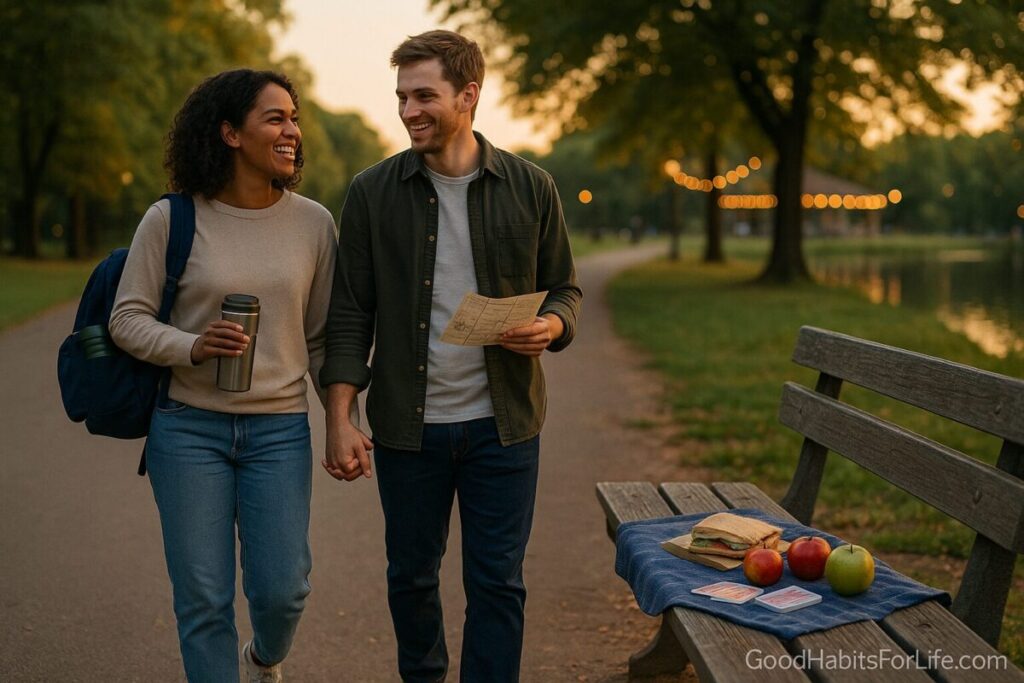
Date Nights on a Budget: Fun without the Bill
Date Nights on a Budget: Fun Without the Bill
Table of Contents
🧭 What & Why: The Case for Budget Date Nights
What: “Budget date nights” are intentional windows of connection designed to cost little (or nothing) while maximizing attention, play, and novelty.
Why it works: Research links regular couple time with higher relationship quality and stability—weekly(ish) dates correlate with more satisfaction and lower divorce risk. scholarsarchive.byu.edu Regular shared activities also nurture closeness and positive affect. iaap-journals.onlinelibrary.wiley.com
Time together doesn’t have to be expensive. Free community spaces and low-cost outdoor activity (e.g., a walk-and-talk) support mood, health, and bonding—adults benefit from 150–300 minutes of moderate activity weekly, and making some of that a walking date reinforces both connection and wellbeing. WHO Apps
Public spaces often open doors to culture at minimal cost: national parks have fee-free days each year, and many world-class museums offer free or pay-what-you-wish entry (e.g., Smithsonian museums are free; The Met is pay-what-you-wish for NY residents). National Park Service+2Smithsonian Institution+2
Social connection itself is protective: the U.S. Surgeon General highlights strong links between connection and health—another reason to make any date night happen. HHS.gov
✅ Quick Start: Tonight (Step-by-Step)
Goal: A 90-minute, zero-stress, under-budget date you can run today.
-
Agree a cap: “Let’s keep tonight under ₹600 / $10.”
-
Pick a theme: Walk & Talk, Cook-Along, or Museum-Late.
-
Decide a prompt: Choose 5 questions (see Scripts below).
-
Do a micro-gift: 2–3 sentences of appreciation on a sticky note.
-
Phone rule: Silent + away during “deep chat” blocks.
-
Snap a selfie memory: Free “memory maker” beats souvenirs.
-
Debrief: What did we love? What to repeat next time?
Three “tonight” options:
-
At-home bistro: Two-course cook-along (pasta + salad), candle + playlist.
-
Walk-and-treat: 30-minute loop, then split a pastry or street snack.
-
Free culture: Library late hours, free museum/gallery, or open rehearsal; many libraries offer free museum passes via local programs. Delaware Libraries+4spl.org+4LA County Library+4
🛠️ Budget Framework: The 3-2-1 Rule
Anchor your month with a simple cadence:
-
3 At-Home Dates (cheapest, lowest friction): cook-along, board-game + mocktails, documentary + debrief, balcony stargaze.
-
2 Local Micro-Adventures (walkable/nearby): free concert in the park, campus theater, public art crawl, sunset viewpoint.
-
1 “Free-Day” Outing (planned): national park fee-free day, free museum day, community festival. National Park Service+1
Budget math: If you cap at ₹600 / $10 for at-home dates, ₹1,000 / $15 for local micro-adventures, and ₹1,600 / $20 for the “free-day” (transport/snacks), you’ll stay near ₹5,400 / $70 per month—often less than one restaurant dinner. In many countries, “food away from home” is a major spend; shifting a few nights homeward saves quickly. Bureau of Labor Statistics+1
📆 30-60-90 Habit Plan
30 Days (Start):
-
Lock a recurring slot (e.g., Fri 7–9 pm).
-
Build a shared idea list (15+ ideas; see Techniques).
-
Run the debrief ritual after each date (2 mins: “repeat/retire/refine”).
-
Check-in at Day 30: Did we hit 3-2-1? What felt most connective?
60 Days (Stretch):
-
Introduce theme months (e.g., “Outdoors September”).
-
Add a skill-share (teach each other something in 30 minutes).
-
Try one community/culture event via library or local listings. spl.org
90 Days (Lock-In):
-
Create your Greatest Hits list (top 6 repeatables).
-
Book your next fee-free day and one museum night in advance. National Park Service+1
-
Set a micro-budget envelope or app rule (see Tools).
🧠 Techniques & Frameworks
1) The N×N Idea Matrix
Build a 5×5 grid: Food · Movement · Art · Nature · Conversation × At-Home · Street · Campus · Park · Online. Fill each cell with 1–2 ideas.
2) Theme & Twist
Pick a familiar activity and add a twist: pasta night + blind taste test, park walk + 3-photo scavenger, poetry reading + each choose a favorite line.
3) Attention Blocks (25-10-25)
25 minutes activity, 10 minutes deep chat (phones away), 25 minutes play (game, music, sketch).
4) The Envelope
Cash or digital wallet budget labeled “Dates—Week 1/2/3/4.” When it’s empty, shift to free options.
5) The Debrief Loop
Two questions: “What made you feel close tonight?” “What to tweak next time?”
👥 Ideas by Audience
Students
-
Coffee cupping at home; campus gallery nights; peer theater; exam-week study date + 20-min sunset walk.
-
Split a budget for picnic tasting (each brings one surprise).
Parents
-
Home-after-bedtime dates: balcony dinner + playlist; 30-minute TV-off chat with dessert.
-
Babysitter swap with another family; park playdate followed by parent stroll.
Professionals
-
Commute-adjacent micro-dates: meet at a midpoint café; 45-minute museum gallery sprint.
-
Lunch-hour walk + “rose/bud/thorn” check-in.
Seniors
-
Free museum mornings; garden volunteer shift together; gentle walk-and-stretch circuit (15–20 min). WHO Apps
Teens (with guardians’ guidelines)
-
Library maker-space; free outdoor film; cook-off with a budget cap and ingredient draft. (Follow local safety rules and curfews.)
⚠️ Mistakes & Myths to Avoid
-
Myth: “Cheap means dull.”
Reality: Novelty + attention beat price; quality time predicts satisfaction. scholarsarchive.byu.edu -
Mistake: Letting phones hijack the night.
-
Mistake: No plan B (weather/closures)—keep a free indoor backup.
-
Myth: “If we can’t afford dinner out, skip it.”
Reality: Free parks, museums, and library passes unlock amazing nights. National Park Service+1
💬 Real-Life Examples & Scripts
Budget opener:
“Let’s keep tonight under ₹600 / $10 and make it our ‘creative challenge.’ Deal?”
Split-cost script (newer couples):
“Would you like to alternate hosting low-cost dates? I’ll plan this week; you choose next.”
Decline pricey plan (kindly):
“That sounds fun, and I’m saving right now—could we try the free gallery night Friday instead?”
Conversation starters (pick 3):
-
“What tiny moment from this week made you smile?”
-
“What kind of dates made you feel close when you were younger?”
-
“What’s a micro-adventure you’d love to try within 5 km (3 mi)?”
-
“Which song feels like ‘us’ lately—and why?”
🧰 Tools, Apps & Resources (free/low-cost)
-
Local Library Website — Reserve museum passes (availability varies by system). spl.org+2LA County Library+2
-
National Parks (US) — Fee-free days; check details and plan ahead. National Park Service
-
Smithsonian (DC/NYC) — Free museum admission daily (some timed passes). Smithsonian Institution+1
-
Event listings — City/community calendars, campus events, library programs. ALA
-
Budgeting — Any envelope-style app or shared note; keep a monthly cap visible.
-
Walking ideas — Build loops near green spaces; stack with photo scavenger or “5-topic promenade.”
📚 Key Takeaways
-
Connection > Cost. Weekly(ish) intentional time predicts stronger relationships. scholarsarchive.byu.edu
-
Structure wins. The 3-2-1 monthly cadence removes decision fatigue.
-
Plan free anchors. Parks, museums, libraries—culture and nature at little to no cost. National Park Service+1
-
Make it a habit. Use the 30-60-90 plan to lock in routines.
-
Talk money kindly. Scripts + clear caps keep dates light and drama-free.
❓ FAQs
How often should we do date night?
Aim for weekly or every other week; regular couple time correlates with higher satisfaction and stability. scholarsarchive.byu.edu
Are free dates “less special”?
No—novelty, attention, and shared meaning drive closeness more than cost. iaap-journals.onlinelibrary.wiley.com
What if there’s nothing free near us?
Check your library for museum/park passes or local event listings; many systems offer digital reservations. spl.org+1
Any outdoor ideas that also support health?
Try a walk-and-talk, light cycling, or a picnic after a short trail; you’ll bank movement toward weekly guidelines. WHO Apps
How do we handle childcare on a budget?
Swap childcare with another family, schedule at-home post-bedtime dates, or do park playdate + parent stroll.
How do we avoid overspending creep?
Use an envelope/app cap, and agree that going over turns the rest of the month into free dates.
We feel awkward talking about money. Tips?
Use neutral scripts (see above), set a cap together, and keep it playful—“creative constraints” make dates fun.
Can we do a “special” date night for zero cost?
Yes: dress up at home, print a simple menu, make a playlist, and do a blind tasting (chocolate, tea, fruit).
References
-
Wilcox, W. B., & Dew, J. The Date Night Opportunity (National Marriage Project, Univ. of Virginia). Evidence that regular couple time is linked to higher relationship quality and stability. [PDF] scholarsarchive.byu.edu
-
U.S. HHS, Office of the Surgeon General. Our Epidemic of Loneliness and Isolation—the health value of social connection. [PDF/NCBI] HHS.gov+1
-
World Health Organization. Guidelines on Physical Activity and Sedentary Behaviour—adults: 150–300 min/week moderate activity. [WHO/BJSM] WHO Apps+1
-
National Park Service (U.S.). 2025 Free Entrance Days—six fee-free days to plan nature dates. [NPS] National Park Service
-
Smithsonian Institution. Museums & Zoo—Admission—free entry information. [Smithsonian] Smithsonian Institution
-
The Metropolitan Museum of Art. Plan Your Visit—pay-what-you-wish admission for NY residents; Date Night program. [The Met] The Metropolitan Museum of Art+1
-
Seattle Public Library. Museum Pass—typical library pass program example. [SPL] spl.org
-
LA County Library. Discover & Go—reserve free/low-cost museum passes. [LACL] LA County Library
-
U.S. Bureau of Labor Statistics. Consumer Expenditures in 2023—food-away-from-home spending context. [BLS] Bureau of Labor Statistics
-
USDA ERS. Food Expenditure Series—FAFH share & trends (2023–2024). [ERS] Economic Research Service
Disclaimer: This guide is educational and not financial advice.