
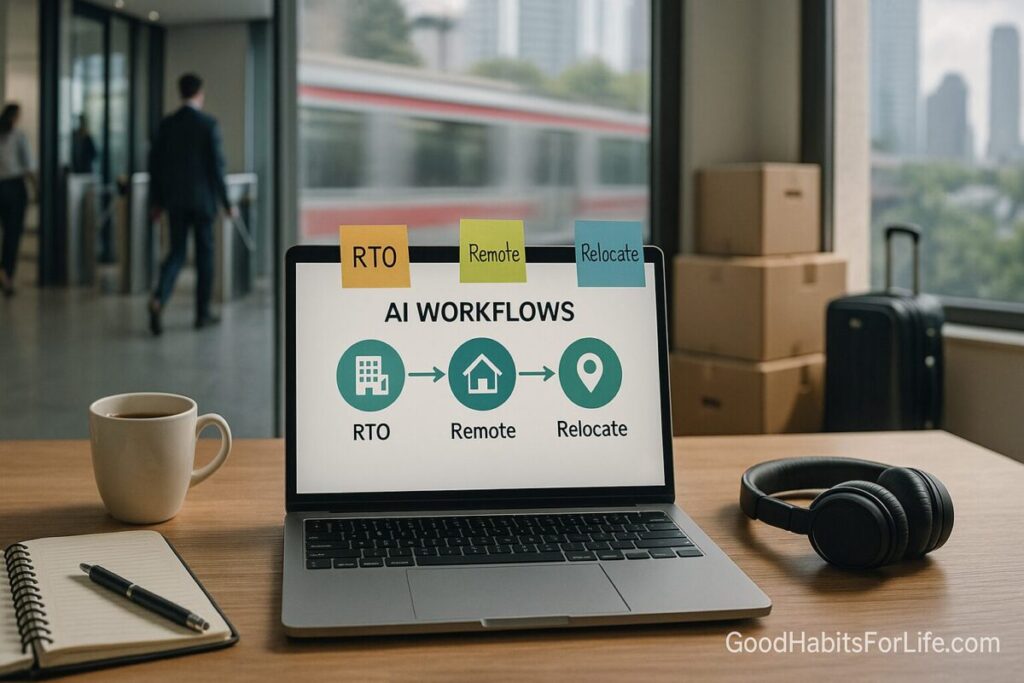
Career Crossroads: Relocation, RTO, or Remote?: AI workflows (2025)
RTO vs Remote vs Relocation: AI Workflows (2025)
Table of Contents
🧭 What this decision is really about (and why it matters)
Three paths compete in 2025: Return-to-Office (RTO), Remote, or Relocation. Each has real trade-offs across money, time, health, and relationships.
-
Remote is no longer an outlier, but it’s not “everyone”: In June 2025, about 27% of paid days in the U.S. were worked from home; among full-time employees by spring 2025, 60% were fully on-site, 27% hybrid, 13% fully remote. wfhresearch.com
-
Working at home on a given day: BLS shows about one-third of employed people worked at home on days worked in 2024 (men down slightly, women steady). Bureau of Labor Statistics
-
Commute still bites: Mean one-way commute in 2023 was 26.8 minutes (≈53.6 minutes/day) with nearly 9% commuting 60+ minutes one way. Longer commutes correlate with poorer wellbeing; active commuting associates with lower CVD and mortality. Census.gov+1
-
Location changes your purchasing power: States and metros differ in price levels; e.g., California’s RPP >110 vs sub-90 in some states—crucial for salary comparisons and remote pay bands. Bureau of Economic Analysis
Bottom line: Treat this as a portfolio decision (cash, time, health, family) and run structured AI workflows to compare options apples-to-apples.
✅ Quick Start: Your 45-minute comparison
-
List scenarios (10 min):
-
S1: Stay put + Hybrid (e.g., 3 days office)
-
S2: Fully Remote (same city)
-
S3: Relocate (City A → City B) + Hybrid/Remote
-
S4: Accept new job (different city)
-
-
Gather inputs (10 min):
-
Gross salary and bonus; benefits %; remote stipend if any.
-
Commute: km/mi, minutes, frequency/week. Census.gov
-
Local price level (RPP/PPP) for each city. Bureau of Economic Analysis
-
WFH reality for your function/industry (sanity check). wfhresearch.com
-
-
Run five AI workflows (25 min): Use your favorite LLM + spreadsheet to compute:
-
Adjusted take-home after cost-of-living.
-
Commute time cost (convert to money & wellbeing). Census.gov+1
-
Career trajectory score (promotion, network access).
-
Couple/family fit score (two incomes, schools, caregiving).
-
Compliance risk flags (tax, visa basics).
-
-
Score each scenario (0–10) on Money, Time, Health, Relationship, Risk. Choose top two; sleep on it; decide.
💸 Workflow 1 — Cost of Living & Compensation (PPP/RPP)
Goal: Compare offers or cities using regional price parities.
-
Formula (monthly):
Adj Salary = Gross Salary × (100 / RPP_city)
Example: ₹ or $100,000 in a city with RPP 112 buys what $89,286 buys nationally (100/112). In an RPP 88 area, it buys $113,636. Bureau of Economic Analysis -
Include benefits: Add employer contributions (insurance, retirement) as % of salary.
-
Housing delta: Apply local rent/mortgage estimates; sanity-check with government price level indices rather than crowdsourced lists. Bureau of Economic Analysis
AI prompts you can paste:
-
“Build a table that compares Adj Salary, after applying RPP for [City A] vs [City B], including benefits at X%, rent of ₹/$Y**, and childcare of ₹/$Z**. Show annual and monthly.”
Why it matters: A “higher” salary can be lower in real terms once price levels bite.
🚇 Workflow 2 — Commute Burden & Wellbeing (RTO/Hybrid)
Goal: Put a currency value on office days.
-
Time cost:
Commute Minutes per day × Days per week × 50 weeks→ hours/year. Use your hourly after-tax rate to get a ₹/**$ figure. Mean one-way = 26.8 min is a useful baseline if you don’t know your route yet. Census.gov -
Health impact: Longer car commutes link to lower wellbeing; active commuting (walk/cycle + transit) associates with lower CVD and all-cause mortality—factor this into your plan. BMJ
-
Hybrid reality check: Many teams still operate with hybrid norms even if policies nudge onsite days; use this to model realistic schedules. wfhresearch.com
AI prompts you can paste:
-
“Calculate annual time cost and money cost for commuting X km/mi and Y minutes each way, Z days/week. Include scenario where 1 day/week is done by walking or cycling and estimate health benefit qualitatively from evidence.”
📈 Workflow 3 — Career Growth, Skills & Promotion Risk
Goal: Estimate trajectory value of being in-person vs remote for your role.
-
Signals to quantify (0–10):
Sponsor access, visibility, mentorship, on-the-job learning, team rituals, lab/client access, confidential work. -
Use evidence as context: Remote grew structurally and remains sticky (≈27% paid days WFH; hybrid common), but career outcomes vary by occupation (finance/tech/professional services show higher WFH). wfhresearch.com
-
Macro lens: BLS analysis links rises in remote work with positive TFP growth association at the aggregate level—productivity doesn’t automatically drop with remote. Your local output and promotion criteria matter most. Bureau of Labor Statistics
AI prompts you can paste:
-
“Score my role (title, level) across 7 exposure levers (sponsor access, lab access, etc.) for (a) full remote, (b) hybrid 3-days, (c) full RTO. Weight by importance to promotion at Company X and output a composite score.”
👥 Workflow 4 — Dual-Career, Marriage & Family Fit
Goal: Optimize two careers, one household.
-
Two-body matrix: Rows = your scenarios; columns = Partner income trajectory, Partner job market depth in city, Childcare/schooling, Elder care, Social support, Time together.
-
Preference weights: Each partner assigns weights (e.g., 30/30/20/20).
-
Liveability lens: Commute + household admin load; studies and surveys highlight that remote/hybrid can improve balance for some and blur boundaries for others—make it explicit. OECD+1
-
Remote tolerance: Many remote workers say they’d likely leave if forced back on-site—factor retention risk and job search optionality if one partner relies on remote flexibility. Pew Research Center
AI prompts you can paste:
-
“Create a two-career decision table for [You] and [Partner] across 3 cities, scoring job prospects, childcare, commute, and time-together hours/week. Recommend the top scenario given weights.”
🛂 Workflow 5 — Taxes, Visas & Compliance Guardrails
Goal: Identify red flags early (don’t learn via penalty letter).
-
Multi-state/region taxes: Remote across borders can trigger nexus, payroll, or filing duties; domestic migration and cross-border work have risen and changed patterns—verify state rules before moving. Census.gov+1
-
Immigration/visa constraints: Employer policy may set location limits regardless of your personal preference.
-
Company policy reality: Compare policy-allowed WFH days with actual WFH days norm in your org (gap often exists). wfhresearch.com
AI prompts you can paste:
-
“List tax/visa/compliance questions to ask HR for working from [Country/State] 100% remote or X days hybrid, and map them to responsible teams.”
🗺️ Habit Plan — 30-60-90 Roadmap
Day 0–30 (Clarity)
-
Build your scenario sheet with RPP-adjusted pay, commute cost, benefits, and partner factors. Bureau of Economic Analysis+1
-
Run 5 AI workflows; shortlist top 2 scenarios.
-
Book informational chats with 3 future peers/managers per scenario.
Day 31–60 (Experiments)
-
Pilot hybrid: If possible, trial 2–3 in-office days for 3 weeks; log energy, output, and commute.
-
Shadow days in prospective city/team; validate network access and mentorship.
Day 61–90 (Decision & Setup)
-
Decide; negotiate (see scripts below).
-
Lock housing, school/care, commute plan; set household rhythms (meeting-free family blocks, active commute day, etc.).
-
Create a Quarterly Review to update costs, career score, and couple/family score.
🧠 Audience Variations
-
Students/early-career: Prioritize learning density (mentors, labs, on-site rituals). Shorter leases; rent near transit; hybrid is often optimal.
-
Parents & caregivers: Weight predictability, childcare, school access, family time over nominal salary deltas.
-
Professionals aiming for leadership: Higher value on sponsor access and in-room moments; consider hub months (concentrated on-site).
-
Seniors/late-career: Flex for health, part-time remote, and community; maintain skills via micro-projects.
-
Dual-career couples: Use the matrix; avoid sacrificing one career entirely unless compensated by clear family gains.
⚠️ Mistakes & Myths to Avoid
-
Myth: “Remote kills productivity.” Reality: aggregate data show positive associations with productivity growth; it’s role- and team-specific. Bureau of Labor Statistics
-
Myth: “RTO always boosts promotion odds.” Not if you’re on the wrong site with poor mentorship. Measure exposure quality, not just proximity.
-
Mistake: Ignoring price levels and comparing raw salaries across cities. Bureau of Economic Analysis
-
Mistake: Pricing only fuel/metro—the time cost of commuting often dwarfs fares. Census.gov
-
Mistake: Not modeling the partner’s career and household load.
💬 Real-Life Examples & Scripts
Negotiation (Remote):
“Given the RPP-adjusted comparison and my output in a distributed setup, I’m seeking a ₹/$X remote stipend and clarity on two quarterly in-person sprints (pre-budgeted travel).”
Negotiation (Hybrid):
“I’ll commit to 3 office days aligned to team rituals (planning, retros, client demos). To offset the 53.6 min daily commute, I’m asking for shifted hours on two days to preserve family time.” Census.gov
Relocation ask:
“If I relocate to City B, RPP indicates ~Y% higher purchasing power; I’m proposing a one-time move grant and a 90-day rent bridge while we settle.” Bureau of Economic Analysis
🧰 Tools & Resources (pros/cons)
-
Spreadsheet (Sheets/Excel/Notion): Transparent, flexible; manual updates.
-
BEA Regional Price Parities: Government price levels; annual cadence; U.S. focus. Bureau of Economic Analysis
-
U.S. Census ACS Commuting: Authoritative commute stats; great for baselines. Census.gov
-
WFH Research (SWAA): Current hybrid/remote reality by sector. wfhresearch.com
-
BLS ATUS & Productivity notes: Time use at home and macro productivity link. Bureau of Labor Statistics+1
-
APA Work in America: Wellbeing risks/benefits to monitor. APA
📌 Key Takeaways
-
Don’t debate philosophy—run the numbers (RPP, commute, benefits) and score real exposure to sponsors/learning. Bureau of Economic Analysis+1
-
2025 reality: Hybrid is common; remote is meaningful; on-site still dominant—optimize for your role’s exposure levers. wfhresearch.com
-
Treat decisions as family portfolio choices; model two careers and household time.
-
Use the 30-60-90 plan to de-risk and revisit quarterly.
❓ FAQs
1) Is remote work “going away”?
No. It has stabilized at a significant share (≈27% of paid days at home in mid-2025), with many roles hybrid. Policies fluctuate, but the structural shift stuck. wfhresearch.com
2) How many days at home/on-site are typical?
By spring 2025 among full-time employees: ~60% fully on-site, ~27% hybrid, ~13% fully remote. wfhresearch.com
3) What’s a fair remote pay comparison across cities?
Adjust for price levels (RPP): Adj Salary = Salary × (100/RPP). Compare real purchasing power, not just nominal pay. Bureau of Economic Analysis
4) How much does a commute really “cost”?
Start with the 26.8-minute mean one-way baseline; multiply to annual hours and price at your after-tax rate. Factor wellbeing; active commuting helps. Census.gov+1
5) Does remote hurt productivity?
Not categorically. BLS notes a positive association between increased remote work and TFP growth; effects vary by task/team. Bureau of Labor Statistics
6) What if my partner’s career depends on a different city?
Use the dual-career matrix; weight each factor and let the numbers drive a joint decision (not vibes). Evidence shows remote/hybrid can help some families and strain others—be explicit. OECD+1
7) What legal/tax issues should I check before relocating as a remote employee?
Cross-state/region work can create filing/nexus obligations; validate rules and HR policy before moving. Use official migration/commuting data for planning. Census.gov
8) I’m early-career—should I prioritize RTO?
Often yes for learning density—but test hybrid with concentrated on-site rituals and mentors.
📚 References
-
U.S. Bureau of Labor Statistics — American Time Use Survey (2024 Results). Bureau of Labor Statistics+2Bureau of Labor Statistics+2
-
WFH Research (Barrero, Bloom, Davis) — SWAA July 2025 Update (paid days WFH; distribution by modality). wfhresearch.com
-
U.S. Census Bureau — Commuting At A Glance (ACS 1-Year, 2023). Census.gov
-
Bureau of Economic Analysis — Regional Price Parities by State & Metro (2025). Bureau of Economic Analysis
-
U.S. Census Bureau — State-to-State Migration Flows (2023). Census.gov
-
BLS — Productivity & Remote Work (TFP association). Bureau of Labor Statistics
-
OECD — Remote work, productivity & wellbeing (public sector/telework insights, 2025). OECD
-
BMJ — Active commuting & reduced CVD/cancer/mortality (2017 cohort). BMJ
-
Pew Research Center — Worker preferences for WFH and RTO (2025). Pew Research Center+1
Disclaimer: This article offers general information for careers/finance planning; it is not legal, tax, or immigration advice—consult a qualified professional for your situation.