
Interview as a Learning Loop: Prep Reflect Iterate: AI workflows (2025)
Interview as a Learning Loop (2025): Prep, Reflect, Iterate
Table of Contents
🧭 What & Why
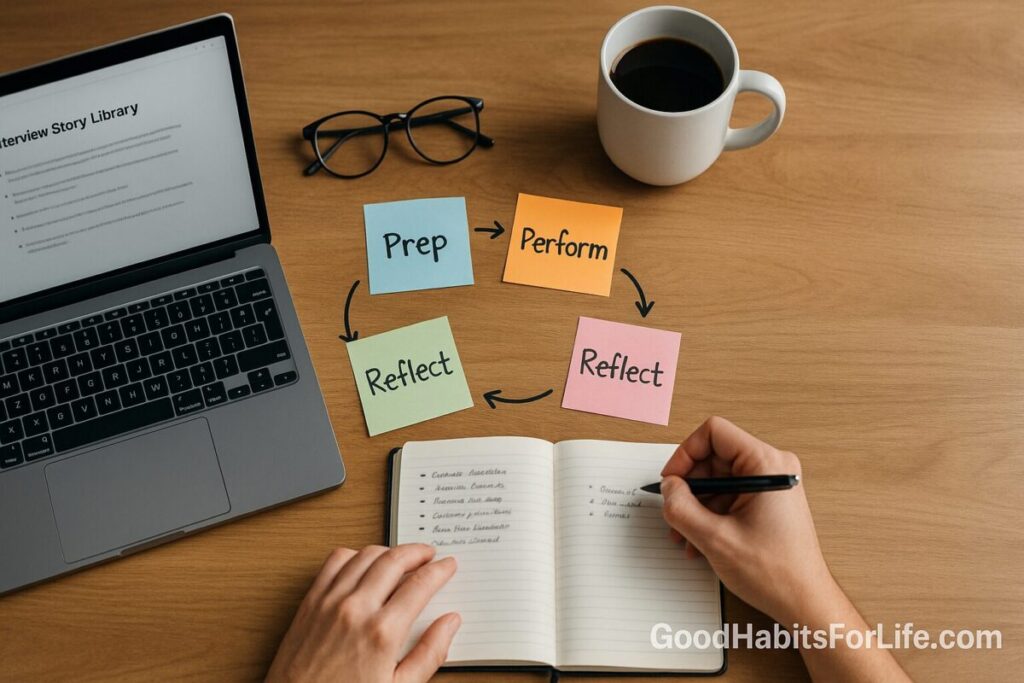
Most candidates treat interviews like one-off performances. High performers run them as learning loops:
-
Prep (role research, story library, practice),
-
Perform (deliver concise, evidence-rich answers),
-
Reflect (capture what went well and what to fix),
-
Iterate (revise stories, repeat practice, redeploy).
Why this works: reflection consolidates learning and measurably boosts next-round performance; retrieval practice (testing yourself) and spaced repetition strengthen recall so your answers are fluent under pressure. PubMed+3Harvard Business School Library+3Larry Ferlazzo’s Websites of the Day…+3
Employers also evaluate against competencies (e.g., communication, critical thinking, teamwork, technology). Aligning your stories to these is a force multiplier for relevance and clarity. Default+1
✅ Quick Start: Do This Today (60–90 minutes)
1) Decode the role (10–15 min).
-
Paste the job description into your notes.
-
Extract 6–8 “must-show” competencies (e.g., stakeholder management, data literacy, prioritisation). Map them to NACE’s eight career-readiness competencies for coverage. Default
2) Draft 3 STAR stories (25–30 min).
-
Choose three meaty experiences. For each, outline Situation, Task, Action, Result (+ “Learned”). The STAR structure keeps answers concise and evidence-based. nationalcareers.service.gov.uk+1
3) Run a 15-minute mock interview.
-
Use a timer and 6–8 likely questions. Record audio (phone is fine). Answer in 60–90 seconds each.
4) Do a 10-minute After-Action Review (AAR).
-
Ask: What was supposed to happen? What actually happened? What went well? What will I change next time? Capture 3 fixes. (AAR is a proven reflection format.) RDL
5) Schedule retrieval & spacing (5–10 min).
-
Create flashcards for question prompts and your key bullet points (not scripts). Review tomorrow, then 3 days later, then a week later. (Spacing + retrieval beat cramming.) PubMed+1
6) Privacy-safe AI assist (ongoing).
-
Use AI to brainstorm question banks or tighten wording—but remove names, client data, proprietary metrics, and any identifiers. Follow recognised AI risk and data-protection guidance. NIST Publications+2NIST Publications+2
🗓️ 30-60-90 Habit Plan
Days 1–30: Build Your Engine
-
Week 1:
-
Create a role “competency map” and 6–8 likely questions per competency.
-
Draft five STAR(L) stories that cover different outcomes and contexts. nationalcareers.service.gov.uk
-
-
Week 2:
-
Two 20-minute mock sessions (voice recorded).
-
AAR after each; turn 3 AAR fixes into micro-goals (e.g., “shorten context to 15 seconds”). RDL
-
-
Week 3:
-
Start spaced reviews (Day 1, 3, 7 pattern) of flashcards and opening lines. PubMed
-
-
Week 4:
-
One panel-style practice (ask 2 friends/mentors).
-
Build a Question Library of 50+ prompts with bullet-point answers.
-
Checkpoint (Day 30): Can you deliver 5 stories in <90 seconds each, with metrics and a clear “learned” line?
Days 31–60: Sharpen & Diversify
-
Add role-specific drills (e.g., product prioritisation, case reasoning, coding warm-ups).
-
Run two “curveball clinics” weekly (e.g., conflict, failure, ethical dilemma).
-
Practice stress-management techniques (brief reappraisal scripts; see below). Evidence suggests reframing arousal can improve performance under evaluation. PMC+1
Checkpoint (Day 60): Answers are concise, metrics-anchored, and mapped to target competencies.
Days 61–90: Simulate & Scale
-
Rotate interview formats (technical, behavioural, panel, presentation).
-
Conduct a full 45–60 min mock every 10 days with a comprehensive AAR.
-
Keep spacing cadence and refresh 1–2 stories with newer results.
Checkpoint (Day 90): You can handle “Tell me about a time…” and “What would you do if…” with calm, structure, and evidence.
🧠 Techniques & Frameworks that Work
STAR → STAR(L) (add “Learned”)
A classic for behavioural questions. Keep Situation ≤15 seconds; anchor Result with metrics; end with what you Learned or changed. nationalcareers.service.gov.uk
Kolb’s Experiential Learning Cycle
Do → Reflect → Conceptualise → Experiment. Your AAR + story updating walks this loop before each next interview. citt.it.ufl.edu
After-Action Review (AAR)
A short, structured debrief used widely in complex performance environments. Apply a lightweight AAR after every mock or real interview to surface repeatable fixes. RDL
Retrieval Practice & Spaced Repetition
Self-testing + spaced reviews lead to durable recall and calmer delivery under load. Use flashcards for prompts, not scripts. Psychnet+1
Competency Mapping
Crosswalk job-specific requirements to broad, validated competencies so answers “speak the employer’s language.” Default
Stress Reappraisal (fast script)
Label arousal as “fuel,” not “threat.” Quick line before you start: “This energy helps me focus and think clearly.” Evidence links reappraisal with better task performance under evaluation. PMC+1
Using AI Safely & Effectively (2025)
-
Do: brainstorm question banks, refine bullet points, simulate follow-ups.
-
Don’t: paste proprietary/confidential data; always pseudonymise identifying details if you need to reference context. Follow reputable risk management guidance. NIST Publications+2NIST Publications+2
👥 Audience Variations
Students/Graduates
-
Use coursework, internships, clubs, and volunteering as story sources. Tie to career-readiness competencies (communication, teamwork, technology). Default
Career Switchers
-
Translate domain-agnostic wins (process improvement, stakeholder management, learning fast). Build one “bridge” story that maps old context → new role value.
Professionals (3–10 yrs)
-
Prioritise impact metrics (revenue, cycle time, quality, risk). Prepare one failure/repair story that shows ownership and learning.
Seniors/Leads
-
Emphasise strategy, delegation, cross-functional influence, and ethical trade-offs. Bring a story on developing others.
Teens/First-time Workers
-
Pull from school projects, sports, caretaking, part-time jobs; the STAR structure still applies. nationalcareers.service.gov.uk
⚠️ Mistakes & Myths to Avoid
-
Memorising scripts. You’ll sound robotic and crack under follow-ups. Use bullets + retrieval practice instead. Psychnet
-
Ignoring reflection. Without AARs, mistakes repeat and gains fade. RDL+1
-
Over-relying on AI. Let AI draft; you verify truth, add numbers, and personalise.
-
Not mapping to competencies. Great stories can still miss the mark if they don’t answer what’s being evaluated. Default
-
Burying the result. Move outcomes up; lead with impact and end with what you learned.
🗣️ Real-Life Examples & Scripts
1) “Tell me about a time you dealt with conflicting priorities.” (STAR[L])
-
S: “When two product launches overlapped by 3 weeks…”
-
T: “I had to prevent resource collisions without delaying either launch.”
-
A: “I built a shared capacity board, negotiated scope trims, and set a daily 10-minute stand-up across teams.”
-
R: “Both launched on time; reduced unplanned overtime by 22%; NPS +6.”
-
L: “Since then I pre-negotiate ‘must/should/could’ and run conflict scans monthly.”
2) “What would you do if a stakeholder rejects your plan?” (Framework)
-
Acknowledge → Surface interests → Offer options with trade-offs → Confirm decision criteria → Close with next steps.
3) “Walk me through a failure.”
-
Frame a real miss → Own the cause (no blame) → Show fix and the metric that changed → Tell how you now prevent recurrence.
4) 30-sec “Why this role/company?” opener
-
1 sentence on mission alignment, 1 on role fit (skills → outcomes), 1 on what you’ll deliver in 90 days.
🛠️ Tools, Apps & Resources (use what fits)
-
Story Library & Notes: Notion, Obsidian, Google Docs.
-
Flashcards for Retrieval/Spacing: Anki, RemNote, Quizlet.
-
Mock Interview Practice: Phone voice recorder; any video meeting app with recording.
-
Scheduling & Tracking: Google Calendar, Trello/Asana, simple spreadsheet habit tracker.
-
AI Helpers (privacy-safe use): brainstorm prompts, compress rambly answers, generate follow-ups—after removing identifiers and sensitive details (use pseudonyms, round numbers). Follow reputable risk and privacy guidance. NIST Publications+2NIST Publications+2
Tip: keep a single “Interview Log” with date, role, questions asked, 3 wins, 3 improvements, and the next experiment.
📚 Key Takeaways
-
Run interviews as loops, not one-offs: prep → perform → reflect → iterate. Harvard Business School Library
-
Anchor stories in STAR(L) and map them to real competencies. nationalcareers.service.gov.uk+1
-
Use retrieval practice and spaced repetition to keep answers crisp. Psychnet+1
-
Apply a 10-minute AAR after every mock or real interview. RDL
-
Leverage AI for speed—but handle data responsibly using recognised AI risk and data-protection guidance. NIST Publications+2NIST Publications+2
❓ FAQs
1) How many STAR stories do I need?
Five well-rounded stories usually cover most behavioural prompts; add 2–3 role-specific ones as you learn more.
2) How long should an answer be?
Aim for 60–90 seconds. If they probe, add detail on actions or trade-offs.
3) What if I’m new or switching careers?
Use projects, volunteering, and personal initiatives. Emphasise transferable skills and outcomes tied to target competencies. Default
4) How do I practise without sounding rehearsed?
Bullet points + retrieval practice. Rehearse openings and transitions; keep wording fresh. Psychnet
5) How soon should I reflect after an interview?
Within 24 hours—ideally the same day—run a 10-minute AAR and log 3 improvements for next time. RDL
6) Is using AI for prep allowed?
For most employers, yes—for preparation. Don’t bring AI-generated content into technical assessments unless explicitly permitted. Always remove identifiers and follow trusted AI risk/data-protection guidance. NIST Publications+1
7) Any quick anxiety tip that’s evidence-aligned?
Try stress reappraisal: tell yourself the arousal is useful energy. It’s linked with better performance under evaluation. PMC+1
📖 References
-
Di Stefano, G., Gino, F., Pisano, G., Staats, B. Learning by Thinking: How Reflection Aids Performance. (Working paper / summaries). Harvard Business School Working Knowledge. Harvard Business School Library
-
National Careers Service (UK). The STAR Method (Interview Advice). nationalcareers.service.gov.uk. nationalcareers.service.gov.uk
-
Ofqual (UK). Using STAR effectively in your job application and interviews. (PDF). ofqual.blog.gov.uk. ofqual.blog.gov.uk
-
NACE. Career Readiness Competencies (Revised Apr 2024). (PDF). naceweb.org. Default
-
NACE. Career Readiness: Definition & Competencies. naceweb.org. Default
-
Cepeda, N. J., et al. (2006). Distributed practice in verbal recall tasks: A review and quantitative synthesis. Psychological Bulletin. PubMed. PubMed
-
Roediger, H. L., & Karpicke, J. D. (2006). The Power of Testing Memory / Test-Enhanced Learning. (Papers). Washington University in St. Louis PDF. Psychnet
-
U.S. Army (2025). TC 7-0.1: After Action Reviews. (PDF). rdl.train.army.mil. RDL
-
NIST (2023). AI Risk Management Framework (AI RMF 1.0). (PDF). nvlpubs.nist.gov. NIST Publications
-
NIST (2024). AI RMF: Generative AI Profile (NIST.AI.600-1). (PDF). nvlpubs.nist.gov. NIST Publications
-
EDPB (2025). Guidelines 01/2025 on Pseudonymisation (Public Consultation). edpb.europa.eu. edpb.europa.eu
-
University of Florida, CITT. Kolb’s Four Stages of Learning (1984). citt.it.ufl.edu. citt.it.ufl.edu
⚖️ Disclaimer
This guide offers general career education and light psychological strategies (e.g., stress reappraisal). It is not medical or legal advice.