
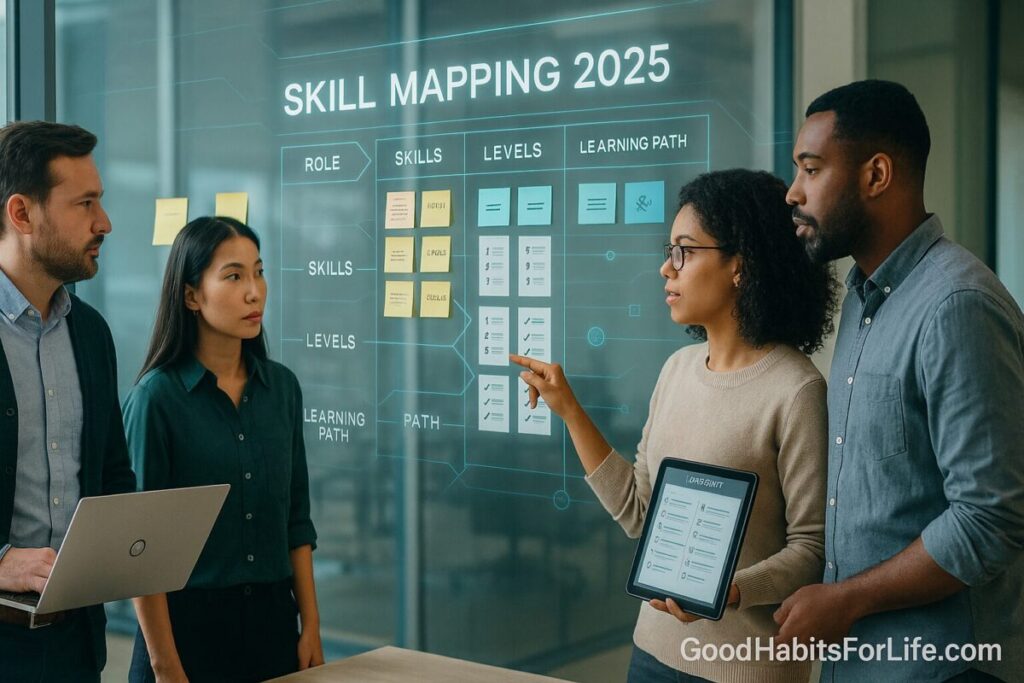
Skill Mapping 2025: From Job Descriptions to Learning Paths
Skill Mapping 2025: From Job Descriptions to Learning Paths
Table of Contents
🧭 What & Why: A skills-first blueprint
Skill mapping is the process of extracting and standardizing the skills in a role (from a job description, career framework, or project scope), assigning proficiency levels, and converting them into learning paths with milestones, practice tasks, and proofs of work.
Why it matters in 2025:
-
Hiring is moving “skills-first.” Employers increasingly describe work in terms of skills, tasks, and outcomes, not just degrees or titles. A skills-first approach helps people navigate green and digital transitions and demographic change. OECD
-
Taxonomies reduce noise. Open, maintained taxonomies like O*NET (U.S.) and ESCO (EU) provide standardized skill/occupation vocabularies that make mapping consistent across roles and industries. O*NET Center+1
-
Sector frameworks increase precision. Examples include NICE (cybersecurity), which defines tasks/KSAs and career pathways—ideal for turning roles into concrete learning outcomes. NIST Computer Security Resource Center
-
Portable proof. Micro-credentials in the EU now have a shared definition, making small, stackable learning visible to employers. eur-lex.europa.eu
Benefits
-
Clear skill gaps and levels
-
Faster onboarding, reskilling, and internal mobility
-
Better ROI from learning budgets and time
🛠️ Quick Start: Turn one job description into a learning path today
Goal: In 90 minutes, convert a single job description (JD) into a draft learning path with resources and practice.
Materials: The JD (copy/paste), spreadsheet, access to O*NET/ESCO, 2–3 trusted course/catalog sources.
Step-by-step (90-minute sprint)
-
Copy the JD → paste into a doc. Delete fluff (culture blurbs), keep Requirements, Responsibilities, Nice to have.
-
Highlight skill nouns & verbs (e.g., “SQL,” “time-series forecasting,” “incident response,” “stakeholder mapping”). Aim for 20–40 items.
-
Normalize to a taxonomy. For each item, find the closest O*NET/ESCO skill term. Merge synonyms and drop brand names unless they’re ubiquitous (e.g., “Excel” → “spreadsheets”). onetonline.org+1
-
Label skill types & levels. Use three tiers:
-
Core (daily), Adjacent (weekly/with coaching), Emerging (watchlist).
-
Draft levels: Foundation / Working / Advanced / Expert (define simple rubrics).
-
-
Group into 4–7 themes (e.g., Data Foundations, Visualization, Stakeholder Skills).
-
Write outcomes per theme using action verbs (“Build,” “Diagnose,” “Present,” “Automate”).
-
Attach resources:
-
1–2 flagship courses per theme (credit-bearing or micro-credentials where possible). eur-lex.europa.eu
-
1 reference/playbook (docs, handbooks, standards).
-
1 practice brief (small, real-world task).
-
-
Build a weekly rhythm using the 70-20-10 mix: 70% job-embedded practice, 20% mentoring/peer feedback, 10% courses. CCL
-
Schedule spaced reviews (Day 2, Day 6, Day 14, Day 30) for key concepts to improve retention. PubMed
-
Publish your v1 path in your LMS/Notes and share with a manager or mentor for feedback.
Output artifact: A one-page learning path with themes → outcomes → resources → practice → checkpoints.
🗺️ 30-60-90 Habit Plan
Principle: Short build cycles; visible proof every month.
Days 1–30 — Audit & Prototype
-
Pick 1 role and 1 project that needs upskilling.
-
Map 25–40 skills from its JD; normalize via O*NET/ESCO.
-
Define levels & outcomes; build a one-page path.
-
Pilot 1 theme (2–3 weeks) with:
-
1 flagship course/module
-
2 practice briefs (job-embedded)
-
1 mentor check-in
-
-
Checkpoint: Ship one proof (e.g., dashboard, lab, policy draft, mini playbook).
Days 31–60 — Expand & Evidence
-
Add two more themes; integrate micro-credential(s) where available. eur-lex.europa.eu
-
Peer review loop: 15-minute weekly feedback on artifacts.
-
Portfolio log: Link each skill to an artifact + acceptance criteria.
Days 61–90 — Operationalize & Scale
-
Retrospective: What outcomes improved?
-
Automate refresh (90-day cadence) to catch new skills (e.g., “RAG pipelines,” “Scope 3 reporting”).
-
Document playbook: templates, rubrics, and mapping rules so others can repeat.
🧠 Techniques & Frameworks that work
1) 70-20-10 learning mix
Use formal courses for foundations (10%), structured shadowing/coaching for techniques (20%), and on-the-job challenges for mastery (70%). It’s a durable heuristic to keep learning aligned to real work. CCL
2) Spaced repetition & retrieval practice
Calendar spaced reviews of key terms, formulas, or procedures (e.g., 1–3–7–14–30 days). Decades of evidence show spaced study boosts long-term retention vs. cramming. PubMed+1
3) Deliberate practice
Define small, high-feedback drills targeting weaknesses (e.g., “write 3 incident reports; mentor scores clarity and root-cause depth”). hhs.purdue.edu
4) T-shaped & “skill trees”
Plot breadth (adjacent skills) and depth (one or two spikes). Draw a skill tree for the role—each branch ends in a measurable task.
5) Sector frameworks
In regulated domains, anchor to official frameworks (e.g., NICE for cybersecurity roles; SFIA for digital roles) to improve transferability and assessment rigor. NIST Computer Security Resource Center
6) Skills intelligence loop
Re-scan roles quarterly; many institutions emphasize ongoing “skills intelligence” to reduce mismatch and obsolescence. International Labour Organization
👥 Audience Variations
Students / Early-career
-
Prioritize Core + 1 Adjacent area.
-
Seek micro-credentials that produce shareable artifacts (capstones, labs). eur-lex.europa.eu
Professionals (ICs)
-
Pick 2 themes tied to current KPIs.
-
Swap a generic course for a project brief that hits this quarter’s deliverables.
Managers / Team Leads
-
Build team skill maps; identify overlapping gaps; run a 6-week guild on one theme.
-
Use peer code-reviews / case clinics for the 20% layer.
Career Switchers
-
Translate prior tasks to target skills (“customer support metrics” → “basic analytics + stakeholder comms”).
-
Aim for three artifacts that mirror the target role’s daily tasks.
Seniors / Specialists
-
Teach a monthly masterclass to cement expertise (teach-back = retrieval + spacing).
-
Maintain an emerging skills watchlist per quarter.
⚠️ Mistakes & Myths to Avoid
-
Buzzword lists ≠ skills. If it doesn’t map to a task or outcome, it’s not yet a skill.
-
Courses without practice. The 10% alone rarely moves performance. CCL
-
No leveling rubric. Without observable criteria, “intermediate” is meaningless.
-
One-and-done paths. Skills decay; refresh every 90 days. International Labour Organization
-
Ignoring sector frameworks. In fields like cybersecurity, skipping frameworks makes learning paths less credible. NIST Computer Security Resource Center
💬 Real-Life Examples & Scripts
A. One-page learning path (structure)
Role: Data Analyst (Sales)
Themes: Data Foundations | BI & Visualization | Revenue Ops | Stakeholder Comms
Outcome example: “Build a monthly pipeline dashboard and present 3 insights driving actions.”
Practice: Recreate last quarter’s report; run a 15-min readout.
Proof: PRD + dashboard link + video demo.
B. Manager email to kick off mapping
“Team, share your top 10 weekly tasks. I’ll normalize them to O*NET/ESCO terms and draft our skill map. We’ll review levels and pick two themes for this quarter’s path.”
C. Mentor feedback checklist (copy/paste)
-
What did you try?
-
Evidence of the skill (artifact link):
-
What worked / what failed?
-
Next micro-drill (30 minutes):
-
Due date + check-in:
D. Self-assessment rubric snippet (Working level)
-
Can perform with minimal guidance on routine cases; escalates edge cases.
-
Produces artifacts that pass defined acceptance criteria.
E. “People-first” JD rewrite (skills-first)
Replace “rockstar, degree in X” with “Can do A/B tasks at Working level; within 60 days can complete C outcome with 1 review.”
🧰 Tools, Apps & Resources
Open Taxonomies / Frameworks
-
O*NET Resource Center & OnLine — U.S. occupations/skills with detailed descriptors; great for mapping & leveling. O*NET Center+1
-
ESCO — EU skills/occupations; multilingual; useful for cross-market teams. ESCO
-
NICE (NIST SP 800-181 r1) — Cyber roles/tasks/KSAs; superb anchor for security learning paths. NIST Computer Security Resource Center
Strategy & Policy Evidence
-
OECD “Skills-first” 2025 — What skills-first looks like across economies. OECD
-
EU Micro-credentials (2022) — Common definition and guidance; supports stackable learning. eur-lex.europa.eu
Learning Science
-
70-20-10 (CCL) — Practical mix to connect learning to work. CCL
-
Spacing effect (Cepeda et al.) — Plan reviews to retain more with less time. PubMed
Platforms (examples; pick what you use)
-
LXP/LMS (e.g., your org’s platform) to host paths, checklists, and artifacts.
-
Course catalogs (university partners, MOOC providers) for high-trust modules.
-
Kanban/Docs (issue trackers, wikis) for practice briefs and proofs.
-
Analytics for tracking completion → performance deltas.
Pros/Cons in brief
-
Taxonomies (O*NET/ESCO): +Standard terms, +free; −granularity varies by domain. O*NET Center+1
-
Sector frameworks (NICE): +High credibility; −narrow scope. NIST Computer Security Resource Center
-
Micro-credentials: +Portable, stackable; −quality varies by issuer (use recognized standards). eur-lex.europa.eu
📌 Key Takeaways
-
Start with one JD → one page: normalize skills, level them, attach outcomes, resources, and practice.
-
Anchor to O*NET/ESCO (and sector frameworks) to speak a common language. O*NET Center+1
-
Use 70-20-10 + spacing + deliberate practice to convert study time into performance. CCL+1
-
Ship proof every 30 days; refresh the map quarterly to prevent obsolescence. International Labour Organization
❓ FAQs
1) Skill mapping vs. competency mapping—what’s the difference?
Skill mapping lists specific capabilities tied to tasks/outcomes; competency adds behaviors and context (e.g., judgment, teamwork) and is often used in performance frameworks.
2) How do I extract skills from a messy JD?
Strip branding, highlight verbs/nouns in the responsibilities and requirements, then normalize to O*NET/ESCO terms; merge duplicates and drop fluff. O*NET Center+1
3) How often should I refresh a skill map?
Quarterly is a healthy default; align to business/tech releases or compliance cycles. Many institutions stress continuous “skills intelligence.” International Labour Organization
4) Courses or projects first?
Do both, but weight job-embedded practice (70) and mentoring (20) more than courses (10) for performance gains. CCL
5) How do I level skills fairly?
Define observable criteria per level (Foundation/Working/Advanced/Expert); ask for proof artifacts that meet acceptance criteria.
6) Which frameworks exist for my field?
Cybersecurity → NICE; software/digital → SFIA; public sector often has role catalogs; search your regulator/association’s framework. NIST Computer Security Resource Center
7) Are micro-credentials worth it?
Yes—when issued under recognized standards and attached to real artifacts; they make small learning visible and portable. eur-lex.europa.eu
8) What about skills mismatch—how does mapping help?
Mapping reduces mismatch by clarifying required skills and guiding targeted learning—an issue frequently highlighted in global policy work. World Bank+1
📚 References
-
O*NET Resource Center. U.S. Department of Labor. https://www.onetcenter.org/ O*NET Center
-
O*NET OnLine (Occupational Information Network). https://www.onetonline.org/ onetonline.org
-
ESCO — European Skills, Competences, Qualifications and Occupations. European Commission. https://esco.ec.europa.eu/ ESCO+1
-
OECD (2025). Empowering the Workforce in the Context of a Skills-First Approach. https://www.oecd.org/en/publications/empowering-the-workforce-in-the-context-of-a-skills-first-approach_345b6528-en.html OECD
-
NIST (2020). SP 800-181 Rev.1: NICE Workforce Framework for Cybersecurity. https://csrc.nist.gov/pubs/sp/800/181/r1/final NIST Computer Security Resource Center
-
CISA (2025). NICE Framework Overview. https://niccs.cisa.gov/tools/nice-framework NICCS
-
Council Recommendation (2022). European approach to micro-credentials for lifelong learning and employability. EUR-Lex C 243/02. https://eur-lex.europa.eu/legal-content/EN/TXT/?uri=oj%3AJOC_2022_243_R_0002 eur-lex.europa.eu
-
Center for Creative Leadership (2025). The 70-20-10 Rule. https://www.ccl.org/articles/leading-effectively-articles/70-20-10-rule/ CCL
-
Cepeda, N. J., et al. (2006). Distributed practice in verbal recall tasks. Psychological Bulletin. PubMed: https://pubmed.ncbi.nlm.nih.gov/16719566/ PubMed
-
Cepeda, N. J., et al. (2008). Spacing effects in learning. Psychological Science. PubMed: https://pubmed.ncbi.nlm.nih.gov/19076480/ PubMed
-
OECD (2025). Employment Outlook 2025. https://www.oecd.org/en/publications/oecd-employment-outlook-2025_194a947b-en/full-report.html OECD