
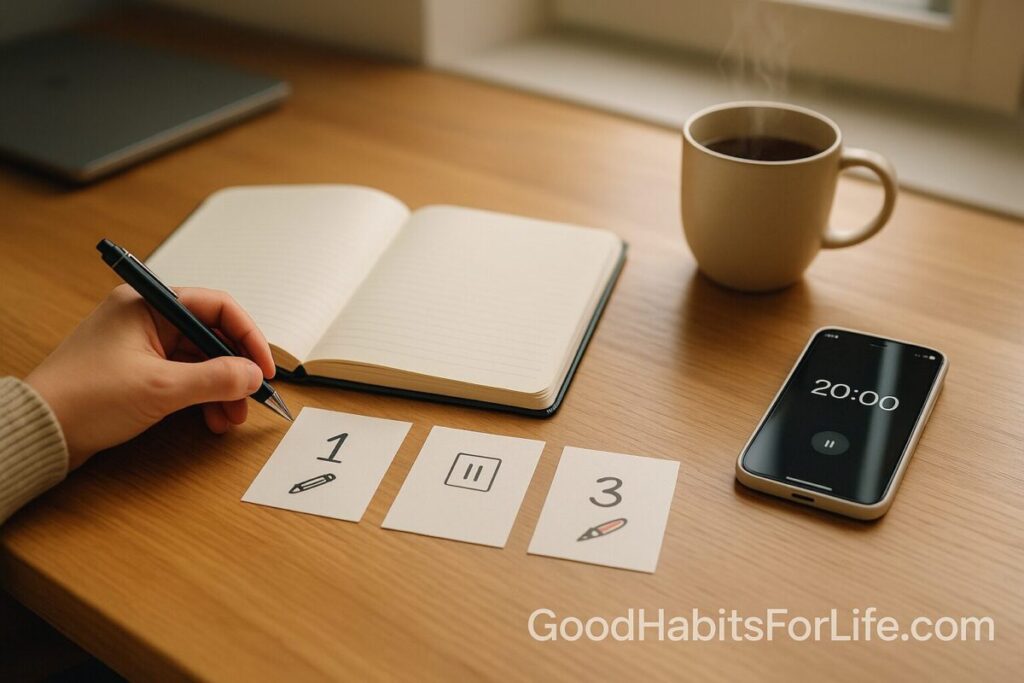
Writing in Cycles: Draft, Rest, Rewrite
Writing in Cycles: Draft, Rest, Rewrite
Table of Contents
🧭 What & Why: The Draft–Rest–Rewrite Cycle
Definition. Writing in cycles means you deliberately separate your work into three distinct phases:
-
Draft quickly to capture ideas.
-
Rest (hours, overnight, or longer) to allow incubation and memory consolidation.
-
Rewrite with fresh eyes, moving from structure to polish.
Why it works (in plain English).
-
Incubation boosts insight. Stepping away improves creative problem-solving and helps you see better alternatives.
-
Sleep strengthens memory and insight. Overnight consolidation makes key ideas “click,” supporting clearer structure the next day.
-
Spacing beats cramming. Distributing work across sessions improves recall and transfer—useful for terminology, citations, and argument flow.
-
Breaks prevent “attention fade.” Short, intentional breaks reset focus so you return sharper.
-
Revision is a different task than drafting. Treating them separately reduces cognitive load and speeds both phases.
Benefits you’ll notice.
-
Faster first drafts (less self-editing while writing).
-
Fewer logical gaps and contradictions.
-
Tighter prose and stronger voice.
-
Easier proofreading (errors “pop” after rest).
-
Less burnout; more consistent output.
✅ Quick Start (Do This Today)
Goal: Ship one solid piece using a single 24-hour cycle.
Today — Morning (60–90 min)
-
Define the promise (1–2 sentences): What will the reader be able to do or know?
-
Bullet outline (10 minutes): H2s → bullets → example or data under each.
-
Draft fast (40–60 minutes): Write ugly on purpose. No backspacing wars.
-
Stop at “half-polish.” Fix only clarity killers (missing steps, broken logic).
Today — Afternoon (10–15 min)
5. Micro-rest + ping. Take a walk. Jot any sudden ideas on your phone. Don’t open the draft.
Tonight — 5 minutes
6. Set rewrite checklist for tomorrow (see below). Park open loops (“Need stats for X?”).
Tomorrow — Morning (45–60 min)
7. Rewrite pass order:
-
Structure: headings, flow, trimming repetition.
-
Clarity: explain terms, add examples, fix transitions.
-
Style: active voice, concrete verbs, tighten sentences.
-
Proof: names, numbers, links, formatting.
-
Ship. Hit publish or send for review.
Worked example timeline (blog post ~1,200 words):
-
Draft: 70 min → Rest: 18–24 h → Rewrite: 50 min → Publish.
🛠️ 30-60-90 Habit Plan
Objective: Make the cycle automatic and scalable.
Days 1–30: Foundations (1 piece/week)
-
Cadence: Mon draft → Tue rest → Wed rewrite → Thu buffer → Fri publish.
-
Templates: Create an outline template and a rewrite checklist.
-
Timebox: Draft in 60–90 minutes; rewrite in 45–60 minutes.
-
Metric: Words published/week and % of on-time posts.
Days 31–60: Throughput (2 pieces/week)
-
Parallel cycles: While Post A rests, draft Post B.
-
Add a “fact pass.” Verify stats, sources, and quotes.
-
Introduce peer swap. 10-minute “reader test” for structure and clarity.
-
Metric: Turnaround time (start → publish) and revision count (keep to ≤3 passes).
Days 61–90: Quality + Scale
-
Modularize. Build a reusable Evidence Box (your top studies and summaries).
-
Systemize intros/outros. Save 2–3 intro patterns and CTA templates.
-
Automate checks. Run your style macro or checklist before every publish.
-
Metric: Reader outcomes (comments, saves, time on page) + “red pen” debt (issues that repeatedly appear).
🧠 Techniques & Frameworks
1) The Two-Mode Rule: Create → Critique
-
Create mode (draft): speed, exploration, “yes-and.”
-
Critique mode (rewrite): structure, evidence, pruning.
Switching mid-sentence drags both modes. Guardrails: put “XX” where you’re tempted to research; keep moving.
2) The S.C.O.P.E. Rewrite Ladder
-
Structure – logical order, headings, signposts.
-
Coherence – transitions, reference consistency, parallelism.
-
Objectivity – claims backed with data/examples.
-
Plain Language – tighten, define terms, kill jargon.
-
Errors – typos, numbers, names, links.
3) Spacing Windows (evidence-friendly)
-
Micro: 5–15 minutes (prevent attention fade).
-
Meso: 12–24 hours (sleep-assisted insight).
-
Macro: 2–7 days (for major pieces/chapters).
Pick your window based on piece size and deadline.
4) Revision Checklists (paste into your doc)
-
Structure: Does each section answer the H1 promise? Any step missing?
-
Clarity: Short sentences (<20–25 words on average). Define acronyms.
-
Evidence: 1 study, stat, or example per claim cluster.
-
Style: Active verbs; trim hedging; vary sentence openings.
-
Proof: Facts, names, links; run spell/grammar last.
5) Load Management
Drafting + revising simultaneously overloads working memory. Solve it by:
-
Timeboxing (hard stop).
-
Outline first (reduces decisions during drafting).
-
One objective per pass (SCOPE).
6) Breaks That Work
Use brief, planned breaks. Don’t switch to heavy cognitive tasks (avoid doom-scrolling). Walk, stretch, drink water, or do a one-minute breath reset.
👥 Audience Variations
Students
-
Use macro spacing: draft before class, rewrite next morning.
-
Keep a glossary box for key terms and citations you’ll reuse.
-
Submit a process memo with major assignments (what changed from draft → final).
Professionals
-
Block 90-minute draft sprints in your calendar; protect with DND mode.
-
For decks and reports, run SCOPE with a logic map (title → one-line takeaway per slide/section).
-
Collect decision snapshots (what you recommended, why).
Parents & Busy Creators
-
Microcycle: 25-minute draft → 5-minute break → 25-minute fix-the-gaps pass → overnight rest → 30-minute polish.
-
Keep a rolling idea inbox (voice notes in phone).
Seniors/Returners to Writing
-
Use larger spacing windows (48–72 hours).
-
Read aloud during rewrite; record and play back for pacing and clarity.
Teens
-
Gamify: streak chart for “draft days” and “publish days.”
-
Swap reader tests with a friend; ask “Where did you get lost?”
⚠️ Mistakes & Myths to Avoid
-
Myth: “Great writers nail it in one go.”
Reality: Quality emerges through cycles; even pros iterate. -
Mistake: Editing while drafting.
Fix: Leave placeholders (XX), highlight, and move on. -
Mistake: Rest = procrastination.
Fix: Rest is scheduled and purposeful; put the next session on your calendar. -
Mistake: Endless tinkering.
Fix: Limit to 3 passes max (Structure → Clarity → Proof). -
Mistake: Skipping evidence.
Fix: Keep an Evidence Box of reliable sources you can cite. -
Mistake: Taking the wrong kind of break.
Fix: Choose light, off-screen breaks that restore attention.
🗣️ Real-Life Examples & Scripts
A) Script your draft opener (pick one):
-
Problem-Solution: “If you struggle to [problem], here’s a 3-step way to [result].”
-
Myth-Buster: “You’ve heard [myth]. Here’s what the data shows—and what to do instead.”
-
Checklist Promise: “In 7 minutes, build a plan you can use today.”
B) Transition templates:
-
“Before we [do X], make sure you’ve [done Y].”
-
“Here’s the rule of thumb: [rule]. Let’s apply it.”
-
“If you’re a [student/pro], tweak it like this: [tip].”
C) Feedback request (paste into email/DM):
“Could you skim this and tell me where you got lost, what felt repetitive, and what you wanted more of? 5 minutes max is perfect—thank you!”
D) Endings that land:
-
“If you only do one thing this week, do [single action].”
-
“Bookmark this checklist and use it on your next draft.”
🧰 Tools, Apps & Resources
Use what fits your stack; the cycle matters more than the tool.
-
Drafting: Google Docs, Obsidian, Notion, Ulysses, Scrivener.
-
Pros: easy outlining, cross-device sync. Cons: can tempt you into formatting rabbit holes.
-
-
Revision aids: Word/Docs Track Changes, grammatical checkers, Hemingway-style readability tools.
-
Pros: catches surface issues fast. Cons: don’t outsource judgment—use your checklist first.
-
-
Focus & timing: Native Focus mode, timers (25/5), website blockers.
-
Pros: lowers context switching. Cons: over-engineering kills momentum.
-
-
Citation managers: Zotero, Mendeley.
-
Pros: quick references, consistent formats. Cons: setup overhead.
-
🔑 Key Takeaways
-
Separate draft, rest, and rewrite to reduce cognitive load and increase quality.
-
Use evidence-backed spacing windows: micro (5–15 min), meso (12–24 h), macro (2–7 days).
-
Keep rewrites to three purposeful passes (SCOPE).
-
Build a reusable Evidence Box and revision kit.
-
Lock the habit with a 30-60-90 plan and simple metrics.
❓ FAQs
1) How long should I rest a draft?
For short pieces, 12–24 hours is ideal. For long pieces, 2–7 days. Even a 15-minute micro-rest helps when you’re under the gun.
2) Isn’t resting just procrastination?
Not if it’s scheduled with a next action on your calendar. Incubation and sleep support insight and recall.
3) How many rewrite passes do I need?
Aim for three: Structure → Clarity → Proof. Add a dedicated fact pass for research-heavy work.
4) What if I have a same-day deadline?
Do a micro-cycle: 45-minute draft → 10-minute walk → 30-minute rewrite. Use placeholders for missing data.
5) How do I avoid over-editing?
Set a pass limit and a timer. When the timer ends, ship or hand off for a quick reader test.
6) How do I keep my voice while using tools?
Write your draft in plain language first. Only then run tools lightly; accept suggestions that preserve meaning and rhythm.
7) What’s the best time of day to rewrite?
When your attention is highest. Many find morning best after sleep; experiment and log what works.
8) Can I draft and revise on the same day?
Yes—separate sessions with at least a micro-rest. If quality matters, insert an overnight.
9) How do I keep track of sources?
Keep a small Zotero/Mendeley library and paste a “References to check” box into your draft while writing.
10) How do I get faster?
Reuse templates, keep an Evidence Box, and stop mid-paragraph when you end a session to make the next start easier.
📚 References
-
Sio, U. N., & Ormerod, T. C. (2009). Does incubation enhance problem solving? A meta-analytic review. Psychological Bulletin, 135(1), 94–120. https://doi.org/10.1037/a0014212
-
Wagner, U., Gais, S., Haider, H., Verleger, R., & Born, J. (2004). Sleep inspires insight. Nature, 427, 352–355. https://doi.org/10.1038/nature02223
-
Cepeda, N. J., Pashler, H., Vul, E., Wixted, J. T., & Rohrer, D. (2006). Distributed practice in verbal recall tasks: A review and quantitative synthesis. Psychological Bulletin, 132(3), 354–380. https://doi.org/10.1037/0033-2909.132.3.354
-
Ariga, A., & Lleras, A. (2011). Brief and rare mental ‘breaks’ keep you focused: Deactivation and reactivation of task goals preempt vigilance decrements. Cognition, 118(3), 439–443. https://doi.org/10.1016/j.cognition.2010.12.007
-
Flower, L., & Hayes, J. R. (1981). A cognitive process theory of writing. College Composition and Communication, 32(4), 365–387. https://doi.org/10.2307/356600
-
Sommers, N. (1980). Revision strategies of student writers and experienced adult writers. College Composition and Communication, 31(4), 378–388. https://doi.org/10.2307/356588
-
Ericsson, K. A., Krampe, R. T., & Tesch-Römer, C. (1993). The role of deliberate practice in the acquisition of expert performance. Psychological Review, 100(3), 363–406. https://doi.org/10.1037/0033-295X.100.3.363
-
Rasch, B., & Born, J. (2013). About sleep’s role in memory. Physiological Reviews, 93(2), 681–766. https://doi.org/10.1152/physrev.00032.2012
-
Sweller, J. (1988). Cognitive load during problem solving: Effects on learning. Cognitive Science, 12(2), 257–285. https://doi.org/10.1207/s15516709cog1202_4
-
Graham, S., & Perin, D. (2007). Writing Next: Effective strategies to improve writing of adolescents in middle and high schools. Carnegie Corporation of New York. https://files.eric.ed.gov/fulltext/ED498555.pdf