
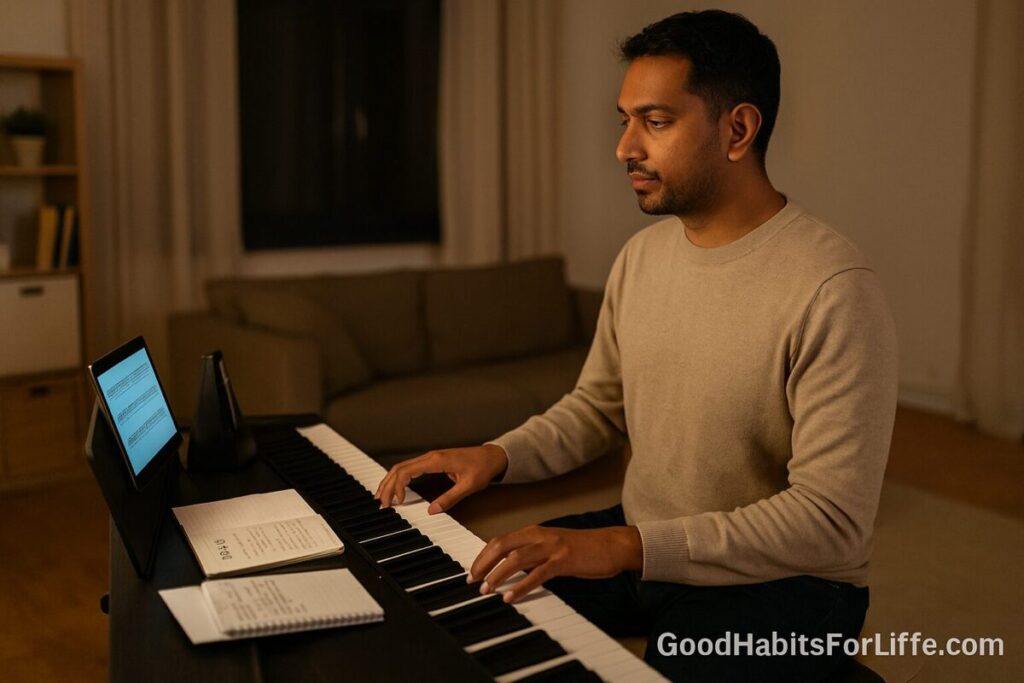
Learn an Instrument as an Adult: 100 Hours to Competent
Learn an Instrument as an Adult: 100 Hours to Competent
Table of Contents
🧭 What & Why
Definition (our standard): “Competent” means you can keep time, play several full pieces cleanly at moderate tempo, read basic notation or tabs, and self-correct common errors. That’s not “advanced,” but it’s genuine, usable skill.
Why adults absolutely can learn: Adult brains remain plastic—training changes neural connections throughout life. Musical training, specifically, engages multi-sensory and motor networks and can drive structural and functional adaptations. PMC+1
The science advantage: Two practice principles have unusually strong evidence:
-
Spacing (distributed practice)—short, frequent sessions beat long, crammed ones for durable learning. PMC
-
Interleaving (mixing pieces/skills)—often slows short-term performance but strengthens later retention and transfer (with some domain nuances). PMC+1
Sleep helps skills stick: Overnight consolidation supports motor learning; consistent 7–9 hours boosts retention of newly learned fingerings and rhythms. ScienceDirect+1
Health & longevity bonus: In older adults, music engagement is associated with cognitive and well-being benefits; research is growing but promising. National Institute on Aging+1
✅ Quick Start (Do This Today)
-
Pick your lane: choose one instrument and one initial style (e.g., acoustic guitar + folk strumming, piano + pop chords).
-
Book your week: schedule 5×25-minute practice blocks (or 4×30). Add 1 optional longer weekend session for review. (Spacing > cramming.) PMC
-
Set up posture & ergonomics: bench/chair height, strap/stool, instrument size, neutral spine, wrists in mid-range. Take a 2–3 min break every 10–15 minutes. kennesaw.edu
-
Install basics: metronome, tuner, and a notes-or-tabs app. Create a simple practice log (paper or app).
-
First reps:
-
Warm-up: 3–5 min of slow, relaxed motion.
-
Technique: 10–12 min (e.g., chord changes, scales, breathing/embouchure).
-
Music: 8–10 min on one short piece plus 2–3 minutes of something different (interleave). PMC
-
-
Sleep & repeat: aim 7–9 h; note what “sticks” the next day. ScienceDirect
🛠️ The 100-Hour Roadmap (Milestones & Checkpoints)
Big idea: Calendar the hours. Put milestones on hours, not months. Most adults hit “competent” between 80 and 120 focused hours; prior experience and instrument choice matter.
0–10 hours: Setup & Control
-
Gear fit, posture, hand position, breath/bow/pick control.
-
Learn to count aloud and keep steady time with a metronome at slow tempos.
-
First two micro-pieces or riffs end-to-end (even if very slow).
Checkpoint: 60–90 seconds of clean playing without pausing; no pain/tension.
10–30 hours: Foundations
-
Core vocabulary: 4–8 chords (guitar/ukulele), 5-finger patterns (piano), or beginner embouchure/long tones (winds).
-
Begin interleaving: rotate songs/exercises every 3–5 minutes within a session. PMC
-
Start sight-reading basics (or tabs) + counting rhythms out loud.
Checkpoint: Two full pieces at slow tempo; can record yourself and self-correct.
30–60 hours: Real Repertoire
-
Add 2–3 songs at target tempo; introduce dynamics (loud/soft) and tone shaping.
-
Weekly “mini-performance” for a friend/camera.
-
1×/week longer review session; keep daily blocks short (spacing). PMC
Checkpoint: Four pieces you can play start-to-finish with steady time.
60–100 hours: Fluent, Not Fancy
-
Clean transitions, consistency at realistic tempos, light improvisation or fills.
-
Polishing: articulation, phrasing, confidence playing with a backing track.
-
If desired, add teacher coaching (even 1×/month) for feedback loops.
Competent = 6–8 pieces at target tempo, steady time with a click or backing track, and the ability to learn a new easy piece in under 2 hours.
🧠 Techniques & Frameworks That Work (Backed by Research)
1) Space it out.
-
Swap “marathons” for frequent 20–30 min blocks. Plan a weekly review session that revisits old material. Spacing builds durable memory. PMC
2) Interleave smartly.
-
Alternate skills/pieces within one session (e.g., 3–5 minutes each). Expect practice to feel harder; that’s normal and predicts better retention. Note: benefits are strongest in lab-style tasks and vary in real-world sports/music—use a hybrid: start blocked, then interleave. PMC+1
3) Sleep on it.
-
Skill improvements often “bloom” after sleep; protect your nights and avoid late-night doomscrolling post-practice. ScienceDirect
4) Deliberate practice loops.
-
Plan → Attempt → Record → Diagnose → Target one error → Retry. Deliberate practice explains meaningful—but not all—performance differences, so be patient. PubMed
5) Slow + correct > fast + sloppy.
-
Use a metronome. If errors repeat twice, slow down 10–20%, fix, then re-accelerate.
6) Chunking.
-
Break pieces into 1–4 bar chunks; perfect each chunk, then link chunks.
7) Motivation engineering.
-
Implementation intentions (“At 7:30 pm, after dinner, I will practice 25 minutes in the study.”) raise follow-through. ScienceDirect
-
Temptation bundling (podcast you love only during practice/setup) helps habits stick. PMC
8) Injury-proofing habits.
-
Neutral posture, micro-breaks, gentle warm-ups, and gradual load reduce risk of playing-related musculoskeletal problems. If it hurts, stop and adjust. kennesaw.edu
👥 Audience Variations
Students/Teens
-
Keep blocks short (15–20 min). Gamify streaks; rotate pieces frequently (interleave).
Busy Professionals
-
Anchor two weekday mornings + two evenings; one weekend review block. Pre-set gear (stand, tuner, metronome ready) to lower friction.
Parents
-
Practice alongside kids: you on chords, child on melody; 10-minute duet windows.
Seniors
-
Emphasize posture, lighter strings/reeds, and frequent micro-breaks. Music engagement shows cognitive/well-being promise; choose comfortable tempos and repertoire you love. National Institute on Aging
⚠️ Mistakes & Myths to Avoid
-
“I’m too old.” Not true—adult neuroplasticity is real, and training changes the brain. PMC
-
“Only long sessions count.” Spaced, shorter sessions win for retention. PMC
-
“Just repeat the same piece for an hour.” Mix (interleave) to improve later performance. PMC
-
“It’s all talent.” Deliberate practice matters, but it’s not the whole story—progress varies by domain and person. PubMed
-
“No pain, no gain.” Discomfort is a red flag in music practice; adjust setup and take breaks. kennesaw.edu
🗣️ Real-Life Examples & Scripts
Daily 25-minute practice template
-
3 min warm-up (slow scales/long tones)
-
10 min technique focus (one skill)
-
8 min repertoire (today’s piece)
-
4 min interleaved contrast (different key/rhythm)
-
Notes: 1 win, 1 fix for tomorrow
Teacher outreach email
Subject: Adult Beginner—Monthly Check-In Lessons
Hi [Name], I’m an adult beginner on [instrument]. I practice ~2 hours/week and follow a 100-hour plan. Could we do a 45-minute check-in lesson every 3–4 weeks to review posture, repertoire, and a few technical goals? Thanks!
Temptation bundling:
“I only listen to my favorite podcast while setting up, tuning, and logging practice.” PMC
Implementation intention:
“At 7:30 pm on Mon/Wed/Fri, after clearing dinner, I’ll practice 25 minutes at the desk with the metronome.” ScienceDirect
🧰 Tools, Apps & Resources (quick pros/cons)
-
Metronome (any free app): essential for timing; dead simple; no downside.
-
Tuner (guitar/strings/winds): keeps you honest; auto-detect saves time.
-
Notation/Tabs apps (e.g., MuseScore/Ultimate Guitar): huge libraries; watch for user-submitted accuracy.
-
Beginner courses (e.g., JustinGuitar, Piano Marvel, Yousician, Simply Piano): structured paths; pair with live/occasional teacher feedback for posture and efficiency.
-
Backing tracks (YouTube/Spotify): improves timing and musicality; ensure keys/tempos match your level.
-
Recording (phone/voice memo): instant feedback; review weekly to spot patterns.
📌 Key Takeaways
-
You can reach competent, real-world playing in about 100 focused hours—if you space sessions, interleave content, and sleep. PMC+2PMC+2
-
Follow the 0–10–30–60–100h roadmap to pace skill growth.
-
Protect your body: posture, micro-breaks, gradual load. kennesaw.edu
-
Use motivation tech: implementation intentions + temptation bundling. ScienceDirect+1
-
Keep it fun: repertoire you love + tiny, daily wins.
❓ FAQs
1) Which instrument is “easiest” for adults?
Ukulele and keyboard have quick early wins (fewer physical demands, fast chord shapes/visual layout). But the “easiest” instrument is the one you’re excited to play consistently.
2) How many days a week should I practice?
Aim for 4–6 short sessions (20–30 min). Spaced, frequent practice beats one long weekend block. PMC
3) Can I learn without a teacher?
Yes—pair structured apps/videos with periodic teacher check-ins (monthly) for posture/technique corrections that DIY often misses.
4) I feel worse when I mix pieces. Should I go back to repeating one?
Feeling slower during interleaving is normal; the benefit shows up later in retention/transfer. Use a hybrid: start blocked to get basics, then interleave. PMC+1
5) How much should I increase tempo?
When you can play 3 clean reps in a row, raise the metronome by 5–10 bpm. If errors recur, drop tempo and rebuild.
6) My hands/shoulders ache—what now?
Stop, shake out, and check posture/height/strap. Resume with a slower tempo and shorter blocks; if pain persists, consult a clinician or teacher experienced with performing-arts ergonomics. kennesaw.edu
7) Does sleep really matter for practice?
Yes. Sleep supports consolidation of motor skills; you’ll often play cleaner after a good night’s rest. ScienceDirect
8) Do I need music theory?
A little goes far: counting, key signatures, and chord basics improve learning speed and communication with teachers/bandmates.
📚 References
-
Cepeda NJ et al. Spacing effects in learning: a temporal ridgeline of optimal retention. PNAS (2008). PubMed
-
Smith CD & Scarf DJ. Spacing repetitions over long timescales: A review and critique. Psychon Bull Rev (2017). PMC
-
Czyż SH et al. High contextual interference improves retention in motor learning: systematic review and meta-analysis. Sports Med Open (2024). PMC
-
Ammar A et al. The myth of contextual interference learning benefit in sports practice: a systematic review & meta-analysis. Physiotherapy in Sport (2023). ScienceDirect
-
Conessa A et al. Sleep-related motor skill consolidation and generalizability. iScience (2023). ScienceDirect
-
Walker MP. Sleep and the time course of motor skill learning. Behav Brain Res (2003). PMC
-
Macnamara BN et al. Deliberate practice and performance… a meta-analysis. Psychological Science (2014). SAGE Journals
-
Olszewska AM et al. How musical training shapes the adult brain. Frontiers in Neuroscience (2021). Frontiers
-
NIA. Cognitive Health and Older Adults. Updated 2024 (arts engagement section). National Institute on Aging
-
StatPearls. Neuroplasticity (2023 update). NCBI
-
Kennesaw State Univ. Health & Safety Guidelines for Musicians (PDF). kennesaw.edu
-
Ohlendorf D et al. Fit to play: posture and seating position analysis… Work (2017). PMC
-
Gollwitzer PM & Sheeran P. Implementation intentions and goal achievement: a meta-analysis. Adv Exp Soc Psychol (2006). ScienceDirect
-
Milkman KL et al. Temptation bundling field experiment. Management Science (2014). PubMed
Disclaimer: This guide is educational and not a substitute for individualized medical advice; stop practice if you feel pain and consult a qualified professional.