
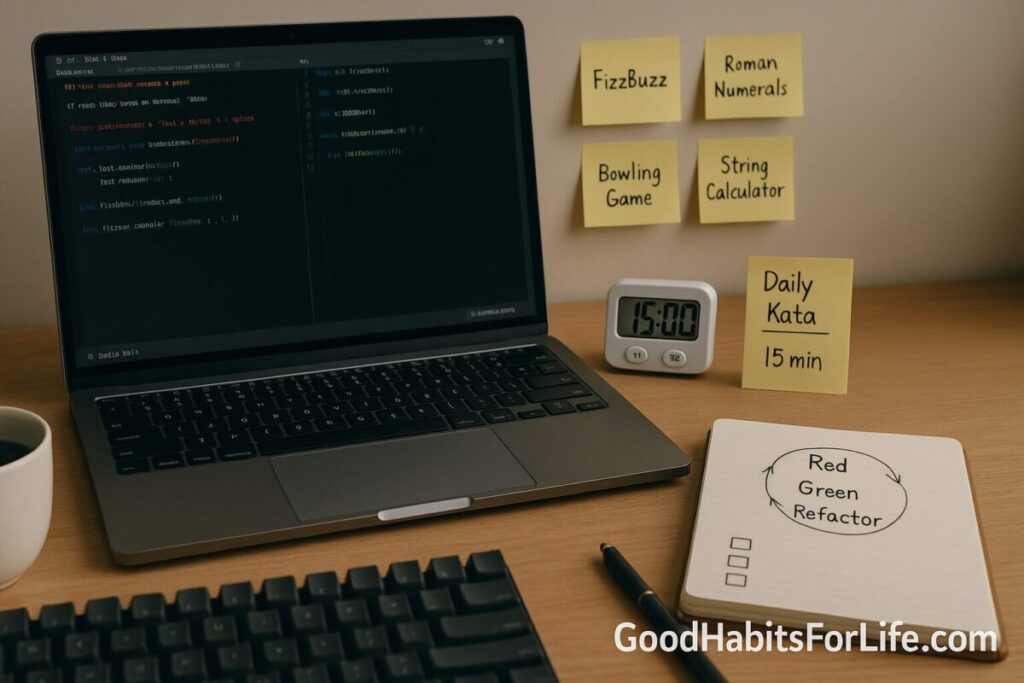
Coding Katas: 15 Minutes a Day (2025)
Coding Katas: 15 Minutes a Day (2025)
Table of Contents
🧭 What & Why
Coding katas are small, repeatable programming exercises you solve deliberately—often from scratch—so core skills become automatic. Think scales for musicians or drills for athletes.
Why 15 minutes?
-
Deliberate practice drives expertise: focused, feedback-rich reps on specific weaknesses—not mindless repetition.
-
Spacing & retrieval beat cramming: short, frequent sessions that force you to recall and re-apply skills strengthen memory and transfer.
-
Interleaving (mixing problem types) improves adaptability, helping you recognize patterns when problems change.
-
Test-First (TDD) gives tight feedback loops, shaping design and preventing regressions.
Benefits you’ll feel within weeks
-
Faster problem recognition and cleaner first drafts.
-
Less “blank-screen” anxiety—your hands know the next step.
-
Stronger debugging instincts; fewer off-by-one and edge-case misses.
-
Better naming, factoring, and habitually writing tests.
✅ Quick Start (Do This Today)
Timebox: 15 minutes. Goal: One kata from scratch with tests.
-
Pick one tiny kata: e.g., FizzBuzz, Reverse String, Roman Numerals, Leap Year, Palindrome, Two Sum.
-
Set a 10 + 5 timer: 10 min to pass baseline tests; 5 min to refactor.
-
Red → Green → Refactor:
-
Red: write a failing test (e.g.,
leap(2000) → true,leap(1900) → false). -
Green: write the minimal code to pass.
-
Refactor: tidy names, extract methods, remove duplication.
-
-
Capture one insight: 1–2 lines in a log (what tripped you up, what you’ll try tomorrow).
-
Commit:
feat(kata): leap year in 10m; edge cases noted.
Definition of done (daily):
-
All tests pass locally.
-
One concrete insight recorded.
-
Code committed (or snippet archived).
🛠️ The 30-60-90 Day Habit Plan
Days 1–30: Syntax & Flow Fluency
Focus: Simple logic, strings, arrays, arithmetic, conditionals, loops.
Repertoire: FizzBuzz, Reverse String, Palindrome, Anagram Check, Word Count, Balanced Parentheses, Caesar Cipher, Two Sum.
Cadence: 5 days/week × 15 min.
Metric: Time-to-green (minutes to first passing test) and test coverage for happy path + 2 edge cases.
Checkpoint (Day 30): You can implement 6–8 katas quickly without searching.
Days 31–60: Data Structures & Tests that Teach
Focus: Sets/maps, stacks/queues, basic recursion, simple parsing.
Repertoire: Roman Numerals, Prime Factors, Run-Length Encoding, Bracket Matcher, LRU Cache (toy), Binary Search, String Calculator.
Add: Property-based tests (e.g., QuickCheck/Hedgehog/FsCheck) for invariants.
Metric: Refactor density (meaningful rename/extract per session) + fewer asserts to cover more via properties.
Checkpoint (Day 60): You recognize smells (duplication, long functions) and refactor confidently within the 5-minute window.
Days 61–90: Design Habits & Transfer
Focus: Decomposition, seams for testability, small OO/FP design decisions.
Repertoire: Bowling Game, Mars Rover, Gilded Rose refactor, Tic-Tac-Toe AI (minimax-lite), Command Parser.
Add: Interleave 2–3 katas per week; repeat “from memory” without looking.
Metric: Bug-free first run rate + cyclomatic complexity trending down.
Checkpoint (Day 90): You can explain trade-offs (data structure choices, naming, boundaries) and your default design is cleaner.
🧠 Techniques & Frameworks That Work
1) Deliberate Practice Loop (5 Steps)
-
Isolate a micro-skill (e.g., edge-case thinking for date math).
-
Design tests that surface the weakness.
-
Timebox (10 + 5).
-
Immediate feedback (asserts + property tests).
-
Reflection (1–2 lines in your log + plan for tomorrow).
2) Retrieval Practice
-
Re-implement from memory without reading yesterday’s code.
-
Hide hints; rely on tests you can recall or quickly rewrite.
3) Spacing & Interleaving
-
Don’t grind the same kata for a week. Rotate topics: strings → maps → parsing.
-
Revisit a solved kata after 2–3 days, then a week, then two.
4) TDD Micro-Cycle
-
Red: start with a concrete example.
-
Green: the laziest code that passes.
-
Refactor: rename, extract, remove duplication, re-run tests.
5) Property-Based Testing
-
Define invariants (e.g., encode→decode returns original).
-
Let the framework generate random cases—great for off-by-one and Unicode gremlins.
6) Cognitive Load Management
-
Keep environments boring and fast: a template repo, a single
run testscommand, and known shortcuts. -
Track WIP limits: one kata per session.
7) Performance & Design Nudges
-
After green, ask: “Can this run in O(n)?” “Can I name this intent better?”
-
Add one more edge case (empty input, Unicode, large numbers) before you stop.
👥 Audience Variations
Students/Bootcampers
-
Use katas to cement lecture topics the same day.
-
Weekly: pick one “oral kata”—explain your approach aloud in 90 seconds.
Professionals (Time-poor)
-
Do “coffee katas” before opening email/Slack.
-
Target your weak stack (e.g., regexes, SQL string manipulation, JSON parsing).
Seniors/Leads
-
Mentor with pair-katas: you drive tests, the junior writes code.
-
Use Gilded Rose or Mars Rover to discuss design boundaries.
Teachers/Coaches
-
Ladder tasks (3 tiers): baseline, stretch, twist.
-
Assess via time-to-green, edge-case coverage, and explanation clarity.
⚠️ Mistakes & Myths to Avoid
-
Myth: “Hours > outcomes.”
Reality: Distributed 15-minute reps outperform marathon sessions for retention and transfer. -
Mistake: Copy-pasting yesterday’s solution.
Fix: Hide past code; force retrieval. -
Mistake: Endless refactor with no tests.
Fix: Timebox; stop at the bell. -
Myth: “TDD is slower.”
Reality: For small problems, TDD speeds you up by preventing rework and clarifying intent. -
Mistake: Never rotating topics.
Fix: Interleave: 2–3 different kata families each week.
💬 Real-Life Examples & Scripts
Daily Script (15 minutes)
-
“Starting: Balanced Parentheses in Python. Timer 10 + 5. First test for
'' → true, then'(' → false'. After green, refactoris_openhelper. Log: missed empty case last time—passed today. Commit.”
Commit Message Templates
-
feat(kata): roman numerals baseline in 9m; added subtractive cases -
test(kata): property ensures encode/decode round-trip -
refactor(kata): extract scoring calc; reduced branch count
Pair-Kata Prompt
-
“I’ll write tests for happy path + two edges. You code to green. We swap for refactor.”
Self-Coaching Questions
-
“What one smell did I remove?”
-
“Did I name the intent, not the mechanism?”
-
“What edge case would break in production?”
🧰 Tools, Apps & Resources
Editors & Runners
-
VS Code / JetBrains IDEs: fast test runners, refactor tools. Pros: speed; Cons: setup variance.
-
Replit / GitHub Codespaces: zero-install. Pros: quick start; Cons: cold starts.
Test Frameworks (by language)
-
Python:
pytest,hypothesis(property-based) -
JavaScript/TypeScript:
vitest/jest,fast-check -
Java/Kotlin:
JUnit5,kotest -
C#:
xUnit,FsCheck -
Go:
testing,gopter -
Rust: built-in tests,
proptest
Practice Platforms
-
Local template repo with
make testornpm testfor instant feedback. -
Problem lists: classic katas (Roman Numerals, Bowling, Gilded Rose), plus your domain-specific tasks (e.g., parsing logs, currency formatting).
Tracking & Spaced Reps
-
Markdown log or Obsidian note (date, kata, time-to-green, one insight).
-
Anki card for each kata’s invariants or tricky edges.
📌 Key Takeaways
-
Consistency beats intensity. Fifteen focused minutes most days wins.
-
Tests are your coach. Start red, finish green, tidy deliberately.
-
Space and mix. Revisit problems on a schedule; rotate types.
-
Measure what matters. Track time-to-green, edge-case coverage, and refactor moves.
-
Reflect fast. One written insight per session compounds learning.
❓ FAQs
1) Are katas just for interview prep?
No. They build core fluency (naming, factoring, edge-case thinking) that transfers to everyday feature work and bug-fixing.
2) Which language should I use?
Use your daily-driver at work/school. Every 2–3 weeks, try one kata in a second language to broaden patterns.
3) How do I avoid memorizing a single solution?
Use retrieval (start from blank), vary inputs/constraints, and interleave different kata families each week.
4) Is 15 minutes really enough?
Yes—when timeboxed and focused. Spaced, repeated retrieval outperforms occasional long sessions for retention and transfer.
5) Should I always use TDD?
For small katas, yes—it accelerates feedback and designs for testability. For exploratory spikes, sketch first, then add tests.
6) What should I measure?
Time-to-green, number of meaningful refactors, failing properties found, and how often you needed to look things up.
7) How do I pick katas?
Rotate across difficulty and topic: strings/maps (easy), parsing/recursion (medium), design/refactoring katas (harder).
8) How do I stay motivated?
Keep a visible streak counter, pair once a week, and publish tiny write-ups. Celebrate reduced time-to-green, not just solved counts.
📚 References
-
Dunlosky, J., Rawson, K. A., Marsh, E. J., Nathan, M. J., & Willingham, D. T. (2013). Improving Students’ Learning with Effective Learning Techniques. Psychological Science in the Public Interest. https://doi.org/10.1177/1529100612453266
-
Cepeda, N. J., Pashler, H., Vul, E., Wixted, J. T., & Rohrer, D. (2006). Distributed practice in verbal recall tasks: A review and quantitative synthesis. Psychonomic Bulletin & Review. https://doi.org/10.3758/BF03193961
-
Roediger, H. L., & Karpicke, J. D. (2006). Test-Enhanced Learning: Taking Memory Tests Improves Long-Term Retention. Psychological Science. https://doi.org/10.1111/j.1467-9280.2006.01693.x
-
Taylor, K., & Rohrer, D. (2010). The Effects of Interleaved Practice. Applied Cognitive Psychology. https://doi.org/10.1002/acp.1598
-
Bjork, R. A., & Bjork, E. L. (2011). Making Things Hard on Yourself, But in a Good Way: Creating Desirable Difficulties to Enhance Learning. Psychology and the Real World (APS). https://bjorklab.psych.ucla.edu/wp-content/uploads/sites/13/2016/07/Bjork_EL_Bjork_RA_2011.pdf
-
Sweller, J., Ayres, P., & Kalyuga, S. (2011). Cognitive Load Theory. Springer. https://doi.org/10.1007/978-1-4419-8126-4
-
Wood, W., & Neal, D. T. (2007). A New Look at Habits and the Habit–Goal Interface. Psychological Review. https://doi.org/10.1037/0033-295X.114.4.843
-
Ericsson, K. A., Krampe, R. T., & Tesch-Römer, C. (1993). The Role of Deliberate Practice in the Acquisition of Expert Performance. Psychological Review. https://doi.org/10.1037/0033-295X.100.3.363
-
Freeman, S., et al. (2014). Active learning increases student performance in science, engineering, and mathematics. PNAS. https://doi.org/10.1073/pnas.1319030111
-
Brown, P. C., Roediger, H. L., & McDaniel, M. A. (2014). Make It Stick: The Science of Successful Learning. Harvard University Press. https://www.hup.harvard.edu/books/9780674729018