
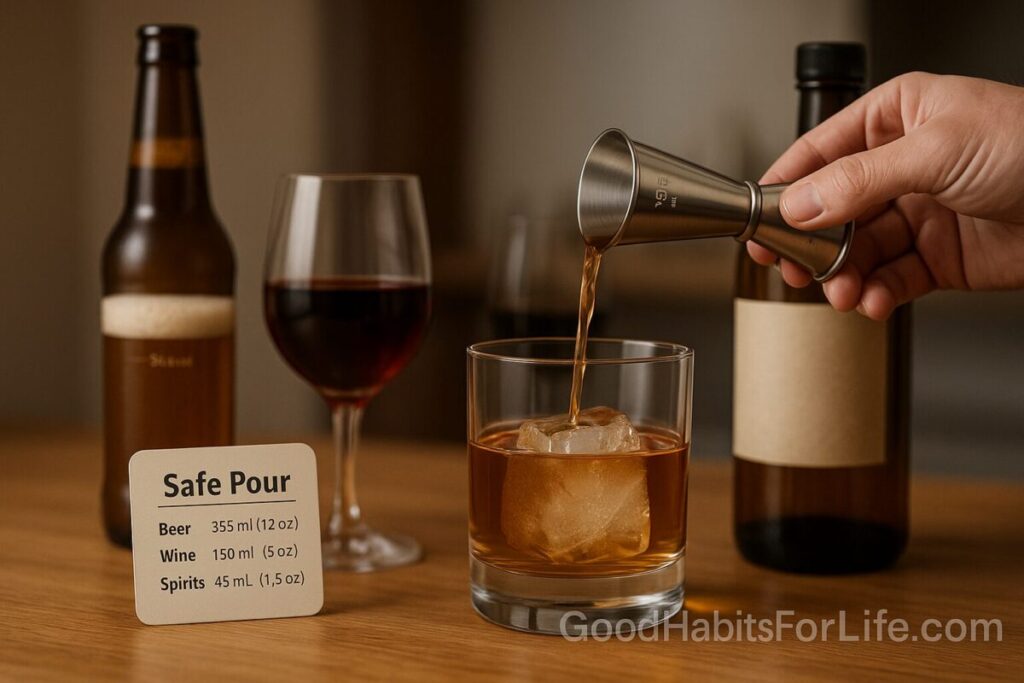
Home Bar, Safe Pour: Jiggers, Glassware, and Cues
Home Bar, Safe Pour: Jiggers, Glassware, and Cues
Table of Contents
🧭 What is a “safe pour” at home?
A “safe pour” means serving yourself a standard drink—the reference amount used in guidelines and on health calculators—so you can pace and track intake accurately.
Typical standard-drink equivalents:
-
Beer (5% ABV): 355 ml (12 fl oz)
-
Wine (12% ABV): 150 ml (5 fl oz)
-
Distilled spirits, 40% ABV (80-proof): 45 ml (1.5 fl oz)
These servings each contain roughly the same amount of pure alcohol (about 14 g in the U.S. definition). CDCRethinking DrinkingNIAAA+1
Important context: Countries express alcohol equivalence differently (e.g., the UK uses “units,” where 1 unit = 10 ml or 8 g of pure alcohol). That framing helps with pacing: as a rough rule of thumb, the average adult metabolizes ≈1 unit/hour, though this varies by person. nhs.uk
Guidance also varies internationally. For example, U.S. Dietary Guidelines advise, if you choose to drink, up to 2 drinks/day for men and 1 for women (on days alcohol is consumed), while Australia recommends no more than 10 standard drinks/week and 4 in any one day. Canada’s 2023 guidance characterizes ≤2 drinks/week as low risk and risk rising with each additional drink. All agree that less is better for health. NIAAAASPHNnhmrc.gov.au+1ccsa.ca
Finally, global health agencies emphasize that there is no completely “safe” level for health, so measurement is about informed choice and harm reduction, not a promise of zero risk. World Health Organization
✅ Why jiggers & glassware matter
Free-pouring at home tends to creep larger over time, especially with short, wide glasses. A dual-sided jigger (30/60 ml, a.k.a. 1/2–1 oz or 1–2 oz) instantly standardizes your pour and keeps cocktails balanced.
Glassware geometry nudges behavior:
-
Wine: Tall, narrower bowls make 150 ml look substantial; consider an etched/marked line on the inside.
-
Beer: Use 355 ml glasses (or cans) for regular lagers/ales; check ABV on craft beers, which may be stronger.
-
Spirits: A small rocks glass discourages heavy top-ups; pour 45 ml over a large cube to slow sipping.
Cues (visual reminders) reduce autopilot refills: coasters printed with your limit, a pacing timer, a water carafe within arm’s reach, and placing non-alcoholic options at eye level.
🛠️ Quick start: your mindful home-bar setup (15 minutes)
-
Pick a jigger: Dual-sided 30/60 ml with inside marks (15 ml and 45 ml) covers most recipes.
-
Standardize glasses:
-
Wine: set a 150 ml discreet line.
-
Beer: use 355 ml glassware or single-serve bottles/cans.
-
Spirits: choose a ~240–300 ml rocks glass to avoid “big glass = big pour.”
-
-
Create a pour station: Jigger, bar spoon (~5 ml), and a small tray; keep the bottle away from the glass to avoid over-top-ups.
-
Set pace tools: Phone 60-minute reminder, a hydration glass (200–250 ml water) to alternate between drinks, and a hard stop alarm.
-
Pre-commit: Decide how many standard drinks you’ll have before opening anything; write it on a sticky or coaster.
-
Track effortlessly: Tally marks on a coaster, a note in your phone, or an app (see Tools).
📏 Standard pour chart (ml & fl oz)
| Drink/ABV (typical) | Standard-drink pour | Notes |
|---|---|---|
| Beer 5% | 355 ml (12 fl oz) | Check craft labels—higher ABV = more than one standard drink per can. Rethinking Drinking |
| Wine 12% | 150 ml (5 fl oz) | Fortified wines (e.g., sherry/port) are smaller pours (≈90–120 ml). NIAAAmcw.edu |
| Spirits 40% | 45 ml (1.5 fl oz) | Use a jigger; large ice slows sipping without changing ethanol content. NIAAA |
| UK “unit” reference | 1 unit = 10 ml/8 g ethanol | ≈ 25 ml of 40% spirits, 76 ml wine @ 13% ABV. Pace ≈1 unit/hour (varies). nhs.uk |
Tip: When ABV is higher than typical (e.g., 7–9% IPAs, 14–15% wines), reduce pour volume to keep the same alcohol amount.
🗓️ 30-60-90 Day Habit Plan
Days 1–30 — Calibrate & measure
-
Always use the jigger for spirits and measured glasses for wine/beer.
-
Pace rule: One standard drink, then one glass of water, then decide.
-
Two “alcohol-free evenings” per week; note sleep/energy the next day.
-
Log 3 things: number of standard drinks, pacing, and how you felt.
Days 31–60 — Optimize & space
-
Shorten drinking window (e.g., 19:00–21:00).
-
Introduce a “first drink after food” rule.
-
Swap-outs: keep 2–3 zero-alcohol options cold.
-
Weekly review: If you exceeded your pre-commitment, what was the trigger?
Days 61–90 — Sustain & safeguard
-
Add a third alcohol-free day (or more).
-
Host smarter: set out water and small glasses first; pre-batched low-ABV punches with ladles/jiggers.
-
Scorecard: % nights you measured, % nights you paced, and any next-day regrets (aim for 0).
(Note: Guidance differs by country; if you choose to drink, less is better for health. Some groups should not drink at all—see Key Safety.) NIAAAWorld Health Organization
🧠 Techniques & frameworks that work
-
Implementation intentions: “If I pour wine, then I fill to the 150 ml line and set a 60-min timer.”
-
Visual management: Keep the jigger on the bottle with a band; store big-bowl glasses out of sight.
-
Pre-commit & tally: Declare “two-drink max tonight” and tick off standard drinks—not top-ups.
-
Slower sips: Larger ice cube; add a non-alcoholic mixer lengthened with soda.
-
Environment design: Put zero-alcohol options at eye level; put spirits lower.
-
Micro-rewards: After honoring your limit, end with a ritual tea or dessert.
👥 Audience variations
-
Students/young adults: Emphasize measuring before games/gatherings, food first, and a buddy who supports your limit.
-
Professionals: Set weeknight limits and “meeting-next-morning” rules.
-
Parents/caregivers: Prefer single-serve formats and lower-ABV choices; never drink if you might need to drive.
-
Seniors: Mind drug–alcohol interactions; consider lower-ABV or alcohol-free alternatives and discuss meds with a clinician.
⚠️ Mistakes & myths to avoid
-
“Wine glasses are supposed to be full.” Modern bowls are large; 150 ml is well below the rim.
-
“Free-pouring is fine; I can eyeball it.” Most people over-pour without a jigger.
-
“Hydrating means I can drink more.” Water supports pacing but doesn’t change alcohol dose.
-
“Guidelines are the same everywhere.” Definitions vary; check your country’s standards. nhs.ukNIAAAnhmrc.gov.auccsa.ca
-
“There’s a safe level for health.” Agencies emphasize no amount is risk-free; measuring simply helps you reduce risk. World Health Organization
-
“Pregnancy has a ‘safe’ amount.” No known safe amount, time, or type during pregnancy. CDC
🗣️ Real-life scripts & examples
-
Hosting friends: “I’ve put out jiggers and small glasses—help yourselves. Standard pours keep the cocktails tasty and light.”
-
Self-limit aloud: “I’m having two standard drinks tonight, then switching to sparkling water.”
-
Declining a top-up: “I’m pacing—finishing this and then water.”
-
Ordering takeaway: “Please include two 355 ml beers; we’re measuring tonight.”
-
After a big week: “I’m doing three alcohol-free evenings—sleep has been meh.”
🧰 Tools, apps & resources
-
Jiggers: Dual-sided 30/60 ml with inner marks (15 ml, 45 ml).
-
Measured glassware: Wine glasses with discreet 150 ml line; 355 ml beer glasses.
-
Timers & counters: Your phone reminders or a kitchen timer; any habit tracker app works.
-
Calculators: NIAAA Drink Size Calculator to sanity-check containers and ABV. Rethinking Drinking
-
Info hubs: NIAAA “Rethinking Drinking,” CDC alcohol basics, national guidelines (UK units, Australia, Canada). Rethinking DrinkingCDCnhs.uknhmrc.gov.auccsa.ca
📌 Key takeaways
-
Measure with a jigger or marked glass to hit standard-drink sizes.
-
Pace with water and time boundaries; remember metabolism ≈1 UK unit/hour varies by person. nhs.uk
-
Plan your limits before you pour; track what you actually drink.
-
Prefer lower-ABV or zero-alcohol options to cut risk.
-
Know when not to drink (e.g., pregnancy, driving, interacting meds/conditions). CDCNIAAA
❓ FAQs
1) Do I really need a jigger at home?
If you want consistent, standard pours (and better-tasting cocktails), yes. A 30/60 ml jigger removes guesswork and helps you track intake accurately.
2) What’s the difference between a standard drink and a UK unit?
A standard drink varies by country (often ~14 g of alcohol in the U.S.), while a UK unit is 10 ml (8 g) of pure alcohol. Both are bookkeeping tools—use whichever your local guidance uses. NIAAAnhs.uk
3) How do I pour wine accurately without a measuring cup?
Use wine glasses with a 150 ml line or test-pour water into your glass, marking the correct height with a tiny glass etch or a subtle sticker.
4) Are stronger craft beers “one drink”?
Not always. A 355 ml can at 7–9% ABV can contain >1 standard drink. Check labels and use calculators to estimate alcohol equivalents. Rethinking Drinking
5) What’s a sensible weekly limit?
Ranges differ: U.S. daily limits (men 2, women 1 on days you drink), Australia (≤10/week; ≤4/day), and Canada (≤2/week low risk, risk increases with each additional drink). Less is better everywhere. NIAAAnhmrc.gov.auccsa.ca
6) Is there a health-safe amount of alcohol?
Health agencies caution there’s no risk-free level; measuring helps you reduce harm and stay within your chosen limits. World Health Organization
7) Who should avoid alcohol entirely?
People who are pregnant or trying to conceive, taking certain medicines, have specific conditions, or need to drive/operate machinery should abstain. CDC
8) What about fortified wines or liqueurs?
Port/sherry are stronger, so standard pours are smaller (≈90–120 ml depending on ABV). Check the label and measure. mcw.edu
9) Can I “cancel” alcohol by drinking more water?
No—water helps with pacing and hydration, but it doesn’t reduce alcohol absorbed. Focus on measuring, pacing, and limits.
10) How fast does alcohol leave my system?
Roughly 1 UK unit/hour on average—varies by body size, sex, food, and genetics. Don’t use this to time activities like driving. nhs.uk
📚 References
-
Centers for Disease Control and Prevention. “About Standard Drink Sizes.” CDC
-
National Institute on Alcohol Abuse and Alcoholism. “What’s a Standard Drink?” and “What Is a Standard Drink?” Rethinking DrinkingNIAAA
-
NIAAA. “What Is a Standard Drink? (Poster).” NIAAA
-
NHS. “Calculating Alcohol Units.” nhs.uk
-
WHO/Europe. “No level of alcohol consumption is safe for our health.” World Health Organization
-
Dietary Guidelines for Americans 2020–2025 (HHS/USDA) + NIAAA summary. ASPHNNIAAA
-
National Health and Medical Research Council (Australia). “Alcohol guidelines.” nhmrc.gov.au
-
Canadian Centre on Substance Use and Addiction. “Canada’s Guidance on Alcohol and Health (Final Report).” ccsa.ca
-
NIAAA. “Alcohol Drink Size Calculator.” Rethinking Drinking
-
CDC. “About Alcohol Use During Pregnancy.” CDC
Disclaimer: This article is educational and not medical advice. If you have health conditions, take interacting medicines, are pregnant, or have concerns about alcohol use, consult a qualified clinician.