
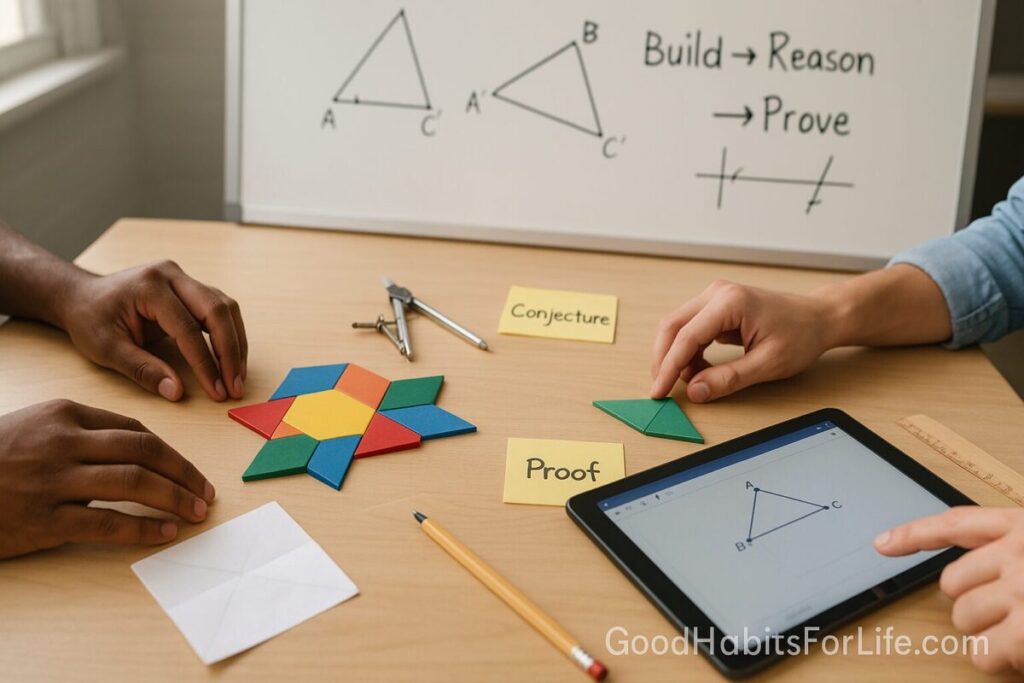
Math Proofs Made Tactile: Build Before You Prove
Math Proofs Made Tactile: Build Before You Prove
Table of Contents
🧭 What & Why
Idea: Make or simulate the object first—build the claim—then extract the pattern and write the proof. This taps embodied cognition and active learning, both shown to improve learning outcomes and narrow achievement gaps in STEM. PNAS+3ResearchGate+3Magic Lab+3
Why it works
-
Concrete → Abstract: Handling tiles, folding paper, or dragging points in dynamic geometry helps you see structure you’ll later name in a proof. This aligns with consensus research in How People Learn II. National Academies Press
-
Proof readiness: Students often rely on “proof schemes” (empirical, authoritative) before they adopt deductive proof. Tactile work nudges them toward genuine deduction. math.ucsd.edu
-
Spatial leverage: Training spatial reasoning transfers to STEM achievement; manipulatives and dynamic diagrams build those skills. groups.psych.northwestern.edu
-
Standards fit: Constructing viable arguments and critiquing reasoning (CCSS MP.3) is exactly the “build → reason → prove” arc. thecorestandards.org
✅ Quick Start (Do This Today)
-
Pick a claim you half-believe, e.g., “Sum of the first n odd numbers is n².”
-
Build it: Use unit tiles (or Polypad) to make 1×1, 2×2, 3×3 squares; notice each layer adds an odd number.
-
Record cases: n = 1,2,3,4… Capture snapshots or sketches.
-
Conjecture: State the pattern you see.
-
Stress test: Hunt counterexamples or edge cases (e.g., n=0, very large n).
-
Name the engine: Is this induction, an invariant, extremal principle, pigeonhole, or contrapositive?
-
Draft the proof: Translate the build into a short argument (structure first, then polish).
-
Critique: Swap with a peer (or future you) to check definitions, cases, and logical flow—MP.3 style. thecorestandards.org
🛠️ 7-Day “Build → Prove” Starter Plan
Goal: One solid proof by Day 7, built from tactile exploration.
-
Day 1 — Choose & Collect: Pick one theorem/puzzle. Gather manipulatives (tiles, string, graph paper) or open a dynamic tool (Polypad/Desmos/GeoGebra).
-
Day 2 — Build 3–5 Cases: Construct small instances; annotate what changes and what stays invariant.
-
Day 3 — Pattern & Precise Statement: Write the conjecture formally (quantifiers, variables, domain).
-
Day 4 — Pick a Proof Engine: Decide among induction, invariant, extremal, pigeonhole, or contrapositive. Write a skeleton.
-
Day 5 — Write the Proof: Fill details; ensure each claim is justified (definition, lemma, previous result).
-
Day 6 — Counterexample Hunt & Peer Review: Try to break it; revise.
-
Day 7 — Teach It: Explain using your build → generalize → prove story. Teaching exposes gaps.
(Pedagogical note: This sequence leverages productive struggle, which primes later instruction to stick.) Tandfonline+1
🧠 Techniques & Frameworks That Work
Build → Generalize → Prove (BGP loop)
-
Build: Construct small cases or a physical/digital model.
-
Generalize: Name the pattern with correct variables and quantifiers.
-
Prove: Choose the right engine and write a tight argument.
Polya’s 4 Steps (overlay on BGP)
-
Understand the problem
-
Devise a plan
-
Carry out the plan
-
Look back (try variants, generalize) Math UCR
Core Proof Engines (with tactile cues)
-
Induction: “Layer” the object (squares, staircases, rectangles).
-
Invariant / Monovariant: Colorings, parity, conserved totals (domino tilings, graph degrees).
-
Extremal Principle: Consider a smallest/largest configuration; show it leads to contradiction.
-
Pigeonhole Principle: Physical bins/cards make it obvious.
-
Contrapositive: Build counter-situations to show impossibility directly.
Reading & Checking Proofs
-
Use modular reading (high-level structure first), line-by-line only after. Draw your own auxiliary diagram; don’t just stare at the author’s. Mathematics Department+1
👥 Audience Variations
-
Students (secondary/early college): Spend more time building and labeling; insist on precise statements by Day 3.
-
Teachers/Parents: Start with tactile puzzles (tilings, parity games). Transition to formal language deliberately; cite definitions openly.
-
Professionals / Software Engineers: Map to loop invariants, pre/postconditions, and type invariants; try proving correctness of a tiny routine (e.g., Euclid’s algorithm) with a physical gcd model.
-
Seniors/Returning Learners: Favor large, high-contrast manipulatives or dynamic tools with zoom; prioritize explanation over notation density.
⚠️ Mistakes & Myths to Avoid
-
Myth: “Proof is only symbol pushing.”
Fix: Start with structure you can touch or move; then translate. National Academies Press -
Mistake: Jumping to induction before seeing the “added layer.”
-
Mistake: Skipping definitions (domain, quantifiers).
-
Myth: “Pictures aren’t rigorous.”
Fix: Pictures are evidence generators; rigor comes when you state assumptions and logic explicitly. -
Mistake: Reading a proof once and assuming you understand it. Practice proof comprehension strategies (paraphrase, re-diagram, identify dependencies). ERIC
💬 Real-Life Examples & Copy-Paste Scripts
Example 1 — Sum of first n odd numbers is n² (induction via squares)
Build: Make a 1×1 square (1), then surround it to make 2×2 (add 3), then 3×3 (add 5)… Each layer adds an odd count of tiles.
Formal Proof (sketch):
Base: n=1 → 1=1².
Inductive step: Assume 1+3+…+(2n−1)=n². Then add (2n+1) to get n²+(2n+1)=(n+1)². QED.
Script (teacher/self): “We built squares by layers. The layer at step n has 2n+1 tiles because it wraps around two sides plus one corner. That’s exactly the induction step.”
Example 2 — Mutilated Chessboard can’t be tiled by dominoes (invariant)
Build: Color a standard 8×8 board; remove two opposite corners (same color). Each domino covers one black and one white.
Invariant: #black − #white stays 0 for any perfect tiling; the mutilated board has imbalance 2 → impossible.
Example 3 — Handshake Lemma (graph degrees sum to an even number)
Build: Use sticks (edges) connecting people (vertices). Each stick contributes 2 to total degree.
Proof idea: Sum of degrees = 2|E| (even) → number of odd-degree vertices is even.
Example 4 — Contrapositive classic
Claim: If n² is even, then n is even.
Build: Pairing argument with counters: you can’t get an odd square from odd rows × odd columns without a leftover.
🧰 Tools, Apps & Resources (quick picks)
-
Polypad (Virtual Manipulatives): Tiles, algebra blocks, fraction bars, geometry, probability—shareable canvases. Pros: huge manipulative set, easy sharing. Con: needs internet sign-in for saving. (polypad.amplify.com) Polypad
-
Desmos Geometry: Construct, measure, transform; animate and connect to algebra. Pros: clean UI, integrates with Desmos Graphing. Con: geometry focus. (desmos.com/geometry) desmos.com+1
-
GeoGebra (Geometry/Graphing/3D): Dynamic geometry and CAS; great for loci, transformations, and 3D reasoning. Pros: rich toolset, offline apps. Con: steeper feature curve. (geogebra.org) GeoGebra+1
📚 Key Takeaways
-
Touch first, prove second: Tactile/dynamic exploration builds the mental model proofs need. ResearchGate
-
Cycle BGP + Polya: Build → Generalize → Prove; then reflect and vary. Math UCR
-
Pick the right engine: Induction, invariant, extremal, pigeonhole, contrapositive.
-
Proof comprehension is a skill: Read structurally, re-diagram, and validate each dependency. Mathematics Department
-
Active learning works—and helps more learners succeed. PNAS+1
❓ FAQs
1) Isn’t “tactile” just for young students?
No—tangible and dynamic models aid adults too by revealing structure and supporting transfer to abstractions. National Academies Press
2) How do I know when to stop building and start proving?
When you can state the conjecture precisely (variables, domain), identify a proof engine, and foresee how each step will be justified.
3) Are pictures “proofs”?
Pictures are evidence. A proof requires explicit assumptions and logical steps. Use the diagram to design those steps.
4) What if my build suggests a false pattern?
Great! That’s productive failure—use it to refine definitions or add hypotheses. Tandfonline
5) Which proof engine should I try first?
-
Layered growth → Induction
-
Color/parity/conservation → Invariant
-
“At least one repeats” → Pigeonhole
-
“If not A, then B impossible” → Contrapositive
-
Extreme/smallest case drives contradiction → Extremal
6) How do I read long proofs without getting lost?
Start with the modular structure (claims/lemmas, overall strategy), then drill down line-by-line and redraw a diagram for each dependency. Mathematics Department
7) Any standards tie-in for schools?
Yes—CCSS MP.3 (“construct viable arguments & critique reasoning”) directly maps to this approach. thecorestandards.org
References
-
Freeman, S. et al. (2014). Active learning increases student performance in science, engineering, and mathematics. PNAS. PNAS+2PubMed+2
-
Theobald, E. et al. (2020). Active learning narrows achievement gaps for underrepresented students in undergraduate STEM. PNAS. PNAS
-
Nathan, M. & Walkington, C. (2017). Grounded and embodied mathematical cognition: Promoting mathematical insight and proof using action and language. Cognitive Research: Principles and Implications. ResearchGate
-
National Academies of Sciences, Engineering, and Medicine. (2018). How People Learn II: Learners, Contexts, and Cultures. National Academies Press. National Academies Press
-
Harel, G. & Sowder, L. (1998). Students’ proof schemes: Results from exploratory studies. Research in Collegiate Mathematics Education. (UCSD pdf). mathweb.ucsd.edu+1
-
Uttal, D. et al. (2013). The malleability of spatial skills: A meta-analysis of training studies. Psychological Bulletin. groups.psych.northwestern.edu
-
Weber, K. & Mejía-Ramos, J. (2011). Why and how mathematicians read proofs: An exploratory study. Educational Studies in Mathematics (pdf). Mathematics Department
-
Common Core State Standards — Standards for Mathematical Practice (MP.3). corestandards.org. thecorestandards.org
-
Pólya, G. (1957). How to Solve It (2nd ed.). Princeton University Press (summary pdfs). Math UCR