
Listening-in-Noise Drills for Real Life
Listening-in-Noise Drills for Real Life
Table of Contents
🧭 What & Why
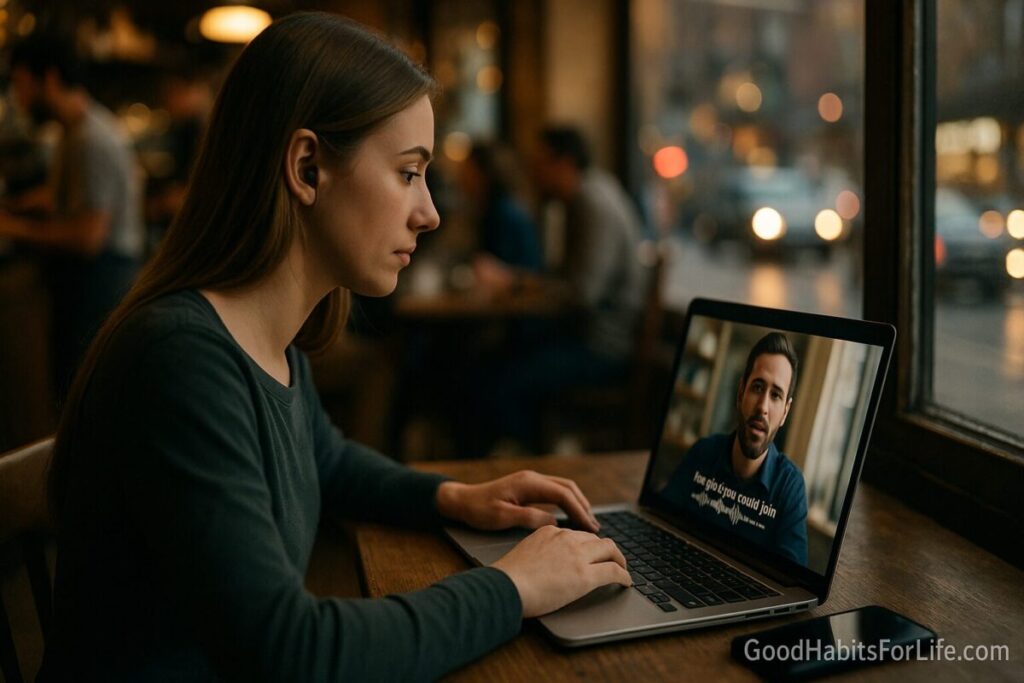
“Listening in noise” means understanding speech when background sound—fans, traffic, clattering plates, chatty offices—masks important speech cues. It’s a top pain-point in cafés, meetings, classrooms, and video calls. Drills that mimic these contexts improve everyday comprehension by training your attention, prediction, and cue-integration (audio + visual + context). Visual speech (seeing the talker’s face) measurably boosts intelligibility in noise, a finding repeated since classic work by Sumby & Pollack and in modern reviews. linguistics.berkeley.edu+1
Real-world acoustics also matter. In learning spaces, experts emphasize not just volume but SNR (how much louder the voice is than the noise) and reverberation (echo) control—both strongly linked to comprehension and effort. Classroom guidance commonly targets about +15 dB SNR with short reverberation. asha.org
Finally, structured auditory training can help speech-in-noise performance—though effects vary with method and generalization. Some studies show meaningful gains; others warn that not all computer drills transfer. Use evidence-aligned training and track outcomes. PubMed+2PMC+2
✅ Quick Start: a 10-Minute “Do-It-Today” Drill
Goal: practice understanding short speech at comfortable loudness while gradually lowering SNR.
-
Pick your material (2 min).
-
A 60–90 s clip: news, podcast, or dialogue.
-
Face the talker if live/video (bonus for lip cues). Visual information helps especially in noise. Frontiers
-
-
Add noise (1 min).
-
Play café/babble noise on a second device. Start easy (voice clearly louder than noise).
-
-
Three passes (6 min total).
-
Pass A (clean): No noise. Shadow key phrases aloud.
-
Pass B (easy noise): Listen once, jot keywords (3–5), confirm gist.
-
Pass C (harder noise): Lower SNR slightly; focus on faces, rhythm, and likely words from context.
-
-
Micro-measure (1 min).
-
Mark: accuracy (0–5), perceived effort (0–10), and one thing that helped (e.g., lip focus, predicting verbs).
-
Optional: check room noise with the free NIOSH Sound Level Meter (iOS). CDC
-
Repeat with new clips; increase difficulty slowly.
🗓️ 7-Day Starter Plan
Daily time: 10–15 min. Materials: short dialogues + a noise track (steady noise, café babble, traffic).
-
Day 1 – Baseline: Clean → easy noise. Track keywords captured and effort.
-
Day 2 – Visual Boost: Add video/face contact; compare accuracy vs audio-only. Visual cues typically increase intelligibility in noise. Frontiers
-
Day 3 – Masker Swap: Try steady noise vs multi-talker babble (harder). Note differences. PubMed
-
Day 4 – SNR Ladder: Start easy, then step down SNR in 2–3 stages within the same clip.
-
Day 5 – Spatial Trick: Put speech in front and noise to the side (earbuds or speaker placement) to exploit spatial release from masking. Frontiers
-
Day 6 – Rate Variation: 0.9× speed (clean), then 1.1× (with noise).
-
Day 7 – Recap & Screen: Re-do Day 1 clip at harder SNR. Optionally self-screen with hearWHO (digits-in-noise) to monitor hearing-in-noise status. World Health Organization
🚀 30–60–90 Roadmap (Level Up)
Outcome: lower your personal speech-in-noise threshold (need less SNR), reduce effort, and generalize to real contexts.
Days 1–30: Foundations
-
SNR Laddering (3×/week): 3 clips/session; drop SNR one notch each pass.
-
Masker Variety: rotate steady noise, babble, and traffic; babble challenges attention most. PubMed
-
Visual & Linguistic Cues: always face the talker; preview topic vocabulary for prediction.
-
Checkpoint: log accuracy/effort trend weekly; if effort spikes, ease SNR.
Days 31–60: Context Transfer
-
Live Practice: cafés, office kitchens, outdoor markets; ask for repetition using polite scripts (below).
-
Spatial Practice: place noise source 60–90° off-axis; compare performance vs co-located sources (expect improvement). PMC
-
Memory Support: 5-item keyword recall after each clip to train working-memory use under noise, a key component in the ELU model. PMC
Days 61–90: Challenge & Consolidate
-
Faster Speech & Accents: 1.1–1.25× speed; include unfamiliar accents (AV cues help). Frontiers
-
Longer Turns: 2–3 min clips; summarize back.
-
Re-screen: repeat hearWHO; compare notes, not just scores. World Health Organization
🛠️ Techniques & Frameworks
SNR Ladder (Core Framework)
-
Why: SNR (voice vs noise) predicts intelligibility better than “volume.”
-
How: Start where you understand ≥90%; step harder by 2–3 dB; end near 60–70% correct to stay trainable.
Masker Types (Make It Real)
-
Steady noise: Fans/AC—easier.
-
Multi-talker babble: Crowds—harder; taxes attention more. PubMed
Spatial Release from Masking
-
Separate talker and noise sources (or pan them L/R). Even simple angular separation improves understanding. Frontiers
Visual Speech & Context Prediction
-
Face the talker; use captions for preview then wean off. Visual cues reliably add intelligibility in noise and reduce effort. Frontiers
-
Activate topic schemas (who/where/what) to narrow vocabulary candidates—aligned with the ELU model of matching degraded input to memory with help from working memory. PMC
Room & Seating Hacks (Low-Tech Wins)
-
Sit closer (every doubling of distance drops speech ~6 dB); reduce echoes with soft surfaces; aim for short reverberation. Schools target about +15 dB SNR; the same logic helps homes/offices. asha.org
👥 Audience Variations
Students
-
Front-zone seating, face the board/talker.
-
Note-taking templates for gist/keywords.
-
Classrooms are often too noisy; standards emphasize SNR and reverberation because these drive comprehension and fatigue. asha.org
-
Noise hurts reading and vocabulary performance in adolescents—make SNR control a priority during study group work. PubMed
Professionals (Meetings, Hybrid Calls)
-
Mic discipline: one mic near the primary talker beats multiple distant mics.
-
Turn on cameras to regain AV cues; summarize decisions in chat; ask “last 10% louder” not “everything louder.”
Seniors
-
Short, frequent blocks to avoid fatigue.
-
Heavier reliance on visual cues; seat with good lighting. If conversation remains unusually difficult, get a hearing evaluation. Training helps some listeners, but not all programs generalize. PubMed+1
ESL Learners
-
Preview vocabulary, chunk by meaning, practice with slower speech first.
-
Expect more SNR sensitivity than native listeners; AV cues and clear speech help. asha.org
⚠️ Mistakes & Myths to Avoid
-
Myth: “Just turn it up.”
Reality: Loudness ≠ intelligibility. Improving SNR and reducing reverberation beats volume gains. asha.org -
Myth: “Any noise is good training.”
Reality: Masker type matters; babble stresses attention differently than steady noise—train both. PubMed -
Myth: “Only people with hearing loss need this.”
Reality: Noise hampers learning and comprehension even for typical-hearing listeners. AIP Publishing
💬 Real-Life Examples & Scripts
Café (order across the counter, blender running):
-
You: “Hi—could you please say the specials once more—slightly slower?”
-
If missed a key word: “Was that pesto or peppers on the sandwich?” (confirm just the missing item)
Open office (status update with chatter nearby):
-
You: “Can we take this 2 meters to the quiet area or face me while you say the numbers?” (uses spatial & visual cues)
Classroom/Training:
-
You: “Could we pause 10 seconds for notes and then recap the three key terms?” (adds structure, reduces load)
Doctor’s office ( masks, HVAC ):
-
You: “I understand better if I can see your face—could you face me while explaining the dosage? If possible, a quick written summary helps.” (uses visual + written redundancy)
🧰 Tools, Apps & Resources
-
hearWHO (WHO) — a digits-in-noise self-screening app that estimates your hearing-in-noise status; great for monitoring but not a clinical diagnosis. World Health Organization
-
NIOSH Sound Level Meter (iOS) — free, validated noise meter to check room levels (with tips for calibration and external mics). CDC+2CDC+2
-
Research-style Babble/Noise tracks — use multi-talker babble for harder drills; alternate with steady noise. PubMed
-
Room tweaks — soft furnishings, closer seating, and facing the talker (or camera) often beat “more volume.” asha.org
📌 Key Takeaways
-
Listening-in-noise improves with purposeful SNR progression, varied maskers, and visual + linguistic support.
-
Spatial separation of talker and noise is a free intelligibility boost. Frontiers
-
Classroom/meeting wins come from acoustic basics: seat placement, shorter reverberation, and +SNR—more than raw loudness. asha.org
-
Evidence shows some auditory training helps, but choose structured drills and track real-life transfer. PubMed+1
❓ FAQs
1) How long before I notice improvements?
Often within 2–4 weeks of short, consistent practice; expect quicker wins from visual and spatial tweaks, slower gains from pure auditory drills. Frontiers
2) Why does babble feel harder than steady noise?
Competing speech pulls attention and shares speech-like features with your target—harder masking than steady noise. PubMed
3) Does turning up the volume fix it?
Not reliably. If noise and echo rise too, intelligibility may barely improve. Manage SNR and reverberation first. asha.org
4) Are visual cues really that powerful?
Yes—seeing the talker’s face increases intelligibility and reduces effort, especially at challenging SNRs. Frontiers
5) Can these drills help older adults?
They can, especially with AV and spatial cues; however, results vary by listener and method, so consider a professional hearing evaluation too. PubMed
6) What’s a good target SNR?
Aim to improve SNR as much as possible; in classrooms, guidance often cites about +15 dB SNR with short reverberation—useful as a north star for other spaces. asha.org
7) Is there a quick self-check?
Try hearWHO (digits-in-noise). It’s not diagnostic but handy for tracking changes over time. World Health Organization
8) How do I measure noise around me?
Use the free NIOSH Sound Level Meter (iOS) to spot noisy hotspots and compare rooms. CDC
📚 References
-
ASHA. Classroom Acoustics (ANSI S12.60 guidance: SNR & reverberation in schools). asha.org
-
ASHA/Survey (Texas Architects). SNR of ≥ +15 dB; reverberation considerations; distance & speech level math. asha.org
-
WHO. World Report on Hearing (2021) & Make Listening Safe materials. PMC+1
-
NIDCD/NIH. Noise-Induced Hearing Loss overview (effects of loud sound exposure). NIDCD
-
Connolly et al., 2019. Effects of classroom noise on reading & vocabulary (adolescents). PubMed
-
Whitton et al., 2017 (Current Biology). Audiomotor perceptual training enhances speech intelligibility in noise. PubMed+1
-
Barlow et al., 2016. Short-term auditory training: small but significant SIN gains. PMC
-
Henshaw & Ferguson, 2013 (PLOS One). Systematic review: mixed evidence for computer-based training. PLOS
-
Pastore et al., 2017 (Frontiers in Psychology). Spatial release from masking with non-co-located sources. Frontiers
-
Rönnberg et al., 2013; 2019. ELU model: working memory & speech-in-noise understanding. PMC+1
-
WHO. hearWHO app (digits-in-noise) — Q&A & app pages. World Health Organization
-
CDC/NIOSH. Sound Level Meter App—overview & tech PDF. CDC+1
Disclaimer: This guide is educational, not medical advice. If you suspect hearing loss or persistent difficulty hearing in noise, consult a licensed audiologist.