
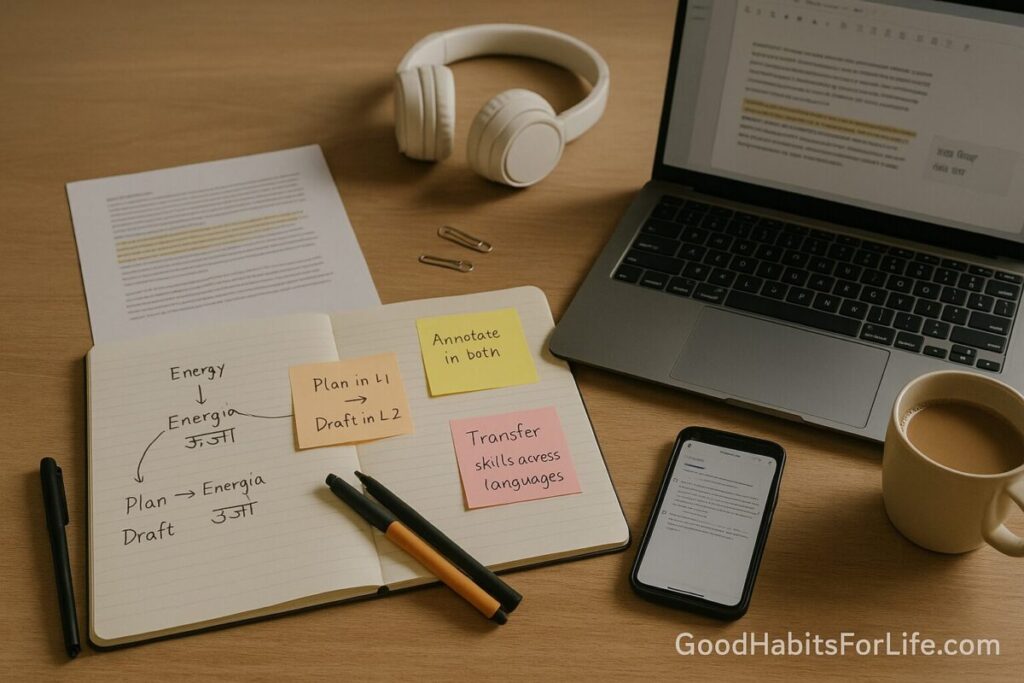
Translanguaging: Use All Your Languages to Learn One
Translanguaging: Use All Your Languages to Learn One
Table of Contents
🧭 What Is Translanguaging & Why It Works
Translanguaging is the deliberate use of your entire linguistic repertoire—across all the languages you know—to make sense of ideas and express them clearly. Instead of keeping languages in separate boxes, you flex them together: plan in your strongest language, draft in your target language, annotate in both, and shift fluidly as needed.
Why it works (evidence-backed):
-
Unitary repertoire view: Modern scholarship frames bilinguals as drawing from one integrated system, not two sealed codes—so using “all of it” can be cognitively efficient and more authentic for meaning-making.
-
Better learning outcomes: Multilingual/Mother-tongue-based education consistently shows gains in understanding content and developing later academic language.
-
Lower cognitive load: Using L1 strategically before or alongside L2 can reduce mental strain and improve both content learning and language acquisition.
-
Cross-language transfer: Skills and knowledge in one language can transfer to another—especially literacy, academic vocabulary, and conceptual understanding.
(See References: Li Wei, 2018; UNESCO, 2025; Roussel et al., 2022; Cummins, 2008/2017; CUNY-NYSIEB Guides; TESL-EJ systematic reviews.)
✅ Quick Start: Do This Today
-
Set a micro-goal (15–30 min).
Pick one concept (e.g., “photosynthesis” or “future perfect”). -
Prime in L1 (5 min).
Skim a short L1 explainer or watch a 2-minute L1 clip to load prior knowledge. -
Input in L2 (10–15 min).
Read/listen to an L2 resource on the same concept. Highlight unknown terms. -
Output toggle (5–10 min).
-
Option A: Retell aloud in L2, then write a 3-sentence L2 summary.
-
Option B: Draft a short answer in L1 → translate/condense to L2.
-
Option C: Make bilingual flashcards: L2 front → L1 gloss + example.
-
-
Reflect (2 min).
Note what switching moments helped: “L1 priming cut confusion on X.”
🛠️ 30-60-90 Habit Plan
Goal: Make translanguaging a default study workflow you can run on any topic.
Days 1–30: Build the Loop
-
Daily 20: L1 prime → L2 input → L2 output → quick L1 check.
-
Bilingual notebook: Two-column notes (left L2, right L1) or color-coded lines.
-
Routine triggers: Always preview in L1 for tough readings; always debrief in L2.
-
Checkpoint (Day 30): Can you explain a topic in L2 for 60–90 seconds without notes? If not, increase L1 priming and add back-translation once per topic.
Days 31–60: Strengthen Transfer
-
Upgrade output: Write 150–250-word L2 summaries; add L1 margin glosses only when stuck.
-
Contrast sets: Build mini-tables (term/definition/example in L2; concise L1 aid).
-
Teachback: Record a 2-minute L2 explanation; script in L1 if needed, perform in L2.
-
Checkpoint (Day 60): Track fewer look-ups and longer L2 stretches. Reduce L1 scaffolds where comprehension is solid.
Days 61–90: Automate & Specialize
-
Domain packs: Create topic-specific bilingual decks (e.g., business, biology, travel).
-
Genre shift: Practice L2 emails/reports; use L1 to plan reasoning, L2 to deliver.
-
Assessment: Take a short L2 quiz after an L1 preview vs. no preview; compare scores.
-
Checkpoint (Day 90): L2 output feels fluent; L1 support appears at tough junctures only.
🧠 Techniques & Frameworks That Work
1) L1-Prime → L2-Perform
-
Read a short L1 overview first to lower cognitive load, then do the main task in L2.
-
Use for lectures, dense readings, or problem-solving.
2) Back-Translation Sprints
-
Draft in L2 (100–150 words) → translate to L1 → hide originals → re-express in L2, tighter.
-
Builds lexical precision and error awareness.
3) Two-Column Bilingual Notes
-
Left: L2 key terms, quotes, formulas. Right: L1 paraphrase, mnemonics, quick examples.
-
Over time, shrink the L1 column to foster independence.
4) Contrastive Language Tables
-
Make side-by-side patterns: tense forms, preposition uses, word order.
-
Add one or two L1 cues where interference is common.
5) “L1 Plan, L2 Pitch”
-
Plan arguments, outlines, or solutions in L1; deliver the final version in L2 (oral or written).
-
Great for presentations and email.
6) Bilingual Retrieval Practice
-
Quiz yourself L2→L1 and L1→L2. Spaced repetition (SRS) with example sentences.
-
Use minimal L1 on review days to ensure genuine L2 recall.
7) Translanguaging Reading Circuit
-
L1 abstract → L2 article → L1 micro-summary (1–2 lines) → L2 paragraph response.
-
Keeps comprehension high while growing L2 output stamina.
8) STEM & Diagrams
-
Label diagrams in L2; write process steps in L1 if stuck; then convert steps to L2.
-
Especially helpful for technical vocabulary.
👥 Audience Variations
Students (school/uni):
-
Use L1 glosses for dense textbooks; attempt exercises in L2.
-
Study groups: Discuss tough steps in L1, present solutions in L2.
Professionals:
-
Draft proposals in L1 for clarity; client-facing versions in L2.
-
Maintain a bilingual termbase (L2 term → L1 definition + context sentence).
Parents with Multilingual Kids:
-
Encourage kids to explain science/homework in whichever language feels easiest, then retell key idea in the school language.
-
Read bilingual storybooks and have kids alternate narration language by page or section.
Seniors/Teens:
-
Teens: turn chats or captions into L2; add short L1 notes for idioms.
-
Seniors: use L1 subtitles to prime, then rewatch short L2 clips without subtitles.
⚠️ Mistakes & Myths to Avoid
-
Myth: “Using L1 will slow L2 progress.”
Reality: Strategic L1 use often accelerates L2 learning and content mastery, especially early on, by lowering cognitive load. -
Myth: “Translanguaging = random code-switching.”
Reality: It’s a planned pedagogy and a purposeful study workflow. -
Over-reliance on L1:
Use L1 to scaffold, not to replace L2 effort. Taper scaffolds as comprehension grows. -
No output in L2:
Always end a study block with L2 output (summary, flashcards, quick talk). -
One-size-fits-all:
Calibrate the L1/L2 mix to task difficulty and your proficiency level.
💬 Real-Life Examples & Scripts
Email (professional):
-
L1 plan (outline bullets): objective → key ask → deadline → thanks.
-
L2 send (final):
“Dear Dr. Chen, Following up on the Q3 dashboard draft, could we confirm the KPI definitions by Friday? I’ve attached the proposed glossary…”
Study group (STEM):
-
L1 huddle: “Let’s agree the three steps for the proof.”
-
L2 shareout: “Step one establishes continuity on [a,b] …”
Vocabulary building:
-
L2 term → L1 micro-definition + L2 example:
“Mitigate — कम करना — ‘These steps mitigate risk during onboarding.’”
Speaking warm-up (90 seconds):
-
L1 brainstorm (30s): 3 bullets.
-
L2 speak (60s): deliver without notes; record and self-review.
Back-translation mini-drill:
-
L2 draft (4 sentences) → L1 translation → L2 rewrite to tighten word choice.
🧰 Tools, Apps & Resources
-
Spaced Repetition: Anki, Memrise (bilingual cards; add L2 example sentences).
-
Reading Aids: ReadLang, LingQ (import texts; hover L1 gloss).
-
Dictionaries: Reverso Context, SpanishDict, WordReference; Pleco (Chinese).
-
Translanguaging Guides: CUNY-NYSIEB free classroom guides (strategies you can adapt for self-study).
-
Writing Helpers: DeepL/Google Translate for draft-level checks—use sparingly; always re-express in your own words in L2.
Pros/Cons (quick):
-
Pros: faster comprehension, richer vocabulary, lower frustration, better retention.
-
Cons: temptation to overuse L1; translation artifacts if you copy verbatim; requires discipline to end in L2.
📌 Key Takeaways
-
Use all your languages on purpose to learn faster.
-
Start each difficult topic with a short L1 prime, then work in L2.
-
End every session with L2 output (speak, write, or teach back).
-
Apply back-translation, two-column notes, and bilingual retrieval.
-
Taper L1 scaffolds as your L2 comprehension strengthens.
❓ FAQs
1) Isn’t translanguaging just code-switching?
No. Code-switching describes alternating between named languages. Translanguaging is broader—a stance and a set of practices that leverage your full repertoire to learn and communicate.
2) Will using L1 hurt immersion?
Not if you end each session with L2 output. Think “L1 to clarify; L2 to perform.”
3) How much L1 is too much?
Use L1 to unblock comprehension, then return to L2 quickly. If your summaries, flashcards, and final deliverables are mostly in L2, you’re on track.
4) Can I use this at beginner level?
Yes. Lean more on L1 early (glosses, quick explanations), but keep L2 exposure frequent and short.
5) What about advanced learners?
Use L1 for complex planning (argument structure, nuanced synonyms) and keep final products purely L2.
6) Does this work for STEM?
Yes. Label diagrams in L2, keep procedural steps in L1 only briefly, then convert them to L2.
7) How do I avoid translation crutches?
Set a timer: L1 priming ≤ 20% of study time. Always finish with a clean L2 rewrite or retell.
8) What if my family speaks multiple languages at home?
Great—discuss ideas in whichever language keeps momentum, then practice short L2 retells at dinner or during commutes.
9) Is there research support?
Yes—see references for theoretical foundations, systematic reviews, and classroom guides.
10) What if my teacher forbids L1 in class?
Use translanguaging privately when you study: L1 prime, bilingual notes, and L2 output outside class.
📚 References
-
Li Wei. (2018). Translanguaging as a Practical Theory of Language. Applied Linguistics, 39(1), 9–30. https://academic.oup.com/applij/article/39/1/9/4566103
-
Otheguy, R., García, O., & Reid, W. (2015). Clarifying translanguaging and deconstructing named languages: A perspective from linguistics. Applied Linguistics Review, 6(3), 281–307. (PDF) https://ofeliagarciadotorg.wordpress.com/wp-content/uploads/2011/02/otheguyreidgarcia.pdf
-
UNESCO. (2025). What you need to know about multilingual education. https://www.unesco.org/en/languages-education/need-know
-
Celic, C., & Seltzer, K. (2014). Translanguaging: A CUNY-NYSIEB Guide for Educators. (Free PDF) https://www.cuny-nysieb.org/wp-content/uploads/2016/04/Translanguaging-Guide-Curr-Inst-Final-December-2014.pdf
-
Kim, G. J. Y., & colleagues. (2020). A Systematic Review on Pedagogical Translanguaging in ESL/EFL. TESL-EJ, 24(3). (PDF) https://www.tesl-ej.org/pdf/ej103/a4.pdf
-
Roussel, S., Tricot, A., & Sweller, J. (2022). The advantages of listening to academic content in a second language may be outweighed by disadvantages: A cognitive load theory approach. British Journal of Educational Psychology, 92(2). https://pubmed.ncbi.nlm.nih.gov/34676548/
-
Cummins, J. (2008). BICS and CALP: Empirical and Theoretical Status of the Distinction. (PDF) https://www.researchgate.net/publication/226699482_BICS_and_CALP_Empirical_and_theoretical_status_of_the_distinction
-
Oxford Research Encyclopedia of Education. (2019). Translanguaging in Educating Teachers of Language-Minority Students. https://oxfordre.com/education/view/10.1093/acrefore/9780190264093.001.0001/acrefore-9780190264093-e-784
-
Vogel, S., & García, O. (2017). Translanguaging. (CUNY Academic Works PDF) https://academicworks.cuny.edu/cgi/viewcontent.cgi?article=1448&context=gc_pubs
-
CUNY-NYSIEB. (n.d.). Translanguaging Guides (resource hub). https://www.cuny-nysieb.org/translanguaging-resources/translanguaging-guides/