
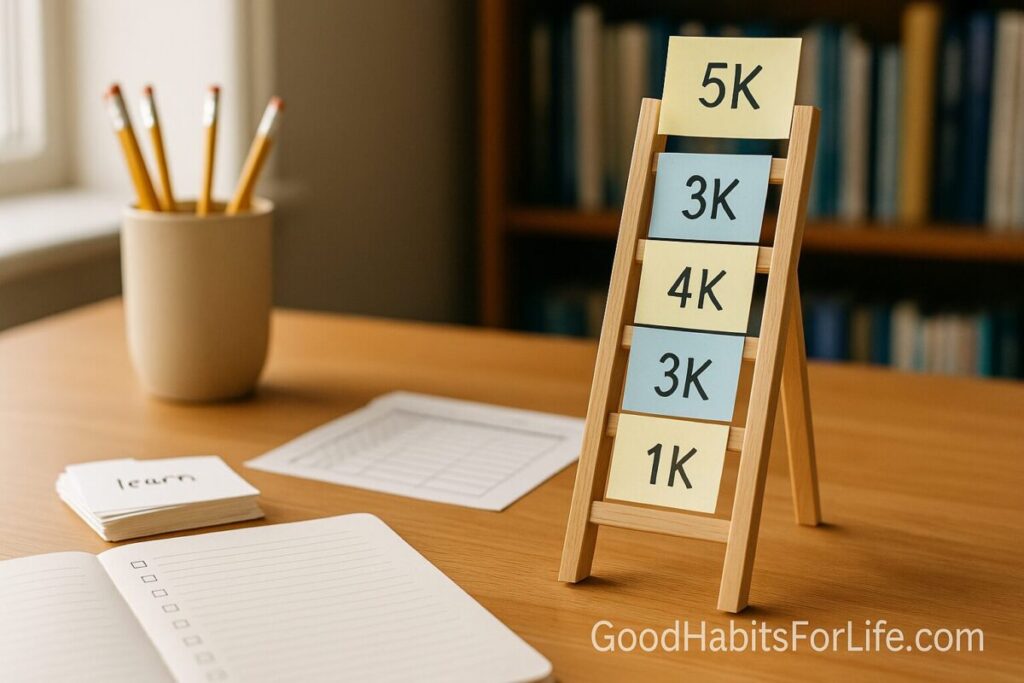
Vocabulary Ladders: From 1K to 5K Words
Vocabulary Ladders: From 1K to 5K Words
Table of Contents
🧭 What & Why
Vocabulary Ladders are a stepwise way to grow your word-family knowledge in 1,000-word bands (1K → 2K → 3K → 4K → 5K). You’ll target the most frequent words first (high ROI), then layer academic/topic words, and keep everything alive with spaced repetition and real input.
Why it works
-
Frequency first: The most frequent 1–3K word families cover the majority of everyday English. The BNC/COCA lists and related resources organize these into 1K bands for focused study. Victoria University of Wellington+1
-
Coverage matters: Comfortable comprehension typically needs ~95–98% known-word coverage; toward 98% for unassisted reading. That implies thousands of word families and justifies a ladder approach. lextutor.ca+1
-
Memory science: Spaced repetition and retrieval practice (testing effect) produce longer-term retention than massed study. eScholarship+1
What is a “word family”?
A headword plus common inflections/derivations (e.g., teach → teaches/teaching/teacher). Counting families focuses you on usable lexicon, not just isolated forms. Victoria University of Wellington
✅ Quick Start (Do This Today)
-
Pick your band: If you’re around 1K, download a reputable 1K–2K list (BNC/COCA headwords). Mark what you already know. Victoria University of Wellington
-
Make smart cards: Create 20 cards from today’s list using sentence-based prompts (ideally cloze deletions).
-
Set your SRS pace: Start with 10 new families/day; cap total daily reviews at ~150.
-
Read for coverage: Choose a graded reader, news-in-levels, or a simplified article you understand ≥95% of words. Highlight only high-value unknowns. Victoria University of Wellington
-
Micro-reviews: 5-minute reviews after breakfast, lunch, and dinner (phone only).
-
Friday audit: Export stats, prune leeches (permanently hard cards), and refill with next 50–70 new items for the week.
-
Sunday input sprint (30–45 min): One podcast + transcript or short story, mining 10 useful words/phrases.
🛠️ 30-60-90 Habit Plan
Goal: Move from ~1K to ~2.5–3K+ families in 90 days, while building the system to reach 5K in the next phase.
Days 1–30 (Foundation: 1K → ~1.8K)
-
New words: 10/day (≈70/wk).
-
Focus: 1K–2K band + survival verbs, connectors, and top collocations.
-
Input: Graded readers or easy news with ≥95% coverage; 15–20 min/day. Victoria University of Wellington
-
Checkpoints (weekly): Retention ≥85% on mature cards; review load ≤150/day.
Days 31–60 (Momentum: ~1.8K → ~2.4K)
-
New words: 12–15/day if reviews stable.
-
Focus: Finish 2K band; start 2–3 topic packs (e.g., “work & study,” “health,” “travel”).
-
Input: Slightly harder texts; short podcasts with transcripts 2–3×/week.
Days 61–90 (Bridge to Intermediate: ~2.4K → ~3K)
-
New words: 12–15/day (or hold if retention dips).
-
Focus: Enter 3K band; add Academic Word List (AWL) if you read study/work texts. edX
-
Input: Native-level snippets with support (readers’ editions, easy editorials).
-
Milestones:
-
Read 600–1,000 words/day with dictionary support.
-
Speak/write using 10 fresh collocations/week (journal or voice notes).
-
After 90 days: Maintain pace (10–15/day) to reach 4K–5K over the next 6–9 months, shifting input gradually toward ≥98% coverage for unassisted reading. lextutor.ca
🧠 Techniques & Frameworks
1) Frequency-First Laddering
-
Study in 1K bands: 1–2K, 2–3K, 3–4K, 4–5K.
-
Mix in topic packs (work/academics/hobbies) so your vocabulary is usable sooner. Victoria University of Wellington
2) Spaced Repetition (SRS) Done Right
-
Intervals: Let the SRS schedule the spacing; avoid cramming.
-
Card types: Prefer cloze deletion and example-sentence cards over isolated L1→L2 translations.
-
Daily ceiling: Keep total reviews manageable; reduce new cards if retention <80–85%.
-
Leech control: Auto-suspend items you repeatedly fail.
Why it works: Spacing out practice and recalling from memory (not rereading) are robustly linked with better long-term retention. eScholarship+1
3) Retrieval Practice
-
End each day with a 2-minute quiz: define, use in a sentence, or recall a collocation.
-
Weekly active recall: Teach 5 words to someone (or to your phone camera). Teaching forces retrieval. Psychnet
4) Coverage-Tuned Input
-
Choose texts/audio where you know most words. Around 95–98% known-word coverage enables incidental learning and fewer lookups. lextutor.ca+1
5) Word Families & Morphology
-
Group by families (create, creates, created, creative, creation) to compress learning and multiply payoff. Use affix awareness to guess meanings.
6) Collocations & Patterns
-
Store chunks (“make a decision,” “take notes”) to increase fluency and naturalness faster than single words.
👥 Audience Variations
-
Students (exams/IELTS): After 2K, add AWL and exam-style collocations. Read abstracts/summaries 10 min/day. edX
-
Professionals: Build topic packs (emailing, meetings, domain terms). Shadow short work podcasts; mine phrases, not just words.
-
Parents/Busy Adults: Keep new words ≤8/day; rely on audiobooks with transcripts during commute.
-
Seniors: Prioritize routine reviews at the same time daily; add handwriting once/week for deeper encoding.
-
Teens: Gamify: streak boards, meme-based example sentences (appropriate), and weekly “teach a friend” challenges.
⚠️ Mistakes & Myths to Avoid
-
Myth: “Learn 50–100 new words daily!” → You’ll overwhelm reviews. Sustainable beats sensational.
-
Mistake: Studying random rare words early. Frequency first. Victoria University of Wellington
-
Myth: “Reading hard texts makes you learn faster.” → Too many unknowns kills context learning. Aim for 95–98% coverage. lextutor.ca
-
Mistake: Keeping leeches. Suspend and revisit later with a new sentence or image.
-
Myth: “Word lists alone are enough.” → Without retrieval + input, gains fade. Psychnet
-
Mistake: Ignoring phrases/collocations; single words don’t deliver fluency.
💬 Real-Life Examples & Scripts
Script: Card-making (30 seconds per word)
-
Front: “I had to ___ a tough choice yesterday.”
-
Back: make a decision — “I had to make a decision about my course.” (CEFR B1 context)
-
Extra: Synonyms/near-synonyms; 1 emoji cue if helpful.
Script: Mining from reading (5 steps)
-
Read an easy article (≥95% coverage).
-
Highlight 10 unknown but useful items.
-
Check a learner dictionary; add one simple definition + one good example.
-
Create 6–8 cards max (skip low-value words).
-
Review twice the same day (morning/evening).
Daily micro-drill (2 minutes):
-
Say aloud 5 collocations with today’s words.
-
Record a 30-sec voice note using at least 3.
Weekly challenge:
-
Write a 120-word paragraph using the week’s top 10 items. Post or read aloud.
🧰 Tools, Apps & Resources
SRS & Card-making
-
Anki / AnkiDroid / AnkiMobile — Free/low-cost, powerful scheduling, add-ons.
-
Quizlet / Memrise — Friendly UIs, discoverable decks; check quality before relying on public decks.
-
Migaku / Cloze tools — Streamlined cloze creation from subtitles/webpages.
Reading & Mining
-
Readlang / LingQ — Click-to-translate with auto card creation; great for graded → native transition.
-
Graded readers — Build coverage confidence; step up when you can read 95–98% easily. Victoria University of Wellington
Frequency & Word Lists
-
BNC/COCA headwords & info — University of Wellington resource hub. Victoria University of Wellington
-
AWL (Academic Word List) — For study/work texts after 2K. edX
-
SUBTLEX (frequency from subtitles) — Helpful for spoken-style frequency. Universiteit Gent
Dictionaries
-
Learner dictionaries (Cambridge, Longman, Oxford) with CEFR labels + collocations.
Set-and-forget automations
-
Daily review alarms, Sunday “input sprint” calendar block, and monthly deck audit reminder.
📚 Key Takeaways
-
Ladder your vocabulary in 1K bands using frequency lists and topic packs. Victoria University of Wellington
-
Keep input at 95–98% coverage so context teaches you instead of tiring you. lextutor.ca
-
Use SRS + retrieval practice every day; small, consistent steps beat big bursts. eScholarship+1
-
Pace yourself (10–15 new families/day), cap reviews, and prune leeches.
-
After 90 days, you’ll have the system and momentum to climb to 5K and beyond.
❓ FAQs
1) How many words do I need to read “real” books?
For unassisted reading, research points to ~8–9K word families (98% coverage). With dictionary support and smart selection, you can start earlier. lextutor.ca
2) Is 95% coverage enough?
95% is a minimum for reasonable comprehension with some lookups; 98% feels smooth and supports guessing from context. Victoria University of Wellington
3) Should I count “word types” or “word families”?
Use families—they reflect real usage and accelerate transfer (teach → teacher → teaching). Victoria University of Wellington
4) Are subtitle-based frequency lists useful?
Yes. SUBTLEX lists (from film/TV subtitles) often predict processing better for spoken language than older norms. Universiteit Gent
5) What’s the best flashcard format?
Cloze and sentence-based cards outperform isolated translations for long-term use, especially with spaced repetition and regular testing. eScholarship+1
6) How fast can I go from 1K to 5K?
At 10–15 new families/day with consistent reviews, expect 6–12 months after your first 90-day base, depending on input time and retention.
7) Do I need the Academic Word List (AWL)?
If you study/work in English and read reports/articles, yes—after finishing the 2K band. edX
References
-
Nation, I.S.P. (2006). How Large a Vocabulary Is Needed for Reading and Listening? (CMLR). (PDF via Lextutor). https://www.lextutor.ca/cover/papers/nation_2006.pdf lextutor.ca
-
Laufer, B. (2010). Lexical text coverage, learners’ vocabulary size and reading comprehension. https://scholarspace.manoa.hawaii.edu/items/eaead47e-853e-4797-ba6f-596df150c1d7 ScholarSpace
-
University of Wellington — Vocabulary lists (BNC/COCA headwords, survival lists, CEFR table). https://www.wgtn.ac.nz/lals/resources/paul-nations-resources/vocabulary-lists Victoria University of Wellington
-
Nation, P. (2014). How much input do you need… (ERIC). https://files.eric.ed.gov/fulltext/EJ1044345.pdf ERIC
-
Cepeda, N.J., et al. (2008). Spacing effects in learning: A temporal ridgeline of optimal intervals. Psychological Science. https://escholarship.org/content/qt0kp5q19x/qt0kp5q19x_noSplash_aedacd613d87c6d68878ac7ba09fdf0b.pdf eScholarship
-
Carpenter, S.K. (2012). Using Spacing to Enhance Diverse Forms of Learning. (ERIC). https://files.eric.ed.gov/fulltext/ED536925.pdf ERIC
-
Roediger, H.L., & Karpicke, J.D. (2006). The Power of Testing Memory. Perspectives on Psychological Science. https://psychnet.wustl.edu/memory/wp-content/uploads/2018/04/Roediger-Karpicke-2006_PPS.pdf Psychnet
-
University of Wellington — About the BNC/COCA word family lists. (PDF). https://www.wgtn.ac.nz/__data/assets/pdf_file/0005/1857641/about-bnc-coca-vocabulary-list.pdf Victoria University of Wellington
-
Brysbaert, M., & New, B. (2009). SUBTLEX-US frequency norms. Ghent University (PDF). https://www.ugent.be/pp/experimentele-psychologie/en/research/documents/subtlexus/brysbaertnew.pdf Universiteit Gent
-
Coxhead, A. (2000). Academic Word List (AWL). Overview (edX PDF). https://courses.edx.org/asset-v1:UQx+IELTSx+3T2015+type@asset+block/Academic_Word_List.pdf edX