
Online Speaking Clubs: Scripts for Shy Learners
Online Speaking Clubs: Scripts for Shy Learners
Table of Contents
🧭 What & Why
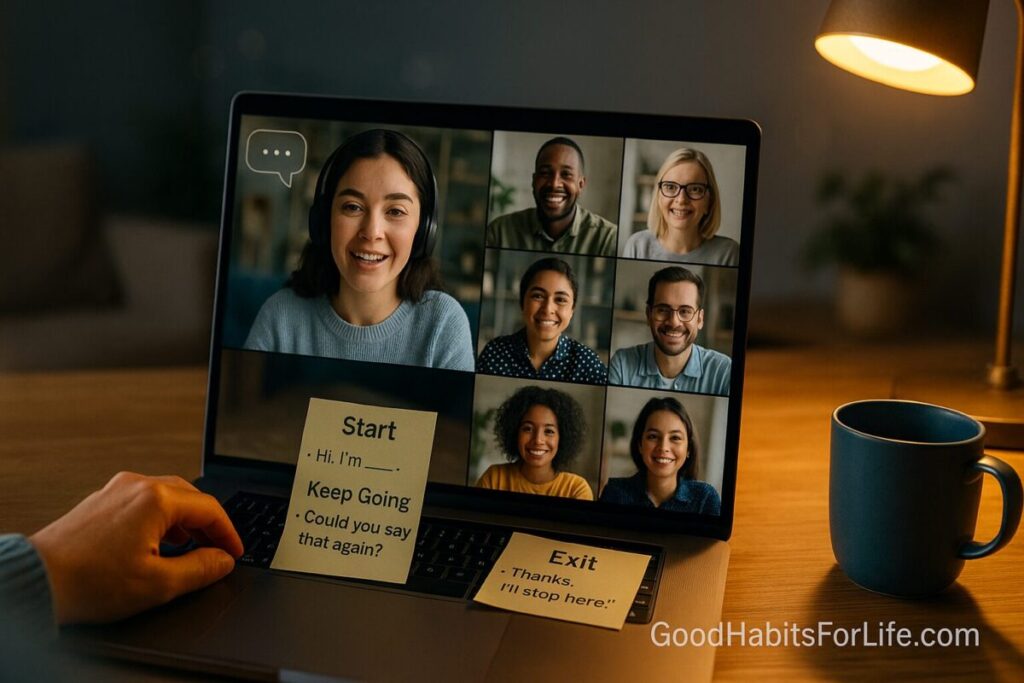
What: Online speaking clubs are live, small-group sessions (usually on Zoom/Meet/Discord) where learners talk around prompts, games, or themes. For shy learners, the main blocker isn’t grammar—it’s activation: starting, maintaining, and exiting turns smoothly.
Why it works:
-
Low-stakes repetition drives fluency: repeating similar tasks improves speed and automaticity.
-
Clear goals and roles reduce cognitive load so you can focus on meaning, not fear.
-
Retrieval practice (recalling words/phrases) strengthens memory better than re-reading.
-
Can-do descriptors (e.g., CEFR/ACTFL) keep progress visible and motivating.
Result: With short, repeatable scripts and a habit plan, shy learners speak earlier, longer, and with more confidence.
✅ Quick Start (Do This Today)
-
Pick a safe room: Choose a club with 3–6 people and clear rules.
-
Paste a mini-bio in your notes (30–60s): name, city, interests, and today’s goal.
-
Prepare 6 universal questions you can ask anyone (see Scripts below).
-
Use the Two-Chunk Reply: Answer + Reason/Example.
-
Run a 3-2-1 warm-up: Speak about a simple topic for 3 minutes, then 2, then 1—same topic, more concise each time.
-
Take a role: volunteer as timekeeper or note-taker to increase talk time with less pressure.
-
Log new words: 6–10 items max; recycle them tomorrow.
🗓️ 7-Day Starter Habit
Goal: One short appearance daily (15–25 min) with the same scripts.
-
Day 1 — Set Up: Write your intro, paste universal questions, learn the Two-Chunk Reply.
-
Day 2 — Join & Observe: Speak your intro; ask 1 question; exit politely.
-
Day 3 — Add a Role: Timekeeper or note-taker; use 3-2-1 warm-up beforehand.
-
Day 4 — Extend Turns: Tell a 30-second mini-story using STAR (Situation-Task-Action-Result).
-
Day 5 — Clarify & Paraphrase: Practice “So you’re saying…” + a follow-up question.
-
Day 6 — Lead a Micro-Prompt: Share a simple prompt (“best morning routine?”) and go first.
-
Day 7 — Review & Recycle: Re-tell 2 stories, re-ask 3 questions, quiz yourself on vocabulary.
🚀 30-60-90 Roadmap
30 Days (Foundation):
-
Join 2–3 sessions/week.
-
Use the same intro + 6 universal questions.
-
Take one supportive role per session.
-
Target A2/B1 can-do: can start simple conversations, ask for clarification, describe routine topics.
60 Days (Growth):
-
Lead the first 5 minutes: greetings, agenda, turn order.
-
Add topic packs (health, study, work, travel): 10–15 phrases each.
-
Practice repair moves: “Could you repeat that?”, “Do you mean…?”.
-
Target B1/B2 can-do: can maintain conversations, give opinions, narrate experiences.
90 Days (Confidence):
-
Host a 20-minute segment monthly (topic + timing + feedback).
-
Switch between styles: informative, persuasive, narrative.
-
Record and reflect (1×/week).
-
Target B2/C1 can-do: can argue a position, hedge politely, manage turn-taking smoothly.
🛠️ Techniques & Frameworks
1) Two-Chunk Reply (TCR)
-
Chunk 1: Direct answer (yes/no/position).
-
Chunk 2: Reason, example, or tiny story.
Why: Keeps replies clear and long enough (10–20 seconds) without rambling.
2) 3-2-1 Fluency Drill
Speak on the same topic for 3 min → 2 min → 1 min. Each round forces better structure and faster retrieval.
3) STAR Micro-Story
Situation – Task – Action – Result in 20–40 seconds. Great for “Tell me about…” prompts.
4) Hedge & Soften
-
“From my experience…”
-
“I might be wrong, but…”
-
“In my context…”
Why: Polite hedges encourage participation and reduce fear of “being wrong.”
5) Paraphrase + Check
-
“So you’re saying ____, right?”
-
“If I understood correctly, ____.”
Why: Builds accuracy and shows active listening.
6) Role Rotation
-
Timekeeper: announces turns, gives 15-sec warnings.
-
Note-taker: records key words; shares a quick recap.
-
Host: opens, sets order, closes.
Why: Structured roles mean more controlled speaking time.
7) Retrieval & Recycling
-
Limit new words to 6–10/session.
-
Quiz yourself 24h later (flashcards), then reuse in the next club.
8) “Evergreen Five”
Prepare five 20–40-second answers you can reuse: morning routine, favorite food, weekend plan, best study tip, recent win.
🧑🎓 Audience Variations
-
Students/Teens: Use school topics; keep turns short (15–30s); add game prompts (Would-You-Rather, Two Truths & a Lie).
-
Professionals: Add brief framing (“One idea, two reasons”), and polite disagreeing scripts.
-
Parents/Caregivers: Use routines, schedules, and problem-solving prompts; timebox strictly.
-
Seniors: Prioritize clear audio, slower pacing, and storytelling prompts; avoid rapid fire games.
-
Exam Takers (CEFR/ACTFL): Practice paired tasks, picture description, compare-contrast, and follow-up justification.
⚠️ Mistakes & Myths to Avoid
-
Myth: “I must study more before I speak.” → Speaking is a skill; you improve by doing small, safe reps.
-
Mistake: Over-collecting vocabulary. → Keep a tight list and recycle it in the next session.
-
Myth: “Native speed = good speaking.” → Clarity and structure beat speed.
-
Mistake: Monologuing. → Ask a question after 20–30 seconds to share the floor.
-
Myth: “Silence is failure.” → Use planned fillers and paraphrase to buy time.
🗣️ Real-Life Scripts (Copy-Paste)
A. Openers & Micro-Intros (30–60 seconds)
-
Basic (A2): “Hi, I’m [Name] from [City]. I’m learning English for [study/work/travel]. Today I’d like to practice [topic]. Nice to meet you!”
-
Neutral (B1): “Hello everyone—[Name] here in [City]. My goal today is to speak more actively and ask at least two follow-up questions.”
-
Professional (B2+): “Good evening, I’m [Name], a [role]. I’d like brief, focused turns—answer, example, and a question back. Please jump in if you want to build on my point.”
B. Time-Buyers (when your mind goes blank)
-
“Give me a second to think…”
-
“That’s interesting—let me organize my thoughts.”
-
“Could you repeat the last part?”
C. Clarifying & Repair
-
“Do you mean [X] or [Y]?”
-
“So you’re saying [paraphrase], right?”
D. Agree/Disagree Politely
-
Agree: “I’m with you—especially the point about [X].”
-
Soft Disagree: “I see it a bit differently. In my context, [reason]. What do you think?”
E. Keep the Ball Moving (follow-ups)
-
“What’s one example from your week?”
-
“If you had to choose, which would you pick—and why?”
-
“How would this work for beginners?”
F. Exit Lines
-
“I’ll stop here so others can jump in.”
-
“That’s my take—curious to hear yours.”
-
“I’m out of time—thank you for the chat!”
G. Hosting a 5-Minute Segment
-
Opening: “Welcome! Agenda: 1) quick intros, 2) prompt: morning routines, 3) recap. Each turn is ~30 seconds; I’ll give a 15-second warning.”
-
Transition: “Let’s switch speakers—[Name], you’re up next.”
-
Closing: “Thanks, everyone. Key words: hydrate, stretch, time-box. See you next time!”
H. Picture/Prompt Tasks (Exam-style)
-
Describe: “In this picture, I notice [3 items]. It looks like [context]. I think [opinion] because [reason].”
-
Compare-Contrast: “Both [A] and [B] involve [shared feature], but [A] is [difference] while [B] is [difference]. I’d choose [A/B] because [reason].”
I. Topic Packs (plug-and-play phrases)
Health & Routines
-
“I usually [verb] before work to feel [adjective].”
-
“A tiny habit that helps me is [action] for [time].”
Study & Productivity
-
“I plan my day with [tool]; it keeps me [benefit].”
-
“One challenge is [problem]; my fix is [strategy].”
Work & Projects
-
“The goal was [X]; we achieved it by [Y]. The result was [Z].”
📚 Tools, Apps & Resources (pros/cons)
-
Timers (e.g., web timer/phone timer): +Keeps turns fair; –Needs discipline.
-
Shared docs (Google Docs/Notion): +Live vocabulary list; –Can distract.
-
Topic wheels/prompt cards: +Instant variety; –Random topics may be too hard.
-
Language-exchange platforms (any reputable app): +Meeting partners outside club; –Quality varies.
-
Recording (phone/desktop): +Objective feedback; –Ask for consent first.
-
Flashcards (spaced repetition): +Great for recycling; –Set limits (10/day).
🧠 Key Takeaways
-
Prepare once, reuse often: intro, universal questions, evergreen answers.
-
Use TCR, 3-2-1, and STAR to structure clear, confident speech.
-
Roles create safe talk time; rotate timekeeper / note-taker / host.
-
Keep vocabulary small and recycle it in the next session.
-
Advance with a 30-60-90 plan tied to CEFR/ACTFL-style can-dos.
❓ FAQs
1) I freeze when it’s my turn. What’s one move?
Use a time-buyer (“Give me a second…”) + Two-Chunk Reply (answer + example).
2) How long should my turns be?
Aim for 15–30 seconds at first; ask a question to pass the ball.
3) Should I correct others?
In clubs, prioritize meaning and flow. Save grammar tips for the end or the chat.
4) How do I track progress?
Record a 60-second self-intro weekly. Listen for clarity, speed, and fewer fillers.
5) What if topics are too hard?
Request topic packs (health, study, work, travel) and recycle phrases.
6) Do I need native-level speed?
No. Clear structure > speed. Hedge politely and keep turns tidy.
7) How can I speak more without feeling pushy?
Volunteer for roles. Timekeeping and hosting naturally increase your airtime.
8) Is writing helpful for speaking?
Yes—drafting evergreen answers builds automaticity you can say out loud.
9) I keep forgetting words.
Limit to 6–10 new items, then quiz and reuse within 24 hours.
10) What if I have strong social anxiety?
Start with listen-only minutes and very short turns. If anxiety interferes with daily life, consider professional support.
📚 References
-
Council of Europe. Common European Framework of Reference for Languages (CEFR) — overview and descriptors. https://www.coe.int/en/web/common-european-framework-reference-languages
-
ACTFL. Proficiency Guidelines — speaking can-do expectations. https://www.actfl.org/resources/actfl-proficiency-guidelines-2012
-
British Council. LearnEnglish – Speaking — learner tips and tasks. https://learnenglish.britishcouncil.org/skills/speaking
-
Oxford Learner’s Dictionaries. The Oxford 3000 and 5000 word lists — high-frequency vocabulary focus. https://www.oxfordlearnersdictionaries.com/wordlists/oxford3000-5000
-
Roediger, H. L., & Karpicke, J. D. (2006). The Power of Testing Memory: Basic research and implications. Perspectives on Psychological Science. https://doi.org/10.1111/j.1745-6916.2006.00012.x
-
Horwitz, E. K., Horwitz, M. B., & Cope, J. (1986). Foreign Language Classroom Anxiety. The Modern Language Journal. https://doi.org/10.1111/j.1540-4781.1986.tb05256.x
-
Ellis, R. (2003). Task-Based Language Learning and Teaching. Oxford University Press. (Publisher page: https://global.oup.com/)
-
Nation, I. S. P. (2013). Learning Vocabulary in Another Language (2nd ed.). Cambridge University Press. (Publisher page: https://www.cambridge.org/)
⚖️ Disclaimer
This article is for education only and isn’t a substitute for personal mental-health advice or therapy.