
Pronunciation Coach: AI Feedback for Languages
AI Pronunciation Coach for Language Learners
Table of Contents
🧭 What & Why
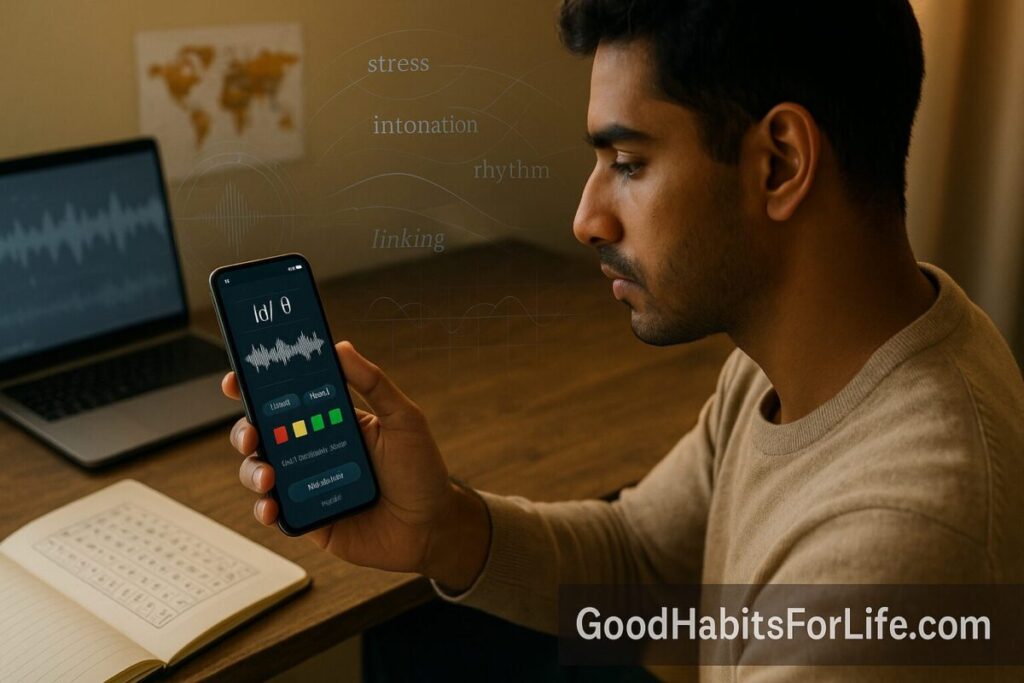
What it is. An AI pronunciation coach is a mobile or web tool that listens to your speech, aligns it with reference audio/text, and returns feedback—phoneme scores, stress/intonation cues, waveform/spectrogram views, and corrective tips. Many use automatic speech recognition (ASR) plus pronunciation-assessment models to detect errors and suggest targeted practice. ACL Anthology+1
Why it works. Research on computer-assisted pronunciation training (CAPT) shows moderate benefits when tech delivers timely, specific feedback and is integrated into instruction. Meta-analyses and systematic reviews consistently report positive effects, especially for beginners and intermediates. Cambridge University Press & Assessment+1
Focus on intelligibility. Your goal isn’t to erase an accent; it’s to be easy to understand across listeners and contexts. Classic and contemporary studies show accent, intelligibility, and comprehensibility are related but distinct; training that targets intelligibility yields the biggest real-world payoff. Cambridge University Press & Assessment
Beyond single sounds. Segmental accuracy (individual sounds) matters, but suprasegmentals—stress, rhythm, intonation, and connected speech—often drive comprehensibility. Instruction that includes these features improves listening and speaking outcomes. teachingenglish.org.uk+1
✅ Quick Start (Do This Today)
-
Pick a coach & set a target. Choose any reputable AI coach. Set a 4-week target using a standard: e.g., “Improve CEFR Phonological Control from A2→B1” or “Move one sublevel on ACTFL Speaking (e.g., Novice High→Intermediate Low).” rm.coe.int+1
-
Baseline in 10 minutes. Record a 60-second passage and 10 personal phrases (your name, job, study field, common questions). Save as Week 0. The coach will flag priority errors (e.g., /θ/→/t/, misplaced stress). PMC
-
Micro-drills (10–15 min).
-
Perception: Minimal-pair quizzes (ship/sheep).
-
Production: Record 5–8 words/phrases; aim for ≥85% coach score on focus sounds.
-
Prosody: Clap or tap word stress; re-record with appropriate stress. Northern Arizona University
-
-
Shadowing ladder (5–10 min). Listen → whisper shadow → full-voice shadow → record and compare to model. Tandfonline
-
Connected-speech check (5 min). Practice weak forms, linking, and thought groups on 3 common sentences. teachingenglish.org.uk
-
Weekly review (20–30 min). Re-take your baseline passage; log scores and note which errors persist.
🗺️ 30-60-90 Day Habit Plan
| Phase | Weekly Time | Focus | What You’ll Do | Checkpoint |
|---|---|---|---|---|
| Days 1–30 | 90–120 min | High-impact sounds + word stress | Daily micro-drills; 3 shadowing sessions/week; minimal pairs; record short monologues | +10–15 pts on coach’s phoneme/stress scores; intelligibility notes improving |
| Days 31–60 | 120–150 min | Rhythm, linking, intonation | Add chunking (thought groups), weak forms, rising/falling patterns; dialogues with time pressure | Faster speech with equal or better scores; fewer stress/intonation flags |
| Days 61–90 | 150–180 min | Transfer to real tasks | Mock meetings, class presentations, interviews; spontaneous answers recorded & reviewed | External listener check: peers/teacher rate you “easy to understand” |
Use spaced practice (short, repeated, distributed sessions). Spacing improves retention and transfer more than massed cramming, including for L2 speech fluency. Cambridge University Press & Assessment
🧠 Techniques & Frameworks
1) Perception → Production Loop
-
Hear it right first. Train your ear on contrastive sounds; accuracy in perception predicts better production.
-
Produce with feedback. Record, get AI scores, and immediately correct.
-
Re-cycle tomorrow. Short, spaced loops outperform long, single sessions. Northern Arizona University+1
2) Shadowing Ladder (4 steps)
-
Listen only (30–60s).
-
Whisper shadow to copy timing/intonation.
-
Full-voice shadow with attention to stress and linking.
-
Record & compare; fix 1–2 issues per pass. Tandfonline
3) Suprasegmental Stack
-
Word stress → sentence stress → intonation → linking/weak forms.
-
Practice with clapping, arrows (↗/↘), and pauses (|) to mark thought groups. teachingenglish.org.uk
4) Task-Based Drills
-
60-second news brief: summarize a short article.
-
2-turn dialog: ask/answer common questions (study, work, directions).
-
Pitch-accent/tonal cues (if applicable): pair the AI coach with slow, exaggerated models, then reduce exaggeration.
5) Objective Progress Markers
-
CEFR Phonology descriptors (A1–C2) and ACTFL Speaking levels; map coach scores to these public scales for week-over-week tracking. rm.coe.int+1
👥 Audience Variations
-
Students/Examinees: Align drills with expected prompts (presentations, interviews). Include 2 timed tasks per week.
-
Professionals: Build a meeting phrasebook (status updates, clarifications) and rehearse with intonation targets.
-
Seniors/Re-starters: Prioritize clarity and comfort—slower pace, larger text, headset mic; shorter but more frequent sessions.
-
Teens: Gamify with streaks and duet shadowing (record with a peer for fun accountability).
⚠️ Mistakes & Myths to Avoid
-
Myth: “I must sound native.”
Reality: Prioritize intelligibility and communicative ease; a noticeable accent can still be perfectly comprehensible. Cambridge University Press & Assessment -
Mistake: Training only individual sounds.
Fix: Include stress, rhythm, and connected speech; these often drive listener understanding. teachingenglish.org.uk -
Mistake: Relying on a single “overall score.”
Fix: Combine AI metrics with CEFR/ACTFL descriptors and human listener notes for a fuller picture. rm.coe.int+1 -
Myth: “Long weekend marathons are best.”
Reality: Distributed, shorter sessions yield better retention and fluency gains. Cambridge University Press & Assessment -
Caution: AI isn’t perfect at diagnosing every mispronunciation or prosody issue; treat feedback as guidance, not gospel. ACL Anthology
💬 Real-Life Practice Scripts
Everyday Clarity (stress & linking):
-
“Could you repeat that last point?”
-
“Let me clarify what I meant.”
-
“The main idea is this: …”
Interview Mini-Drill (60s):
-
Q: “Tell me about a project you’re proud of.”
-
A: Speak in 3 thought groups: context | your role | result. Record, then check stress on key words.
Meeting Hand-Off (intonation):
-
“I’ll stop here ↘ and hand over to Sara ↗ for the timeline.”
Connected Speech Set (weak forms):
-
“I’m going to go-to the store at about five.” (linking/weak forms)
Paste these into your AI coach, record, and fix one issue per run.
🛠️ Tools, Apps & Resources
-
AI Coaches (mobile/web): Look for phoneme-level scoring, stress/intonation feedback, slow-motion playback, and comparison to model audio. Consider privacy settings and exportable logs. Research supports ASR-based feedback when it’s timely and specific. PMC
-
Open Standards: Use CEFR Companion Volume phonology descriptors and ACTFL 2024 Speaking Guidelines to set goals and self-assess. rm.coe.int+1
-
Evidence Hubs: Language Learning & Technology (open access) often publishes CAPT studies with practical classroom takeaways. lltjournal.org
-
Teacher-grade Tips: British Council’s materials on connected speech and rhythm are concise and actionable. teachingenglish.org.uk
Pros & Cons (at a glance)
-
Pros: Immediate, objective feedback; repeatable drills; progress charts; low cost. PMC
-
Cons: Imperfect diagnosis for nuanced prosody; scores can vary across models; needs human judgment for communicative fit. ACL Anthology
📚 Key Takeaways
-
Train daily in short, spaced sessions; review weekly with a fixed passage. Cambridge University Press & Assessment
-
Balance segments (sounds) with suprasegmentals (stress, rhythm, intonation, linking). teachingenglish.org.uk
-
Let intelligibility lead your goals; use CEFR/ACTFL descriptors to measure progress beyond a single app score. Cambridge University Press & Assessment+2rm.coe.int+2
-
Use shadowing and a perception→production loop to accelerate change. Tandfonline+1
❓ FAQs
1) How many minutes per day are enough?
10–15 minutes daily plus a 20–30 minute weekly review is a solid minimum. Spaced schedules outperform cramming for long-term retention. Cambridge University Press & Assessment
2) Will an AI coach help with my accent?
It will improve clarity and consistency. Some accent features may persist, but intelligibility—not sounding “native”—is what boosts communication outcomes. Cambridge University Press & Assessment
3) Are app scores reliable?
They’re useful indicators, but not perfect. Pair them with CEFR/ACTFL descriptors and occasional human feedback. ACL Anthology+1
4) Should I start with sounds or intonation?
Do both. Start with 1–2 high-impact sounds and word stress; add sentence stress and intonation in Week 2. This blended approach aligns with CAPT research. Cambridge University Press & Assessment
5) Is shadowing really effective?
Yes—especially when you climb the ladder (listen → whisper → full voice → record). Evidence reviews show benefits for rhythm and fluency. Tandfonline
6) How do I know my level is improving?
Re-record a fixed script every week and map your performance to CEFR/ACTFL descriptors; look for fewer stress mistakes, better rhythm, and listener-rated clarity. rm.coe.int+1
7) What if the app disagrees with my teacher?
Use disagreement as data. Replay your audio, check model references, and prioritize intelligibility for your real audience and tasks. Cambridge University Press & Assessment
References
-
Amrate, M. (2022). Computer-assisted pronunciation training: A systematic review. ReCALL (Cambridge University Press). https://cambridge.org … Cambridge University Press & Assessment
-
Saito, K., & Plonsky, L. (2019). Effects of second language pronunciation teaching revisited: A proposed measurement framework and meta-analysis. Language Learning. https://doi.org/10.1111/lang.12345 Northern Arizona University
-
Hirschi, K. (2025). Artificial Intelligence-Generated Feedback for Second Language Learning. Language Learning (Wiley). Wiley Online Library
-
North, B., et al. (2020). CEFR Companion Volume with New Descriptors. Council of Europe. rm.coe.int
-
ACTFL (2024). ACTFL Proficiency Guidelines (Speaking). American Council on the Teaching of Foreign Languages. ACTFL
-
British Council. Connected speech: strategies for teaching weak forms and linking. TeachingEnglish. teachingenglish.org.uk
-
Frontiers in Psychology (2023). The impact of ASR technology on second-language speaking/pronunciation. Open-access review. PMC
-
Fouz-González, J. (2025). Teaching & learning pronunciation with technology: recommendations & future directions. PSLLT (open PDF). iastatedigitalpress.com
-
Saito, K. (2021). What characterizes comprehensible and native-like L2 pronunciation? Two meta-analyses. TESOL Quarterly (open). Wiley Online Library
-
Language Learning & Technology (2025). CAPT for grammatical features; distance learners pronunciation growth. (open access). lltjournal.org+1