
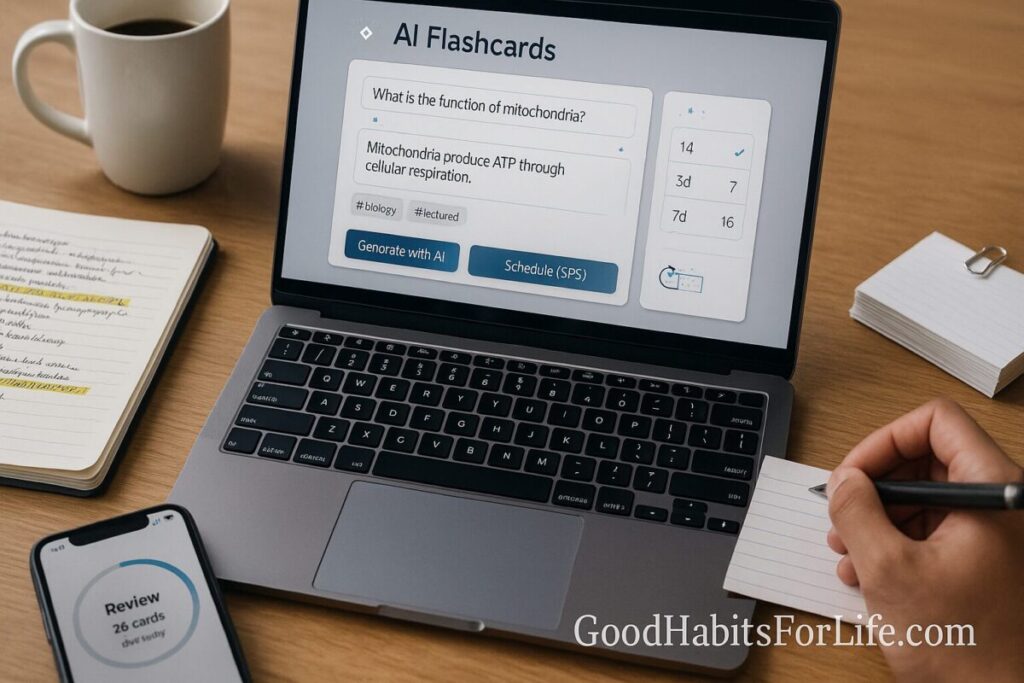
AI Flashcards: Turn Notes into SRS Decks
AI Flashcards: Turn Notes into SRS Decks
Table of Contents
🧭 What & Why
What this is: A practical system to convert lecture notes, readings, and meeting takeaways into AI-drafted flashcards you human-edit and schedule via spaced-repetition systems (SRS) like Anki or RemNote. The goal is long-term retention with less total time.
Why it works:
-
Memory decays predictably without review (forgetting curve). Spaced reviews interrupt that decline and “re-consolidate” knowledge. PMC
-
Spacing (distributed practice) + retrieval practice (testing yourself) dramatically outperform rereading/highlighting for long-term learning; interleaving related topics improves discrimination and transfer. PubMed+3PubMed+3SAGE Journals+3
Why AI helps: Language models can summarize, propose Q→A/cloze cards, suggest tags, and draft mnemonics, turning hours of manual card-writing into minutes—as long as you verify and edit. Early trials of well-designed AI tutors also show learning gains compared with traditional classes (details below). Nature+1
✅ Quick Start (Do This Today)
-
Pick one source (a 10–15-page chapter or a 45-min lecture).
-
Paste your notes into an editor (Notion or Obsidian).
-
Run an AI prompt (below) to draft cards:
-
Generate 15–30 atomic cards, 70% cloze deletions, 30% Q→A.
-
Each card must contain one fact/idea; keep to ≤25 words per side.
-
Include a source line (book/article/lecture timestamp).
-
Propose 2–4 tags per card.
-
-
Human edit (15–20 min): Delete dupes, fix wording, add units, check facts/citations.
-
Batch import into Anki/RemNote (CSV/TSV/AnkiConnect).
-
Review daily (10–20 min). Aim for active recall, not recognition.
-
Interleave with 1–2 other topics after Day 3.
Copy-paste prompt (general):
“From the notes below, propose 20 flashcards that obey the Minimum Information rule. Use 70% cloze (
{{c1::...}}) and 30% Q→A. Keep each fact atomic and precise, include metric units, add aSource:line (URL/page/timestamp), and suggest 2–4 topical tags per card. Avoid trivia and avoid verbatim copying.”
🗓️ 7-Day Starter Plan
Day 1 — Build & Import
-
Draft 20–30 cards from one source; review/edit; import; first review.
Day 2 — First Spaced Review (5–10 min)
-
Do the due cards. Suspend any too-trivial cards.
Day 3 — Interleave
-
Add 10–15 cards from a different topic; review both sets together.
Day 4 — Focused Fix
-
Do reviews; rewrite any card you failed twice. Add mnemonics/examples.
Day 5 — Retrieval Boost
-
10-min cold recall: list key ideas on paper, then check with cards.
Day 6 — Tag & Group
-
Consolidate tags (e.g.,
bio/cell,method/stats,case/examples).
Day 7 — Light Refactor
-
Merge duplicates; split long cards; archive low-value ones. Set weekly goal: +50 net cards/week or 15 min/day reviews.
🧠 Techniques & Frameworks That Work
1) Retrieval > Rereading
Self-testing creates stronger memory traces than rereading or concept mapping. Use closed-book recall before you reveal answers. SAGE Journals+1
2) Spacing that fits the goal
Best gaps depend on how long you need to remember: as the desired retention interval grows, the optimal review gap is a fraction of that interval (rule-of-thumb from the “temporal ridgeline”). Your SRS automates this. PubMed+1
3) Interleaving
Shuffle related topics (e.g., types of enzymes or problem types) so each review requires choosing the right concept. Expect lower practice scores but higher exam performance. PubMed
4) Minimum Information Principle
One idea per card. Prefer:
-
Cloze for definitions, formulas, code idioms, quotations.
-
Q→A for concepts (“Why/How”), steps, comparisons.
-
Image occlusion for diagrams (if license allows).
5) Desirable Difficulties
Make it effortful but doable: short prompts, mixed contexts, and partial cues. If you never fail a card, it’s too easy. bjorklab.psych.ucla.edu
6) Evidence-aligned AI guardrails
-
Require sources on AI-proposed facts.
-
Redact PII and sensitive data; avoid uploading restricted content.
-
Prefer local or institution-approved models for protected material.
-
Follow UNESCO/OECD guidance on safe, human-centred AI use in education. UNESCO+1
🧑🎓 Audience Variations
-
Students: Keep decks course-scoped and past-paper aligned. Add equation units and typical distractors.
-
Professionals: Focus on standards, checklists, and case snippets; include “gotchas” and decision thresholds.
-
Seniors/Returners: Fewer cards, larger fonts, more cloze; review windows earlier in the day.
-
Teens: Use examples from your hobbies; convert long notes into 10–15 daily micro-cards; add image occlusions for diagrams.
⚠️ Mistakes & Myths to Avoid
-
Myth: “More cards = more learning.” Quality beats quantity; delete low-value or duplicate cards.
-
Myth: “Rereading is enough.” It feels fluent but doesn’t stick like retrieval practice. SAGE Journals
-
Error: Copy-pasting AI cards blindly. Always verify, trim, and tag.
-
Error: Giant multi-fact cards. Split into atomic cloze/Q→A.
-
Error: Single-topic cramming. Interleave related concepts. PubMed
🗣️ Real-Life Examples & Scripts
Turn a dense note into cloze cards
-
Note: “Mitochondria produce ATP via oxidative phosphorylation across the inner membrane; the proton gradient is generated by complexes I–IV.”
-
Cards:
-
Mitochondria produce {{c1::ATP}} via {{c2::oxidative phosphorylation}}. -
The proton gradient forms across the {{c1::inner mitochondrial membrane}}. -
ETC complexes that pump protons: {{c1::I, III, IV}}.
-
Prompt to propose tags & difficulty levels
“Assign 2–4 topical tags (namespace style, e.g.,
bio/ETC) and a difficulty score (1–3) based on abstraction and prerequisite load. Suggest interleaving pairs.”
Script to paraphrase into Q→A
“Rewrite these statements as question→answer pairs that test why/how, not just definitions. Keep answers ≤25 words and add the original source.”
Academic integrity nudge (use as a footer in your decks):
“These flashcards are for learning. Do not use them during closed-book assessments. Cite sources when ideas are reused.”
🛠️ Tools, Apps & Resources
-
Anki (desktop/mobile) + AnkiConnect — gold-standard SRS; CSV/TSV imports; powerful templates.
-
RemNote — native SRS + outliner + cloze; backlinks; PDF highlights.
-
Obsidian → Anki plugins — send markdown headings & clozes directly.
-
Notion → Anki (N2A) — export Notion databases to Anki.
-
Readwise / Reader — capture highlights; export to notes for card creation.
-
Memrise / Quizlet — quick visual decks; check licensing for images/audio.
-
Privacy tip: For sensitive content, use local LLMs or institution-approved tools; avoid cloud uploads of PII.
Pro tip: Keep a deck schema: fields = Front | Back | Tags | Source | Hint | ImageAttribution.
📚 Key Takeaways
-
AI can draft cards fast; you ensure accuracy, granularity, and tagging.
-
Combine retrieval, spacing, and interleaving for durable learning. SAGE Journals+2PubMed+2
-
Start small: one source → 20 cards → daily 10–20-min reviews → weekly tidy-ups.
-
Guard privacy and academic integrity; follow human-centred AI guidance. UNESCO
❓ FAQs
1) How many new cards per day?
10–20 is sustainable; prioritize high-yield concepts.
2) Cloze or Q→A?
Use cloze for facts/equations and Q→A for mechanisms, reasoning, and trade-offs.
3) What review accuracy should I aim for?
If you never fail cards, they’re too easy. Some failure is healthy—desirable difficulty. bjorklab.psych.ucla.edu
4) Should I interleave different subjects?
Yes—especially similar concepts that are easy to confuse (e.g., look-alike formulas). PubMed
5) Can I trust AI-generated cards?
Treat them as drafts. Verify facts, add sources, and rewrite for clarity.
6) How do I use images legally?
Add only licensed or your own images; record attribution in a field (e.g., “ImageAttribution”).
7) Does this replace note-taking?
No. Keep concise notes; then convert the essentials into cards.
8) Is there evidence that AI helps learning?
Early RCTs of structured AI tutors show higher learning gains than in-class active learning (context matters). Nature+1
9) What if I fall behind on reviews?
Do “due” cards first; suspend low-value sub-decks; then resume new cards.
10) How do I prevent bloated decks?
Weekly: delete or merge low-value cards, fix wording, and consolidate tags.
📚 References
-
Cepeda NJ, et al. Spacing effects in learning. Psychological Science (2008). https://pubmed.ncbi.nlm.nih.gov/19076480/
-
Roediger HL, Karpicke JD. Test-Enhanced Learning. Psychological Science (2006). https://journals.sagepub.com/doi/10.1111/j.1467-9280.2006.01693.x
-
Karpicke JD, Blunt JR. Retrieval practice produces more learning than elaborative studying. Science (2011). https://www.science.org/doi/10.1126/science.1199327
-
Dunlosky J, et al. Improving Students’ Learning With Effective Learning Techniques. Psychological Science in the Public Interest (2013). https://journals.sagepub.com/doi/10.1177/1529100612453266
-
Brunmair M, Richter T. A meta-analysis of interleaved learning and its moderators. Psychonomic Bulletin & Review (2019). https://pubmed.ncbi.nlm.nih.gov/31556629/
-
Murre JMJ, Dros J. Replication and Analysis of Ebbinghaus’ Forgetting Curve. PLOS ONE (2015). https://pmc.ncbi.nlm.nih.gov/articles/PMC4492928/
-
Bjork EL, Bjork RA. Making things hard on yourself, but in a good way: Creating desirable difficulties to enhance learning. (2011). UCLA Bjork Lab PDF: https://bjorklab.psych.ucla.edu/wp-content/uploads/sites/13/2016/04/EBjork_RBjork_2011.pdf
-
UNESCO. Guidance for generative AI in education and research (2023; updated 2025). https://www.unesco.org/en/articles/guidance-generative-ai-education-and-research
-
OECD. Digital Education Outlook 2023: Towards an Effective Digital Education Ecosystem (2023). https://www.oecd.org/en/publications/oecd-digital-education-outlook-2023_c74f03de-en/full-report.html
-
Kestin G, Miller K, et al. AI tutoring outperforms in-class active learning: an RCT… Scientific Reports (Nature) (2025). https://www.nature.com/articles/s41598-025-97652-6