
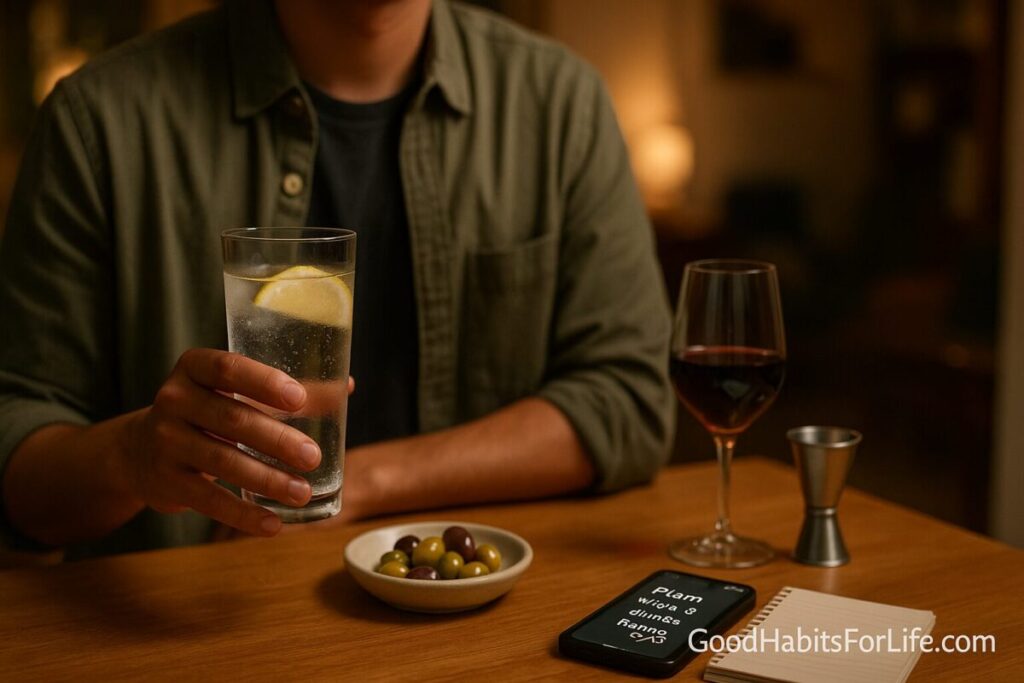
Mindful First Drink: Arrival Rituals that Reduce Overdoing
Mindful First Drink: Arrival Rituals that Reduce Overdoing
Table of Contents
🧭 What Is a “Mindful First Drink”?
A mindful first drink is a short, repeatable routine you perform before the first alcoholic beverage and during the first hour of a social event. It front-loads decisions—hydration, food, pace, and boundaries—so you stay in control all night.
Core components
-
Pause: Arrive, breathe, and check in with your body and intent.
-
Fuel: Eat or plan food alongside the first drink.
-
Hydrate: Start with water or a non-alcoholic (NA) drink.
-
Pace: Cap the first hour at ≤1 standard drink; alternate with water.
-
Plan: Set a max drink limit (including 0) and a home time.
Why it works
-
Alcohol’s effects ramp quickly in the first hour; setting pace and food early slows absorption and reduces peak blood alcohol concentration (BAC).
-
Anchoring habits early leverages implementation intentions (“If X happens, then I do Y”), which improves follow-through.
✅ Why Arrival Rituals Reduce Overdoing (Science & Benefits)
Physiology & timing
-
Your body metabolizes roughly 1 standard drink per hour on average; drinking faster raises BAC and impairment risk. Food—especially protein/fat—slows absorption.
-
Hydration reduces subjective thirst cues that can be misread as a desire for alcohol.
Behavioral science
-
Habits & defaults: A preset routine becomes the default, reducing on-the-spot willpower demands.
-
Mindfulness: Brief awareness practices decrease automaticity, helping you notice taste, pace, and social pressure.
-
If-then plans: Pre-deciding responses to offers (“If someone tops me up, I put my hand over the glass and ask for water.”) cuts impulsive refills.
Benefits you’ll feel
-
More consistent energy and mood during events
-
Better sleep quality after social nights
-
Fewer regrets, safer choices, easier next-day recovery
-
Clearer data about what truly makes nights enjoyable
Standard drink quick guide
~14 g ethanol ≈ 355 ml beer (5%), 148 ml wine (12%), 44 ml spirits (40%).
UK: 1 unit = 10 g alcohol; AU: std drink = 10 g; adjust pacing to local “standard drink” definitions.
🛠️ Quick Start: Do This Today (5 Steps)
-
Arrive with water
-
Walk in holding water/NA first. This buys time, hydrates, and sets a pace cue.
-
-
Order food early
-
If dinner is later, get a protein snack (nuts, cheese, hummus, grilled skewers) within 15 minutes.
-
-
State your plan
-
Tell a friend or the server: “I’m pacing—one drink an hour, alternating with water.”
-
-
Make your first alcoholic drink intentional
-
Savor it: first three sips slowly, glass down between sips, talk more than sip.
-
-
Lock the alternation
-
Alcoholic → water → alcoholic → water. Stop at your pre-set limit.
-
Pacing timeline (first 60 minutes)
| Minute | Action |
|---|---|
| 0–5 | Water/NA in hand, greet, breathe (3 slow breaths) |
| 5–15 | Order/share food; scan menu for a lower-ABV option |
| 15–25 | If choosing alcohol, order your first drink |
| 25–55 | Sip slowly; glass down between sips; chat; drink water alongside |
| 55–60 | Decide: water top-up or stop; only order drink #2 if still within plan |
🗺️ 7-Day Starter Plan
Goal: Install a repeatable arrival ritual + consistent pacing.
Day 1 (Design):
-
Choose your opening line, water/NA default, and first drink choice (e.g., spritzer, half-pint, mocktail).
-
Set a drink cap (e.g., 0–2) and a go-home time.
Day 2 (Dry Rehearsal):
-
Practice at home: plate a snack, pour an NA, rehearse scripts out loud.
Day 3 (Light Social):
-
Coffee shop or casual meet. Run the ritual with NA only; notice social ease.
Day 4 (At-Home Dinner):
-
Serve food first; then a single alcoholic drink with alternating water.
Day 5 (Outing):
-
Apply the full ritual. Track start time, number of drinks, end time.
Day 6 (Review & Adjust):
-
Journal: triggers, successes, where you sped up. Adjust scripts.
Day 7 (Real Test Night):
-
Full ritual + friend accountability text. Celebrate wins; debrief next morning.
🧠 Techniques & Frameworks (Research-Aligned)
PACE: A simple pacing rule
-
≤1 standard drink/hour.
-
Alternate each alcoholic drink with water/NA.
-
Lower ABV first (e.g., session beer, spritzer, wine + soda).
-
Stop at the limit you set before arrival.
HALT check-in
Before any drink, scan H-A-L-T: Hungry? Angry/Anxious? Lonely? Tired?
-
If yes, address that first (eat, breathe, text a friend, rest).
Urge surfing (90 seconds)
-
Notice the urge like a wave; breathe and watch it rise/fall for 90 seconds.
-
Most urges peak and fade if you don’t react.
If-Then Plans (implementation intentions)
-
If someone tops up my glass, then I cover it and ask for water.
-
If the group orders shots, then I’ll toast with NA and take photos.
-
If I finish a drink in <20 minutes, then I wait 20 minutes before any refill.
Environment shaping
-
Sit/stand away from the bar.
-
Use a tall NA glass as a visual cue.
-
Ask the server for no automatic refills.
💬 Real-Life Examples & Scripts
At the door
-
“Hey! I’m pacing tonight—starting with a soda & lime.”
-
“Food smells great. I’ll grab a water and say hi.”
Ordering
-
“Could I start with your lowest-ABV beer / a wine spritzer?”
-
“Please no top-ups—happy to order each drink separately.”
When offered a shot
-
“I’m skipping shots, but I’ll cheers with this NA—get in the photo!”
When you want to stop
-
“I’m good—switching to water. Early morning tomorrow.”
Host text before the event
-
“Excited for tonight! I’m doing a mindful first drink—pace with me?”
👥 Audience Variations
Students
-
Pre-eat with protein (budget-friendly: eggs, dal, yogurt).
-
Pair every round with water to save money and reduce hangovers before classes.
Professionals
-
At work events, open with NA. Network better with clear head; set a 1–2 drink max.
Parents
-
If you’re the driver or on kid duty next morning, set 0–1 drinks and strict cut-off time.
Seniors
-
Med interactions are common—consider NA options and check with your clinician.
Teens (general guidance for caregivers/educators)
-
Emphasize delay and refusal skills; model NA alternatives at family events.
⚠️ Mistakes & Myths to Avoid
-
Myth: “Coffee sobers you up.”
Reality: Only time metabolizes alcohol; coffee may mask sleepiness. -
Mistake: Skipping food to “save calories.”
Fix: Eat first; you’ll likely drink less overall, which often lowers calories. -
Myth: “Light beer/wine doesn’t count.”
Reality: Track standard drinks, not container counts. -
Mistake: Ordering the strongest drink first.
Fix: Start low-ABV; it sets a slower rhythm. -
Myth: “I can handle more because I’m bigger.”
Reality: Size matters somewhat, but rate of intake still drives BAC rise.
🧰 Tools, Apps & Resources
-
Tracking & mindful drinking apps: Sunnyside, Reframe, Less, Try Dry, DrinkControl, I Am Sober.
-
Pros: Easy logging, reminders, coaching content.
-
Cons: Subscription costs; data privacy varies—review policies.
-
-
Wearables/notes: Use phone notes or a smart-watch to time drinks and water breaks.
-
Restaurant hacks: Ask for half-pours, spritzers, or low-ABV cocktails (vermouth soda, sherry cobbler, Americano).
🪜 Key Takeaways
-
Arrival rituals turn intentions into action: water, food, pace, and plan.
-
Keep to ≤1 standard drink/hour; alternate every drink with water.
-
Use if-then scripts for social pressure—practice them in advance.
-
Start low-ABV and savor the first drink; delay refills.
-
Track outcomes and review—small tweaks compound into safer, happier nights.
❓ FAQs
How many drinks is “moderate”?
Guidelines vary by country. Commonly, low-risk limits recommend keeping weekly totals modest and avoiding heavy episodic drinking. Consider alcohol-free days each week and talk to your clinician if you have health conditions or take medications.
What counts as 1 standard drink?
About 14 g alcohol in the U.S.: 355 ml beer (5%), 148 ml wine (12%), or 44 ml spirits (40%). In the UK and Australia, a standard drink/unit is 10 g alcohol—check local definitions.
Does eating really help?
Yes. Food—especially protein and fat—slows alcohol absorption and blunts the early BAC spike.
Is alternating with water just “bro science”?
No. Alternating reduces total alcohol consumed and helps maintain pace and hydration.
Can I do a mindful first drink with 0 alcohol?
Absolutely. The ritual is about arrival and pacing, not mandatory alcohol. NA beer, mocktails, or soda & lime work perfectly.
What if friends pressure me?
Use a friendly script: “I’m pacing tonight—cheers with this one.” If needed, step away, text an ally, or switch environments.
Will this help hangovers?
Lower peak BAC, fewer drinks, and better hydration typically mean fewer and milder hangover symptoms.
How do I track without ruining the vibe?
Set a 60-minute phone timer, note start time, and log drinks after conversations—not during.
📚 References
-
World Health Organization. Alcohol. https://www.who.int/news-room/fact-sheets/detail/alcohol
-
U.S. National Institute on Alcohol Abuse and Alcoholism (NIAAA). Rethinking Drinking (standard drinks, risk). https://www.rethinkingdrinking.niaaa.nih.gov
-
NIAAA. Alcohol Metabolism: An Update. https://www.niaaa.nih.gov
-
UK Chief Medical Officers. Low Risk Drinking Guidelines. https://www.gov.uk/government/publications/alcohol-consumption-advice
-
Centers for Disease Control and Prevention (CDC). Alcohol and Public Health. https://www.cdc.gov/alcohol
-
National Health and Medical Research Council (Australia). Australian Guidelines to Reduce Health Risks from Drinking Alcohol. https://www.nhmrc.gov.au
-
University of Washington, Addictive Behaviors Research Center. Urge Surfing & Mindfulness. https://depts.washington.edu/abrc
-
Harvard T.H. Chan School of Public Health. Alcohol: Balancing Risks and Benefits. https://www.hsph.harvard.edu/nutritionsource/alcohol
-
Office of the Surgeon General (US). Facing Addiction in America (brief interventions, behavior strategies). https://addiction.surgeongeneral.gov
Disclaimer: This article is for general information only and is not medical advice. If you have health conditions, are pregnant, or take medications, consult a qualified clinician.