
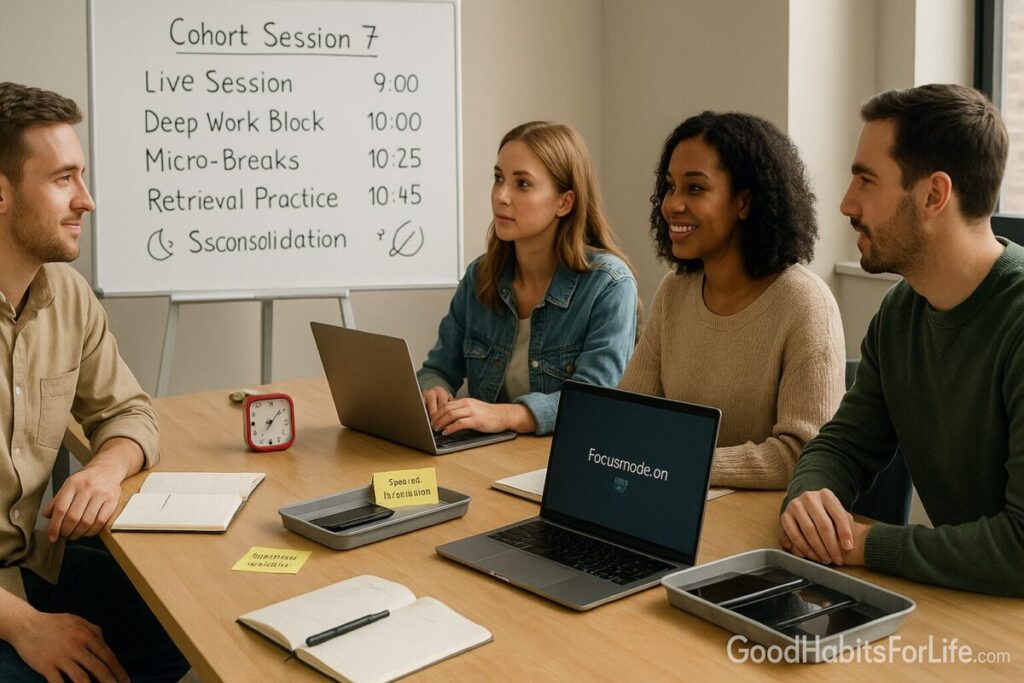
Make the Most of Cohort-Based Courses: Dopamine Detox (2025)
Make the Most of Cohort-Based Courses: Dopamine Detox (2025)
Table of Contents
🧭 What This Is & Why It Works
Cohort-based courses are programs where a group progresses together with live sessions, deadlines, and peer support. Done right, cohorts add accountability, community, and structured feedback—factors consistently linked to better engagement and learning outcomes. ERIC+2ScienceDirect+2
“Dopamine detox,” as used here, is not about eliminating dopamine (a vital neurotransmitter). It’s a practical routine to minimize high-stimulation cues (social feeds, push alerts, multitasking) during deep-work windows so your attention stays on the task. Medical and academic sources caution against taking “detox” literally, but agree that reducing overstimulating inputs can help focus—especially when paired with healthy routines. Harvard Health+2Cleveland Clinic+2
Why combine them? Cohorts supply social structure; detox supplies stimulus control. Together they protect working memory, reduce mind-wandering, and raise follow-through. Even the mere presence of a smartphone measurably drains cognitive capacity; notifications further impair attention. Chicago Journals+2PMC+2
Evidence pillars we’ll use: retrieval practice (“testing effect”), spaced repetition, micro-breaks, and sleep-supported consolidation. CDC+3Psychnet+3SAGE Journals+3
✅ Quick Start: Today-Tonight-This Week
Today (15–30 minutes):
-
Write your Course North Star (1–2 sentences).
-
Book 3 recurring deep-work blocks in your calendar (90 minutes each).
-
Silence the noise: turn off non-essential notifications; put your phone in another room during blocks. Chicago Journals
-
Form a buddy pair in your cohort; agree on weekly check-ins.
-
Create a simple “study log” (Notion/Sheets): date, task, retrieval quiz score, next step.
Tonight (10 minutes):
-
Plan tomorrow’s first task as a concrete verb + object (“Draft outline for Module 2 reflection”).
-
Set Focus Mode/Do Not Disturb schedule that auto-triggers your deep-work windows.
This week:
-
Start a 7-Day Detox Sprint (below).
-
Attend live sessions with 1 question pre-written; post one helpful comment per session.
-
Do retrieval first, re-read second—quiz yourself before reviewing notes. Psychnet
🛠️ 7-Day Detox Sprint for Cohort Success
Goal: Cut digital noise, build momentum, and cement a high-impact routine.
Rules (daily during your deep-work blocks):
-
Phone in another room; laptop on single-tab mode; feeds closed. Chicago Journals
-
Push alerts off except calendar and critical contacts (family/manager). Recent data show “alert fatigue” pushes people to disable alerts altogether—be selective. Reuters Institute
-
Work in 40–50 min focus + 5–10 min micro-break cycles; short breaks boost vigor without harming performance. PMC
-
Finish each session with a 3-item retrieval quiz you write for yourself; log score. Psychnet
Daily Checklist:
-
Block #1 complete (score: __/3)
-
Logged next-step + time estimate
-
Buddy check-in sent (2 lines: “what I did / what’s next”)
End-of-Week Reflection (20 minutes):
-
What time of day gave you the highest quiz scores?
-
Which triggers (apps, sites) still leak in? Add them to your blocker list.
-
Commit to a 30-60-90 plan (below).
🧠 30-60-90 Learning Roadmap (with Checkpoints)
30 days — Foundation
-
Set skill outcomes (e.g., “publish a working demo”, “deliver a 5-minute teach-back”).
-
Establish three fixed focus blocks/week + one cohort ritual (peer review or office hours).
-
Start spaced repetition: review key concepts after 1, 3, 7, 14, 28 days. (Spacing works: optimal gaps scale with how long you must remember.) SAGE Journals
-
Checkpoint: 2–3 artifacts (notes, quiz scores, a mini-deliverable).
60 days — Application
-
Add a capstone thread: small project or case study with weekly milestones.
-
Keep “detox” boundaries for all deep-work windows; pings stay off.
-
Enhance retrieval practice: 10-question self-tests; swap quizzes with your buddy. Psychnet
-
Checkpoint: Public share (demo, write-up, or lightning talk).
90 days — Mastery & Transfer
-
Teach a live mini-lesson to your cohort (15 minutes).
-
Compile a portfolio page: artifact + reflection + “what I’d improve.”
-
Decide which routines become permanent habits; research suggests habit formation is gradual (often ~66 days median). Wiley Online Library
-
Checkpoint: Instructor/buddy feedback + next course or project plan.
🛠️ Techniques & Frameworks that Move the Needle
1) Retrieval before review — Test yourself first; it strengthens memory more than re-reading. Psychnet
2) Spaced practice — Distribute reviews over days/weeks; aim for gaps ~10–20% of your target retention interval. SAGE Journals
3) Micro-breaks — 5–10 minute pauses restore vigor; use them at natural stopping points. PMC
4) Sleep-protect your learning — Adults generally need ≥7 hours; sleep supports memory consolidation. CDC+1
5) Implementation intentions (“if-then” plans) — Pre-decide cues and actions: If it’s 7:30 p.m., then I open the cohort portal and start the quiz. cancercontrol.cancer.gov
6) Commitment devices — Self-imposed deadlines and public commitments reduce procrastination; external deadlines work even better. PubMed
🤝 Make the Cohort Work for You (Roles & Rituals)
Roles:
-
Buddy Pair: accountability + quiz swap.
-
Pod of 4–6: rotating “Hot Seat” to present work-in-progress weekly.
-
Mentor/TA loop: 1 question/week, focused and concrete.
Weekly Rituals:
-
Monday 15′ Plan: one outcome + three tasks.
-
Midweek 10′ Pod Check-in: “Green/Yellow/Red + next step.”
-
Friday 20′ Show-and-Tell: micro-demo + peer score (1–5) on clarity/applicability.
Why this structure? Cooperative/collaborative learning improves achievement and engagement across levels and subjects; cohorts bring those benefits online when you add cadence and accountability. ERIC+1
👤 Audience Variations
Students: Shorter blocks (25–30 min) are fine; prioritize retrieval quizzes and weekly office hours.
Professionals: Protect early-day deep work; tie outcomes to a work deliverable.
Parents/Caregivers: Use two 40-minute blocks/day; front-load high-cognitive work during quiet windows.
Seniors: Add slightly longer review intervals for spacing; pair with a younger buddy for tech setup.
Teens: Phone in another room is non-negotiable during blocks; swap memes for a single Discord summary after study. (Presence matters.) Chicago Journals
⚠️ Mistakes & Myths to Avoid
-
Myth: “Dopamine detox removes dopamine.” False. We’re reducing stimulus exposure, not brain chemistry. Harvard Health
-
Mistake: Keeping the phone on the desk “just in case.” Even silent phones nearby tax cognition. Chicago Journals
-
Mistake: Re-reading notes as the main strategy. Retrieval + spacing outperform passive review. Psychnet+1
-
Mistake: Endless sessions without breaks. Small, regular micro-breaks preserve energy. PMC
-
Myth: “More alerts = more informed.” Over-alerting leads to “alert fatigue”—curate your notifications. Reuters Institute
🗣️ Real-Life Scripts You Can Copy-Paste
Buddy Invite (DM):
“Hey! Want to pair up for weekly 10-minute check-ins? I’ll send Tues/Thu updates (what I did / next step). We can swap 5-question quizzes before Friday.”
Cohort Post (before live):
“I’m aiming to build ___ by Week 4. Today I’m stuck on ___. If anyone’s solved it, I’d love a 2-minute pointer after class.”
Manager Message (protect time):
“I’m in a cohort through Oct. I’ve blocked Tue/Thu 7:30–9:00 a.m. IST for skill practice. I’ll share a one-pager each Friday summarizing progress.”
Self “If-Then” Plan:
“If it’s 20:00 and I’m home, then I open the portal, start the quiz, and keep my phone in the kitchen.” cancercontrol.cancer.gov
🧰 Tools, Apps & Resources (brief pros/cons)
-
System Focus Modes / Do Not Disturb (iOS/Android/macOS/Windows): free, schedule-able; set exceptions for family/manager.
-
Website/App Blockers (Freedom, Cold Turkey, FocusToDo): strong guardrails; can be too rigid—use “allowlist” during sprints.
-
Spaced-Repetition (Anki, RemNote): ideal for concepts/definitions; pair with applied practice.
-
Timers (native Clock, Focus To-Do): simple cycles (40–50/5–10).
-
Note Systems (Notion, Obsidian): easy logs; don’t over-engineer—template a 1-page “Study Log.”
-
Calendar + Habit Tracker (Google Calendar + Streaks/Loop): automate your 3 weekly blocks; track streaks to reinforce habits.
📌 Key Takeaways
-
Cohorts amplify learning via community, cadence, and accountability—match that structure with a calm stimulus environment. ERIC
-
“Dopamine detox” here = reducing high-dopamine cues during study, not biology tinkering. Harvard Health
-
Anchor your routine in retrieval + spacing + sleep + micro-breaks, proven to improve retention and energy. CDC+3Psychnet+3SAGE Journals+3
-
Protect attention: phone away, alerts curated; build buddy and pod rituals for momentum. Chicago Journals
❓ FAQs
1) Is “dopamine detox” scientific?
Not as a literal detox. It’s a helpful shorthand for reducing overstimulation (alerts, feeds) while you study. Pair it with sleep and evidence-based study methods. Harvard Health
2) How many focus blocks per week?
Start with 3 blocks of 90 minutes. Scale to 5 when sustainable.
3) What if my cohort is fully async?
Create sync moments: buddy check-ins, weekly pod “Hot Seat,” and end-of-week show-and-tell.
4) Is Pomodoro required?
No. Use 40–50/5–10 cycles or 90-minute blocks with micro-breaks; meta-analyses support short breaks for vigor. PMC
5) How much sleep do I need while studying?
Most adults need ≥7 hours; sleep consolidates learning. CDC+1
6) Should I turn off all notifications?
Keep calendar and family/manager; mute the rest. Over-alerting creates “alert fatigue.” Reuters Institute
7) What if I still procrastinate?
Use if-then plans and commitment devices (public deadlines, buddy stakes). cancercontrol.cancer.gov+1
8) How long to build a study habit?
Varies by person/behavior; a classic field study found a ~66-day median to automaticity. Wiley Online Library
📚 References
-
Ward AF, Duke K, Gneezy A, Bos MW. Brain Drain: The Mere Presence of One’s Own Smartphone. Journal of the Association for Consumer Research (2017). (PDF) https://r.jordan.im/download/cognition/ward2017.pdf r.jordan.im
-
Skowronek J, et al. The mere presence of a smartphone reduces basal cognitive performance. Scientific Reports (2023). https://www.nature.com/articles/s41598-023-36256-4 Nature
-
Roediger HL, Karpicke JD. The Power of Testing Memory. Perspectives on Psychological Science (2006). https://psychnet.wustl.edu/memory/wp-content/uploads/2018/04/Roediger-Karpicke-2006_PPS.pdf Psychnet
-
Cepeda NJ, et al. Spacing effects in learning. Psychological Science (2008). https://journals.sagepub.com/doi/abs/10.1111/j.1467-9280.2008.02209.x SAGE Journals
-
Albulescu P, Macsinga I. “Give me a break!” A systematic review and meta-analysis on the efficacy of micro-breaks. PLOS ONE (2022). https://pmc.ncbi.nlm.nih.gov/articles/PMC9432722/ PMC
-
CDC. About Sleep (updated 2024): recommended hours for adults. https://www.cdc.gov/sleep/about/index.html CDC
-
Newbury CR, et al. Sleep Deprivation and Memory: Meta-Analytic Reviews. Psychonomic Bulletin & Review (2021). https://pmc.ncbi.nlm.nih.gov/articles/PMC8893218/ PMC
-
Gillies RM. Cooperative Learning: Review of Research and Practice. Australian Journal of Teacher Education (2016). (PDF) https://files.eric.ed.gov/fulltext/EJ1096789.pdf ERIC
-
Kyndt E, et al. Meta-analysis of the effects of cooperative learning on achievement and attitudes. Procedia – Social and Behavioral Sciences (2013). https://www.sciencedirect.com/science/article/abs/pii/S1747938X13000122 ScienceDirect
-
Reuters Institute. Digital News Report 2025: Executive Summary (on alert fatigue & notifications). https://reutersinstitute.politics.ox.ac.uk/digital-news-report/2025/dnr-executive-summary Reuters Institute
-
Harvard Health Publishing. Dopamine fasting: Misunderstanding science spawns a maladaptive fad (2020). https://www.health.harvard.edu/blog/dopamine-fasting-misunderstanding-science-spawns-a-maladaptive-fad-2020022618917 Harvard Health
-
Cleveland Clinic. Dopamine Detoxes Don’t Work: Here’s What To Do Instead (2024). https://health.clevelandclinic.org/dopamine-detox Cleveland Clinic
Disclaimer: This guide is educational and not a substitute for professional medical or mental-health advice; consult a qualified professional for personalized guidance.