
Wearables for Study: HRV, Focus & Break Timing: Dopamine Detox (2025)
Wearables for Study: HRV, Focus & Dopamine Detox (2025)
Table of Contents
🧭 What & Why
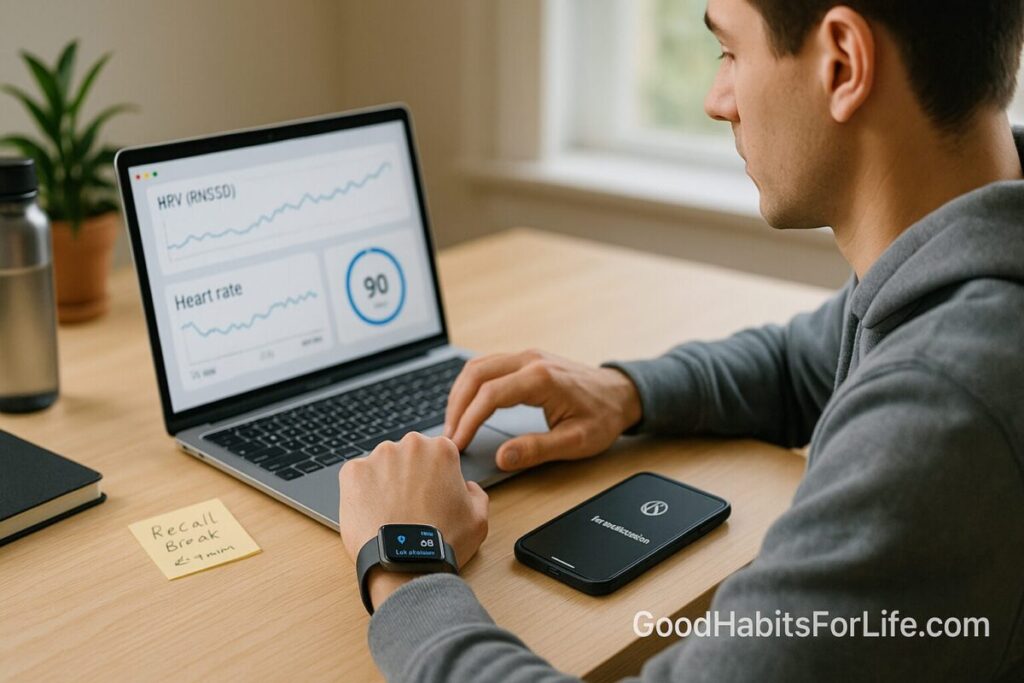
Definition. “Wearables for study” means using smartwatch/ring sensors plus phone settings to shape when you focus, how you break, and what to change when fatigue creeps in. The most useful signals for students and knowledge workers are:
-
HRV (RMSSD/lnRMSSD): higher is generally better parasympathetic tone; drops from your personal baseline can indicate stress or recovery debt. PMC+1
-
Heart rate + notifications/interruptions: frequent pings and context switches degrade performance and increase re-orientation costs. PMC+1
-
Screen/eye strain indicators: short vision breaks keep comfort and focus higher across long sessions. AOA
Evidence snapshot. HRV correlates with cognition (processing speed, working memory). Micro-breaks help well-being and performance, while reducing notification-driven interruptions improves performance and lowers strain. PMC+2PMC+2
Why it matters in 2025. Modern wearables measure HRV via PPG (good enough when used consistently, but not lab-grade); chest-strap or ECG patches are most accurate. Build decisions on your trend, not single numbers. Oxford Academic+1
✅ Quick Start: Today’s Setup (15–20 minutes)
-
Pick your focus window (90–120 min total): two × 40–50-minute focus blocks with a 7–10-minute break between. Add a 20–30-minute break after two blocks. Use your wearable/phone timer. Micro-breaks work; you don’t need to over-engineer them. PMC
-
Silence interruptions: Enable Focus/Do Not Disturb for study apps only; kill banner notifications. Consider batch-checking messages at the big break. PMC
-
Baseline your HRV: Each morning, note the wearable’s overnight RMSSD/lnRMSSD trend. Mark today as normal / above / below baseline. Decisions use the trend, not one reading. PMC
-
Protect your eyes: Use the 20-20-20 rule every ~20 minutes: look 6 m (20 ft) away for 20 s. AOA
-
Loop: Focus → micro-break (stand, stretch, water) → quick check: “How’s energy? Any HRV dip vs. baseline? Too many pings?” → adjust next block length. PMC
-
Reframe “dopamine detox”: Treat it as a stimulus audit—remove compulsive triggers (autoplay, infinite scroll) during study days, not a biology cleanse. Harvard Health+1
🛠️ 30-60-90 Study Habit Plan
Days 1–30: Build the Loop
-
Goal: Consistent two-block sessions + micro-breaks.
-
Actions:
-
Checkpoint (Day 30): ≥15 study days completed; <5 unplanned interruptions per session.
Days 31–60: Personalize by Signals
-
Goal: Match block length to your fatigue curve.
-
Actions:
-
Checkpoint (Day 60): Interruptions down ≥30%; subjective focus up (journal 1–5 scale).
Days 61–90: Deep Work & Exam Peaks
-
Goal: Back-to-back focus cycles with minimal pings.
-
Actions:
-
Batch messages at top of big break only; keep device on DND otherwise. PMC
-
Consider ECG-grade strap for exam periods if you rely heavily on HRV; PPG is fine day-to-day but less precise minute-to-minute. Oxford Academic+1
-
-
Checkpoint (Day 90): Two 90–120-minute focus windows/day without drift; sustainable energy through finals week.
🧠 Techniques & Frameworks that Pair Well with Wearables
1) Micro-Breaks > Marathon Sessions
Short, purposeful breaks maintain well-being and give a small but real performance lift. Avoid doom-scroll breaks—move, stretch, breathe. PMC
2) Pomodoro vs. Flowtime
-
Pomodoro (25/5) is popular, but emerging studies show mixed motivational effects; adjust to your energy curve. Try 40–50/7–10 or Flowtime (work until natural fatigue, then break). PMC+1
-
Rule of thumb: Increase block length when HRV trend is steady/above baseline; shorten when trend is down and you feel mental drag. PMC
3) Notification Fasting (the real “detox”)
Reduce alerts; each interruption adds re-orientation cost and strain. Schedule two message windows per half-day. PMC+1
4) Eye & Posture Hygiene
Use 20-20-20 and stand/shoulder rolls every break; comfort preserves focus across a long study day. AOA
5) Signal → Action Map (use this cheat sheet)
| Signal (from device) | What it may indicate | Action during study |
|---|---|---|
| Morning HRV ↓ vs. your 7-day avg | Lower recovery/higher stress | Shorter blocks; longer breaks; early night. PMC |
| Notifications spike | Fragmented attention | Lockdown Focus Mode; batch messages. PMC |
| Eye fatigue/headache | Visual strain | 20-20-20; soften brightness; enlarge text. AOA |
👥 Audience Variations
-
Students: Use class times as anchors: one focus block before class, one after. Protect evenings pre-exam with stricter notification fasting. PMC
-
Professionals: Reserve two daily focus windows (AM/PM). Align breaks with meeting clusters; batch email at lunch + end-day. UC Irvine ICS
-
Seniors/Returning learners: Favor slightly shorter blocks (30–40 min) and longer breaks; prioritize comfort and lighting. Micro-break benefits extend to well-being. PMC
-
Teens: Co-design a family “study quiet hour” with phones parked outside the room; enable app limits. PMC
⚠️ Mistakes & Myths to Avoid
-
Myth: “Dopamine detox lowers dopamine.”
Reality: It’s a behavior strategy, not a biochemical cleanse; use it to reduce impulsive triggers, not to “reset brain chemicals.” Harvard Health+1 -
Mistake: Chasing exact HRV numbers from a smartwatch.
Fix: Track trends vs. your baseline; PPG is convenient but not clinical—ECG/strap is more precise. Oxford Academic+1 -
Mistake: Breaks = scrolling.
Fix: Make breaks off-screen: walk, stretch, water, breath work. Micro-breaks work best when restorative. PMC
💬 Real-Life Examples & Scripts
-
Focus Mode script (friends/roommates):
“I’m on two 45-minute focus blocks. I’ll reply at 1:15 and 3:30. If urgent, knock—otherwise I’ll catch up then.” -
Study partner check-in:
“HRV dipped today; let’s do 35/8 blocks and swap notes at the big break.” -
Self-prompt at break:
“Stand, sip water, 10 deep breaths. Eyes 20-20-20. One stretch. Back in 7.”
📚 Tools, Apps & Resources (quick pros/cons)
-
Wearables: Apple Watch, Garmin, WHOOP, Oura, Polar H10 (strap). Pros: easy HR/HRV trends, timers, DND. Cons: PPG HRV less precise minute-to-minute; straps more accurate but less comfy. Oxford Academic+1
-
Timers/Focus apps: iOS Focus, Android Focus Mode, Forest, Focus To-Do, Flowtime. Pros: scheduling + block analytics. Cons: can become another distraction—keep simple.
-
Distraction blockers: Freedom, Cold Turkey, Screen Time/Focus filters. Pros: removes triggers for a real “detox.” Cons: requires setup discipline. PMC
-
Eye care: Native reminders or 20-20-20 apps; blue-light filters optional; the rule matters more than the tint. AOA
🔑 Key Takeaways
-
Use your wearable as a decision aid, not a judge—trend over time beats single numbers. PMC
-
Protect attention first (DND + batching); then fine-tune block lengths with HRV and energy. PMC
-
Make breaks active and off-screen; micro-breaks and eye hygiene keep you going longer. PMC+1
-
Treat “dopamine detox” as stimulus control, not biochemistry. Harvard Health
❓ FAQs
1) What’s a good HRV for students?
There’s no universal “good” HRV—track your 7–30-day average and note trends (↑/→/↓). Use dips to shorten blocks and extend breaks. PMC
2) Can my smartwatch’s HRV be trusted?
For day-to-day trends, yes. For precise, minute-level analysis, ECG/strap is more accurate than wrist PPG. Oxford Academic+1
3) How long should my breaks be?
Short micro-breaks (e.g., 5–10 min) help well-being and performance; test 40–50/7–10 or Flowtime. PMC+1
4) Is the Pomodoro Technique the best?
It’s a great starting point, but not magic. Research is mixed; adapt intervals to your energy and HRV trend. PMC
5) Does “dopamine detox” increase focus?
It can help by removing triggers (autoplay, notifications), not by changing dopamine levels. Think “notification fasting.” Harvard Health+1
6) Why are notifications so bad for studying?
They cause context switches that slow you down and raise strain. Use DND and batch checks. PMC+1
7) Any simple eye-care rule I can remember?
Yes—20-20-20: every 20 minutes, look 6 m (20 ft) away for 20 seconds. AOA
8) Should I study longer when my HRV is high?
You can try slightly longer blocks on high-recovery days; shorten when HRV is low or you feel mental drag. PMC
References
-
Nicolini, P. et al. Heart Rate Variability and Cognition: A Narrative Review. 2024. https://pmc.ncbi.nlm.nih.gov/articles/PMC10780278/ PMC
-
Liu, K.Y. et al. HRV in relation to cognition and behavior. 2022. https://pmc.ncbi.nlm.nih.gov/articles/PMC8783051/ PMC
-
Albulescu, P. et al. “Give me a break!” A meta-analysis of micro-breaks. 2022. https://pmc.ncbi.nlm.nih.gov/articles/PMC9432722/ PMC
-
Ohly, S. et al. Task interruptions from notifications and performance. 2023. https://pmc.ncbi.nlm.nih.gov/articles/PMC10244611/ PMC
-
Mark, G. et al. The Cost of Interrupted Work. CHI 2008. https://www.ics.uci.edu/~gmark/chi08-mark.pdf UC Irvine ICS
-
American Optometric Association. Computer Vision Syndrome & 20-20-20. https://www.aoa.org/healthy-eyes/eye-and-vision-conditions/computer-vision-syndrome AOA
-
Theurl, F. et al. Smartwatch-derived HRV vs ECG accuracy. 2023. https://academic.oup.com/ehjdh/article/4/3/155/7084638 Oxford Academic
-
Sinichi, M. et al. Assessing the Accuracy of Heart Rate Wearables & HRV. 2025. https://pmc.ncbi.nlm.nih.gov/articles/PMC11794680/ PMC
-
Harvard Health Publishing (Grinspoon, P.). Dopamine fasting: misunderstanding science. 2020. https://www.health.harvard.edu/blog/dopamine-fasting-misunderstanding-science-spawns-a-maladaptive-fad-2020022618917 Harvard Health
-
Fei, Y.Y. Dopamine fasting as a self-control strategy. 2022. https://onlinelibrary.wiley.com/doi/full/10.1002/lim2.54 Wiley Online Library
Disclaimer: This guide is educational and not a substitute for medical or mental-health advice; consult a qualified professional for personal decisions.