
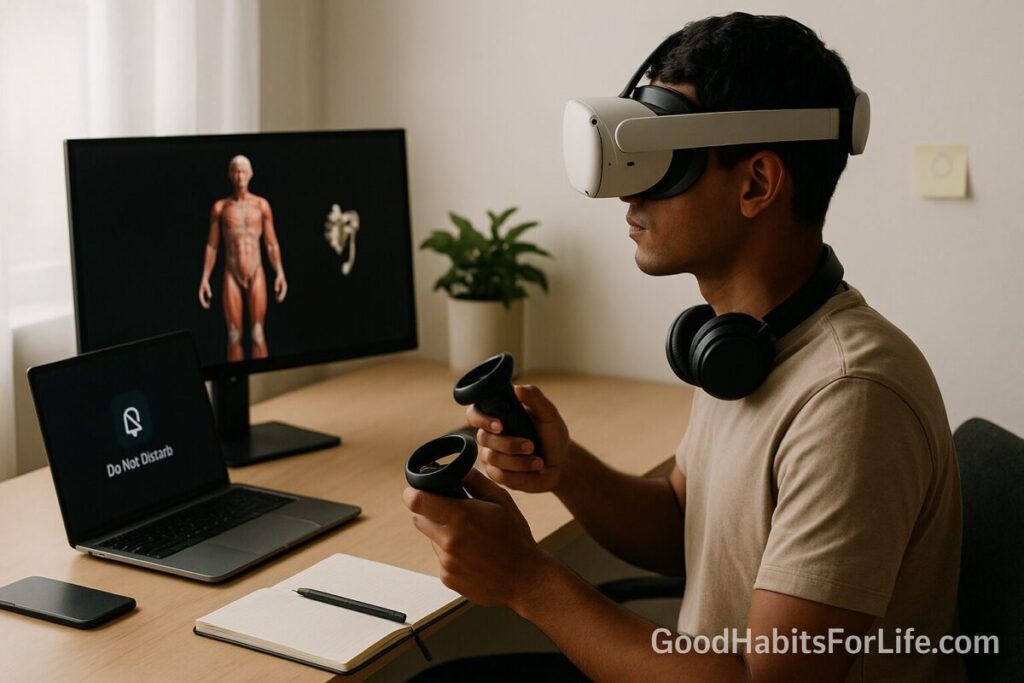
VR/AR for Learning: When Immersion Helps: Dopamine Detox (2025)
VR/AR for Learning: When Immersion Helps: Dopamine Detox
Table of Contents
🧭 What & Why
VR/AR for learning can improve motivation, presence, and certain learning outcomes—especially where 3D spatial understanding, embodied practice, or safe simulation matter (e.g., anatomy, labs, engineering, language immersion). The Cognitive Affective Model of Immersive Learning (CAMIL) explains how presence and agency in immersive environments influence outcomes via motivation, self-efficacy, and cognitive load. SpringerLink+1
What “Dopamine Detox” means here: not a medical detox. It’s a low-stimulation study window (no endless scrolling/alerts) to reduce novelty-seeking distractions so attention can anchor on a meaningful task. Experts warn the “detox” label is misleading, but reducing high-stimulation inputs can support self-control and learning focus. Harvard Health+1
Evidence snapshot
-
Meta-analyses find AR and VR can yield small-to-moderate gains in achievement, motivation, and engagement—when instruction is designed well. ScienceDirect+2ScienceDirect+2
-
Risks: cybersickness (nausea, dizziness) appears in a notable minority of users and can undermine learning if sessions are long or poorly designed. ACM Digital Library+1
Bottom line: Immersion helps when it reduces extraneous load and adds otherwise-impossible experiences—not just because it’s shiny.
✅ Quick Start (Do This Today)
-
Pick the right target: Choose a concept that truly benefits from immersion (e.g., visualizing molecular structures, touring historical sites).
-
Set a 20-minute cap: Short, goal-tied sessions reduce fatigue and cybersickness risk. Add a 5-minute debrief. ACM Digital Library
-
Create a “detox window”: Silence notifications, close social apps, and put phone out of reach. This reframes “dopamine detox” as distraction-light study time. Harvard Health
-
Define a success metric: e.g., “label 10 anatomy structures at 90% accuracy” or “explain turbine airflow with a diagram.”
-
Run + debrief: Take quick notes (what clicked, what confused, any discomfort).
-
Cool-down transfer: Immediately write a one-paragraph summary or sketch what you learned; retrieval strengthens memory.
🛠️ 30-60-90 Habit Plan
Days 1–30: Pilot & Fit
-
Choose 1–2 topics where 3D/embodiment matters.
-
Two sessions/week, 15–20 min each; log comfort, achievement, and motivation (1–5 scale).
-
Detox routine: No notifications + clean desk + time-boxed focus.
-
Exit survey: What improved vs. textbook/video? Any cybersickness? ScienceDirect
Days 31–60: Optimize & Compare
-
Apply CAMIL and cognitive load checks (see next section).
-
AB test: VR/AR vs. high-quality 2D explainer. Track accuracy/retention after 48 hours. SpringerLink
-
Tune: Shorten segments, add advance organizers (pre-briefs), and insert micro-pauses if discomfort arises. ACM Digital Library
Days 61–90: Scale & Systematize
-
Expand to 3–4 modules only if data show gains.
-
Build a playbook: when to use VR/AR, session length, debrief prompts, accessibility steps.
-
Share results and templates with your class/team; keep iterating quarterly.
🧠 Techniques & Frameworks
1) CAMIL (Cognitive Affective Model of Immersive Learning)
-
Aim for presence and agency while controlling cognitive load.
-
Design moves: clear goals, guided prompts, minimal UI clutter, and immediate feedback. SpringerLink
2) Cognitive Load Management
-
Intrinsic load (task difficulty): sequence from simple to complex.
-
Extraneous load (distractions): avoid over-busy scenes; remove irrelevant audio/objects.
-
Germane load (meaning-making): add quick reflection notes or label-as-you-go tasks.
3) The “3R” Immersion Rule
-
Replace: Use VR/AR only when it replaces the impossible (dangerous/remote/invisible).
-
Refine: Use it to refine mental models with spatial cues and embodiment.
-
Rehearse: Use it to rehearse procedures safely before real-world practice.
4) Low-Stimulation Study Windows (“Detox Windows”)
-
20–45 minutes with no novelty feeds (shorts/reels), no alerts, and one task.
-
Pair the window with an immersive session or with retrieval practice right after. Clarify that this is behavior design, not a neurochemical cleanse. Harvard Health
5) Cybersickness Mitigation
-
Prefer teleport locomotion to smooth walking; keep stable horizon and high frame rates.
-
Start with seated experiences; add breaks and hydration.
-
Screening: Offer a 2-minute trial and an opt-out alternative. ACM Digital Library+1
👥 Audience Variations
-
Students (K–12 & college): Use VR for field trips, anatomy, physics visualizations; AR for lab overlays and step guidance. Keep sessions brief; add worksheet prompts to transfer learning to paper. ERIC+1
-
Professionals: Use VR for safety drills, equipment walk-throughs, and client demo rehearsals—log performance metrics. ScienceDirect
-
Seniors: Prioritize comfort (seated, large text, slower pacing). Offer 2D alternatives.
-
Parents/Guardians: Co-view short AR experiences; ask kids to teach back what they saw in 2–3 sentences.
-
Teens: Tie detox windows to a study contract: one immersive session → one retrieval practice → short break (walk, water).
⚠️ Mistakes & Myths to Avoid
-
Myth: “Any VR beats 2D.” Not true—design quality decides. Use immersion only for unique value. ScienceDirect
-
Myth: “Dopamine detox” fixes learning. It’s a catchy label; what helps is structured stimulus control and habits. Harvard Health
-
Mistake: Long sessions. Over 20–30 minutes, fatigue and cybersickness rise; split into micro-sessions with debriefs. ACM Digital Library
-
Mistake: No transfer task. Always summarize/diagram/quiz right after the immersive experience.
-
Mistake: Ignoring accessibility. Provide seated options, subtitles, and non-VR paths.
💬 Real-Life Examples & Scripts
Teacher → Class (pre-brief)
“In 15 minutes you’ll explore a virtual wind tunnel. Your goal: sketch airflow around a wing and label 3 high-pressure zones. If you feel dizzy, raise your hand—we’ll pause.”
Student self-prompt (detox window)
“Phone on Do Not Disturb, timer 20 minutes, goal: complete heart-chamber identification at 90% accuracy, then write a 4-sentence summary.”
Manager → Team (pilot)
“We’ll A/B test VR equipment checks vs. video. Measure errors, completion time, and confidence. If VR wins by 15%+, we’ll scale.”
Parent → Teen
“We’ll try a 20-minute AR cell-model tour with no notifications. After, you’ll explain how mitochondria ‘pay the bills’ in two sentences.”
🧰 Tools, Apps & Resources (brief, non-exhaustive)
-
Headsets/Devices: Standalone VR headsets; AR on tablets/phones. Prioritize comfort, resolution, and frame rate to cut cybersickness. ssih.org
-
Content types:
-
Simulations (lab safety, anatomy), 3D field trips, language role-play, procedural practice.
-
-
Design helpers:
-
Advance organizers (one-page pre-brief), guided labels, checklists, voiceovers with captions.
-
-
Data capture: Simple exit tickets, 3-item confidence scales, short delayed quizzes (48–72 hours).
Pros: high presence, safer practice, spatial insight. Cons: discomfort risk, prep time, device cost, variable content quality. SpringerLink+1
📚 Key Takeaways
-
Use VR/AR only when immersion solves a real problem (spatial/embodied/safety).
-
Pair with low-stimulation study windows to protect attention—skip the hype, keep the habit. Harvard Health
-
Keep sessions short and goal-based; always debrief and transfer learning. ACM Digital Library
-
Pilot, measure, and scale with CAMIL and cognitive load as your guardrails. SpringerLink
❓ FAQs
1) Is VR/AR always better than video or a textbook?
No. It helps when it adds unique value (3D/embodiment/safety). Otherwise, high-quality 2D may match or beat it. ScienceDirect
2) How long should sessions be?
Start with 15–20 minutes, then debrief. Extend only if comfort and performance are stable. ACM Digital Library
3) What is “dopamine detox” in practical terms?
Think stimulus diet: a scheduled, low-stimulation window (no notifications/feeds) to protect attention. It’s behavior design, not a chemical detox. Harvard Health
4) How do I measure if VR/AR worked?
Use clear success metrics (accuracy, time, transfer quiz at 48–72 hours) and compare against a 2D control.
5) How do I reduce cybersickness?
Short sessions, seated starts, teleport locomotion, high frame rates, and frequent breaks. Offer an opt-out path. ACM Digital Library+1
6) Can immersion boost motivation?
Yes—presence and agency can raise interest and self-efficacy when load is managed. SpringerLink
7) Is there evidence for AR in schools?
Meta-analyses show positive effects on achievement and motivation, especially when aligned to clear goals. ScienceDirect+1
8) What about younger learners?
Elementary-level studies report benefits with thoughtful design and short sessions. ERIC
📚 References
-
Makransky, G., & Petersen, G. B. (2021). The Cognitive Affective Model of Immersive Learning (CAMIL). Educational Psychology Review. https://link.springer.com/article/10.1007/s10648-020-09586-2 SpringerLink
-
Zhi, Y., et al. (2023). A CAMIL perspective on XR language learning. Frontiers in Psychology. https://pmc.ncbi.nlm.nih.gov/articles/PMC9935696/ PMC
-
Chang, H-Y., et al. (2022). Ten years of AR in education: A meta-analysis. Computers & Education. https://www.sciencedirect.com/science/article/pii/S0360131522002123 ScienceDirect
-
Prasetya, F., et al. (2024). Impact of AR learning experiences: A meta-analysis. Heliyon (Elsevier). https://www.sciencedirect.com/science/article/pii/S2590291124001232 ScienceDirect
-
Lara-Alvarez, C. A., et al. (2023). Effectiveness of VR in elementary school: A meta-analysis. ERIC. https://files.eric.ed.gov/fulltext/EJ1406978.pdf ERIC
-
Cossio, S., et al. (2025). Cybersickness and discomfort from HMDs: Systematic review. Digital Health and Technology. https://www.sciencedirect.com/science/article/pii/S1471595325001325 ScienceDirect
-
ACM (2024). “Are you feeling sick?”—Systematic review of VR cybersickness. https://dl.acm.org/doi/10.1145/3670008 ACM Digital Library
-
Harvard Health (2020). Dopamine fasting: Misunderstanding science spawns a fad. https://www.health.harvard.edu/blog/dopamine-fasting-misunderstanding-science-spawns-a-maladaptive-fad-2020022618917 Harvard Health
-
Stanford Medicine (2025). Why our brains are wired for addiction. https://med.stanford.edu/news/insights/2025/08/addiction-science-human-brain-ancient-wiring.html Stanford Medicine
-
Howard, M. C. (2021). Meta-analysis of VR training programs. Computers in Human Behavior. https://www.sciencedirect.com/science/article/abs/pii/S074756322100131X ScienceDirect
Disclaimer: This article is educational and not a substitute for professional medical or mental-health advice; stop any session that causes discomfort and consult a professional if needed.