
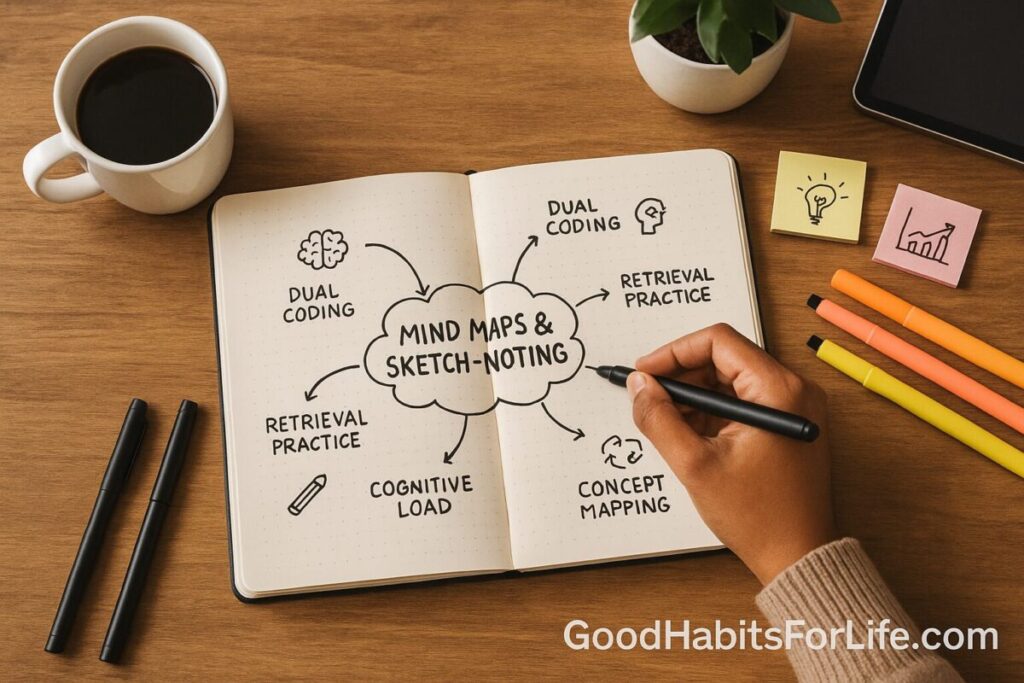
Mind Maps & Sketch-Noting: Learn with Lines
Mind Maps & Sketch-Noting: Learn with Lines
Table of Contents
🧭 What & Why (The Science in Brief)
Mind maps and sketchnotes turn linear notes into compact “meaning maps.” They combine text, arrows, and simple drawings so your brain encodes information in two channels (verbal + visual). This aligns with Dual Coding Theory and the Cognitive Theory of Multimedia Learning, both showing that learning with words and pictures beats words alone. nschwartz.yourweb.csuchico.edu+1
Drawing itself is a powerful mnemonic: across multiple experiments, drawing items to be remembered produced substantial recall gains versus writing the words. That robust “drawing effect” holds across instructions and contexts—exactly what sketchnoting formalizes. SAGE Journals
For structure and concept relationships, mapping (concept/mind maps) shows positive effects on learning across ages and subjects in a large meta-analysis. That’s why mind maps shine for planning, overviews, and exam synthesis. SAGE Journals
Retention doesn’t just depend on how you capture notes; it depends on how you revisit them. Two of the most reliable learning effects are retrieval practice (self-testing) and the spacing effect (reviewing over expanding intervals). Build these into your visual-note routine to lock in knowledge. Psychnet+1
Finally, good visuals respect cognitive load limits: reduce clutter, chunk information, and guide attention with layout and hierarchy so working memory isn’t overwhelmed. @LeadingLearner
✅ Quick Start: Your First Visual Note (20–30 minutes)
Setup (2–3 min)
-
Pick one topic (chapter/lecture/problem).
-
Choose medium: A4 paper, tablet, or a clean digital canvas.
-
Title + date at the top; leave margins for later additions.
Mind Map (12–15 min)
-
Draw a central bubble with the core idea.
-
Add 4–6 primary branches for key themes (verbs/nouns only).
-
Add 2nd-level twigs: definitions, examples, formulas, risks.
-
Use 1 icon per branch (🔬, 📈, ⚠️, 💡, etc.) and one color per branch.
-
Cross-link related branches with thin dashed arrows.
Sketchnote (alternative, 12–15 min)
-
Divide the page into title → big idea → details → actions.
-
Use containers (panels, boxes, speech bubbles) to group ideas.
-
Add simple sketches (stick figures, arrows, timelines, cycles).
-
End with 3 action bullets or an “If I only remember 3 things…” box.
Finish (3–5 min)
-
Circle 1–3 key takeaways.
-
Write 1 self-test question per main branch/panel.
-
Star anything to review tomorrow (🟊).
🛠️ 7-Day Starter Habit Plan
Goal: Produce and review one visual note daily without perfectionism.
Day 1 – Frame
-
Create a 15-minute mind map of today’s topic.
-
Add 3 retrieval questions at the edges.
Day 2 – Explain
-
Sketchnote a single concept you struggled with.
-
Add 3 panels: “What it is,” “Why it matters,” “One example.”
Day 3 – Synthesize
-
Merge yesterday’s sketchnote into yesterday’s mind map with cross-links.
-
Create a 1-minute audio summary while pointing at branches.
Day 4 – Retrieve (24-h check)
-
Close your notes and answer your questions from memory. Add/adjust branches where recall was weak. Psychnet
Day 5 – Clean & Chunk
-
Remove duplicate words, bold only the essentials, and re-draw messy arrows to reduce cognitive load. @LeadingLearner
Day 6 – Spaced Review (1-week check)
-
Revisit Day-1 notes quickly (3–5 min). Add a mini-sketch for the hardest branch. PubMed
Day 7 – Share & Script
-
Teach a friend/colleague using your visual. Note any gaps, add clarifying icons, and write a 50-word “explain like I’m new” caption.
Keep going with a 24 h → 1 week → 1 month spacing loop for hard topics. PubMed
🧠 Techniques & Frameworks that Work
1) Dual Coding in Practice
-
Pair labels with icons (term + tiny sketch).
-
Convert dense sentences into noun-verb “chunks” next to a diagram.
-
Replace repeated words with visual metaphors (e.g., funnel, ladder, cycle). nschwartz.yourweb.csuchico.edu+1
2) Retrieval + Spacing (the retention engine)
-
For every map/panel, write 2–3 self-test prompts (“Explain X in 2 steps”).
-
Schedule quick, expanding reviews: 24 h, 7 days, 30 days.
-
Use cover-and-recall: hide sub-branches and redraw them from memory. Psychnet+1
3) Cognitive Load Guardrails
-
Signal what’s important (thicker lines for main branches).
-
Segment the canvas (columns/panels) to reduce scanning.
-
Weed extraneous clipart and long sentences.
-
Align related items spatially; proximity beats color-coding alone. @LeadingLearner+1
4) Visual Vocabulary (fast, reusable)
-
People: ○ with two dots and a smile; add label.
-
Processes: arrows →, cycles ⟲, stacks ▤, ladders ⇧.
-
Decisions: diamonds ⬦ with yes/no arrows.
-
Time: horizontal timeline with tick marks; today = filled dot.
🧩 When to Use What: Mind Map vs. Sketchnote vs. Outline
| Situation | Best Tool | Why |
|---|---|---|
| Surveying a new topic, planning a project | Mind Map | Radial structure surfaces themes + gaps quickly; great for cross-links. SAGE Journals |
| Explaining a process, story, or case | Sketchnote | Panels + arrows show sequence, cause-effect, and examples; taps drawing effect. SAGE Journals |
| Drafting detailed procedures or code | Outline | Linear steps with nesting; pairs well with a side map for “why.” |
| Exam review | Mind Map + Retrieval Cards | Big-picture map + self-test prompts enable spaced, active recall. Psychnet+1 |
👥 Audience Variations
Students
-
Create a lecture map in class (main branches only). Flesh out with a sketchnote at home.
-
Convert each branch into an Anki card prompt for spaced retrieval. PubMed
Professionals
-
Use maps to scope meetings (agenda branches), then sketchnote decisions and action owners.
-
For rapid updates, maintain a living map of a project: scope, risks, metrics, next actions.
Parents
-
Sketchnote home routines (morning/evening) with kids—icons make it fun and memorable.
-
Use a mind map to plan vacations/menus together.
Seniors
-
For new tech or health info, panel sketchnotes with big labels and arrows improve clarity; keep color contrast high.
Teens
-
Turn hobby learning (music, art, gaming mods) into sketchnotes; teach a friend using your panels to reinforce.
⚠️ Mistakes & Myths to Avoid
-
Myth: “I’m bad at drawing, so sketchnoting isn’t for me.”
Stick figures are enough—the recall gain doesn’t depend on artistic quality. SAGE Journals -
Dumping paragraphs onto branches.
Use keywords; move sentences to a separate summary box to avoid overload. @LeadingLearner -
Only re-reading maps.
Always quiz yourself (hide branches, redraw from memory). Psychnet -
Laptop verbatim typing for understanding-heavy topics.
For conceptual learning, longhand/hand-drawn notes often outperform verbatim laptop notes. cpb-us-w2.wpmucdn.com
🗣️ Real-Life Examples & Scripts
Lecture capture (live) — 60-second script
“Topic in center. I’ll make five branches (definitions, examples, formulas, pitfalls, questions). I’ll add a tiny icon per branch. If I miss details, I’ll add twigs later. End with three self-test questions.”
Explain a model
“Panel 1: Big idea with a metaphor sketch. Panel 2: Steps 1–3 with arrows. Panel 3: Common mistake (⚠️) and fix. Panel 4: One real example with numbers.”
Project kickoff map
-
Center: Project name
-
Branches: Goals, Stakeholders, Risks, Milestones, Metrics, Next 2-weeks
-
Close with RACI mini-panel (who’s doing what, by when).
Exam revision (cover-and-redraw)
-
Hide sub-branches with sticky notes, redraw from memory in pencil, then reveal and correct.
🧰 Tools, Apps & Resources (quick picks)
Paper & Pens
-
Any dot-grid notebook + two pens (black + one color). Reliable, distraction-free.
Tablets/Stylus
-
GoodNotes / Notability / Concepts / Procreate: fluid handwriting, layers, export to PDF.
Mind Mapping Apps
-
XMind, MindMeister, Freeplane (free, desktop), Obsidian Canvas. Look for: keyboard shortcuts, easy rearranging, export to image/PDF.
Lightweight Diagramming
-
Excalidraw (hand-drawn look), tldraw, draw.io for quick arrows and boxes.
Spaced Retrieval
-
Anki (cards from your map branches), RemNote (maps + cards), Obsidian + Spaced Repetition plugins. (Use 24 h → 7 d → 30 d review cadence.) PubMed
Pros/Cons in brief:
-
Paper = fast, durable; harder to rearrange.
-
Digital = searchable, easy to fix; risk of app distraction—use Do Not Disturb.
📚 Key Takeaways
-
Visual notes pair words with imagery to boost encoding and comprehension. nschwartz.yourweb.csuchico.edu+1
-
Drawing is a proven memory booster; simple sketches suffice. SAGE Journals
-
Concept/mind maps improve learning outcomes across domains. SAGE Journals
-
Retrieval practice + spacing transform notes into long-term knowledge. Psychnet+1
-
Respect cognitive load: signal, segment, and simplify. @LeadingLearner
❓ FAQs
1) What’s the difference between mind maps and sketchnotes?
Mind maps are radial diagrams for structure and relationships; sketchnotes are panel-based visual explanations with a narrative flow. Use maps to organize, sketchnotes to explain—and mix as needed.
2) Do I need to be good at drawing?
No. The drawing effect works with simple sketches; recall benefits don’t require artistic skill. SAGE Journals
3) How many branches should a mind map have?
Aim for 4–6 primary branches; add twigs as needed. Too many main branches increases cognitive load and weakens hierarchy. @LeadingLearner
4) How do I review visual notes effectively?
Use cover-and-recall (retrieval practice) on a 24 h → 7 d → 30 d schedule (spacing effect). Psychnet+1
5) Is digital or paper better?
Both work. If you tend to type verbatim on laptops, handwritten/drawn notes may improve conceptual learning. Digital shines for rearranging and sharing. cpb-us-w2.wpmucdn.com
6) How long should a good sketchnote take?
15–30 minutes for a focused concept; longer for multi-topic lectures. Keep it lightweight—signal the big ideas, not every detail. @LeadingLearner
7) Can I use this for team meetings?
Yes—live-map agendas, then sketchnote decisions and action items. Sharing the visual recap boosts alignment and recall.
8) What if my topic is very formula-heavy?
Use a mind map for structure (definitions, assumptions, cases), then a sketchnote panel for worked examples and common mistakes.
References
-
Clark, J. M., & Paivio, A. (1991). Dual coding theory and education. [PDF]. California State University Chico. https://nschwartz.yourweb.csuchico.edu/Clark%20%26%20Paivio.pdf nschwartz.yourweb.csuchico.edu
-
Mayer, R. E. (2009). Multimedia Learning (2nd ed.). Cambridge University Press. [Book PDF excerpt]. https://eclass.uth.gr/modules/document/file.php/PRE_P_122/%CE%98%CE%B5%CF%89%CF%81%CE%AF%CE%B5%CF%82%20%CE%BC%CE%AC%CE%B8%CE%B7%CF%83%CE%B7%CF%82%20%CE%BA%CE%B1%CE%B9%20%CE%B3%CE%BD%CF%89%CF%83%CF%84%CE%B9%CE%BA%CE%AD%CF%82%20%CE%B8%CE%B5%CF%89%CF%81%CE%AF%CE%B5%CF%82%20—%20%CE%95%CE%BA%CF%80%CE%B1%CE%B9%CE%B4%CE%B5%CF%85%CF%84%CE%B9%CE%BA%CF%8C%CF%82%20%CF%83%CF%87%CE%B5%CE%B4%CE%B9%CE%B1%CF%83%CE%BC%CF%8C%CF%82/Richard%20E.%20Mayer-Multimedia%20Learning-Cambridge%20University%20Press%20%282009%29.pdf eclass.uth.gr
-
Wammes, J. D., Meade, M. E., & Fernandes, M. A. (2016). The drawing effect: Evidence for reliable and robust memory benefits in free recall. Quarterly Journal of Experimental Psychology, 69(9), 1752–1776. https://journals.sagepub.com/doi/10.1080/17470218.2015.1094494 SAGE Journals
-
Nesbit, J. C., & Adesope, O. O. (2006). Learning with concept and knowledge maps: A meta-analysis. Review of Educational Research, 76(3), 413–448. https://journals.sagepub.com/doi/10.3102/00346543076003413 SAGE Journals
-
Roediger, H. L., & Karpicke, J. D. (2006). The power of testing memory: From basic research to educational practice. Perspectives on Psychological Science, 1(3), 181–210. [PDF]. https://psychnet.wustl.edu/memory/wp-content/uploads/2018/04/Roediger-Karpicke-2006_PPS.pdf Psychnet
-
Cepeda, N. J., et al. (2008). Spacing effects in learning: A temporal ridgeline of optimal intervals. Psychological Science, 19(11), 1095–1102. https://pubmed.ncbi.nlm.nih.gov/19076480/ PubMed
-
Sweller, J., van Merriënboer, J. J. G., & Paas, F. (2019). Cognitive architecture and instructional design: 20 years later. Educational Psychology Review, 31, 261–292. [PDF]. https://leadinglearner.me/wp-content/uploads/2019/02/sweller2019_article_cognitivearchitectureandinstru.pdf @LeadingLearner
-
Mueller, P. A., & Oppenheimer, D. M. (2014). The pen is mightier than the keyboard: Advantages of longhand over laptop note-taking. Psychological Science, 25(6), 1159–1168. [PDF]. https://cpb-us-w2.wpmucdn.com/sites.udel.edu/dist/6/132/files/2010/11/Psychological-Science-2014-Mueller-0956797614524581-1u0h0yu.pdf cpb-us-w2.wpmucdn.com