
Zettelkasten for Students (2025 Edition)
Zettelkasten for Students (2025 Edition)
Table of Contents
🧭 What & Why
What is Zettelkasten?
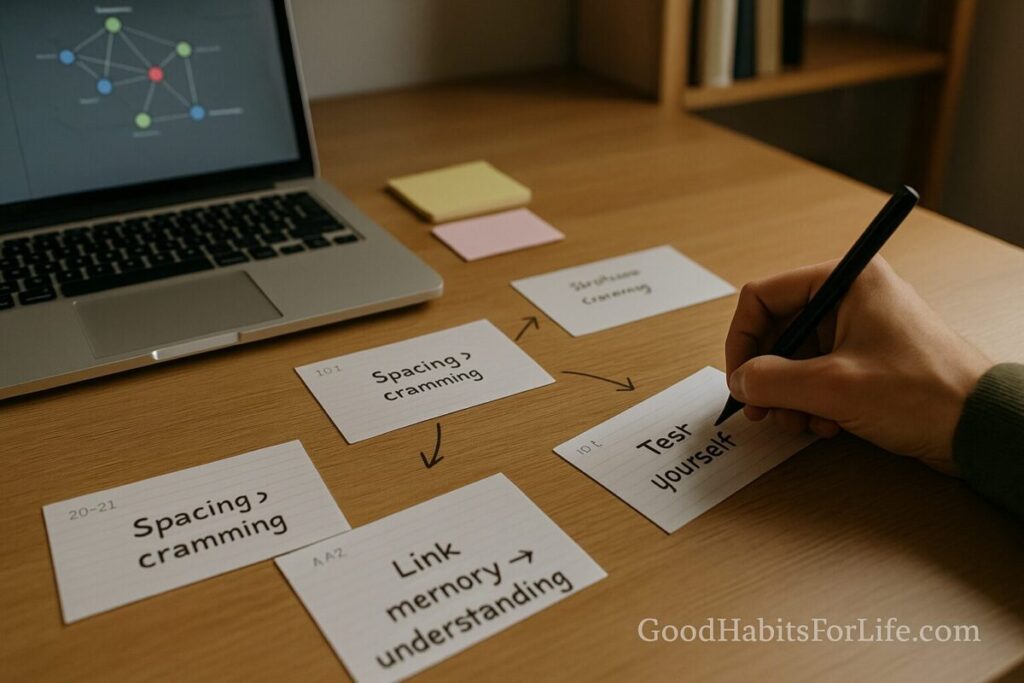
Zettelkasten (“slip-box”) is a note-taking method where you write one permanent idea per note in your own words, give it a simple identifier, and link it to related notes. Over time you get a web of ideas you can browse, study, and assemble into papers. Think ideas-first, not folders-first. Zettelkasten+1
Why students should care in 2025
-
Better memory: Regular self-testing and spaced study sessions beat highlight-and-re-read. Zettelkasten makes retrieval easy because each note is a cue. Psychnet+1
-
Faster writing: Linked notes become ready-made outlines for essays and projects (popularized for students by Ahrens). Sönke Ahrens
-
Deeper understanding: Building a network of concepts (like a personal concept map) improves learning outcomes. Semantic Scholar
-
Clean workflow: University libraries now teach modern note-taking with digital tools you already use. guides.library.yale.edu
✅ Quick Start (Do This Today)
-
Pick a home base. Use Obsidian, Logseq, Notion, or a plain folder of Markdown files. Don’t overthink it—start simple.
-
Set up three inboxes:
-
Fleeting notes (quick capture during class/reading)
-
Literature notes (source-tied summaries in your words)
-
Permanent notes (standalone idea, 3–7 sentences)
-
-
Adopt IDs + links: Name notes with
YYYYMMDDHHMM topic(e.g.,20250914 osmosis-vs-diffusion) and add 2–3 links to related notes. -
Convert daily: After class, turn 3–5 fleeting notes into permanent notes. Link each new note to at least two others.
-
Study by retrieval, not review: Quiz yourself from your notes; schedule spaced sessions (e.g., 1d → 3d → 7d → 21d). ERIC+1
-
Write from the box: When you get an assignment, search your ZK for the topic, open the linked cluster, and drag notes into an outline.
🛠️ 30-60-90 Day Habit Plan
Days 1–30 — Build the engine
-
10–15 minutes daily: convert 3–5 fleeting notes into permanent notes.
-
Weekly: create one structure note (a hub index) for your course (e.g., “BIO101 – Cell Membranes”) listing key notes as bullets with links.
-
End of week: one retrieval session per course (self-quiz from your notes). Psychnet
Days 31–60 — Link depth & retrieval
-
Add why-links: when linking, write a short clause: “→ because both explain passive transport.”
-
Interleave study blocks across topics (e.g., calc derivatives ⇄ limits ⇄ integrals) to train discrimination. Wiley Online Library
-
Use spaced reviews: schedule next reviews at ~10–20% of your target retention interval. PubMed
Days 61–90 — Publish from notes
-
For each essay/report, start from a structure note; promote 8–12 notes into an outline, then draft.
-
Run exam rehearsals: closed-book recall from structure notes; open book only to check gaps. Psychnet
-
Reflect weekly: prune duplicates; split any multi-idea notes.
🧠 Techniques & Frameworks That Supercharge ZK
1) Retrieval Practice (Testing Effect)
Write prompts into your notes (“Explain osmosis in 2 lines →”) and answer from memory. Retrieval cements learning far more than passive review. Psychnet
2) Spaced Practice
Set reminders to revisit clusters at increasing intervals. A practical rule: schedule the next review roughly 10–20% of the time until the exam/paper deadline. PubMed
3) Interleaving
Mix similar topics (physics kinematics ⇄ forces ⇄ energy). Interleaving feels harder during practice but boosts later performance. Wiley Online Library
4) Concept Mapping & Structure Notes
Complement your ZK with occasional concept maps or hub pages; both strengthen connections and retrieval paths. Semantic Scholar
5) Cognitive Load “Guardrails”
Keep notes short, one idea each; reduce redundancy; and segment complex procedures. This aligns with cognitive load principles that protect working memory. education.nsw.gov.au
6) Longhand When It Matters
If you tend to transcribe lectures verbatim on a laptop, switch to pen-and-paper capture and convert to permanent notes later; longhand can encourage deeper processing. SAGE Journals
👥 Audience Variations
-
Students (primary): Keep permanent notes concise (3–7 sentences), include exam-style prompts, and add a “common pitfalls” bullet under each note.
-
Teens (high school): Use emojis minimally for cues (⚖️ for laws of motion), and switch to spoken-note capture right after class to reduce friction.
-
Professionals: Create structure notes per project/client; link to decisions and rationale to build institutional memory.
-
Neurodiverse learners: Use color-coded tags for sensory load and add audio “explanations to future me” on complex notes; pair with concept maps for visual anchors. Semantic Scholar
⚠️ Mistakes & Myths to Avoid
-
Myth: “ZK is just tagging.” Tags help, but links with reasons are the power move. Zettelkasten
-
Myth: “I need a perfect app/theme first.” Start with any editor; process beats platform. University guides emphasize adapting tools you already have. guides.library.yale.edu
-
Mistake: mega-notes. Split into single-idea notes to reduce cognitive overload and improve linking. education.nsw.gov.au
-
Mistake: re-reading highlights. Replace with retrieval sessions and spaced reviews. Psychnet+1
-
Mistake: no structure notes. Without periodic hubs, your graph becomes a junk drawer. Use structure notes per course/module.
✍️ Real-Life Examples & Copy-Paste Scripts
A. Permanent Note Template (3–7 sentences)
B. Literature Note (from a paper/chapter)
C. Structure Note (course hub)
D. Retrieval Block (15 minutes)
-
Close all notes.
-
Write answers to today’s prompts from memory.
-
Check notes; append missing points as new notes.
-
Schedule next review: 3 days → 10 days. PubMed
📚 Tools, Apps & Resources (Quick Pros/Cons)
-
Obsidian — local Markdown, backlinks/graph, plugins. Pros: fast, offline; Cons: plugin choices can distract.
-
Logseq — outliner + backlinks, daily journal. Pros: great for block refs; Cons: learning curve.
-
Notion — databases & templates. Pros: flexible tables; Cons: slower offline.
-
Zotero — citation manager; add a “Notes” pane per paper and send to your ZK. University guides now include Zettelkasten workflows for Zotero. libraryguides.missouri.edu
-
Anki/RemNote — spaced-repetition cards from notes. Pros: automates spacing; Cons: needs maintenance.
-
Good old paper cards — tactile, no distractions. Pros: focus; Cons: search/linking slower (still workable with card IDs). نیکلاس لومان
🧾 Key Takeaways
-
One idea per note, in your words; link intentionally.
-
Study by retrieval + spacing; don’t rely on re-reading. Psychnet+1
-
Interleave related topics to sharpen discrimination. Wiley Online Library
-
Use structure notes to turn clusters into essay outlines.
-
Keep friction low: simple IDs, short notes, daily processing beats big weekly dumps.
❓ FAQs
1) Is Zettelkasten just another name for flashcards?
No. ZK stores ideas and their links; flashcards drill facts. Use both: build ideas in ZK, turn key definitions into cards for spaced practice. ERIC
2) How many tags should I use?
As few as you can—think 3–7 broad tags for a course. Links + short “why” notes beat deep tag trees. Zettelkasten
3) Does handwriting really help?
When typing leads to verbatim transcription, longhand can encourage generative processing and better test performance. SAGE Journals
4) How do I review before exams?
Open your structure note, write practice answers from memory, then consult notes to fill gaps; schedule spaced follow-ups (e.g., 1d → 3d → 7d → 21d). PubMed
5) Can I start with Notion/Google Docs?
Yes—any tool works if you enforce single-idea notes and links. University guides stress adapting the tool you already have. guides.library.yale.edu
6) Where can I learn the “why” behind ZK?
Read Ahrens for the workflow, Luhmann for origins, and learning-science research (testing, spacing, interleaving, concept mapping) for the cognitive backbone. Semantic Scholar+5Sönke Ahrens+5نیکلاس لومان+5
References
-
Luhmann, N. Communicating with Slip Boxes (English translation). (PDF). نیکلاس لومان
-
Ahrens, S. How to Take Smart Notes (author site overview). Sönke Ahrens
-
Roediger, H. L., & Karpicke, J. D. (2006). The Power of Testing Memory. Perspectives on Psychological Science. (PDF). Psychnet
-
Cepeda, N. J., et al. (2008). Spacing effects in learning: A temporal ridgeline of optimal retention. Psychological Science. (PubMed abstract). PubMed
-
Taylor, K., & Rohrer, D. (2010). The effects of interleaved practice. Applied Cognitive Psychology. (Publisher PDF). Wiley Online Library
-
Mueller, P. A., & Oppenheimer, D. M. (2014). The Pen Is Mightier Than the Keyboard. Psychological Science. (SAGE PDF). SAGE Journals
-
Nesbit, J. C., & Adesope, O. O. (2006). Learning With Concept and Knowledge Maps: A Meta-Analysis. Review of Educational Research. (Publisher page). SAGE Journals
-
NSW Education (2025). Cognitive Load Theory: Research that teachers really need to understand. (PDF). education.nsw.gov.au
-
Yale University Library (2025). Note-Taking: Techniques – Considerations for Note-Taking Software. (Guide). guides.library.yale.edu
-
University of Missouri Libraries (2024). Zotero: Zettelkasten Notetaking. (Guide). libraryguides.missouri.edu