
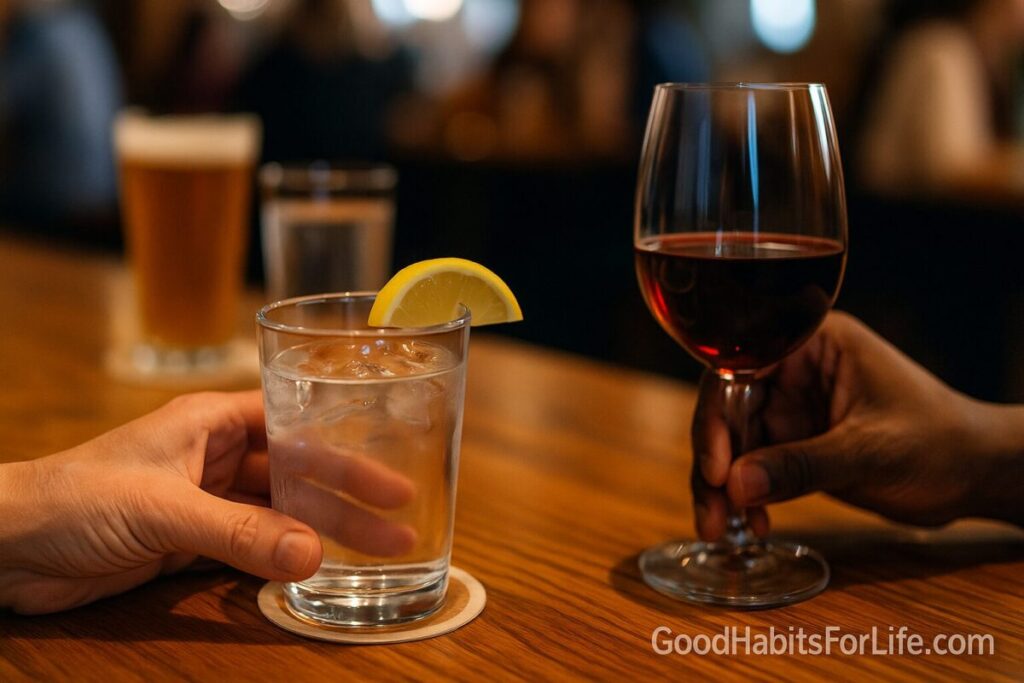
Pace Your Night: Alternate Drinks & Add Water
Pace Your Night: Alternate Drinks & Add Water
Table of Contents
🧭 What It Is & Why It Works
The idea: Interleave every alcoholic drink with a glass of water (or a zero-alcohol drink). Pair this with slower sipping and a pre-set drink limit.
Why it helps
-
Reduces total alcohol consumed. Alternating naturally cuts the number of alcoholic rounds and helps keep you near low-risk guidelines.
-
Slows your blood alcohol concentration (BAC) rise. Spacing drinks to ≤1 standard drink per hour gives your body more time to metabolize alcohol.
-
Improves next-day functioning. Fewer alcoholic drinks generally means better sleep quality and fewer next-day effects.
-
Keeps you social without pressure. A water-in-hand looks normal, supports inclusion, and buys time to decide your next move.
Evidence-aligned: National public-health guidance emphasizes pacing, counting drinks/units, setting limits, eating before/while drinking, and alternating with non-alcoholic options as practical ways to reduce risk (see References).
✅ Quick Start: Do This Tonight
-
Pre-game plan (2 minutes).
-
Set a cap (e.g., 2–3 standard drinks for the night).
-
Choose a start & stop time (e.g., 19:30–22:30).
-
Decide your order pattern: Beer → Water → Beer → Water… or Wine → Sparkling water → Wine → Sparkling water…
-
-
Eat first. Prioritize a meal with protein + complex carbs + healthy fats.
-
Begin with water. First order = water (or soda water with lime). This establishes the rhythm.
-
One per hour. If a round comes early, keep water in your hand and wait.
-
Switch to lower-ABV. Choose 3–4% beers, spritzers, or smaller pours.
-
Track on the fly. Use an app or notes to count standard drinks/units.
-
Close with water + food. Hydrate and grab a small snack before bed.
🛠️ 7-Day Starter Plan
Goal: Build the alternate-with-water habit so it feels automatic.
-
Day 1 (Home rehearsal): Pour one standard drink. Set a 60-minute timer. Alternate with a full glass of water. Stop at 2 drinks max.
-
Day 2 (Script practice): In the mirror or notes app, write and say 3 ways you’ll order water and respond to offers.
-
Day 3 (Social coffee/zero-proof): Go out but choose no-alcohol drinks only; focus on vibe, not alcohol.
-
Day 4 (Dining out): Order water first, then your drink. Alternate all night; track units.
-
Day 5 (Refine): Review what worked. Set a personal pace rule (e.g., “max 3, one per hour, water every round”).
-
Day 6 (Event trial): Try the method at a busier event. Add a buddy who knows your plan.
-
Day 7 (Debrief + lock-in): Note wins, slip-ups, and a simple if-then: If someone buys a shot → I say “I’m pacing—sparkling water for me this round.”
🧠 Techniques & Frameworks (PACE)
Use PACE to remember the habit:
-
P — Pour with purpose. Choose smaller pours, lower ABV, or a spritzer.
-
A — Alternate every round. Water (or 0% beer, soda water, diet cola) between alcoholic drinks.
-
C — Count standard drinks/units. Know what counts as “one.”
-
E — Eat & extend time. Eat before/while drinking; stretch rounds to ~60 minutes.
If-Then Backstops
-
If someone keeps topping up my glass, then I switch to a bottle/can I control.
-
If I finish my drink too fast, then I hold water until 15 minutes pass.
-
If the group moves to shots, then I order a zero-proof option.
📊 Standard Drinks & Units (Quick Table)
| Beverage (typical ABV) | One standard drink |
|---|---|
| Beer (≈5% ABV) | 355 ml (12 oz) |
| Wine (≈12% ABV) | 150 ml (5 oz) |
| Spirits (≈40% ABV) | 44 ml (1.5 oz) |
-
UK: Track units (1 unit = 10 ml pure alcohol). Low-risk guidance: ≤14 units/week, spread over 3+ days.
-
US: Moderation is ≤2 drinks/day for men, ≤1 for women (when adults choose to drink).
(See References for details and definitions.)
👥 Audience Variations
-
Students/young adults: Pre-commit with a roommate or friend; bring your own water bottle; choose venues with easy water access; set a strict budget.
-
Professionals/networking: Order sparkling water with lime as your “alternate” to keep a polished look; schedule a hard stop (train, rideshare).
-
Parents on a night out: Eat early, plan your return ride, alternate strictly, and aim for earlier rounds to protect sleep.
-
Seniors/medications: Interactions are common; review meds with a clinician. Pace conservatively and consider zero-alcohol options.
⚠️ Mistakes & Myths to Avoid
-
Myth: “Water cancels alcohol.”
Reality: Water doesn’t change metabolism; it helps you drink less overall and feel better hydrated. -
Mistake: Bottomless top-ups. Use bottles/cans or ask for no refills.
-
Mistake: Skipping food. Eat first; it slows absorption.
-
Myth: “Coffee sobers you up.” It doesn’t; only time lowers BAC.
-
Mistake: Guessing units. Always count.
💬 Real-Life Examples & Scripts
-
At the bar: “Can I start with sparkling water? I’m pacing tonight.”
-
When offered a drink early: “I’m good with water this round—catching up in a bit.”
-
Rounds culture: “I’m alternating. Grab me a soda water this turn?”
-
Shots: “I’m sitting out—pacing myself. Cheers with this water.”
-
Host refill: “No top-ups, please. I’m tracking my units.”
📱 Tools, Apps & Resources
-
Drink/Unit trackers: Try Dry, Less, Sunnyside, Reframe — easy logging, reminders, weekly reviews.
-
Pros: Awareness, pacing nudges, clear totals.
-
Cons: Manual entry; notifications can feel naggy—tune settings.
-
-
Timers: Any phone timer for the 60-minute pace rule.
-
Zero-alcohol options: 0.0% beer, mocktails, soda water with citrus—keep it festive.
📌 Key Takeaways
-
Alternate every alcoholic drink with water or a zero-alcohol option.
-
One per hour pace + pre-set cap = lower risk, better next day.
-
Eat, count, and choose lower-ABV to keep total intake in check.
-
Use scripts and a buddy to stick to your plan in social settings.
❓ FAQs
1) Does alternating with water prevent hangovers?
Not guaranteed. It helps by reducing total alcohol and maintaining hydration, which often lessens next-day effects, but only less alcohol and time truly lower risk.
2) What counts as one standard drink?
Beer 355 ml (5% ABV), wine 150 ml (12% ABV), spirits 44 ml (40% ABV). See the table above and NIAAA/CDC definitions.
3) Can I alternate with soda or juice instead of water?
Yes—zero-alcohol options work. Water keeps sugar and calories down; choose what helps you slow down.
4) How do I handle friends who pressure me?
Use short scripts: “I’m pacing tonight—water this round.” Hold a drink (water) so you’re not empty-handed.
5) Is this safe if I’m on medication?
Alcohol interacts with many medicines. Check with a clinician or pharmacist; consider zero-alcohol choices.
6) I don’t drink often—do I still need to alternate?
If you choose to drink, alternating is an easy default to keep nights predictable and low-risk.
7) What if the venue is pushing rounds quickly?
Order water first, slow your sip rate, and skip rounds that come before your 60-minute mark.
8) Can I use sports drinks instead of water?
Water is usually enough. If you’re sweating (e.g., dancing outdoors), an electrolyte drink can be reasonable.
📚 References
-
National Institute on Alcohol Abuse and Alcoholism (NIAAA). Rethinking Drinking: Alcohol and Your Health. Practical strategies for cutting down, pacing, and standard drinks. https://rethinkingdrinking.niaaa.nih.gov
-
NIAAA. What Is a Standard Drink? Definitions used in the U.S. https://www.niaaa.nih.gov/alcohols-effects-health/overview-alcohol-consumption/what-standard-drink
-
Centers for Disease Control and Prevention (CDC). Alcohol and Public Health—Moderate Drinking. Guidance on moderation and risks. https://www.cdc.gov/alcohol/fact-sheets/moderate-drinking.htm
-
NHS. Alcohol Units. Understanding units and UK low-risk guidance (≤14 units/week). https://www.nhs.uk/live-well/alcohol-advice/alcohol-units/
-
World Health Organization (WHO). Alcohol. Health impacts and risk-reduction messaging. https://www.who.int/news-room/fact-sheets/detail/alcohol
-
Cochrane Review. Brief interventions for heavy alcohol users in primary care. Evidence that simple strategies reduce consumption. https://www.cochranelibrary.com/cdsr/doi/10.1002/14651858.CD004148.pub4/full
-
Canadian Centre on Substance Use and Addiction (CCSA). Canada’s Guidance on Alcohol and Health (2023). Risk levels and practical advice. https://www.ccsa.ca/canadas-guidance-alcohol-and-health
-
National Health and Medical Research Council (Australia). Alcohol Guidelines (2020). Low-risk drinking advice. https://www.nhmrc.gov.au/health-advice/alcohol
Disclaimer: This article is educational and not a substitute for medical advice; speak with a qualified clinician about your situation and medications.