
Metacognition Mini-Reviews: Are You Learning or Just Reading?: AI workflows (2025)
Metacognition Mini-Reviews: AI Workflows (2025)
Table of Contents
🧭 What & Why
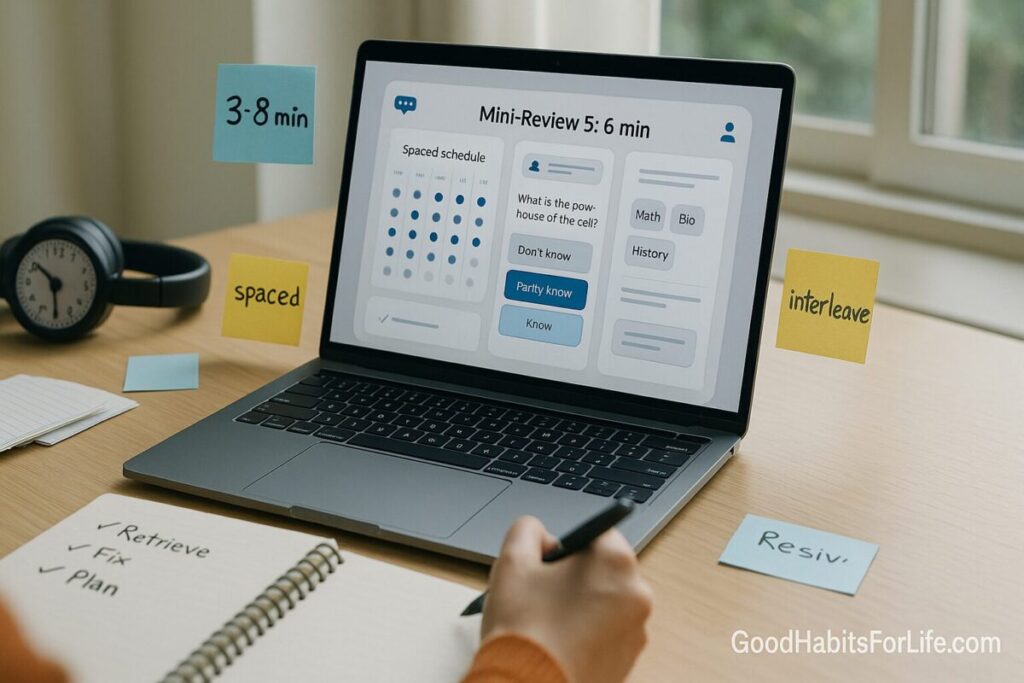
Metacognition is your ability to monitor and steer your own learning—asking “Do I actually know this?” and “What should I do next?” Mini-reviews are short, structured check-ins (3–8 minutes) that replace passive rereading with active recall, targeted fix-ups, and a next-session plan.
Why it works:
-
Retrieval practice (self-quizzing) produces medium-to-large improvements vs. restudy across many subjects. PubMed
-
Spaced practice (reviewing after delays) reliably outperforms cramming; optimal gaps depend on how long you need to remember. PubMed+1
-
Interleaving (mixing related topics) improves transfer and problem solving in real courses. Nature+1
-
Teaching metacognition (goal-monitor-review cycles) is an evidence-informed, high-impact approach in classrooms. EEF
AI matters in 2025 because it can automate the mechanics—generating quizzes, wrappers, and spaced schedules—while you stay in control of quality and ethics. Policy bodies (UNESCO, OECD) recommend human-centered, evidence-informed use. UNESCO+1
✅ Quick Start (today, ~10 minutes)
-
Pick one topic (2–5 key ideas).
-
Run a 4-minute recall drill. Close notes. Answer 5 AI-generated questions; mark right/wrong. (Scripts below.)
-
2-minute “mini wrapper.” Note which confusions were process problems (e.g., rushed, no examples) vs. knowledge gaps. (Use the exam-wrapper prompts.) Carnegie Mellon University
-
2-minute fix-up. Re-study only what failed; add one concrete example.
-
Plan next gap. Schedule the next review in 2–3 days (short-term goal), then a longer gap next week. PubMed
🛠️ 30-60-90 Day Habit Plan
Goal: Make mini-reviews automatic, measurable, and scalable.
Days 1–30 (Install the loop)
-
Daily (Mon–Fri): 1 mini-review (3–8 min).
-
Structure: 5 recall Qs → wrapper notes → fix-up → next date.
-
Metric: % correct, and a 0–100 confidence rating before/after.
Days 31–60 (Scale & interleave)
-
Add a second, interleaved set every other day (mix similar topics).
-
Use longer gaps for items you’ve answered correctly twice. Nature+1
-
Calibration check weekly: Compare confidence vs. accuracy; reduce overconfidence by adding harder questions/examples. PMC
Days 61–90 (Refine with AI)
-
Batch-generate banks of 50–100 questions with varying difficulty.
-
Tag by error type (definition, concept link, application) to target practice.
-
Quarterly audit: Retire mastered items; schedule long-term spaced boosts (2–4 weeks). PubMed
🧠 Techniques & Frameworks (use inside mini-reviews)
1) Retrieval Practice (self-quiz first, notes later)
-
Use free recall, short-answer, or MCQ with rationales; prioritize effortful retrieval. Meta-analyses show clear benefits vs. restudy. PubMed
2) Spacing (plan the next gap)
-
If your exam is ~30 days away, review each item after 2–4 days, then 1–2 weeks, then 3 weeks (“expand then stretch”). PubMed
3) Interleaving (mix related but distinct skills)
-
Alternate problems/ideas that look similar but require different moves (e.g., types of proofs, physics chapters, grammar forms). Real courses show improved problem solving. Nature
4) Self-Explanation (say why the answer works)
-
Brief prompts (“because…”, “therefore…”) strengthen transfer and error-spotting; recent studies and meta-analyses support prompted explanations. ScienceDirect+1
5) Exam/Mini Wrappers (plan-do-review)
-
Micro-forms of “exam wrappers” help you analyze prep tactics and set next steps; widely used by CMU and others. Carnegie Mellon University
6) Calibration with JOLs (judgments of learning)
-
Quickly rate confidence before you check answers. Recent work suggests making JOLs after retrieval doesn’t inflate performance—use them to track bias. PMC
👥 Audience Variations
-
Students: Keep mini-reviews to 5–8 minutes; interleave homework items from two units.
-
Professionals: Tie questions to on-the-job scenarios; review meeting notes next morning with 5 recall prompts.
-
Parents & Teens: Do “two-question check-ins” after study sessions; help teens write their own wrappers.
-
Seniors/Lifelong learners: Use voice to answer and record rationales; prioritize spacing over volume.
⚠️ Mistakes & Myths to Avoid
-
Myth: “Rereading = learning.”
Fix: Retrieval + spacing beats rereading for durable memory. SAGE Journals -
Mistake: Only cramming near deadlines.
Fix: Expand gaps toward your target date (days → weeks). PubMed -
Myth: “Interleaving = random mixing.”
Fix: Mix related concepts that can be confused; don’t shuffle unrelated topics. bera-journals.onlinelibrary.wiley.com -
Mistake: Trusting “feels easy.”
Fix: Track confidence vs. accuracy; adjust difficulty weekly. PMC -
Mistake: Letting AI decide everything.
Fix: Follow human-centered, ethical guidance; you approve, AI assists. UNESCO+1
🗣️ Real-Life Examples & Copy-Paste Scripts
A) 5-Question Recall (any topic, 4 minutes)
“Create 5 short-answer recall questions (mix definitions + applications) on [topic] at [beginner/intermediate/advanced] level. After I answer, show the correct answer with a one-sentence rationale and ask me to rate confidence 0–100.”
B) Mini Wrapper (2 minutes)
“Prompt me with 5 reflection items: (1) What stuck? (2) Where did I guess? (3) One misconception; (4) One example I can generate; (5) What will I do differently next time?”
C) Interleaving Set (6 minutes)
“Build a 6-item problem set interleaving [topic A] and [topic B] so I must choose the right method. After each answer, ask why that method fits; then give a contrast example.” Nature
D) Spacing Plan (10 seconds)
“Given my exam on [date], schedule 3 reviews per item using expanding gaps optimized for ~30-day retention. Output as dates in my time zone.” PubMed
E) Tutor-Assist Workflow (for teachers/tutors)
“For these errors [paste samples], propose 3 tutor moves (Socratic hints, worked example, retrieval cue). Keep me in control and provide rationale.” (Human-in-the-loop designs have emerging RCT support.) arXiv
🧰 Tools, Apps & Resources (quick notes)
-
Flashcard/Spaced tools: Anki, RemNote, Quizlet—automate scheduling; add your own rationales and tags.
-
Outliners/Notes: Obsidian, Notion—store wrappers and weekly calibration logs.
-
Timers: Any Pomodoro app—cap reviews at 8 minutes to avoid drift.
-
Institutional guides: EEF Metacognition report (teaching playbook), CMU Eberly exam wrappers (templates), UNESCO/OECD (AI policy & guardrails). OECD+3EEF+3Carnegie Mellon University+3
📚 Key Takeaways
-
Short, structured mini-reviews beat long rereads.
-
Combine retrieval + spacing + interleaving for durable learning. SAGE Journals+2PubMed+2
-
Use wrappers to analyze process, not just score. Carnegie Mellon University
-
Track calibration (confidence vs. accuracy) weekly. PMC
-
Keep AI as your assistant: generate, you curate—aligned with UNESCO/OECD guidance. UNESCO+1
❓ FAQs
1) How long should a mini-review be?
3–8 minutes is plenty: 5 questions, a 60–90-second wrapper, one fix-up, schedule the next gap.
2) What’s the best review gap?
Start with 2–3 days, then 7–10 days, then ~3 weeks for month-long goals; adjust to your target retention window. PubMed
3) Doesn’t rereading help?
It can refresh familiarity, but for retention, retrieval + spacing outperform rereading across contexts. Use rereading only for pinpointed fix-ups. SAGE Journals
4) How do I interleave without chaos?
Mix related but confusable categories (e.g., distribution vs. dispersion measures; subjunctive vs. indicative). bera-journals.onlinelibrary.wiley.com
5) Can AI replace tutors?
No. Use AI to generate questions and suggestions while humans guide, verify, and keep context/ethics in check. Early RCTs support tutor-assist models. arXiv
6) How do I measure calibration?
Log confidence (0–100) before grading; compute error = |confidence − accuracy|. Aim to shrink that gap weekly. PMC
7) What if I’m short on time?
Do one 5-question mini-review daily; expand on weekends. Consistency beats marathon sessions.
8) Do wrappers work outside exams?
Yes—use “mini-wrappers” after problem sets, readings, or meetings to adjust your next move. Carnegie Mellon University
References
-
Dunlosky, J., et al. (2013). Improving Students’ Learning With Effective Learning Techniques. Psychological Science in the Public Interest. (Monograph overview of high-utility techniques). SAGE Journals
-
Rowland, C. A. (2014). The Effect of Testing Versus Restudy on Retention: A Meta-Analytic Review of the Testing Effect. Psychological Bulletin. PubMed
-
Cepeda, N. J., et al. (2006). Distributed Practice in Verbal Recall Tasks: A Review and Quantitative Synthesis. Psychological Bulletin. PubMed
-
Cepeda, N. J., et al. (2008). Spacing Effects in Learning: A Temporal Ridgeline of Optimal Retention Intervals. Psychological Science. PubMed
-
Samani, J., et al. (2021). Interleaved practice enhances memory and problem solving in physics. npj Science of Learning. Nature
-
Firth, J., et al. (2021). A systematic review of interleaving as a concept learning strategy. Review of Education. bera-journals.onlinelibrary.wiley.com
-
Education Endowment Foundation (EEF). Metacognition and Self-Regulated Learning: Guidance Report. EEF
-
Zhao, W., et al. (2023). Judgments of Learning Following Retrieval Practice. Memory & Cognition. (JOLs and reactivity). PMC
-
UNESCO (2023–2025). Guidance for Generative AI in Education and Research. (Policy guardrails). UNESCO
-
OECD (2025). What should teachers teach and students learn in a future of powerful AI? (Curriculum & competencies in the age of AI). OECD
-
Wang, R. E., et al. (2024). Tutor CoPilot: A Human-AI Approach for Scaling Real-Time Expertise (RCT). arXiv preprint. arXiv
-
Carnegie Mellon University, Eberly Center. Exam Wrappers (examples & templates). Carnegie Mellon University