
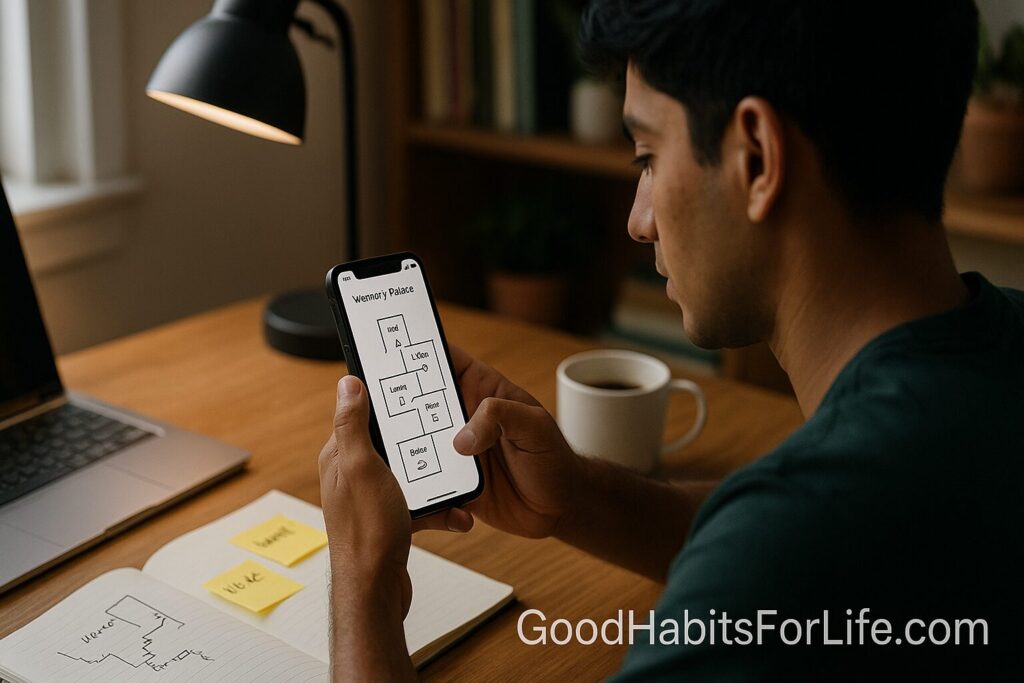
Memory Palaces for Modern Students (Phone-Friendly): AI workflows (2025)
Memory Palace for Students: Phone-Friendly AI Workflows (2025)
Table of Contents
🧭 What & Why
What is a Memory Palace?
The Memory Palace—method of loci—is a classic mnemonic where you place items you want to remember along a familiar route (home → gate → lobby → stairs → desk) and “walk” it to recall in order. It’s one of psychology’s most reliable memory systems. dictionary.apa.org
Why it works (short version):
-
It harnesses spatial memory (a strength of the human brain). Neuroimaging shows superior memorizers engage hippocampal and navigation areas while using spatial strategies. PubMed
-
Training reshapes brain networks; a 6-week mnemonic program made novices’ connectivity patterns look more like memory athletes’ and improved long-term recall. PubMed
-
It pairs images + words (a form of dual coding), creating richer cues for retrieval. nschwartz.yourweb.csuchico.edu
-
It combines perfectly with spaced practice and retrieval practice (testing yourself)—two of the most evidence-based study methods. citl.indiana.edulsc.cornell.edu
Does it help real learners?
Yes—beyond competitions, studies show MoL can improve performance in students and is usable—even beneficial—after brief training, including in older adults. PMC+1
✅ Quick Start: Do This Today
-
Pick a 10-stop route you know by heart.
Example: Gate → Shoe rack → Sofa → TV → Balcony → Dining chair → Fridge → Sink → Study chair → Bed. -
Define your target.
Choose one small chapter or list (e.g., 10 biology terms). -
Create wild images.
Make each term concrete + exaggerated + emotional. “Mitochondria” becomes a tiny power plant humming on the shoe rack. -
Place items.
Put each image at one stop. One item per stop. -
Walk & talk.
Close your eyes and narrate the journey out loud once forwards, once backwards. -
Quick retrieval test (2 minutes).
Write the list without looking. Mark errors. -
Micro-reviews today:
+1 hour, +3 hours—walk the route mentally. Use a timer. -
Tomorrow:
Run the route once, then self-test from memory (blank page). That’s spaced retrieval in action. citl.indiana.edulsc.cornell.edu
🗓️ 7-Day Starter Plan
Goal: Master one 10-stop palace for one course; prove gains via metrics.
Metrics to track:
-
Recall accuracy (%).
-
Recall time for all 10 items (seconds).
-
Cue strength (0–2 scale: 0=stuck, 1=hesitant, 2=instant).
Day 1: Build your 10-stop route + place 10 items. Two review walks (+1h, +3h).
Day 2: Add a second list (new 10 items) to a second 10-stop route (avoid overloading one). Reviews: morning & evening.
Day 3: Shuffle recall: odd-even stops, backwards. 1 timed test per route.
Day 4: Interleave with other study (problem sets/flashcards). Short palace run at night. lsc.cornell.edu
Day 5: Merge with retrieval practice: blank-page recall → check → fix weak images. lsc.cornell.edu
Day 6: Compression: replace bulky images with tighter, more personal ones; remove any two weak stops.
Day 7: Mock exam: randomize order; aim for ≥90% accuracy under time. Log your improvements.
🧠 Techniques & Frameworks That Actually Work
🎯 Make images sticky
-
Exaggerate: size, motion, emotion, sound, smell.
-
Personalize: use your friends/teachers as characters.
-
One locus, one payload: don’t cram multiple facts at one stop.
🔗 Dual Coding in practice
Pair a verbal hook (keyword, acronym) with a striking visual. This taps both verbal and visual systems to strengthen memory traces. nschwartz.yourweb.csuchico.edu
🧩 Chunking & schematics
Turn lists into chunks (3–4 items) and map one chunk per room.
🧪 Retrieval & spacing (the power combo)
Test yourself often and space sessions across days; both boost durable learning far more than re-reading. citl.indiana.edulsc.cornell.edu
🔁 Interleaving
Mix palaces/topics in a session (Bio → Chem → History). It feels harder but improves transfer. University learning centers recommend it alongside spacing. lsc.cornell.edu
🧓 For long-term retention
Even brief training helps; scheduled refreshers maintain gains. PMC
📱 Phone-Friendly + AI Workflows (2025)
Workflow A — Camera Route Cards (5 minutes):
-
Walk your chosen location; snap 10 photos (one per stop).
-
Create a “Palace 01” album.
-
Add text captions with your images (Android/iOS).
-
Quick review = swipe the album while recalling.
Workflow B — Google Maps Street View Palace:
-
Use the road from your hostel to class; drop 10 pins.
-
Screenshot each pin as a “stop.”
-
Perfect for learners studying away from home.
Workflow C — Anki / RemNote deck:
-
Make one deck per palace; one card per stop.
-
Front: photo of the stop; Back: the vivid image + answer.
-
Anki’s scheduler handles spaced repetition for you. citl.indiana.edu
Workflow D — Visual boards (Apple Freeform / GoodNotes / Obsidian Canvas):
-
Drop your 10 photos in order; connect with arrows.
-
Record a 30-second audio walkthrough per board.
Workflow E — AI-Assist (your “co-pilot”):
-
Generate palaces fast: “List 3 familiar routes in a dorm/home with 10 distinct stops each.”
-
Imagery brainstorm: “For [term], propose 3 bizarre, high-emotion images tied to [locus].”
-
Convert lists → flashcards: “Turn this outline into Q/A cards with mnemonics + hints.”
-
Exam packs: “Design a 7-day spaced schedule for these 30 terms; batch into three palaces.”
Use AI to speed setup; you still do retrieval—the part that strengthens memory. citl.indiana.edulsc.cornell.edu
👥 Audience Variations
Students (school/uni):
-
Use one palace per chapter; cap at ~15 loci per palace for speed.
-
Pair with problem-solving (not just definitions).
Parents (helping kids):
-
Build “house routes” with 5–7 stops; keep images funny, not gory.
-
Review during short walks or car rides.
Professionals:
-
Palaces for slides, client names, speech beats; “walk” the talk instead of reading notes.
Seniors:
-
Short daily runs (3–5 minutes). Research suggests older adults can adopt MoL and benefit after brief training; keep imagery simple. PMC
Teens:
-
Use game maps as palaces (only if stable), or school corridors; keep 1 palace per subject.
⚠️ Mistakes & Myths to Avoid
-
Myth: “Photographic memory.” Success comes from imagery + retrieval, not magic.
-
Overloading one locus. One clear payload per stop.
-
Skipping reviews. Without spaced retrieval you’ll forget. citl.indiana.edu
-
Random routes. Pick places you know deeply; unfamiliar VR rooms are slower (use them only if truly familiar).
-
No emotion. Bland images fade; add motion, humor, surprise.
📘 Real-Life Examples & Copy-Paste Scripts
Biology (Cranial Nerves, order & function)
-
Gate – Olfactory (I): Giant nose sniffing flowers by the gate.
-
Shoe rack – Optic (II): Sunglasses beaming laser vision.
-
Sofa – Oculomotor (III): Sofa sprouts moving eyes in all directions…
…continue through all 12; attach functions as mini-actions at each stop.
AI prompt:
“Create vivid, funny images for each cranial nerve (I–XII) mapped onto these loci: [paste your 12 stops]. Make each image show function.”
Chemistry (Periodic Trends)
-
Balcony (Atomic radius ↓ across a period): Balcony shrinks as you walk left→right.
-
Fridge (Ionization energy ↑ across a period): Magnet pulls electrons harder as you move right.
History (Causes of WWI)
-
Dining chair (Militarism): Chair wearing a steel helmet.
-
Fridge (Alliances): Two fridge magnets shaking hands…
Languages (Vocabulary, 10 nouns/day)
-
Use a market route; at each stall, place one new word with a comic scene.
🧰 Tools, Apps & Resources (quick pros/cons)
-
Anki (free/desktop+mobile): World-class spaced repetition; steeper learning curve; unbeatable for long-term recall. citl.indiana.edu
-
RemNote: Flashcards + notes; easy cloze deletions; solid syncing.
-
Obsidian (Canvas) / Apple Freeform / GoodNotes: Visual board for route maps; great for “see-it-all” palaces.
-
Notion: Simple databases for palaces; good for tagging courses.
-
Voice Recorder (native app): Fast “walkthrough” rehearsal on commutes.
-
Google Maps / Street View: Build outdoor palaces when dorms/homes feel overused.
📚 Key Takeaways
-
The Memory Palace is a spatial, image-driven system with strong scientific backing. PubMed+1
-
Keep palaces small, vivid, personal; one item per locus.
-
Pair with spaced + retrieval practice for durable learning. citl.indiana.edulsc.cornell.edu
-
Your phone + AI remove setup friction; you still must test yourself.
-
Prove it: track accuracy, speed, and cue strength for 7 days.
❓ FAQs
1) How many loci should a beginner use?
Start with 10. Expand to 12–15 when recall is smooth.
2) Can one room work, or do I need a mansion?
One room with distinct stations is fine. Just ensure each stop is visually unique.
3) How fast will I see results?
Usually within a week if you rehearse with spacing. Gains consolidate over weeks. citl.indiana.edu
4) Can I store formulas or concepts, not just lists?
Yes—encode the meaning (units, relationships) into objects/actions at the locus, then practice retrieval with problems.
5) Do digital/VR palaces help?
They can, but familiarity matters more than graphics. Real-world routes you know often work faster.
6) I’m bad at visualizing—now what?
Use sounds, motion, dialogue, touch. Imagery can be multisensory; stick figures > perfect art.
7) How many palaces do I need for a course?
Common pattern: 3–5 palaces per term (10–15 loci each). Retire/refresh when cluttered.
8) How often should I review?
Right after learning, then 1 day, 3 days, 7 days, 14 days—let your SRS app fine-tune intervals. citl.indiana.edu
9) Will this replace understanding?
No—it’s a memory scaffold. Pair it with practice problems, concept maps, and teaching others.
10) Is there evidence beyond anecdotes?
Yes: neuroimaging and training studies, plus university learning-center guidance for spacing/retrieval. See References. PubMed+1citl.indiana.edulsc.cornell.edu
References
-
American Psychological Association. Method of loci. https://dictionary.apa.org/method-of-loci dictionary.apa.org
-
Dresler, M., et al. (2017). Mnemonic Training Reshapes Brain Networks to Support Superior Memory. Neuron, 93(5), 1227–1235. https://pubmed.ncbi.nlm.nih.gov/28279356/ (Open-access version available via Radboud Repository.) PubMedrepository.ubn.ru.nl
-
Maguire, E. A., Valentine, E. R., Wilding, J. M., & Kapur, N. (2003). Routes to remembering: the brains behind superior memory. Nature Neuroscience, 6(1), 90–95. https://pubmed.ncbi.nlm.nih.gov/12483214/ PubMed
-
Indiana University—Center for Innovative Teaching & Learning. Spaced Practice. https://citl.indiana.edu/teaching-resources/evidence-based/spaced-practice.html citl.indiana.edu
-
Cornell University—Learning Strategies Center. Effective Study Strategies (Retrieval Practice, Spacing, Interleaving). https://lsc.cornell.edu/how-to-study/ lsc.cornell.edu
-
UNC Learning Center. Preparing for Finals (distributed practice guidance). https://learningcenter.unc.edu/tips-and-tools/preparing-for-finals/ Learning Center
-
Qureshi, A., et al. (2014). The method of loci as a mnemonic device in endocrinology improves test performance. Advances in Physiology Education. https://pmc.ncbi.nlm.nih.gov/articles/PMC4056179/ PMC
-
Gross, A. L., et al. (2014). Do older adults use the Method of Loci? Aging, Neuropsychology, and Cognition. https://pmc.ncbi.nlm.nih.gov/articles/PMC3955885/ PMC
-
Clark, J. M., & Paivio, A. (1991). Dual Coding Theory and Education. (PDF). https://nschwartz.yourweb.csuchico.edu/Clark%20%26%20Paivio.pdf nschwartz.yourweb.csuchico.edu
-
Wagner, I. C., et al. (2021). Durable memories and efficient neural coding through mnemonic training. Science Advances. https://www.science.org/doi/10.1126/sciadv.abc7606 Science