
Interleaving + Retrieval: The Power Combo for Exams: AI workflows (2025)
Interleaving & Retrieval: Power Combo for Exams (2025)
Table of Contents
🧭 What & Why: The Science Behind the Combo
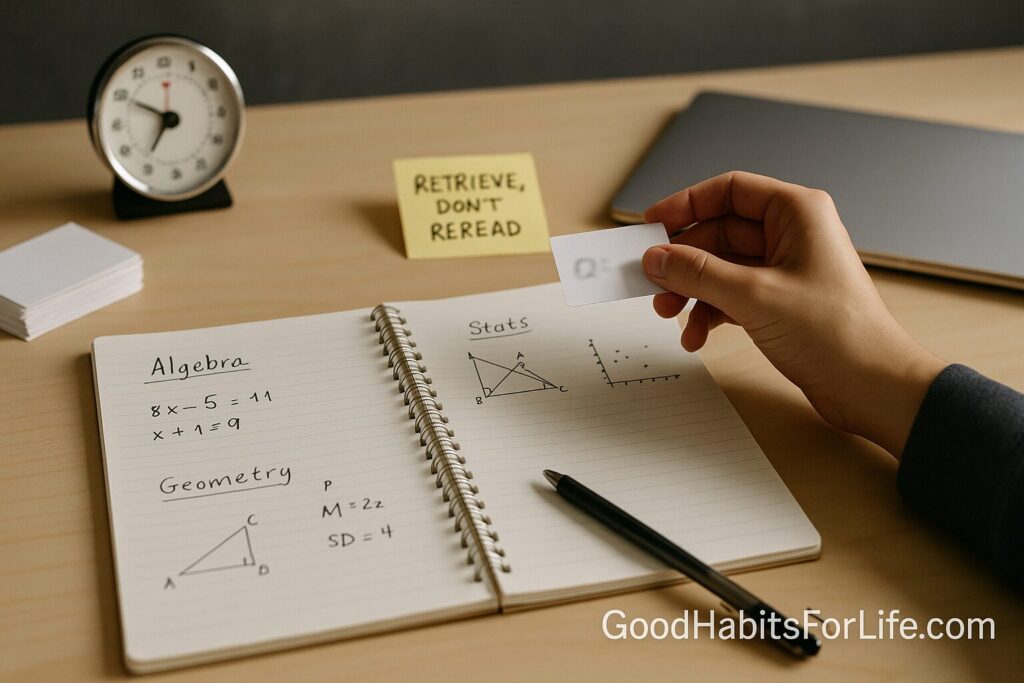
Interleaving means mixing related topics or problem types within the same study block (e.g., algebra + geometry + statistics), rather than “blocking” one topic at a time.
Retrieval practice means pulling information from memory—answering questions, solving problems, or explaining ideas without looking.
Why it works
-
Interleaving builds discrimination: you learn when to use a method, not just how.
-
Retrieval strengthens memory traces and reveals knowledge gaps, outperforming rereading or highlighting.
Across dozens of lab and classroom studies, both methods improve long-term retention and transfer to new problems. See the research in References for meta-analyses and classroom replications.
✅ How Interleaving Works (with examples)
Blocking: 30 problems of “Find the derivative.”
Interleaving: rotate through derivative, integral, and limits problems in one set.
Humanities example: Mix rhetorical devices (ethos/logos/pathos) while analyzing different articles in one sitting.
Languages: Alternate vocabulary families (food, travel, health) and grammar forms, not one list at a time.
Medicine/Certification: Mix case vignettes from cardiology, pulmonology, and endocrinology in the same round.
Rule of thumb: Aim for A–B–C–A–B–C cycles of small sets (3–6 items per topic) rather than big single-topic chunks.
🧠 How Retrieval Practice Works (and why it beats rereading)
Retrieval isn’t just assessment—it’s learning. When you try to recall and then check, you:
-
strengthen memory (the “testing effect”);
-
spot illusions of competence created by familiar rereading;
-
get immediate feedback on what to fix next.
Make retrieval effective
-
Go closed-book first, then open-book to check.
-
Use free recall prompts (“Explain X in 3 sentences”), cued recall (terms → definitions), and mixed problems (identify the right method).
-
Score each response: 0 = blank, 1 = needed hint, 2 = correct unaided. Promote/demote cards by score.
📚 Why the Combo Wins
Interleaving trains choice of strategy; retrieval cements core knowledge. Together they:
-
reduce context-dependent learning (you can solve unfamiliar exam mixes);
-
improve far transfer (using knowledge in new situations);
-
make weaknesses obvious early, so you fix them before high-stakes tests.
🛠️ Quick Start: Do This Today
-
Select 3 topics you’ll likely see mixed on the exam.
-
Build a mini set: 4 items per topic (12 total).
-
25-minute sprint: A1–A2–B1–B2–C1–C2–A3–B3–C3–A4–B4–C4.
-
Retrieval round (10 minutes): Closed-book answers; then check.
-
Triage: Any item scored 0–1 goes to a “redo” pile for Day 1; 2’s revisit on Day 3.
-
Exit ticket: Write three “what I’ll do differently” notes for next session.
🗓️ 7-Day Starter Plan (with checkpoints)
Assumptions: 3 topics (A, B, C), 25-minute Pomodoros, exam in ~3–4 weeks.
-
Day 0 (Today)
-
Create 12–18 mixed items (A/B/C).
-
2 sprints + 10-minute retrieval each.
-
Tag misses (0–1) for Day 1.
-
-
Day 1 (First Spaced Review)
-
Warm-up: free recall of yesterday’s summaries (5 min).
-
Do only missed items first, then add 6 new mixed items.
-
Quick explain-to-a-friend voice note (2 minutes).
-
-
Day 3 (Second Spaced Review)
-
Fresh mixed set (12 items) + 6 carryovers.
-
One “method choice” round: look at a problem, name the method before solving.
-
Checkpoint: ≥80% of items at score 2.
-
-
Day 5 (Application Day)
-
Past papers or scenario vignettes—strictly mixed order.
-
1 sprint devoted to error analysis: Why did I choose the wrong method?
-
-
Day 7 (Consolidation)
-
20-item exam-style set in random order; simulate timing.
-
Build a 1-page cheat sheet from memory, then correct with notes.
-
-
Beyond: Repeat reviews on Day 14 and Day 21 with larger mixed sets.
🧩 Techniques & Frameworks
-
Desirable Difficulties (Bjork): make practice a bit harder (mixed, spaced, varied) to boost retention.
-
Successive Relearning: alternate retrieval with feedback across days until the item is consistently recalled.
-
Leitner System for Flashcards: move cards up/down boxes based on recall score.
-
3–2–1 Mix: For each cycle, do 3 problems of your weakest topic, 2 medium, 1 strongest.
-
Method-ID First: Before solving, state which principle you’ll use and why—trains discrimination.
🤖 AI Workflows (2025) for Faster Study Builds
Use AI as a content generator and organizer, not a substitute for thinking. Always verify with your syllabus, textbook, or lecturer.
Workflow 1: Rapid Question Bank (STEM or facts)
-
Prompt: “You are a subject-expert tutor. Generate 36 exam-style questions (12 each for Topics A, B, C) aligned to {syllabus bullets}. Use multiple forms: short answer, worked problems, and ‘choose the method’ items. Provide an answer key at the end. Mark difficulty: E/M/H.”
-
Paste to a CSV template → import into Anki/RemNote/Quizlet.
Workflow 2: Method-Choice Interleaver
-
Prompt: “Create 20 mixed items where the first task is to select the correct method (from {list}), then solve. Ensure similar-looking problems require different methods.”
Workflow 3: Free-Recall Cue Cards
-
Prompt: “Produce 25 three-word cues (no definitions) covering the key concepts from {chapter}. One concept per line.”
-
Use cues for 2-minute oral summaries (record and check).
Workflow 4: Error Analysis Coach
-
After a practice set, paste your top 5 mistakes:
-
Prompt: “Classify each mistake type (concept, calculation, method choice, misread). Suggest one fix and one retrieval question per mistake.”
-
Workflow 5: Anki-Ready Exports
-
Prompt: “Convert these Q/A pairs to an Anki CSV (Front,Back) with tags {A,B,C,difficulty} and a ‘source’ field. Escape commas/quotes properly.”
Guardrails
-
Keep items within syllabus scope.
-
For numerical answers, double-check with textbook solutions or a trusted .edu source.
-
If AI produces identical patterns, ask it to increase surface variety and include near-miss distractors.
👩🎓 Variations: Students, Professionals, Parents/Teachers
-
University/HS Students: Lean on past papers; convert every worked example into a Q→A card + a “method choice” twin.
-
Professionals & Certification: Build case-based vignettes; mix domains you’ll face together on the exam (e.g., security + cloud + networking).
-
Parents/Teachers: Use 10-minute mixed review at the start of lessons; ask students to label which strategy they picked and why.
-
Language Learners: Interleave speaking, listening, reading micro-tasks; do retrieval with picture cues and cloze deletions.
⚠️ Mistakes & Myths to Avoid
-
Myth: “Blocking is always better.” → Interleaving often outperforms blocking for long-term retention and transfer.
-
Mistake: Only rereading/highlighting. → Add closed-book recall.
-
Mistake: Over-mixing unrelated material. → Interleave related topics that can be confused.
-
Mistake: Checking answers too soon. → Struggle first; then feedback.
-
Mistake: Letting AI solve for you. → Use AI to create prompts, you do the retrieval.
📝 Real-Life Examples & Scripts
STEM schedule snippet (60 minutes)
-
0–5: Free recall—“Teach last lecture in 5 sentences.”
-
5–30: Mixed set (A/B/C) 12 items.
-
30–40: Check + error tags.
-
40–55: New mixed set focused on weak items.
-
55–60: Summarize three methods you confused today.
Flashcard wording upgrades
-
Weak: “Photosynthesis?”
-
Strong: “Explain the light-dependent reactions: location, inputs, outputs.”
-
Method card: “Given a growth dataset, which model fits (linear/exponential/logistic) and why?”
Self-explanation stems
-
“I chose ___ because the givens suggest ___.”
-
“This fails because ___ violates assumption ___.”
-
“To check, I would ___.”
🧰 Tools, Apps & Resources
-
Anki / RemNote / Quizlet — Spaced retrieval flashcards; tags for A/B/C. Pros: automation, mobile. Cons: setup time; temptation to memorize shallow facts.
-
Obsidian + Spaced Repetition plugin — Great for connected notes. Pros: backlinks; markdown. Cons: initial learning curve.
-
Notion / Tana — Databases of questions; templates for error logs.
-
Focus To-Do / Forest — Pomodoro timers, simple streaks.
-
LearningScientists.org — Student-friendly explainers and posters on interleaving and retrieval.
-
Past Papers (.edu) — Source authentic mixed items.
🔑 Key Takeaways
-
Mix related topics and self-test from memory—this duo outperforms cramming.
-
Use short, spaced sessions with built-in retrieval and error analysis.
-
Let AI draft mixed questions and exports, but you must do the thinking.
-
Track recall quality (0–2) and promote/demote cards accordingly.
-
Run spaced reviews on Day 1, 3, 7, 14 for durable memory.
❓ FAQs
1) Is interleaving always better than blocking?
No. For initial understanding of brand-new material, a short blocked phase can help. Switch to interleaving once basics are in place.
2) How many topics should I interleave?
Three is a great start. Too many fragments momentum; too few fails to train discrimination.
3) What if my course is purely conceptual?
Use method-choice and explanation prompts (“Which theory best explains this case and why?”), not just definitions.
4) How does spacing fit in?
Space your retrieval sessions (Day 1/3/7/14). Spacing + interleaving + retrieval is a powerful trio.
5) I feel slower when I interleave—is that bad?
Feeling slower is normal; it’s a desirable difficulty and predicts better long-term performance.
6) Can I just use AI to quiz me directly?
Use AI to generate items, but attempt recall before revealing answers. Don’t outsource retrieval.
7) How do I know if I’m improving?
Track percent of items recalled unaided (score 2) and the number of days to re-learn missed items (successive relearning).
8) What’s the best session length?
20–30-minute sprints work well for most learners; adjust to attention and task complexity.
9) Does interleaving help writing or design?
Yes—interleave tasks (outline → paragraph → revise) and genres (argument, narrative) to practice selection and adaptation.
10) How do I adapt this for group study?
Have each person bring 6 mixed questions; rotate asking, and force a “method choice + why” before revealing answers.
📚 References
-
Dunlosky, J., et al. (2013). Improving Students’ Learning With Effective Learning Techniques. Psychological Science in the Public Interest. https://doi.org/10.1177/1529100612453266
-
Roediger, H. L., & Karpicke, J. D. (2006). Test-Enhanced Learning. Psychological Science, 17(3), 249–255. https://doi.org/10.1111/j.1467-9280.2006.01693.x
-
Rohrer, D., & Taylor, K. (2007). The shuffling of mathematics problems improves learning. Instructional Science, 35, 481–498. https://doi.org/10.1007/s11251-007-9015-8
-
Rohrer, D. (2012). Interleaving helps students distinguish among similar concepts. Educational Psychology Review, 24, 355–367. https://doi.org/10.1007/s10648-012-9201-3
-
Rohrer, D., Dedrick, R. F., & Stershic, S. (2015). Interleaved practice improves mathematics learning. Journal of Educational Psychology, 107(3), 900–908. https://doi.org/10.1037/edu0000001
-
Pan, S. C., & Rickard, T. C. (2018). Transfer of Test-Enhanced Learning: A Meta-Analysis. Psychological Bulletin, 144(7), 710–756. https://doi.org/10.1037/bul0000151
-
Kang, S. H. K. (2016). Spaced Repetition Promotes Efficient and Effective Learning. Policy Insights from the Behavioral and Brain Sciences, 3(1), 12–19. https://doi.org/10.1177/2372732215624708
-
Cepeda, N. J., et al. (2006). Distributed practice in verbal recall tasks. Psychological Bulletin, 132(3), 354–380. https://doi.org/10.1037/0033-2909.132.3.354
-
The Learning Scientists. “Interleaving” and “Retrieval Practice” (teacher/student guides). https://www.learningscientists.org/
-
Vanderbilt University – Center for Teaching. “Interleaving for Learning.” https://cft.vanderbilt.edu/guides-sub-pages/interleaving/
-
University of Arizona – Learning to Learn. “Retrieval Practice.” https://learningtocenter.arizona.edu/strategies/retrieval-practice
-
Agarwal, P. K., & Bain, P. M. (2019). Powerful Teaching: Unleash the Science of Learning. (for classroom applications)