
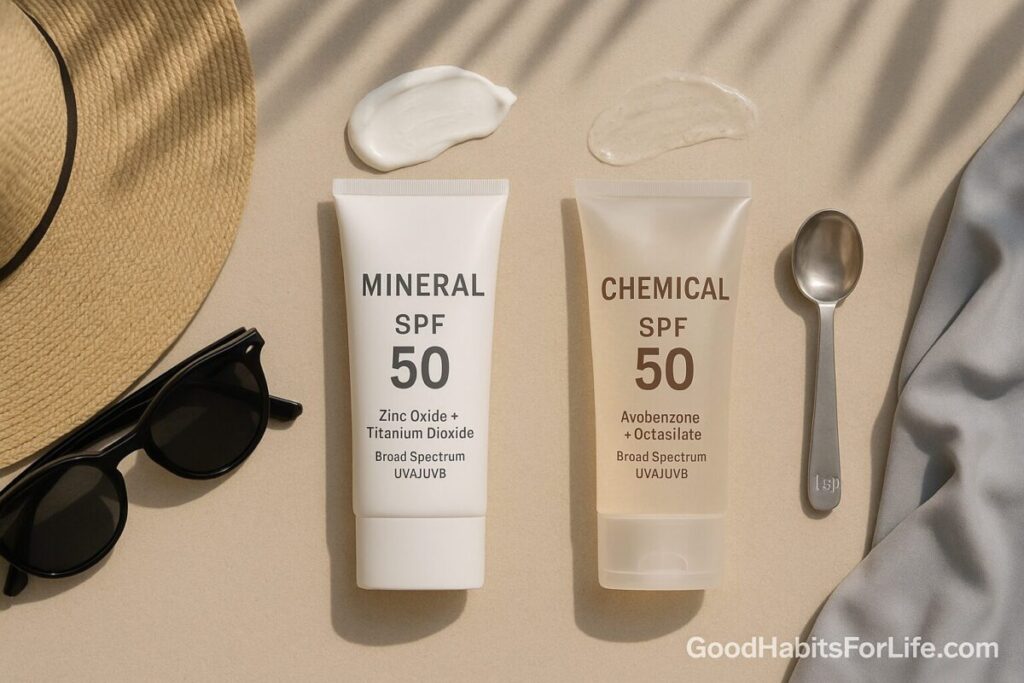
Sunscreen 2025: Mineral vs Chemical
Sunscreen (2025): Mineral vs Chemical
Table of Contents
🧭 What & Why
Sunscreen is one pillar of a full “sun-smart” routine—alongside shade, clothing, hats, and sunglasses—to lower sunburn, photoaging, and skin-cancer risk. Use a broad-spectrum product (UVA + UVB) at SPF 30 or higher, reapply at least every 2 hours (sooner if swimming/sweating), and apply enough: roughly 30 mL/1 oz for the body and ~1 tsp for face/neck. Apply 15 minutes before exposure. U.S. Food and Drug Administration+1
UV levels change with time of day, season, altitude, clouds, and latitude. A simple rule: when UV Index ≥3, use protection; that’s the global public-health threshold. AAD
Regulatory note (US): FDA continues to update sunscreen requirements. Zinc oxide and titanium dioxide are recognized as generally safe and effective (GRASE) in proposals; other filters remain under review, but consumers should keep using sunscreen along with other protection. U.S. Food and Drug Administration+1
✅ Quick Start (Do this today)
-
Pick one you’ll use daily. Broad-spectrum, SPF 30+, water-resistant if outdoors/active. For sensitive skin or eye-sting issues, try mineral (zinc oxide/titanium dioxide). U.S. Food and Drug Administration
-
Dose it right. Body: ~30 mL (1 oz/“shot-glass”). Face/neck: ~1 tsp (≈ two fingers of product). Apply 15 min before sun; cover ears, scalp/hairline, hands, and feet. AAD
-
Reapply every 2 hours, and after 40 or 80 minutes of water/sweat depending on the label (water-resistant vs very water-resistant). “Waterproof/sweatproof” claims are banned. U.S. Food and Drug Administration
-
Layer protection. Add a UPF shirt, wide-brim hat, UV-blocking sunglasses; seek shade 10:00–14:00. U.S. Food and Drug Administration
-
Check UV Index. If UV ≥3, be strict with protection. Use WHO SunSmart or EPA UV Index apps for alerts. World Health Organization+1
🧠 Mineral vs Chemical: The 2025 Reality
Mineral filters (zinc oxide, titanium dioxide) and chemical (organic) filters (e.g., avobenzone, octisalate, octocrylene) protect by attenuating UV energy before it damages skin. Both categories can deliver excellent protection when properly formulated and applied. Choose based on skin feel, sensitivity, and local regulations. U.S. Food and Drug Administration
-
Mineral: Often preferred for sensitive skin and around eyes; modern formulas can be elegant but may leave a cast on deeper skin tones unless tinted. Tinted mineral with iron oxides also helps block visible light that worsens hyperpigmentation. AAD
-
Chemical: Typically lighter, clearer finishes; may sting eyes for some; some filters need stabilizers for UVA durability (e.g., avobenzone). US labels require “broad-spectrum” performance to meet UVA criteria. U.S. Food and Drug Administration
Nanoparticles? EU safety panels conclude nano-titanium dioxide and nano-zinc oxide are safe in sunscreens (with caution for sprays/powders due to inhalation). ResearchGate+1
Environment & reef rules. Jurisdictions differ: Hawaiʻi (statewide) bans sale of sunscreens with oxybenzone and octinoxate, and Maui County allows mineral-only without prescription. “Reef-safe” isn’t a regulated scientific term; rely on ingredient lists and local laws. Hawaii Data Portal+1
🛠️ UVA, UVB & Ratings (SPF, UVA-PF, PA, Broad-Spectrum)
-
SPF rates UVB (sunburn) protection; it does not tell you UVA protection level. US “broad-spectrum” means the product passes a critical-wavelength test (≥ 370 nm), ensuring meaningful UVA coverage. U.S. Food and Drug Administration+1
-
UVA ratings vary globally. In Europe/UK, the UVA-in-a-circle logo indicates UVA-PF ≥ 1/3 of SPF (and critical wavelength ≥ 370 nm). In parts of Asia, PA+ to PA++++ relates to UVA-PF/PPD. Internal Market Hub+1
-
Water resistance is 40 or 80 minutes and must be tested; “waterproof” is not allowed on US labels. U.S. Food and Drug Administration
Bottom line: pick SPF 30+, broad-spectrum, and a texture you’ll use generously and often.
📅 Habit Plan: 30-60-90 Day Roadmap
Days 1–30 (Foundation)
-
Audit your routine: Check expiration dates (or toss if >3 years from purchase and no date). Stock 2–3 textures (lotion for body; gel or fluid for face; stick for on-the-go). U.S. Food and Drug Administration
-
Dose discipline: Put a 30 mL shot-glass in your bathroom as a visual cue for body days; 1 tsp line on a spoon for face/neck. AAD
-
Set UV alerts: Install SunSmart Global UV (global) or EPA UV Index (US). Enable notifications at UV ≥ 3. World Health Organization+1
Days 31–60 (Consistency)
-
Reapply system: Carry a stick or compact in your bag/car. Schedule a phone reminder for 120 min when outdoors.
-
Clothing upgrade: Add a UPF 50 long-sleeve and broad-brim hat to your default kit. U.S. Food and Drug Administration
-
Surface area map: Identify “missed zones” (ears, hairline, hands, tops of feet) and hit them first. U.S. Food and Drug Administration
Days 61–90 (Optimization)
-
Context switchers: Have a sport water-resistant SPF for runs/swims (check 40/80 min on label) and a tinted mineral SPF for commute/indoor window exposure. U.S. Food and Drug Administration+1
-
Refill & rotate: Replace near-empty bottles; mark open dates; keep one in gym bag, one at desk, one by the door.
-
Seasonal check: As UV peaks seasonally, increase reapply cadence and shade breaks (10:00–14:00). U.S. Food and Drug Administration
🧩 Techniques & Frameworks
-
“Cover-Apply-Reapply” Protocol
-
Cover with UPF clothing/hat/sunglasses; 2) Apply SPF 30+ 15 min before; 3) Reapply every 2 hours or per water-resistance time. U.S. Food and Drug Administration
-
-
“2-2-2” Rule (easy memory aid): 2 mg/cm² (lab dose ≈ 30 mL body/1 tsp face), every 2 hours, two fingers for face/neck as a proxy. AAD
-
UVA-First Mindset: Prefer broad-spectrum or the UVA-in-a-circle (EU) for meaningful UVA coverage that drives photoaging and some skin cancers. Internal Market Hub
-
Tint for Pigment-Prone Skin: Choose tinted mineral + iron oxides to also block visible light that can trigger melasma or dark spots. AAD
👥 Audience Variations
-
Students/Professionals (indoor + windows): UVA penetrates glass—use a daily broad-spectrum on exposed skin; top up before lunch walks/commutes. U.S. Food and Drug Administration
-
Parents/Caregivers: Under 6 months: shade + clothing only; ask a doctor before using sunscreen. For older kids, stick formulas are tidy for school bags; avoid sprays near faces. U.S. Food and Drug Administration
-
Athletes/Outdoor Workers: Choose very water-resistant (80 min), sweat-tested textures; reapply with sticks/gels that grip. U.S. Food and Drug Administration
-
Seniors: Prioritize high-contrast labels and easy-spread lotions; set phone reminders.
-
Darker Skin Tones: Tinted mineral options reduce cast and improve visible-light protection for hyperpigmentation. AAD
⚠️ Mistakes & Myths to Avoid
-
Using too little. Most people apply 25–50% of what’s needed. Aim for the shot-glass body dose and 1 tsp face/neck. AAD
-
Skipping reapplication. Protection wanes with time, sweat, and rub-off—2-hour rule still applies. AAD
-
“Waterproof” belief. Not allowed; only water-resistant (40/80 min) claims are permitted. U.S. Food and Drug Administration
-
Vitamin D trade-off myth. Real-world sunscreen use does not meaningfully lower vitamin-D status; get vitamin D from food/supplements if needed. PubMed+2PMC+2
-
“Reef-safe” label as science. It’s not a standardized or regulated scientific term; check local regulations and ingredients.
-
Expired bottles. If no date, treat as expired 3 years after purchase. U.S. Food and Drug Administration
-
Spray near flames/face. Many sprays contain flammable solvents; spray onto hands first and apply to face, away from flames. U.S. Food and Drug Administration
🗣️ Real-Life Examples & Scripts
-
Beach day reminder: “It’s been 2 hours—quick SPF break before we head back in.”
-
Team fieldwork: “UV is 8 at noon (app alert). Let’s reapply now and take a shade break at 1 pm.” US EPA
-
For sensitive eyes: “I switched to a zinc stick for the eye area; no more sting.” U.S. Food and Drug Administration
-
For hyperpigmentation: “I use a tinted mineral SPF daily to block UVA and visible light.” AAD
🧰 Tools, Apps & Resources
-
SunSmart Global UV (WHO/WMO/UNEP/ILO): Global UV forecasts and protection windows. World Health Organization+1
-
EPA UV Index (US): Local UV alerts and education. US EPA
-
UPF clothing & hats: Make shade wearable; pair with sunglasses. U.S. Food and Drug Administration
-
Check labels: Look for Broad-Spectrum + SPF 30+ + Water-Resistant; in EU/UK, the UVA-in-a-circle helps gauge UVA balance. U.S. Food and Drug Administration+1
📚 Key Takeaways
-
Any sunscreen beats none, but enough + often beats everything.
-
Mineral vs chemical is a preference; broad-spectrum SPF 30+ and reapplication matter most. U.S. Food and Drug Administration
-
UVA savvy: Seek broad-spectrum (US) or UVA-logo (EU). Internal Market Hub
-
Habitify it: Apps, reminders, and stashing sticks where you live, work, train, and travel make consistency easy. World Health Organization
❓ FAQs
1) Which is “safer,” mineral or chemical?
Both are regulated; zinc oxide and titanium dioxide are recognized as safe/effective in FDA proposals. Several organic filters remain under review, which does not mean “unsafe.” Choose what you tolerate and will apply generously. U.S. Food and Drug Administration+1
2) What SPF do I really need daily?
SPF 30+ broad-spectrum is the practical minimum for most people; go higher for prolonged outdoor exposure or high UV days. Reapply at least every 2 hours. AAD
3) Do I need sunscreen indoors?
If you sit near windows or you’ll be outside at any point, yes. UVA penetrates glass; apply a daily broad-spectrum and reapply if you go out later. U.S. Food and Drug Administration
4) I wear makeup with SPF—enough?
Often not at the right dose; use a dedicated sunscreen under makeup and top-up with a stick, cushion, or spray (spray onto hands for face). AAD
5) What about vitamin D?
Evidence shows sunscreen doesn’t meaningfully reduce vitamin-D levels in real life; meet needs via diet/supplements if necessary. PubMed+1
6) Are sprays OK?
Yes, but use away from flames; spray into hands for face and mind inhalation. Many are flammable; always read labels. U.S. Food and Drug Administration
7) Is “reef-safe” a guarantee?
No. The term isn’t legally or scientifically standardized; follow local laws (e.g., Maui mineral-only) and check ingredients. mauicounty.gov
8) How long does sunscreen last?
If no expiration date, treat as expired 3 years from purchase; store away from heat/sun. U.S. Food and Drug Administration
9) What should I look for to ensure UVA protection?
In the US, look for broad-spectrum. In EU/UK, look for the UVA-in-a-circle logo (UVA-PF ≥ 1/3 of SPF). U.S. Food and Drug Administration+1
10) When should babies start sunscreen?
Under 6 months, avoid direct sun and use clothing/shade; consult a doctor before using sunscreen. U.S. Food and Drug Administration
📖 References
-
FDA. Sunscreen: How to Help Protect Your Skin from the Sun (content current: Aug 16, 2024). U.S. Food and Drug Administration
-
American Academy of Dermatology. How to apply sunscreen (updated Aug 15, 2025). AAD
-
American Academy of Dermatology. 5 common sunscreen mistakes—and how to avoid them (updated Aug 15, 2025). AAD
-
WHO/WMO/UNEP/ILO. SunSmart Global UV App & update (2024). World Health Organization+1
-
WHO. Global Solar UV Index: A Practical Guide—UV ≥3 threshold for protection. AAD
-
FDA (Proposed Order, 2021). Sunscreen active ingredients status under CARES Act process. U.S. Food and Drug Administration
-
FDA (2011 rule & guidance). Broad-spectrum & critical wavelength (≥ 370 nm) criteria (UVA). AAD
-
European Commission. Sunscreen products—UVA logo guidance (UVA-in-a-circle). Internal Market Hub
-
DermNet NZ. Topical sunscreen agents—UVA-PF ≥ 1/3 of SPF; critical wavelength ≥ 370 nm (EU). DermNet®
-
SCCS (EU). Opinions on titanium dioxide (nano) and zinc oxide (nano) safety in sunscreens. ResearchGate+1
-
Maui County, Hawaiʻi. Ordinance 5306: Mineral-Only Sunscreen (effective Oct 1, 2022). mauicounty.gov
-
Hawaiʻi State Legislature. Act 104 (2018): Oxybenzone/Octinoxate sale ban (effective Jan 1, 2021). Hawaii Data Portal
-
NOAA. Sunscreen and coral reefs—ingredients of concern and marine protection tips. ISO
-
NIH ODS. Vitamin D—Health Professional Fact Sheet (updated 2025). Office of Dietary Supplements
-
Passeron T., et al. Sunscreen photoprotection and vitamin D status (2019). PMC
⚖️ Disclaimer
This guide is educational and not a substitute for medical advice. For personal recommendations, consult a qualified healthcare professional.