
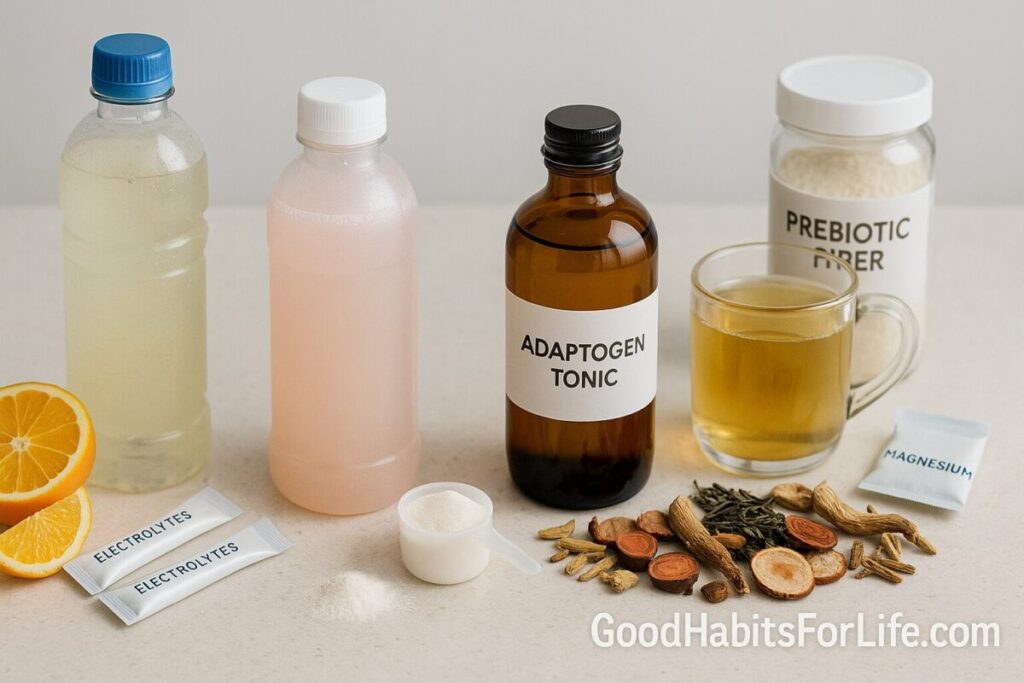
Functional Drinks 2025: Collagen, Adaptogens, Electrolytes
Functional Drinks 2025: Collagen, Adaptogens, Electrolytes
Table of Contents
🧭 What Counts as a Functional Drink (and Why It Matters)
Definition (2025): A beverage formulated to deliver a measurable function—e.g., hydration, stress support, cognitive calm/alertness, skin/joint support, gut health, or workout recovery—beyond basic nutrition or taste.
Why this matters:
-
The category is crowded and under-standardized. Some formulas are evidence-aligned; others are marketing-heavy.
-
Picking by function saves money and avoids unnecessary sugar, caffeine, or botanicals that don’t fit your goal.
Major sub-types you’ll see in 2025
-
Hydration & Electrolytes: sodium/potassium blends; some include carbs for endurance.
-
Collagen Waters/Shakes: hydrolyzed collagen peptides for skin/joints.
-
Adaptogen Tonics: ashwagandha, rhodiola, ginseng, mushrooms (reishi, lion’s mane).
-
Focus/Calm Blends: L-theanine + moderate caffeine; magnesium drinks at night.
-
Gut & Immunity: kefir, probiotic sodas, prebiotic fiber drinks.
Evidence snapshot (high level)
-
Collagen peptides: growing evidence for skin elasticity and some joint discomfort outcomes after consistent intake.
-
Adaptogens: variable—some promising results (ashwagandha for stress/sleep; rhodiola for fatigue); quality and dosing matter.
-
Electrolytes: strongly evidence-based when needed (prolonged sweat, heat, illness). For ordinary desk days, water usually wins.
✅ Quick Start: Smarter Sips Today
Step 1 — Pick the job to be done
-
Hydrate through long workouts/heat? → Electrolyte drink (see amounts below).
-
Support skin/joints over months? → Collagen peptides (not a quick fix).
-
Manage stress or mental fatigue? → Consider adaptogen tonic (after checking meds/conditions).
Step 2 — Use the 3-Check Label Rule
-
Sugars (per 100 ml):
-
Everyday sipping: ≤3 g/100 ml (≤30 g/L).
-
Endurance (60–150 min): 6–8 g/100 ml (60–80 g/L) with electrolytes.
-
-
Caffeine (per serving): Adults keep total daily ≤400 mg.
-
Sodium (per litre):
-
Everyday use: low (you get sodium from food).
-
Heavy sweat/endurance: aim ~300–700 mg/L with some potassium.
-
Step 3 — Safer limits & smart timing
-
Avoid stacking multiple caffeinated drinks close together.
-
If a blend includes botanicals (adaptogens), introduce one change at a time for 2–3 weeks and track how you sleep, feel, and perform.
-
For illness with diarrhea, consider WHO-style ORS rather than sports drinks.
Step 4 — Buy better
-
Choose transparent labels showing exact mg/g amounts.
-
Prefer products with 3rd-party testing (NSF, Informed Choice, USP where applicable).
-
Start with small trial sizes before committing to cases.
🧪 Ingredient Deep Dive: Collagen, Adaptogens, Electrolytes
Collagen (Hydrolyzed Collagen Peptides)
What it is: Collagen protein broken into small peptides for absorption. Types I & III are common for skin; type II for joint cartilage.
What it can help:
-
Skin metrics such as elasticity and hydration (8–12 weeks).
-
Joint comfort in some people, especially active adults or those with mild joint complaints.
How to use
-
Dose: Common range 2.5–10 g/day (some studies use up to ~15 g).
-
Form: Powders (neutral taste), ready-to-drink waters/shakes.
-
With vitamin C: Collagen assembly requires vitamin C; many users pair with a C-rich food.
-
Expectations: Think months, not days. Take daily at a consistent time.
Watch-outs
-
Not suitable for strict vegans (animal-derived).
-
Does not replace a protein-adequate diet for muscle building.
Adaptogens (Ashwagandha, Rhodiola, Ginseng)
What they are: Botanicals traditionally used to help the body “adapt” to stressors.
Potential benefits (depends on plant & dose)
-
Ashwagandha (Withania somnifera): stress and sleep quality support in some trials.
-
Rhodiola rosea: fatigue and perceived exertion in some studies.
-
Panax ginseng: modest effects on fatigue and cognition reported; quality varies.
How to use
-
Start low: e.g., ashwagandha extract 120–300 mg once daily, then reassess; many trials use 240–600 mg/day.
-
Cycles: Try 6–8 weeks, then break or reassess.
-
Single-variable testing: Add only one adaptogen at a time to attribute effects.
Watch-outs
-
Possible interactions (sedatives, thyroid meds, blood pressure meds, anticoagulants).
-
Occasional GI upset; rare liver issues reported with some botanicals.
-
Pregnant/breastfeeding or teens: consult a clinician; many products are not studied in these groups.
Electrolytes (Sodium, Potassium, etc.)
What they do: Replace minerals lost in sweat or illness and help water move where it’s needed.
When you need them
-
Workouts >60–90 minutes, hot/humid conditions, heavy sweaters/salty sweat.
-
Illness with fluid loss (use oral rehydration solutions formulated to WHO standards).
-
High-altitude or heat exposure where sweat loss is pronounced.
Amounts & forms
-
Everyday hydration: water, milk, or unsweetened tea/coffee typically suffice.
-
Endurance training: target ~300–700 mg sodium/L with some potassium, plus 6–8% carbs if you need fuel.
-
ORS (medical-style): a specific sodium-glucose ratio for absorption; not the same as sports drinks.
Watch-outs
-
Overuse can add unnecessary sugar/sodium.
-
Hyponatremia risk comes from too much water with too little sodium during long exertion—match fluids to sweat rate and include sodium for long events.
🧠 Techniques & Frameworks
1) The “S.M.A.R.T. Sips” filter
-
Specific: “I use an electrolyte drink only on runs ≥75 min.”
-
Measurable: “≤8 g sugar/100 ml; sodium 300–600 mg/L.”
-
Achievable: Fits budget and availability.
-
Relevant: Aligns with your training or skin/joint goal.
-
Time-bound: Reassess in 8 weeks.
2) The 3-Check Label Rule (print this)
-
Sugars (g/100 ml) → Everyday ≤3; Endurance 6–8.
-
Caffeine (mg/serv) → Daily total ≤400 mg (adults).
-
Sodium (mg/L) → Everyday low; Endurance ~300–700.
3) Drink Decision Tree
-
Desk day? → Water/tea/coffee.
-
Long workout/heat? → Electrolyte + fuel.
-
Chronic skin/joint goal? → Collagen daily.
-
Stress or poor sleep? → Trial a single adaptogen (screen for interactions first).
-
GI illness? → ORS until normal hydration returns.
4) Measurement ideas
-
Skin: monthly close-up photos under the same lighting; self-ratings on elasticity/hydration.
-
Energy/stress: 1–10 scale daily; sleep duration/quality.
-
Training: pace, RPE (perceived exertion), and cramps frequency.
-
Hydration: body-mass change across long sessions; urine color chart.
🗺️ 30-60-90 Day Habit Plan
Days 1–30 — Audit & Baseline
-
Track everything you drink for 7 days.
-
Cut “mindless” sugar: swap sweetened drinks for water, sparkling water, or unsweetened tea.
-
Implement the 3-Check Rule on all purchases.
-
If starting collagen, pick a single product and take it daily; log a baseline skin/joint score.
Days 31–60 — Targeted Experiments
-
Training ≥75 min? Introduce electrolyte + 6–8% carbs in long sessions; compare RPE/cramps.
-
Stress issues? Trial one adaptogen (e.g., ashwagandha) for 6–8 weeks; track sleep and stress scores.
-
Keep sugars in routine drinks ≤3 g/100 ml.
Days 61–90 — Keep & Scale What Works
-
Retain only interventions with clear benefits in your logs.
-
Bulk-buy the one electrolyte and one collagen that passed your tests.
-
Set auto-reminders (calendar/app) for re-evaluation every quarter.
👥 Audience Variations
Students: prioritize low-cost hydration; avoid high caffeine stacking near exams; watch sugar.
Professionals: limit afternoon caffeine; keep a desk bottle with marked volumes to pace water intake.
Parents: skip multi-herb tonics for kids; for youth sports, electrolytes are for hot/long days—not routine.
Seniors: check medication interactions (BP, anticoagulants); favor lower caffeine; consider sodium cautiously.
Teens: avoid adaptogens unless advised by a clinician; watch energy drinks; prioritize sleep and meals first.
Pregnant/Breastfeeding: many adaptogens lack safety data; consult your clinician before use.
⚠️ Mistakes & Myths to Avoid
-
“Electrolytes every workout.” Not needed for short, light sessions.
-
“Collagen works in a week.” Most skin/joint outcomes appear after 8–12 weeks of daily use.
-
“Adaptogens are side-effect free.” They can interact with meds and aren’t one-size-fits-all.
-
“Zero sugar means weight loss.” Non-sugar sweeteners aren’t a magic bullet; focus on overall diet.
-
“More sodium prevents all cramps.” Cramps are multifactorial; pacing, conditioning, and temperature matter too.
💬 Real-Life Examples & Scripts
-
At the café: “I’ll get a small latte and a glass of water. No added syrup.”
-
Before a 90-min run in heat: “Mix 1 L bottle: label shows ~500 mg sodium/L and 60–80 g carbs/L.”
-
Evening unwind: “Herbal tea; if trialing ashwagandha, take the lowest effective dose 1–2 hours before bed.”
-
During GI illness: “Use an ORS packet as directed until thirst and urination normalize; avoid high-sugar sodas.”
-
Starting collagen: “10 g hydrolyzed peptides with breakfast; monthly skin photo check-ins on the 1st.”
🧰 Tools, Apps & Resources
-
Cronometer — tracks micronutrients and added sugars; good label database.
-
MyFitnessPal — quick logging; watch crowdsourced entries for accuracy.
-
Yuka/Food switchers — barcode scans to flag sugar/sodium.
-
Timer/Calendar — habit reminders for daily collagen or pre-workout electrolyte prep.
-
Heart-rate/GPS apps — pair hydration strategy with training load and heat index.
📌 Key Takeaways
-
Buy for the job, not the buzzword.
-
Use the 3-Check Label Rule every time.
-
Collagen is a daily, long-game intervention.
-
Adaptogens are maybes, not musts—test carefully and check for interactions.
-
Electrolytes shine in heat, illness, or long sessions, not desk days.
-
Keep what measurably works; drop the rest.
❓ FAQs
1) Are collagen coffees or waters as good as powders?
Yes—if the grams of hydrolyzed collagen peptides are comparable. Check actual grams per serving, not just “with collagen.”
2) Can I take collagen if I’m already meeting my protein target?
You can, but collagen lacks essential amino acids for muscle building; treat it as a targeted supplement for skin/joints, not as your main protein.
3) Which adaptogen is “best”?
None universally. Start with one, such as ashwagandha for stress/sleep or rhodiola for fatigue, and track outcomes for 6–8 weeks.
4) Do I need electrolytes for a 45-minute gym session?
Usually no. Water is enough unless you’re in extreme heat or have high sweat losses.
5) What about magnesium sleep drinks?
Magnesium can help people who are deficient; forms and doses vary. Keep caffeine away from bedtime and focus on sleep hygiene first.
6) Are non-sugar sweeteners better than sugar?
They reduce calories but aren’t a guaranteed weight-loss solution. Whole-diet quality and habits matter more.
7) Is ORS the same as a sports drink?
No. ORS follows a specific sodium-glucose balance for rehydration during illness; sports drinks are designed for sweat + fuel during exercise.
8) Any risks with adaptogens?
Possible interactions and rare adverse events exist. If you take prescription meds or have health conditions, talk to a clinician first.
9) How much caffeine is safe per day?
Most healthy adults should stay ≤400 mg/day from all sources.
10) What’s one habit to start this week?
Apply the 3-Check Label Rule to every drink you buy. It instantly upgrades your choices.
📚 References
-
U.S. FDA. Spilling the Beans: How Much Caffeine is Too Much? https://www.fda.gov/consumers/consumer-updates/spilling-beans-how-much-caffeine-too-much
-
World Health Organization. Guideline: Sugars intake for adults and children. https://www.who.int/publications/i/item/9789241549028
-
World Health Organization. Use of non-sugar sweeteners: guideline (2023). https://www.who.int/publications/i/item/9789240073616
-
National Academies of Sciences, Engineering, and Medicine. Dietary Reference Intakes for Sodium and Potassium (2019). https://nap.nationalacademies.org/catalog/25353/dietary-reference-intakes-for-sodium-and-potassium
-
American College of Sports Medicine. Exercise and Fluid Replacement (Position Stand). https://www.acsm.org/
-
World Health Organization / UNICEF. Oral Rehydration Therapy (ORT/ORS). https://www.unicef.org/health/oral-rehydration-therapy
-
Harvard Health Publishing. Collagen supplements: Do they work? https://www.health.harvard.edu/staying-healthy/collagen-supplements-do-they-work
-
Choi FD et al. The Use of Collagen Supplementation in Dermatology: A Systematic Review. J Drugs Dermatol. 2019. https://pubmed.ncbi.nlm.nih.gov/30681787/
-
National Center for Complementary and Integrative Health (NCCIH). Ashwagandha. https://www.nccih.nih.gov/health/ashwagandha
-
NCCIH. Rhodiola. https://www.nccih.nih.gov/health/rhodiola
-
NCCIH. Asian Ginseng (Panax ginseng). https://www.nccih.nih.gov/health/asian-ginseng
-
LiverTox (NIH). Ashwagandha. https://www.ncbi.nlm.nih.gov/books/NBK548561/
Disclaimer: This article is for general education and is not medical advice; consult a qualified professional for personal recommendations, especially if you’re pregnant, breastfeeding, a teen, or on prescription medications.