
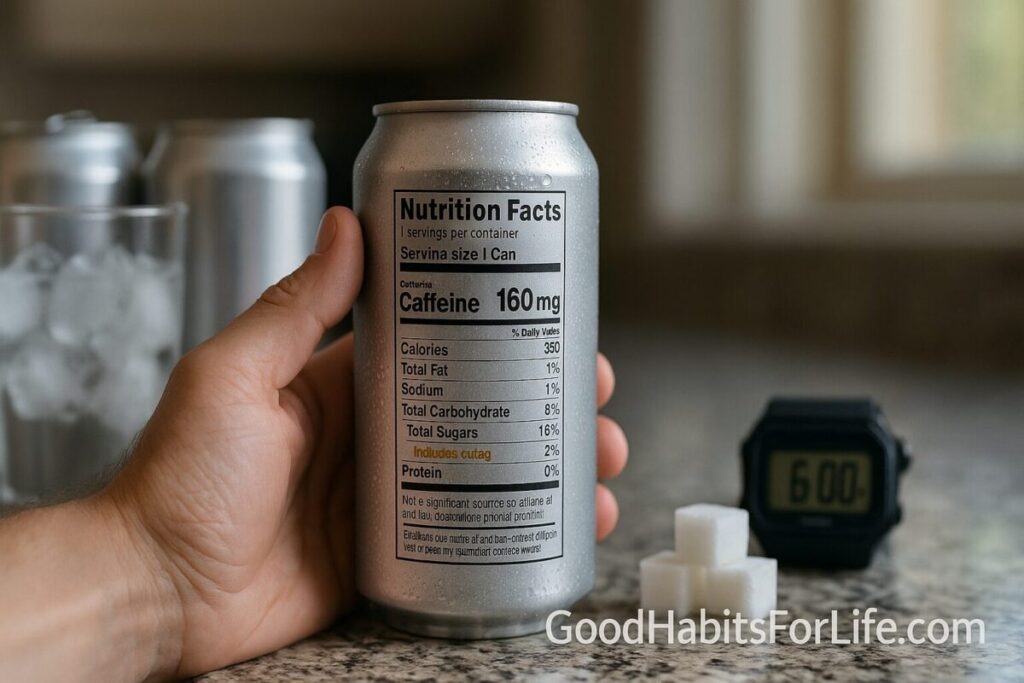
Energy Drinks: Labels, Limits, and Safer Defaults
Energy Drinks: Labels, Limits & Safer Defaults
Table of Contents
🧭 What Counts as an Energy Drink (and how it works)
“Energy drink” is an industry term for beverages formulated to boost alertness via caffeine and other stimulants (e.g., guarana), often with sugar, taurine, and B-vitamins. Caffeine is the main active—most 16-oz (473 mL) cans land anywhere from ~54–328 mg caffeine, but formulas vary widely. U.S. Food and Drug Administration
How it works: caffeine blocks adenosine receptors (reducing sleep pressure) and stimulates the central nervous system; the effect size depends on your dose, body mass, time of day, and sensitivity. Large or late doses impair sleep and may raise heart rate and anxiety. A controlled study shows even 400 mg taken 6 hours before bed can significantly disrupt sleep. PubMedJCSM
📚 Label Decoding: Caffeine, Sugars, and “Proprietary” Blends
Use this fast checklist when you pick up a can:
-
Total caffeine (per can, not just per serving): Prefer products that disclose the total mg from all sources (including guarana). In the U.S., labels must list “caffeine” when added, but the exact milligrams aren’t federally required on conventional beverages (many brands still disclose voluntarily). Guarana itself contributes caffeine and may not be broken out unless the brand lists a total. U.S. Food and Drug AdministrationRegistrar CorpPMC
-
Serving size vs. can size: Some cans are 2 servings; double the numbers.
-
Sugars / “free sugars”: WHO recommends keeping free sugars <10% of energy (ideally <5% ≈ ≤25 g/day); the American Heart Association sets practical caps (≈25 g/day women; 36 g/day men). A single energy drink can blow most of that. World Health Organizationwww.heart.org
-
EU advisory statement: In Europe, drinks >150 mg/L must carry “High caffeine content. Not recommended for children or pregnant or breastfeeding women,” plus the caffeine amount per 100 mL. Legislation.gov.uk
-
Other actives: Taurine (often ~4,000 mg/L) and glucuronolactone are common; at typical concentrations they don’t change the safety profile of a single 200 mg caffeine dose in adults. European Food Safety Authority
Bottom line: Choose cans that clearly show total caffeine per can, watch sugar grams, and beware of “proprietary blends” that obscure amounts.
⚖️ Evidence-Backed Limits (Adults, Teens, Pregnancy)
-
Healthy adults: Up to 400 mg/day from all sources appears not generally associated with adverse effects; single doses up to 200 mg are considered of no concern for most adults. Spread intake earlier in the day to protect sleep. U.S. Food and Drug AdministrationEuropean Food Safety Authority
-
Pregnancy: Keep total caffeine ≤200 mg/day. Count caffeine from coffee, tea, cola, chocolate, and energy drinks. ACOG
-
Teens & children: The AAP advises against energy drinks for kids and adolescents due to stimulant loads; for youth, conservative guidance is to avoid or keep caffeine minimal. AAP Publications
-
Sleep timing: Avoid caffeine within 6–12 hours of bedtime depending on dose; even 400 mg taken 6 hours before bed disrupted sleep in lab studies. PubMed
-
Alcohol: Don’t mix energy drinks with alcohol; caffeine can mask intoxication and increase risky behaviors. CDC
🛠️ Quick Start: Safer Defaults You Can Use Today
-
Pick a cap: Set a personal daily budget (e.g., ≤200–300 mg/day if you’re caffeine-sensitive; ≤400 mg/day absolute ceiling for healthy adults). U.S. Food and Drug Administration
-
One-can rule: If you choose an energy drink, limit to one standard can (e.g., 200 mg or less) and finish before 14:00. European Food Safety AuthorityPubMed
-
Trade sugar: Prefer zero-sugar or low-sugar versions; still count the caffeine. Track daily sugars against AHA/WHO limits. World Health Organizationwww.heart.org
-
Hydrate: Alternate each caffeinated drink with water.
-
No mix with alcohol—ever. CDC
-
Read for guarana: If present, ensure the label lists total caffeine from all sources. PMC
🗺️ 7-Day Reset Plan (from “random cans” to controlled intake)
-
Day 1 – Count: Log what you drink (time, size, mg). Totals >400 mg? Cut 25% tomorrow. U.S. Food and Drug Administration
-
Day 2 – Swap late doses: Move any caffeine after 14:00 to before 11:00. PubMed
-
Day 3 – Reduce sugar: If your go-to has ≥25–35 g sugar/can, switch to zero-sugar or unsweetened coffee/tea. World Health Organizationwww.heart.org
-
Day 4 – One-can policy: Pick a can ≤200 mg and lock to mornings only. European Food Safety Authority
-
Day 5 – Caffeine budget: Allocate remaining mg (e.g., 100–150 mg) to coffee or tea; skip “top-ups” after lunch.
-
Day 6 – Sleep check: If sleep latency or quality dropped this week, roll caffeine earlier (before 10:00) or lower the daily cap. PubMed
-
Day 7 – Review & lock defaults: Keep what worked: cap, timing, and label-aware picks.
🧠 Techniques & Frameworks to Stay Within Limits
-
Caffeine Budgeting: Treat caffeine like a wallet: 400 mg/day max (adults). Pre-allocate: e.g., 150 mg morning coffee + 150 mg energy drink (AM) + 0–100 mg tea. U.S. Food and Drug Administration
-
8-Hour Buffer: Keep 8–12 hours between last dose and bedtime (err longer if sensitive). PubMed
-
Label Triad: Check (1) total mg, (2) sugar grams, (3) serving count—if any is unclear, choose another product. U.S. Food and Drug Administration+1
-
“Green-Yellow-Red” Picks:
-
Green: 0–150 mg per serving; 0–5 g sugar.
-
Yellow: 151–200 mg; ≤10 g sugar.
-
Red: >200 mg or >20 g sugar per serving.
-
-
Habit Stack: Pair your can with food + water; avoid on an empty stomach if you’re jitter-prone.
👥 Audience Variations
-
Students/teens: Choose sleep first; use caffeine sparingly for exams (≤100 mg once in the morning), and avoid energy drinks entirely per pediatric guidance. AAP Publications
-
Professionals on deadlines: Use a single morning dose (100–200 mg) and schedule “ultra-focus” blocks 30–60 min later. Avoid “rescue” cans after lunch. European Food Safety Authority
-
Athletes: A single ≤200 mg dose <2 h pre-workout is generally of no concern; hydrate and avoid late-day dosing. European Food Safety Authority
-
Pregnancy/breastfeeding: Keep ≤200 mg/day; many “regular” cans exceed that in one go—opt for decaf or herbal alternatives. ACOG
-
Sensitive/insomnia/anxiety/HTN: Lower caps (e.g., ≤100–200 mg/day) and earlier timing. If symptoms persist, talk to your clinician.
❌ Mistakes & Myths to Avoid
-
“Sugar-free means safe.” The issue can be caffeine dose and timing, not just calories. PubMed
-
“Guarana isn’t caffeine.” It is—labels may not spell out its mg. PMC
-
“Labels always show caffeine mg.” U.S. labels must list added caffeine, but mg disclosure isn’t mandatory for conventional drinks; choose brands that disclose totals. U.S. Food and Drug Administration
-
“Alcohol + energy drink sobers you up.” False—caffeine masks impairment and can increase risky drinking. CDC
-
“Taurine makes it unsafe.” At typical drink levels, taurine doesn’t alter the safety of a single 200 mg caffeine dose in adults. European Food Safety Authority
💬 Real-Life Examples & Scripts
-
At a café: “What’s the caffeine per can? Is that total including guarana?”
-
At a store: “Does this can list total caffeine per can? If not, I’ll pick one that does.”
-
With friends (party): “I’m skipping energy drinks with alcohol—it hides how tipsy you are.” CDC
-
With a teen: “Energy drinks aren’t for kids—let’s plan earlier nights and a small morning tea on exam days.” AAP Publications
🧰 Tools & Resources
-
Caffeine tracking apps (search “caffeine tracker” on your app store) to keep daily totals under your budget.
-
WHO/AHA guidance to calibrate sugar limits (aim for <25–36 g/day). World Health Organizationwww.heart.org
-
Brand websites for product-specific caffeine mg. If absent, consider another option.
✅ Key Takeaways
-
Keep daily caffeine ≤400 mg (healthy adults), single doses ≤200 mg, and push intake earlier. U.S. Food and Drug AdministrationEuropean Food Safety Authority
-
Teens/kids: avoid energy drinks; pregnancy: ≤200 mg/day. AAP PublicationsACOG
-
Choose cans with transparent caffeine totals and low/no sugar; beware guarana. U.S. Food and Drug AdministrationPMC
-
Never mix with alcohol. CDC
-
Protect sleep: avoid caffeine within 6–12 h of bedtime. PubMed
❓ FAQs
1) How many energy drinks can I have in a day?
For most healthy adults, keep total caffeine ≤400 mg/day. Since many cans contain 150–200 mg or more, one standard can is a practical ceiling—especially if you also drink coffee or tea. U.S. Food and Drug Administration
2) Are sugar-free energy drinks safe?
They can still carry high caffeine and impair sleep if taken late. Sugar-free helps calories, but dose/timing still matter. PubMed
3) What’s a safe single dose?
A single dose up to 200 mg is considered of no concern for most adults; sensitive individuals should use less and earlier. European Food Safety Authority
4) What about teens?
Pediatric guidance says energy drinks are not appropriate for children and adolescents. Encourage sleep, water, and small, earlier caffeine from tea only when necessary. AAP Publications
5) Is guarana “extra” beyond the caffeine number?
If the brand declares total caffeine from all sources, guarana should be included. If the label doesn’t state totals, the drink may contain more caffeine than you think. U.S. Food and Drug AdministrationPMC
6) Can I use an energy drink as a pre-workout?
If you do, limit to ≤200 mg and take it <2 hours pre-exercise; avoid late-day sessions to protect sleep. Hydrate. European Food Safety Authority
7) Why avoid mixing with alcohol?
Caffeine can mask intoxication, leading to more drinking and higher risk behaviors. CDC
8) What’s the sugar target for the day?
WHO: <10% of daily energy from “free sugars,” ideally <5% (≈25 g); AHA gives simple gram caps (≈25 g women, 36 g men). World Health Organizationwww.heart.org
9) Do taurine or B-vitamins make energy drinks safer?
Not really. Taurine at typical levels doesn’t change the caffeine safety picture for single 200 mg doses; mega-doses of B-vitamins don’t counter caffeine’s sleep effects. European Food Safety Authority
10) I’m sensitive—what’s a better plan?
Cap at ≤100–200 mg/day, use mornings only, and consider coffee/tea where strength is easier to titrate. If palpitations, insomnia, or anxiety persist, speak with your clinician.
📚 References
-
U.S. FDA. Spilling the Beans: How Much Caffeine is Too Much? (Adults ≈400 mg/day; labeling notes). https://www.fda.gov. U.S. Food and Drug Administration+2U.S. Food and Drug Administration+2
-
European Food Safety Authority (EFSA). Safety of caffeine (single-dose 200 mg; 400 mg/day adults; taurine/glucuronolactone notes). https://efsa.europa.eu. European Food Safety Authority+1
-
American Academy of Pediatrics. Sports Drinks and Energy Drinks for Children and Adolescents. https://publications.aap.org. AAP Publications
-
ACOG. How much coffee can I drink while I’m pregnant? (≤200 mg/day). https://www.acog.org. ACOG
-
WHO. Sugars intake for adults and children (free sugars <10% energy; ideally <5%). https://www.who.int. World Health Organization
-
American Heart Association. Added sugars (≈25 g women; 36 g men). https://www.heart.org. www.heart.org
-
CDC. Effects of Mixing Alcohol and Caffeine. https://www.cdc.gov. CDC
-
Drake C. et al. Caffeine effects on sleep taken 0, 3, or 6 hours before bedtime. J Clin Sleep Med. 2013. PubMed
-
EU Regulation (No 1169/2011). Food information to consumers (high-caffeine labeling >150 mg/L). https://www.legislation.gov.uk. Legislation.gov.uk
-
Kole J. Caffeine Content Labeling: A Missed Opportunity… (guarana adds caffeine; disclosure gaps). Am J Health Syst Pharm. 2013. PMC
Disclaimer: This article is for general education and is not a substitute for personalized medical advice; consult your clinician for guidance tailored to your health.