
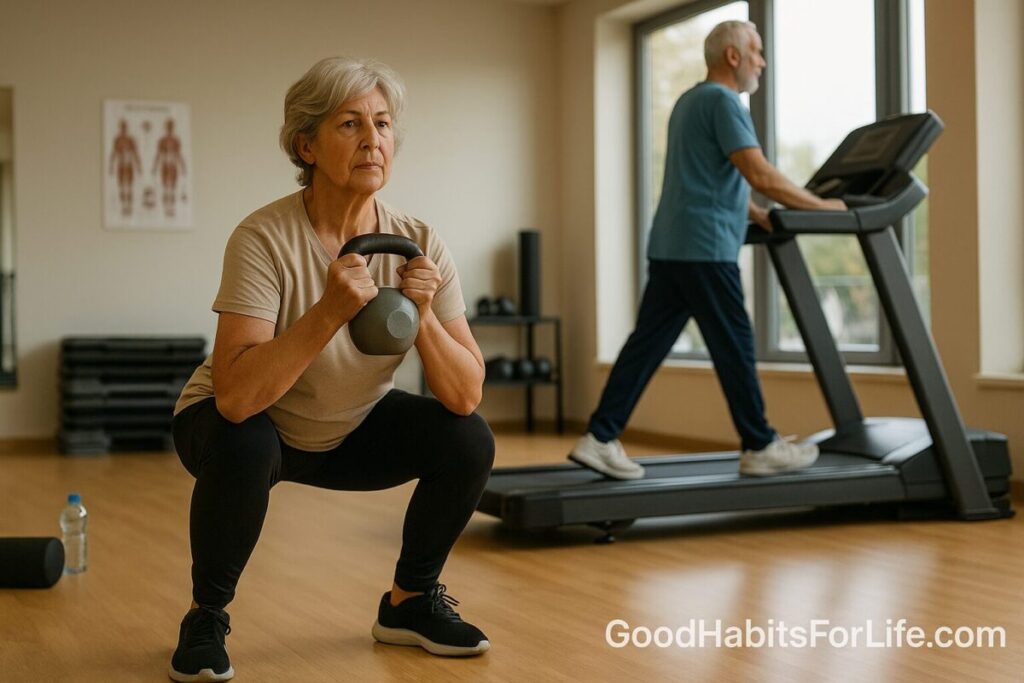
Strength After 60: Power Before Endurance: Zone 2 + NEAT (2025)
Strength After 60: Power Before Endurance—Zone 2 + NEAT
Table of Contents
🧭 What & Why: Strength After 60
Aging naturally reduces muscle mass, power (how fast you can produce force), balance, and aerobic capacity. Power declines earlier and faster than maximal strength, so restoring “fast strength” improves the real-world tasks that matter—standing up, catching yourself if you trip, climbing stairs, and carrying groceries. Position statements and meta-analyses show resistance training (with a power emphasis) improves function and independence in older adults. NSCA+2JAMA Network+2
At the same time, endurance (e.g., steady walking or cycling) supports heart, brain, and metabolic health. The safest, most effective order in the same workout is power/strength first, endurance after—that sequence preserves strength gains when you mix both (“concurrent training”). NSCA
Public-health guidelines for adults 65+: aim for 150–300 min/week of moderate aerobic activity, 2+ days/week of muscle-strengthening, and regular balance training. CDC+1
✅ Quick Start: Do This Today
-
Safety check (5 min). If you’re new to training, have heart disease, or take medications affecting heart rate or balance, talk with your clinician before progressing intensity. Use RPE 0–10: start around 3–4 (moderate) for cardio and light-to-moderate loads for lifting. Cleveland Clinic
-
Pick two power moves you can do safely (e.g., sit-to-stand “fast up, slow down”, light step-ups, or light medicine-ball chest pass if coached). Do 2–3 sets × 6–8 fast reps with light-to-moderate load—stop well before form breaks. NSCA
-
Add two strength moves next (e.g., leg press or goblet squat, row, overhead press, hip hinge/bridge): 2–3 sets × 6–10 reps at 70–80% 1RM feel (challenging but controlled). NSCA
-
Finish with Zone 2: 10–20 min brisk walk or easy cycle where you can talk but not sing. CDC
-
NEAT now: set a movement timer every 30–60 min; stand, stroll, or do calf raises 1–3 min. Aim 6,000–8,000 steps/day to start (3,000–4,000 if deconditioned). The Lancet
-
Balance: heel-to-toe walk, single-leg stand near support, 5 min, 3–5x/week. CDC
🛠️ 30-60-90 Day Habit Plan (with checkpoints)
Weeks 1–4 (Days 1–30): Learn & Groove
-
2x/week Power + Strength (non-consecutive days).
-
Power: 2 moves × 2 sets × 6–8 reps @ light-moderate load, fast up, slow down.
-
Strength: 3–4 moves × 2 sets × 6–10 reps @ RPE 6–7/10.
-
-
Zone 2: 3 sessions × 20–30 min @ talk test “can chat”.
-
NEAT: break sitting every 30–60 min; log steps (baseline + +500/day).
-
Balance: 5–10 min, 3–5x/week.
-
Checkpoints: 30-sec sit-to-stand count; comfortable walk test distance. CDC+1
Weeks 5–8 (Days 31–60): Build Capacity
-
3x/week Power + Strength.
-
Power: progress to 2–3 sets, keep 40–60% 1RM feel; crisp form.
-
Strength: 2–3 sets; add small load or reps weekly (still RPE ≤8/10).
-
-
Zone 2: up to 150–180 min/week total. One optional vigorous day if cleared.
-
NEAT: target 6,000–8,000+ steps/day average.
-
Balance: add dynamic drills (head turns, foam pad).
-
Checkpoint: faster Timed Up & Go or longer 6-min walk. CDC
Weeks 9–12 (Days 61–90): Perform & Protect
-
Power: 2–3 moves × 3 sets; keep reps 6–8; controlled explosive intent.
-
Strength: 3 sets across big patterns (squat, hinge, push, pull).
-
Zone 2: 180–300 min/week, optionally a tempo day (short “can only speak in phrases”).
-
NEAT: solid habit—integrate walk breaks, stairs, errands on foot.
-
Balance: integrate into warm-ups and daily tasks.
-
Checkpoint: compare sit-to-stand, walk time, and how everyday tasks feel. CDC
🧠 Techniques & Frameworks (Power → Strength → Endurance)
Session order matters. Do power/strength before endurance in the same session to optimize strength gains; it’s a formal recommendation in older-adult resistance training guidance. NSCA
Power guidelines (older adults). Use moderate intensities (~40–60% 1RM) with fast concentric and controlled eccentric; 2–3 sets, 6–8 reps, long rests (1.5–3 min), stop before technique degrades. NSCA
Strength guidelines. Build toward 2–3 sets of 1–2 multi-joint exercises per major muscle group at ~70–85% 1RM, 2–3×/week, progressing gradually. NSCA
RPE & Talk Test. Use RPE 0–10 to gauge strength difficulty and the talk test for cardio (can talk = moderate Zone 2; only phrases = vigorous). Cleveland Clinic+1
Balance & bone. Add balance moves most days. For bone health (especially in postmenopausal women), progressive resistance training improves hip/femur BMD and strength; impact or higher-velocity elements, when supervised, can help. PubMed+1
🚶 Zone 2 & NEAT: How Much, How Hard
Zone 2, simply. It’s the easy, steady, aerobic zone just below your first ventilatory threshold—you can talk comfortably and sustain the pace. Definitions vary among “zone” systems, so use the talk test and RPE rather than chasing one number on a watch. CDC+1
Dose. Accumulate 150–300 min/week of moderate-intensity aerobic activity (e.g., brisk walking, cycling), spread across 3–6 days. CDC
NEAT (Non-Exercise Activity Thermogenesis). This is the energy you burn outside structured exercise—steps, chores, gardening, walking to the shop, fidgeting. It varies widely and powerfully shapes daily energy expenditure and metabolic health; break up sitting and keep moving. PubMed
Steps target. Mortality benefits in older adults appear well below 10,000 steps; 6,000–8,000 steps/day is a practical health range for many 60+. The Lancet
Why break up sitting? Prolonged occupational sitting is linked with higher all-cause and cardiovascular mortality; build mini-bouts of movement into every hour. JAMA Network
👥 Audience Variations
-
Arthritis or joint sensitivity: Favor machines (leg press, cable row), partial ranges that are pain-free, and moderate loads (50–70% 1RM) with more control; progress slower and prioritize warm-ups. NSCA
-
Osteopenia/osteoporosis (cleared by clinician): Prioritize progressive resistance for hips/spine and include impact/velocity only with supervision; programs like HiRIT improved bone strength in trials. PubMed
-
Type 2 diabetes/metabolic risk: Strength + Zone 2 improve glycemic control; avoid long sitting—move every 30–60 min. JAMA Network
-
Beginners/deconditioned: Start with 1–2 sets, RPE ≤6/10, short Zone 2 blocks (10–15 min), and balance holds near stable support; progress by adding reps before load. order.nia.nih.gov
⚠️ Mistakes & Myths to Avoid
-
Myth: “After 60, only walking is safe.”
Reality: Properly taught resistance training is safe and beneficial for older adults and improves independence. NSCA -
Mistake: Doing cardio first in the same workout.
Fix: Do power/strength before endurance to protect strength gains. NSCA -
Myth: “Zone 2 is one exact heart-rate number.”
Reality: Zone systems differ; use talk test and RPE to guide effort. Human Kinetics Journals+1 -
Mistake: Sitting most of the day despite hitting the gym.
Fix: Increase NEAT and break up sitting—both matter for longevity. JAMA Network
💬 Real-Life Examples & Scripts
A) 45-min Gym Session (2–3x/week)
-
Warm-up (6–8 min): easy treadmill + mobility.
-
Power (10 min):
-
Sit-to-stand (fast up, slow down) 3×6
-
Cable row “pop” (light, crisp) 3×6
-
-
Strength (20 min):
-
Leg press 3×8, Seated row 3×8, DB press 2×8, Hip hinge/bridge 2×10
-
-
Endurance finish (10–15 min): bike or walk at talk-test pace. NSCA+1
B) 30-min Home Session (2–3x/week)
-
Power: Step-ups (low step) 2×6/leg; Wall ball-tap 2×6
-
Strength: Chair squat 2×8; Backpack row 2×8; Counter push-up 2×8
-
Balance: Tandem walk 2×30 steps; Single-leg hold 2×15s/side. order.nia.nih.gov
C) Quick script to your doctor
“I’m starting a power-first strength plan (light, fast reps, then traditional sets), plus Zone 2 walking and daily movement breaks. Any precautions given my meds/history?”
🧰 Tools, Apps & Resources
-
NIA (National Institute on Aging) exercise hub & PDF guide—safe moves, videos, and progressions. (Free) National Institute on Aging+1
-
CDC Measuring Intensity & Older-Adult Guidelines—talk-test explainer and weekly planning examples. (Free) CDC+1
-
ACSM aerobic intensity infographic (RPE, %HRmax, step-rate cues). (Free) ACSM
-
Pedometer or watch—track steps and stand breaks (set hourly alerts). (General)
📚 Key Takeaways
-
Train power and strength first, then do cardio in the same session. NSCA
-
Accumulate 150–300 min/week Zone 2 and 2+ strength days; practice balance most days. CDC
-
Raise NEAT and interrupt sitting; steps 6–8k/day is a strong goal for many older adults. The Lancet+1
-
Use RPE and the talk test to stay in the right zone—simple, safe, effective. Cleveland Clinic+1
❓ FAQs
1) How many days per week should I lift?
Start with 2 days, progress to 3 as recovery allows. Keep a rest day between strength days. NSCA
2) What if my knees/shoulders hurt?
Use machines, reduce range/load, and stick to pain-free patterns. Consider a session with a qualified coach or physio. NSCA
3) How do I know I’m in Zone 2?
You can talk in short sentences, breathing is elevated but controlled; RPE ~3–4/10. CDC
4) Is walking enough?
Great for heart health, but add power/strength to protect function, bone, and independence. NSCA+1
5) How heavy for power training?
Typically light-to-moderate loads (~40–60% 1RM) moved quickly with perfect form; stop before it feels sloppy. NSCA
6) Should I worry about heart rate zones or just talk test?
Zones vary by system; talk test + RPE are accurate and practical for most older adults. Human Kinetics Journals+1
7) I sit a lot for work—can the gym offset it?
The gym helps, but long sitting still raises risk. Break up sitting and increase NEAT. JAMA Network
8) Will this help my bones?
Progressive resistance improves hip/femur BMD; impact/velocity elements can help when supervised. PubMed+1
References
-
World Health Organization. Guidelines on physical activity and sedentary behaviour (2020). World Health Organization
-
CDC. Physical Activity Guidelines—Older Adults (Dec 2023). CDC
-
NSCA Position Statement. Resistance Training for Older Adults (2019). Key points: 40–60% 1RM for power; strength before endurance in concurrent sessions. NSCA
-
JAMA Network Open (2022). Power vs Strength Training and Physical Function in Adults ≥60—systematic review/meta-analysis. JAMA Network
-
European Review of Aging and Physical Activity (2022). Power training vs strength training—meta-analysis. BioMed Central
-
CDC. Measuring Physical Activity Intensity—Talk test. CDC
-
Kwon Y et al. (2023). Talk Test as a Tool to Monitor Aerobic Exercise—review. PMC
-
Levine JA (2002/2004). Non-Exercise Activity Thermogenesis (NEAT)—foundational reviews. PubMed+1
-
JAMA Network Open (2024). Occupational Sitting and Mortality—cohort of 481,688 adults. JAMA Network
-
The Lancet Public Health (2022). Daily Steps & Mortality—benefits for older adults at 6,000–8,000 steps/day. The Lancet
-
O’Bryan SJ et al. (2022). Progressive Resistance Training & Bone Mineral Density—meta-analysis. PubMed
-
LIFTMOR Trial (2018/2019). High-Intensity Resistance/Impact Training in Postmenopausal Women—improved indices of bone strength. PubMed
Disclaimer: This guide is educational and does not replace personalized medical advice; consult your clinician before changing your exercise program, especially if you have medical conditions or take prescription medications.