
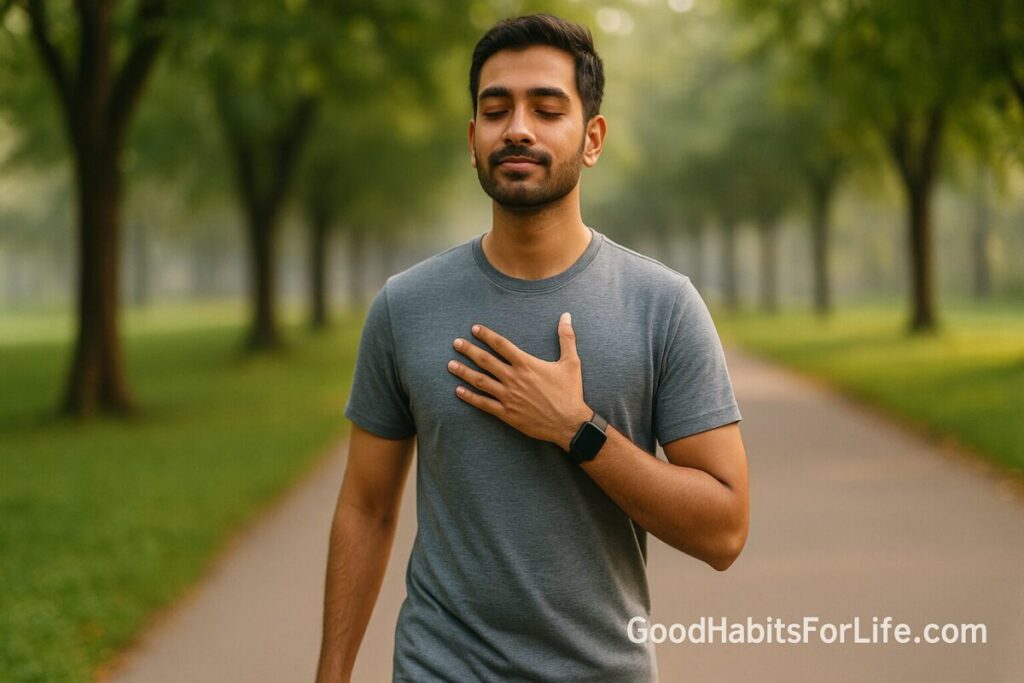
Anxiety Skills: Ground, Breathe, Reframe: Zone 2 + NEAT (2025)
Anxiety Skills: Ground, Breathe, Reframe + Zone 2 & NEAT
Table of Contents
🧠 What & Why: Skills for a Calmer Brain and Body
Anxiety has two loops: a body loop (fast breathing, racing heart, jittery muscles) and a thought loop (catastrophizing, what-ifs). To feel better now and over time, you want quick skills that interrupt both loops and daily habits that make your nervous system less reactive.
This guide blends three immediate skills—Ground, Breathe, Reframe—with two lifestyle levers: Zone 2 cardio (steady, conversational-pace aerobic work) and NEAT (non-exercise movement all day). Together they can reduce momentary distress and build a calmer baseline.
Evidence snapshot (plain language):
-
Grounding (orienting to present sensations) can reduce acute anxiety by shifting attention away from threat cues.
-
Slow diaphragmatic breathing (≈ 6 breaths/min) improves vagal tone and may lower sympathetic arousal.
-
Cognitive reframing (CBT) replaces unhelpful predictions with balanced, testable alternatives.
-
Regular aerobic exercise reduces anxiety symptoms and improves sleep and mood; moderate intensity is highly accessible.
-
NEAT counters the physiological costs of long sitting and supports mood and energy.
⚡ Quick Start: A 10-Minute “Settle & Move” Protocol
Use this anytime anxiety spikes or before a stressful moment (meeting, exam, conversation).
1) Ground (90 seconds).
-
Name 5 things you see, 4 feel, 3 hear, 2 smell, 1 taste.
-
Press your feet into the floor; say silently: “Right here, right now.”
2) Breathe (4 minutes).
-
Paced breathing: Inhale 4s → exhale 6s (or 4-7-8 if comfortable).
-
Breathe through the nose, belly expands, shoulders relaxed.
-
If dizzy, pause and return to normal breathing.
3) Reframe (3 minutes).
-
Write a one-line thought: “I’ll fail this presentation.”
-
Ask: Evidence for/against? What’s an alternative?
-
New thought: “I’ve prepared 3 key points; if I forget one, I can check my notes.”
4) Move (2 minutes).
-
Stand, shake out arms, walk briskly or climb a flight of stairs.
-
Bonus: Grab water, open a window for a sensory reset.
Micro-tracking (15 seconds).
-
Rate anxiety 0–10 (before/after).
-
Log “B4R1” (Breathe 4 min, Reframe 1 min) + steps walked.
🗺️ Habit Plan: 30-60-90 Roadmap
Goal: Automatic skills + a steadier nervous system.
Days 1–30 (Foundation)
-
Daily: 6–8 minutes of paced breathing (set a timer).
-
Ground-Breathe-Reframe once per day, even when calm (build the groove).
-
NEAT: Aim for 250–300 steps each hour + 7–10k steps/day (or baseline +20%).
-
Zone 2: 3×/week 25–30 minutes (comfortable conversation pace).
-
Track: Anxiety rating (0–10), breath minutes, Zone 2 minutes, steps.
Checkpoint: 10% reduction in average anxiety rating or fewer spikes.
Days 31–60 (Build)
-
Breathing: 8–10 minutes/day; try adding box breathing (4-4-4-4) during work blocks.
-
Zone 2: 3–4×/week 30–35 minutes (optional heart-rate monitor).
-
NEAT: Add standing tasks (calls while standing) and 3× 5-minute walks.
-
Cognitive reps: 3 short reframes/week using a thought record.
Checkpoint: Notice quicker recovery from stressors; sleep and focus improve.
Days 61–90 (Maintain & Personalize)
-
Mix in tempo/intervals 1×/week if you enjoy them; keep most sessions Zone 2.
-
NEAT “default walk”: any trip <800 m (½ mile) = walk by default.
-
Advanced reframes: practice probability vs. severity and behavioral experiments.
-
Relapse plan: Identify top 3 triggers + a 3-step response you’ll use.
Checkpoint: Calmer baseline; habits feel automatic 5+ days/week.
🛠️ Techniques & Frameworks
🧭 Grounding: 3 Ways
-
5-4-3-2-1 (senses).
-
Object anchor: Hold keys/stone; describe color, weight, texture for 60–90 s.
-
Orientation: Turn your head slowly; name the room, date, and one safe person.
🫁 Paced Breathing: Options
-
4-6 (or 4-7-8): Longer exhale nudges your parasympathetic system.
-
Box breathing: 4s inhale → 4s hold → 4s exhale → 4s hold.
-
Coherent breathing: ≈ 5–6 breaths/min; smooth, light, nasal.
Form tips: Belly moves first; keep shoulders soft; if breath feels tight, reduce counts.
🧠 Reframing (CBT mini-loop)
-
Trigger → 2. Automatic thought → 3. Feeling (0–10) →
-
Evidence for/against → 5. Balanced thought → 6. Re-rate feeling.
Helpful prompts:
-
“If my friend said this, what would I tell them?”
-
“What’s the most likely outcome (not the worst)?”
-
“What small action proves or disproves this?”
🚴 Zone 2 Basics (Anxiety-friendly cardio)
-
What it is: Steady, easy-moderate effort that you could maintain for 45–60 minutes.
-
Talk test: You can speak in full sentences but couldn’t sing.
-
Heart-rate guide: Roughly 60–70% of HRmax (estimate HRmax as 220 − age; personalize by feel if you don’t use a device).
-
Why it helps: Improves aerobic base, sleep quality, and stress resilience without spiking stress hormones as much as all-out training.
Great options: brisk walking outdoors, cycling, elliptical, easy jogging, light dance.
🚶 NEAT: Movement All Day
Non-exercise activity thermogenesis = all movement that isn’t a workout.
Tactics:
-
Pomodoro walk: 25 min work + 2–3 min steps.
-
Phone-walk rule: Walk during every call.
-
Task bundling: Kettle boils? Do 30 calf raises.
-
Environment: Keep comfy shoes visible; set reminders for hourly steps.
👥 Variations by Audience
Students
-
Use campus walks between classes as NEAT.
-
Before exams: 3 minutes of 4-6 breathing + quick reframe (“I know 70% already; I’ll start with what I know.”).
Parents & Caregivers
-
Make family Zone 2: stroller walks, playground circuits.
-
Practice co-regulation: 5 slow breaths together with kids.
Busy Professionals
-
Calendar block a 30-minute walking meeting 3×/week.
-
Use the Inbox Pause + 90-second grounding before difficult emails.
Seniors
-
Prioritize low-impact Zone 2 (walking, cycling, pool).
-
If you get light-headed: shorten breath counts; sit for grounding.
Teens
-
Pair breathing with favorite songs (≈ 4–5 minutes).
-
Use two-column notes: “Worry → What I can do in the next 10 minutes.”
⚠️ Mistakes & Myths to Avoid
-
Myth: “Deep breaths mean big breaths.” Aim for slow, gentle breaths, not forceful inhaling.
-
Skipping the body: Reframing works better after you’ve settled physiology (ground + breathe).
-
Going too hard: High-intensity training is great, but if you’re anxious, build a base with Zone 2 first.
-
All-or-nothing steps: Start with 2 minutes; consistency beats heroic sessions.
-
Ignoring sleep and caffeine: Both strongly affect anxiety. Avoid caffeine late in the day; protect 7–9 hours of sleep.
🗣️ Real-Life Examples & Copy-Paste Scripts
Before a presentation
-
Ground: “I see three chairs, two windows…”
-
Breathe: 4-6 for 3 minutes.
-
Reframe: “Nerves mean I care. I’ll deliver my three big ideas.”
When waking at 3 a.m.
-
Script: “Mind, thanks for the alert. We’re safe. I’ll breathe slow for 5 minutes, then write one step for tomorrow and rest.”
-
Action: 5 minutes coherent breathing, jot one to-do, back to bed.
During a panic surge
-
Script: “This feels intense and temporary. I’ve ridden this wave before.”
-
Action: Sit or stand; 5-4-3-2-1; 2 minutes 4-6 breathing; splash cool water; short walk.
Worry time (15-minute container)
-
Script: “I’ll park this until 6:30 p.m.”
-
Action: Note worry on your phone; at 6:30, brainstorm solutions for 10 minutes, then close.
🔧 Tools, Apps & Resources
-
Breath apps: Breathwrk, Othership, Insight Timer (timed sessions; haptic pacing).
-
Pros: Easy timers, reminders. Cons: Paywalls; keep it simple.
-
-
CBT helpers: CBT Thought Diary, Sanvello, Woebot (guided reframing, mood logs).
-
Pros: Structure; data. Cons: Not a substitute for therapy.
-
-
HR monitors/wearables: Polar, Garmin, Apple Watch.
-
Pros: Estimate Zone 2; track trends. Cons: Don’t chase numbers over body cues.
-
-
Step nudgers: Google Fit, Apple Health, Pacer (hourly step prompts).
-
Environment aids: A comfy pair of walking shoes by the door; a water bottle you like.
✅ Key Takeaways
-
Calm the body first (ground + breathe), then calm the story (reframe).
-
Build a calmer baseline with Zone 2 cardio most days you can.
-
Keep NEAT high: small steps, all day, prevent tension from accumulating.
-
Use tiny, repeatable cues—90-second resets, short walks, thought records.
-
Track only a few metrics that matter to you: breath minutes, steps, Zone 2, and how you feel.
❓FAQs
1) What is Zone 2 and how do I find it?
It’s easy-moderate cardio where you can speak in full sentences; roughly 60–70% of your max heart rate. If you’re new, use the talk test first.
2) How many minutes of Zone 2 help anxiety?
Aim for 150+ minutes/week of moderate activity. Many feel calmer with 3–4 sessions of 25–40 minutes.
3) Can breathing really stop a panic attack?
Breathing might not stop it instantly, but slow, gentle exhalation plus grounding can reduce intensity and duration.
4) What if slow breathing makes me feel breathless?
Shorten the counts (e.g., 3-4) or breathe normally for a minute, then try again. Sit down if dizzy.
5) Is walking enough?
Brisk walking absolutely counts as Zone 2 and raises mood; add small hills or longer routes as you adapt.
6) How soon will I notice results?
Many notice quicker recovery within 2–3 weeks when they practice breathing daily and add regular Zone 2.
7) Do I need a heart-rate monitor?
No. Devices help some people, but the talk test and your perceived effort are perfectly fine.
8) What’s NEAT in real life?
Steps while calling, standing tasks, stairs, light chores—movement that isn’t a workout but adds up.
9) Can I combine these with therapy or medication?
Yes. These skills complement professional care. Work with your clinician for a personalized plan.
10) What if I miss days?
Just restart with 2 minutes today. Consistency over perfection.
📚 References
-
World Health Organization. Guidelines on Physical Activity and Sedentary Behaviour (adults). https://www.who.int/publications/i/item/9789240015128
-
American Psychological Association. Anxiety and Cognitive Behavioral Therapy (overview). https://www.apa.org/ptsd-guideline/patients-and-families/cognitive-behavioral
-
National Institute for Health and Care Excellence (NICE). Generalised anxiety disorder and panic disorder in adults: management. https://www.nice.org.uk/guidance/cg113
-
Cochrane Library. Exercise therapy for anxiety disorders: a systematic review. https://www.cochranelibrary.com/
-
National Center for Complementary and Integrative Health (NIH). Relaxation Techniques for Health. https://www.nccih.nih.gov/health/relaxation-techniques-what-you-need-to-know
-
Centers for Disease Control and Prevention (CDC). Target Heart Rate & Moderate Intensity. https://www.cdc.gov/physicalactivity/basics/measuring/
-
Harvard Medical School – Health Publishing. Breathing techniques for anxiety. https://www.health.harvard.edu/mind-and-mood/relaxation-techniques-breath-control-helps-quell-errant-stress-response
-
Levine JA. Non-exercise activity thermogenesis (NEAT): environment and biology. Nutr Rev. 2007;65(3):S208–S212. https://doi.org/10.1301/nr.2007.dec.S208-S212
-
Frontiers in Human Neuroscience. Breathing at 6 breaths/min increases HRV: implications for anxiety. https://www.frontiersin.org/journals/human-neuroscience
-
American College of Sports Medicine. Quantity and Quality of Exercise for Developing and Maintaining Cardiorespiratory Fitness. https://www.acsm.org/
Disclaimer: This guide is educational and not a substitute for professional medical or mental-health advice; consult a qualified clinician for personalized care.