
Alcohol & Sleep: The Two-Drink Distance: Zone 2 + NEAT (2025)
Alcohol & Sleep: The Two-Drink Distance (Zone 2 + NEAT)
Table of Contents
🧠 What This Is & Why It Works
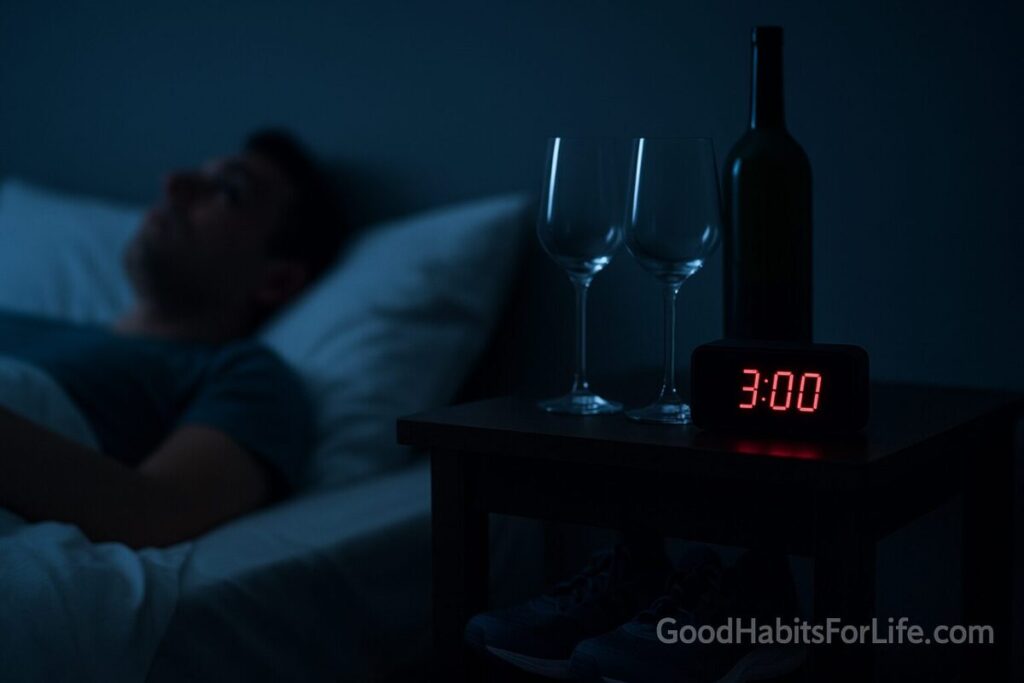
Alcohol is a sedative that can shorten sleep-onset latency and deepen sleep early in the night—but it rebounds later: more awakenings, lighter sleep, and reduced REM. That’s why nights with drinks often feel “knockout then ping-awake at 3 a.m.” rather than restorative sleep. PubMedPMC
Key mechanisms (plain English):
-
Sedation ≠ quality: Alcohol increases early slow-wave sleep but disrupts sleep homeostasis and circadian regulation later. PMC
-
REM suppression: Less REM early in the night with a rebound later → grogginess and mood swings next day. PMC
-
Fragmentation: More awakenings and lighter stages overnight; people often underestimate this. PMC
Bottom line: reducing how much and how close to bedtime you drink pays off fast for sleep quality. Even public health bodies advise avoiding alcohol near bedtime. AASMnhs.uk
✅ The “Two-Drink Distance” Rule (with cut-off table)
A practical, evidence-aligned heuristic:
**If you drink, finish your last drink at least the number of hours it takes your body to clear it—roughly ≈1 standard drink per hour—**and add extra buffer before sleep. For two drinks, that’s ≥4 hours before lights-out. (Metabolism varies widely; when in doubt, extend the distance.) PMCNIAAAAASM
What’s a “standard drink”? ~14 g ethanol: ≈350 ml beer (5%), 150 ml wine (12%), or 44 ml spirits (40%). NIAAA+1
Cut-off suggestions (heuristic, not medical advice):
| Total drinks | Minimum time between last sip & bedtime | Notes |
|---|---|---|
| 0 | — | Best for sleep & recovery. |
| 1 | ≥2–3 h | Hydrate; small snack if empty stomach. |
| 2 | ≥4 h | The classic Two-Drink Distance. |
| 3 | ≥6 h | Or shift to earlier in the day; consider skipping. |
| 4+ | ≥8 h+ | Expect major sleep disruption; reconsider the session. |
These buffers combine (a) average metabolism (~1 drink/hour) and (b) sleep guidance to avoid alcohol within 4–6 hours of bedtime. Adjust upward if you’re smaller, unwell, or sleep-sensitive. PMCAASM
🛠️ Quick Start: Do This Today
-
Set tonight’s cut-off: Decide bedtime → subtract your Two-Drink Distance.
-
Hydrate smart: Alternate water; 500–750 ml in the last hour of drinking; add electrolytes if very hot or you trained hard.
-
Food timing: Pair alcohol with a protein-rich meal to slow absorption; avoid big meals <3 h before bed.
-
Light movement: A 10–20-minute easy walk after the last drink.
-
Wind-down routine: Dim lights, 15 minutes of reading or breathing; room 17–19 °C (63–66 °F).
-
Fixed wake-time: Keep it constant even after a late night; nap <30 minutes if needed midday.
🏃 Zone 2 + NEAT: Why Movement Supercharges Sleep
Zone 2 = moderate-intensity aerobic work (roughly conversational pace; ~40–59% of heart-rate reserve or ~64–76% of HRmax). This intensity is strongly associated with better sleep quality across trials and meta-analyses. PMCACSM
NEAT (Non-Exercise Activity Thermogenesis) = all the movement outside formal workouts—walking, taking stairs, chores, fidgeting. It meaningfully increases daily energy expenditure and supports sleep pressure without overstimulating your nervous system. PubMed
Why movement helps alcohol-affected nights:
-
Homeostatic sleep drive: Daytime activity builds “sleep pressure,” making it easier to fall and stay asleep. PMC
-
Stress modulation: Regular moderate activity improves mood and autonomic balance, countering alcohol’s next-day fatigue. WHO Apps
-
Gentle, not heroic: Keep late-day work easy; vigorous evening sessions can delay sleep for some. Aim Zone 2 earlier. AASM
Target (adults): 150–300 minutes/week moderate aerobic activity + 2 days/week strength; more light movement (NEAT) daily. WHO AppsACSM
📈 7-Day Starter Plan (2025)
Goal: Protect sleep while enjoying social occasions sensibly.
-
Mon: Zone 2: 35–45 min (easy jog, brisk walk). Evening: no alcohol.
-
Tue: Strength 30–40 min (full-body). NEAT: 8–10k steps.
-
Wed: Zone 2: 30–40 min + mobility 10 min. Set your weekend cut-off times.
-
Thu: NEAT focus day: 10–12k steps; gentle stretch before bed.
-
Fri (social): If drinking 1–2, finish by 7 p.m. for an 11 p.m. bedtime. Hydrate; light walk.
-
Sat: Zone 2 40–50 min late morning; NEAT ≥10k steps. Alcohol-free evening or Two-Drink Distance if social.
-
Sun: Recovery walk 30 min; plan week; fixed wake-time.
🧪 Techniques & Frameworks that Stick
-
If-Then Planning: “If I’m offered another drink after my cut-off, then I’ll switch to sparkling water with lime.”
-
HALT check-in: Hungry, Angry, Lonely, Tired—don’t drink to fix these; solve the state first.
-
Drink Math: Pre-compute cut-offs: e.g., 2 drinks → last sip ≥4 h pre-bed.
-
Environment design: Order low-ABV options first; keep alcohol off weeknights; stock zero-proof alternatives.
-
Trackers (optional): Use sleep/HR apps for trends—not perfection—when changing drinking patterns.
👥 Audience Variations
-
Students & early-career professionals: Social clusters can stack drinks late. Agree on a group cut-off and a shared ride home; keep a consistent wake-time to avoid Monday jet-lag.
-
Parents: Early mornings demand predictable sleep—choose earlier gatherings; cap at 1–2 drinks; water after each.
-
Seniors: Alcohol sensitivity rises; medications may interact. Favor alcohol-free nights; prioritize daytime Zone 2 walks. (Speak with your clinician.)
-
Athletes & weekend warriors: Alcohol impairs recovery metrics; schedule hard sessions after alcohol-free nights; keep NEAT high the day after.
-
Teens: Avoid alcohol; build sleep-protective routines (sport, consistent schedule). (Legal/health considerations apply.)
⚠️ Mistakes & Myths to Avoid
-
Myth: “A nightcap helps me sleep.” It helps you doze off, then harms your second-half sleep and REM. PubMed
-
Mistake: Late heavy workouts post-drinks. Do light movement instead; save intensity for alcohol-free days. AASM
-
Myth: “Coffee sobers you up.” It doesn’t lower BAC or undo alcohol’s sleep effects.
-
Mistake: Ignoring serving sizes: your “one glass” may equal 1.5–2 standard drinks. NIAAA
-
Myth: “Moderate nightly drinking is harmless.” Even small amounts near bedtime degrade sleep quality. PMC
💬 Real-Life Examples & Scripts
-
At a wedding: “I’m on a sleep streak—I’ll switch to soda water after 8:30.”
-
Work dinner: “Two glasses max, last one with the main course; then herbal tea.”
-
Hosting at home: “Drinks 6–8 p.m., night walk at 8:15, lights out at 11:30.”
-
Cutting back: “Dry weeknights; if I drink Saturday, last sip by 7 p.m.”
-
Partner plan: “We’ll do a 15-minute stroll after our last drink.”
🧰 Tools, Apps & Resources (pros/cons)
-
Zero-proof options (beer/wine/spirits): + ritual without alcohol; − some added sugars.
-
Drink trackers (e.g., simple counters, habit apps): + visibility; − can feel tedious—automate with shortcuts.
-
Sleep apps & wearables: + trendlines for bedtime and awakenings; − don’t obsess over nightly “scores.”
-
Kitchen scale/measuring jigger: + calibrate true serving size; − minor upfront effort.
-
Timers/Shortcuts: + pre-set a “Last Drink” alarm tied to bedtime; − needs initial setup.
🔑 Key Takeaways
-
Alcohol and sleep are timing-sensitive. Early sedation masks later fragmentation and REM suppression. PubMed
-
The Two-Drink Distance works: plan ≥4 hours between your second drink and bedtime (more if smaller or sensitive). PMCAASM
-
Zone 2 + NEAT improve sleep quality and resilience—even if you don’t drink. PMC
-
Consistent wake-time beats “sleeping in.” Use naps (<30 min) to catch up instead.
-
Small changes stack: earlier last sip, light walk, hydration, and cool room deliver outsized gains.
❓ FAQs
1) Is any alcohol “sleep-friendly”?
Not really. Lower-ABV options and earlier timing help, but alcohol near bedtime degrades sleep quality. PubMed
2) What’s Zone 2, exactly?
A conversational-pace aerobic effort—roughly 40–59% heart-rate reserve or ~64–76% HRmax. It’s sustainable and linked to better sleep in trials. ACSMPMC
3) Does a post-drink workout help?
Do light movement only (walk, gentle cycle). Save intensity for alcohol-free days to avoid compounding sleep disruption. AASM
4) I only have one drink—do I still need a cut-off?
Yes. Aim for ≥2–3 hours pre-bed, hydrate, and keep a fixed wake-time. (Metabolism varies.) PMC
5) What if I binge drink?
Expect substantial sleep disruption and next-day impairment; best choice is to avoid binge episodes. NIAAA
6) How does NEAT help?
More daily movement (walking, stairs, chores) raises energy expenditure and sleep pressure without taxing your system. PubMed
7) Does alcohol worsen snoring or sleep apnea?
Yes—alcohol relaxes airway muscles and can exacerbate snoring/SDB when used near bedtime. jcsm.aasm.org
8) Any official guideline on alcohol timing before bed?
Sleep organizations advise avoiding alcohol in the hours before bedtime; AASM educational materials recommend 4–6 hours. AASM
📚 References
-
NIAAA — What Is a Standard Drink? https://www.niaaa.nih.gov/alcohols-effects-health/what-standard-drink NIAAA
-
NIAAA — Alcohol Metabolism. https://www.niaaa.nih.gov/publications/alcohol-metabolism NIAAA
-
Cederbaum AI. Alcohol Metabolism. Alcohol Res. 2012. (avg ≈7 g/h ≈1 drink/h). https://pmc.ncbi.nlm.nih.gov/articles/PMC3484320/ PMC
-
AASM — How to Sleep Better (patient handout). “Avoid alcohol within 4–6 hours of bedtime.” https://aasm.org/resources/pdf/products/howtosleepbetter_web.pdf AASM
-
Ebrahim IO et al. Alcohol & Sleep I: Effects on Normal Sleep. Alcohol Clin Exp Res. 2013. https://pubmed.ncbi.nlm.nih.gov/23347102/ PubMed
-
Koob GF et al. Alcohol use disorder and sleep disturbances. Neuropsychopharmacology. 2019. https://pmc.ncbi.nlm.nih.gov/articles/PMC6879503/ PMC
-
Kredlow MA et al. Exercise can improve sleep quality: systematic review & meta-analysis. Br J Sports Med. 2018. https://pmc.ncbi.nlm.nih.gov/articles/PMC6045928/ PMC
-
WHO — Guidelines on Physical Activity and Sedentary Behaviour (2020). https://apps.who.int/iris/bitstream/handle/10665/336656/9789240015128-eng.pdf WHO Apps
-
ACSM — Exercise Intensity & HRR (patient handout). https://acsm.org/wp-content/uploads/2025/02/Exercising-Your-Way-to-Lowering-Your-Blood-Pressure-handout.pdf ACSM
-
Levine JA. Non-exercise activity thermogenesis (NEAT). Best Pract Res Clin Endocrinol Metab. 2004. https://pubmed.ncbi.nlm.nih.gov/15102614/ PubMed
-
NHS — Tips on cutting down alcohol (sleep section). https://www.nhs.uk/live-well/alcohol-advice/tips-on-cutting-down-alcohol/ nhs.uk
-
Sleep Foundation — Alcohol and Sleep (consumer explainer). https://www.sleepfoundation.org/nutrition/alcohol-and-sleep Sleep Foundation
⚖️ Disclaimer
This article is educational and not medical advice. If you have sleep problems, medical conditions, or take medications, consult your clinician—especially before changing alcohol use or exercise.