
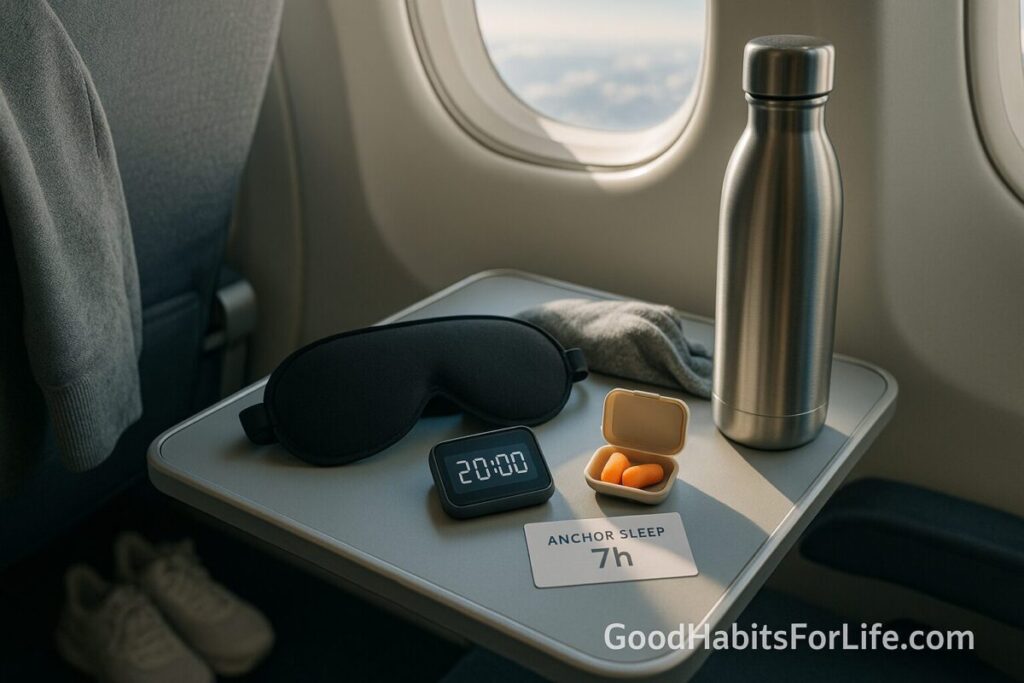
Travel Sleep Kit: Mask, Earplugs, Timer: Zone 2 + NEAT (2025)
Travel Sleep Kit 2025: Mask, Earplugs, Timer + Zone 2 & NEAT
Table of Contents
🧭 What & Why
Travel sleep collapses for two main reasons: circadian disruption (new light/dark schedule → jet lag) and environmental stressors (light, noise, cramped seats). A lean kit and smart routine fix both.
-
Eye masks + earplugs: RCTs and meta-analyses show that blocking light and noise improves objective and subjective sleep quality—even in noisy ICU settings; that effect translates to airplanes and hotels with thin curtains/walls. PubMed+1
-
Timer: Power naps of ~10–30 minutes boost alertness while minimizing sleep inertia; longer naps risk grogginess unless you complete a full ~90-minute cycle. NASA cockpit-rest research and broader nap science support short, strategic naps. NASA Technical Reports Server+2PMC+2
-
Zone 2 + NEAT: Moderate-intensity activity (your “conversational pace”) and keeping daily movement high improve sleep quality and help shift your clock—especially when done in daytime light at the destination. PubMed+1
-
Anchor sleep: Adults generally need ≥7 h per night for health; aim for that window after arrival as quickly as feasible. AASM+1
✅ Quick Start: Your 24-Hour Travel Sleep Plan
Before flight (home time zone):
-
Pack kit: contoured eye mask, comfortable earplugs (foam or moldable silicone), and set a timer on your phone.
-
Caffeine cut-off: stop 6–8 h before your target sleep. European Food Safety Authority+1
-
Seat & service: request to skip meal service during your planned sleep window.
-
Screens off: last 60–90 min before intended sleep → minimize bright screens to protect melatonin. PNAS+1
In-flight or on the road:
5) Nap smart:
-
If you must nap: set a 20–30 min timer (power nap) or commit to a full ~90 min cycle—avoid the ~60-min middle ground that maximizes sleep inertia. PMC+1
-
Optional daytime coffee-nap: drink coffee then nap 20 min (avoid within 8 h of target nighttime sleep). PubMed
-
Mask + earplugs on: block cabin light and noise. PubMed
On arrival (destination time):
7) Daylight Zone 2 walk (30–45 min): conversational pace outdoors to anchor your clock and boost sleep that night. PubMed
8) Stay moving (NEAT): stairs, strolls, unpack standing; keep noise & light low at bedtime (mask, earplugs, drawn curtains). WHO noise guidance underscores why quiet nights matter. World Health Organization+1
🛠️ 7-Day Habit Plan (Arrival → Settle)
Day 0 (arrive):
-
AM/PM light: Seek morning light for eastward trips and late-afternoon/evening light for westward to steer your circadian phase; avoid the opposite with sunglasses. PMC
-
30–45 min Zone 2 walk outside; gentle mobility later. PubMed
-
Bedtime kit: mask + earplugs; room at ~18–20 °C (64–68 °F) if possible.
Days 1–2:
-
Hold a consistent bedtime aligned to destination.
-
NEAT target: 8–10k steps through easy tourist loops (adjust for ability).
-
Optional melatonin (short-term, low dose, correctly timed) if crossing multiple time zones; consider product quality variability. CDC+1
Days 3–4:
-
Maintain Zone 2 30–45 min in daylight; add light mobility or easy resistance work.
-
Keep caffeine to mornings only; screens dimmed after sunset. EFSA Journal+1
Days 5–7:
-
Stabilize routine: same rise time; mask/earplugs at night; NEAT through sightseeing.
-
If still adjusting, fine-tune light timing per direction of travel (avoid bright light at the wrong biological times). PMC
🧠 Techniques & Frameworks
😴 Eye Masks: What to Choose & Why It Works
-
Choose: contoured/3D mask to avoid eyelash pressure; adjustable strap; blackout fabric.
-
Why: Light suppresses melatonin and shifts circadian timing; masks remove this cue. PubMed
🔇 Earplugs: Type & Fit
-
Choose: foam (high attenuation, disposable) or moldable silicone (comfort for side-sleeping).
-
Fit beats rating: Real-world protection is often lower than the package NRR; insert properly. CDC+1
-
Noise targets: Lower night noise is linked to better sleep; WHO suggests conservative nighttime levels to protect health—use earplugs when environments exceed those. World Health Organization+1
⏲️ Timers: Naps Without the Fog
-
Power nap: 10–30 min; set an alarm; brief light after waking. PMC
-
Full cycle: ~90 min if you need more recovery. Avoid ~60 min wake-ups (max sleep inertia). ScienceDirect
-
Coffee-nap (daytime only): espresso → 20-min nap → wake as caffeine peaks; do not use near bedtime. PubMed
🌞 Light Strategy (Core to Jet Lag)
-
Phase-shift with light: Timed bright light advances or delays your clock; combine with avoiding light at the wrong times (sunglasses/blue-blockers). AASM+1
-
Screen hygiene: Evening blue-light exposure reduces melatonin and pushes sleep later; set a 60–90-minute screens-off timer. PNAS
☕ Caffeine: Cut-off & Special Use
-
Cut-off: Average half-life ≈ 4 h (range 2–8 h). Stop 6–8 h before target sleep; longer if sensitive. European Food Safety Authority
-
Use case: Coffee-nap only when you need daytime alertness and nighttime sleep is far away. PubMed
🚶 Zone 2 + NEAT (Movement That Helps You Sleep)
-
Zone 2 = “conversational pace”; typically ~40–59% HRR or ~64–76% HRmax (guideline range for moderate intensity). Health.gov+1
-
Why it helps: Regular moderate activity improves sleep quality; evening sessions are often fine unless vigorous and too close to bed. PubMed+1
-
NEAT: Walk the terminal, take stairs, light stretching—keep the body gently active all day.
💊 Melatonin (Optional, Short-Term)
-
What it does: Helps shift circadian timing when carefully timed to your direction of travel. CDC
-
Caution: OTC products show large dose variability; look for reputable brands and use the lowest effective dose for a few nights. JAMA Network
🧍 Audience Variations
-
Students/Backpackers: Budget masks/earplugs still work; set hostel “quiet hours” with roommates and use the 20-min power nap between buses.
-
Professionals on short trips: Prioritize a screens-off buffer and earplugs at hotels near traffic; schedule Zone 2 walks between meetings (daylight).
-
Parents with kids: Pack child-safe silicone ear putty (for older kids as age-appropriate) and a soft mask for dark rooms; keep caffeine to adults only.
-
Seniors: Favor earplug comfort and safe insertion; keep Zone 2 as brisk walks; confirm meds interact safely with melatonin/caffeine with your clinician.
⚠️ Mistakes & Myths to Avoid
-
“Any nap helps.” Mid-length (~45–60 min) naps often maximize sleep inertia; choose ≤30 or ~90. ScienceDirect
-
“Evening exercise ruins sleep.” Generally false—vigorous sessions ending ≤1 h before bed can impair sleep; moderate activity usually benefits it. PubMed
-
“NRR = actual protection.” Real-world noise reduction is usually lower without proper fit. CDC
-
“Melatonin is one-size-fits-all.” Timing and product variability matter; don’t megadose. JAMA Network
🗣️ Real-Life Examples & Scripts
-
Plane to sleep: “Hi! I’m planning to sleep—could you skip my meal service? Thanks.”
-
Hotel near traffic: “Could I have a room away from the elevator and street side, please?”
-
Evening plan: “I’m going to step out for a 30-minute daylight walk, then screens off 90 minutes before bed.”
🧰 Tools, Apps & Resources
-
Mask: Contoured/3D blackout mask with adjustable strap.
-
Earplugs: Foam (high attenuation) or moldable silicone (comfort).
-
Timers: Built-in Clock apps (iOS/Android) for 20–30 min power naps and 90-min cycles.
-
Jet lag planners: Evidence-aligned guidance emphasizes timed light; CDC notes jet lag calculators can help personalize timing. CDC
-
Activity tracker: Any step counter to keep NEAT high.
-
Blue-light controls: Native Night Shift/Bedtime modes; set a screens-off reminder.
📌 Key Takeaways
-
Your travel sleep kit (mask + earplugs + timer) solves the biggest environmental blockers quickly.
-
Zone 2 daylight walks and high NEAT help you adapt faster and sleep better.
-
Power naps (10–30 min) or full cycles (~90 min) beat mid-length naps; avoid late caffeine. PMC+1
-
Light is medicine for your body clock—seek it at the right time, avoid it at the wrong time. AASM
-
Adults need ≥7 h; lock this in by Night 2–3 at your destination. AASM
❓ FAQs
1) What’s the single most important item to pack?
A comfortable mask you’ll wear all night; light control is foundational for circadian alignment. PubMed
2) Foam or silicone earplugs?
Foam typically offers higher lab attenuation; silicone can be comfier for side-sleepers. Fit well, and don’t over-insert. Real-world protection is often below the labeled NRR. CDC
3) How long should a travel nap be?
10–30 min (fast reset) or ~90 min (full cycle). Avoid waking at ~60 min to dodge sleep inertia. PMC+1
4) Does evening exercise ruin sleep on trips?
Usually no; moderate evening activity can help. Avoid vigorous sessions ending within an hour of bedtime. PubMed
5) When should I stop caffeine before destination bedtime?
Aim for 6–8 h before target sleep due to caffeine’s variable half-life. European Food Safety Authority
6) Is melatonin safe and effective for jet lag?
It can help when timed correctly for your direction of travel. Use low doses briefly; product content can vary widely—choose reputable brands. CDC+1
7) What if my hotel is noisy?
Use earplugs, set the HVAC fan to constant (white noise), and keep the mask on; WHO noise guidance supports quieter nights for sleep health. World Health Organization
8) Do eye masks really matter if the room is dark?
Yes—unexpected light (hallway leaks, alerts, sunrise) still affects melatonin and timing. PubMed
9) How much movement should I aim for?
Follow global guidelines for moderate activity (Zone 2) across the week; on travel days, prioritize daylight walks and NEAT. World Health Organization
10) Will a “coffee nap” at 4 p.m. hurt my night sleep?
Possibly. Keep coffee-naps for midday only and ensure ≥8 h before planned bedtime. European Food Safety Authority
📚 References
-
CDC Yellow Book — Jet Lag Disorder (timed light & melatonin). https://www.cdc.gov/yellow-book/hcp/travel-air-sea/jet-lag-disorder.html CDC
-
AASM/SRS — Adult Sleep Duration Consensus (≥7 h). https://jcsm.aasm.org/doi/10.5664/jcsm.4758 AASM
-
Chang A-M. et al. Evening light-emitting eReaders delay circadian phase & suppress melatonin. PNAS (2015). https://www.pnas.org/doi/10.1073/pnas.1418490112 PNAS
-
Fang C-S. et al. Earplugs & Eye Masks Improve Sleep Quality (systematic review). J Adv Nurs (2021). https://pubmed.ncbi.nlm.nih.gov/34096647/ PubMed
-
Karimi L. et al. Eye Mask/Earplug Interventions (meta-analysis). Nurs Midwifery Stud (2021). https://pmc.ncbi.nlm.nih.gov/articles/PMC8678458/ PMC
-
NIOSH — Hearing Protection & NRR Fit. https://www.cdc.gov/niosh/noise/prevent/ppe.html and https://www.cdc.gov/niosh/docs/2015-181/ CDC+1
-
EFSA — Caffeine: Absorption & Half-Life (2015 Scientific Opinion). https://efsa.onlinelibrary.wiley.com/doi/pdf/10.2903/j.efsa.2015.4102 EFSA Journal
-
Hilditch C. (NASA) — Controlled Rest Study (avg. 26-min nap; alertness/performance gains). https://ntrs.nasa.gov/…/20190033981.pdf NASA Technical Reports Server
-
Stutz J. et al. Evening Exercise & Sleep (systematic review). Sports Med (2019). https://pubmed.ncbi.nlm.nih.gov/30374942/ PubMed
-
Kredlow M. et al. Exercise Improves Sleep (meta-analysis). J Behav Med (2015). https://pubmed.ncbi.nlm.nih.gov/25596964/ PubMed
-
WHO — Environmental Noise Guidelines (sleep & health). https://www.who.int/europe/publications/i/item/9789289053563 World Health Organization
-
WHO — Physical Activity Guidelines 2020 (moderate-intensity recommendation). https://www.who.int/publications/i/item/9789240015128 World Health Organization
-
Erland L.A.E., Saxena P.K. Melatonin Label Variability. J Clin Sleep Med (2017) & JAMA (2023 gummies). https://pmc.ncbi.nlm.nih.gov/articles/PMC5263083/ ; https://jamanetwork.com/journals/jama/fullarticle/2804077 PMC+1
Disclaimer: This guide is educational and not a substitute for personalized medical advice; consult your clinician for sleep disorders, medication interactions, or travel health concerns.