
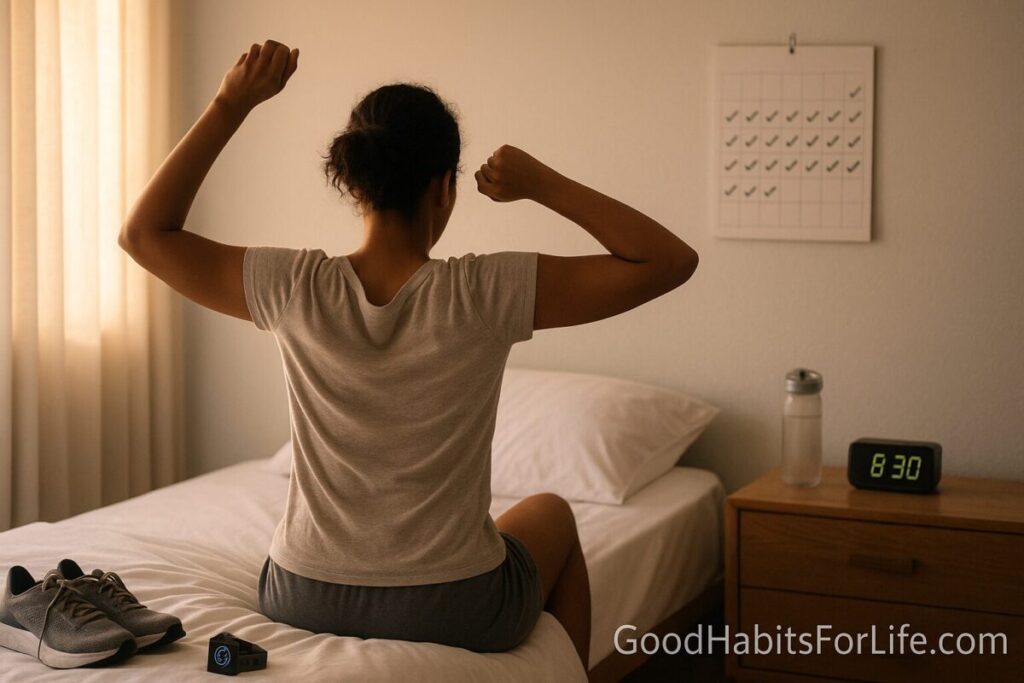
Sleep Consistency: The 80% Rule: Zone 2 + NEAT (2025)
Sleep Consistency: 80% Rule + Zone 2 & NEAT (2025)
Table of Contents
🧭 What & Why: Sleep Consistency, Defined
Sleep consistency means keeping your bedtime and wake time within a tight window (typically ±30–60 minutes) most days. It matters because healthy sleep isn’t only about duration—it also depends on quality, timing, and regularity. The American Academy of Sleep Medicine (AASM) explicitly identifies regularity as a core component of sleep health. JCSM
Large cohort studies show that irregular sleep timing is associated with higher cardiovascular risk, independent of total sleep time—an important reason to stabilize your schedule. PMC+1
This guide uses the 80% Rule plus two movement pillars—Zone 2 cardio and NEAT—to help you lock in a sustainable rhythm.
✅ Quick Start: Do This Today
-
Fix your anchor wake time. Choose a wake time you can keep daily (yes, weekends). Keep it within ±15 min.
-
Set a realistic sleep window (e.g., 23:00–07:00). Protect 7+ hours in bed.
-
Move early: 20–45 min Zone 2 (light-moderate cardio) in the morning or afternoon; finish ≥3–4 h before bed. Evening light to moderate exercise is fine for most; avoid vigorous sessions right before bedtime. PMC+1
-
Stack NEAT: hit 6,000–10,000 steps/day via walks, stairs, and 2–3 min movement breaks each hour. NEAT (non-exercise movement) adds up and supports energy balance and sleep pressure. PubMed
-
Light: get 20–30 min morning outdoor light; dim household screens/lights 2–3 h before bed. Morning light helps advance your body clock; bright evening light delays it. PMC
-
Caffeine cut-off: set a timer 8–9 h before bed (conservative), since even 6 h pre-bed can measurably disrupt sleep. PMC+1
-
Wind-down: 30–45 min routine (shower, light stretch, breathing, no work).
-
Track three metrics for 2 weeks: adherence %, bedtime/wake variability, daytime sleepiness.
🛠️ The 80% Rule—How to Use It (without perfectionism)
Definition (practical): Aim to hit your chosen sleep window (bed and wake within ±30–60 min) on ≥80% of days per month (e.g., 24 of 30). This is a behavioral benchmark, not a medical threshold. Why 80%? Habit science shows that occasional misses don’t break the process; consistency over time is what drives automaticity. PMC
Why it works: Habits form through context-dependent repetition (same cues, same time), nudging the behavior toward automaticity over weeks. In longitudinal studies, missing one day did not materially derail habit formation. PMC+1
How to apply it:
-
Pick one anchor (wake time).
-
Keep a 30–60 min bedtime window.
-
Allow planned exceptions (travel, events).
-
Review your adherence % weekly; reset quickly after slips.
🧠 Science: Circadian Rhythm, Light, Movement
-
Circadian timing: Morning light advances circadian phase; evening/late-night light delays it (the phase response curve). This is why early outdoor light and dim evenings help you fall asleep on time. PMC
-
Movement & sleep: Moderate aerobic exercise programs improve sleep quality and insomnia symptoms in RCTs and reviews. Timing matters: most people tolerate evening moderate sessions, but avoid vigorous workouts just before bed. PMC+2PubMed+2
-
NEAT: Non-exercise activity thermogenesis (walking to the store, cleaning, fidgeting) is a meaningful energy-expenditure stream that complements structured exercise and supports daytime sleep pressure. PubMed
🏃 Zone 2 + NEAT: Definitions, Targets, Timing
Zone 2 (practical definition): Light-to-moderate aerobic intensity where you can talk but not sing (the talk test). For many adults this is roughly 60–70% of maximal heart rate or ~40–60% HRR (don’t fixate on numbers; go by feel). CDC
Targets
-
Frequency: 3–5 days/week.
-
Duration: 20–45 min per session (longer on weekends if you like).
-
Timing: Morning or afternoon preferred; finish ≥3–4 h before bed. Evening moderate is usually fine; keep vigorous work earlier in the day. AASM
NEAT (all day):
-
Steps: aim for 6,000–10,000+/day via short walks, stairs, chores.
-
Micro-bouts: every hour, 2–3 min of light movement.
-
Habit hooks: tie walks to existing cues (after meals, post-calls).
-
Outdoors when possible to combine light + movement.
📅 30-60-90 Habit Plan (with checkpoints)
Days 1–30 (Stabilize)
-
Lock anchor wake; bedtime within ±60 min.
-
Zone 2: 20–30 min 4×/week.
-
NEAT: movement break every hour (set a timer).
-
Light: 20–30 min outdoor light within 1–2 h of waking.
-
Caffeine cut-off: 8–9 h pre-bed. PMC+1
-
Checkpoint (Day 30): ≥80% adherence; bedtime variability ≤60 min; self-rated sleepiness trending down.
Days 31–60 (Reinforce)
-
Keep wake time; tighten bedtime to ±45 min.
-
Zone 2: 30–40 min 4–5×/week.
-
Add 2× week strength (short sessions).
-
Checkpoint (Day 60): ≥80–85% adherence; 1 weekend “late night” max; consistent morning light.
Days 61–90 (Automaticity)
-
Bedtime ±30–45 min.
-
Zone 2: 30–45 min 5×/week (or 3–4x + longer weekend session).
-
NEAT: hit weekly step targets without thinking (built into routine).
-
Checkpoint (Day 90): Adherence ≥85%; smoother mornings; fewer daytime dips.
👥 Audience Variations
-
Students/teens: Keep wake time steady even on weekends (late-night study = earlier afternoon Zone 2 instead of evening). Use campus walks for NEAT.
-
Parents: Protect the wake anchor; split workouts (2×15 min) if needed. Early light with the stroller works.
-
Professionals: Time-box late meetings. If you train after work, keep it moderate and finish ≥3–4 h before bed.
-
Seniors: Prioritize morning light and gentle Zone 2 (brisk walk, cycling). Check meds and fall risk with your clinician.
-
Shift workers: Anchor sleep timing relative to shift; use bright light at shift start and dark/sunglasses on commute home; consider melatonin strategy with a clinician.
⚠️ Mistakes & Myths to Avoid
-
Myth: “If I hit 8 hours, timing doesn’t matter.” → Regularity matters for metabolic and cardiovascular health. PMC
-
Mistake: Going all-out workouts late at night. → Most people sleep worse after vigorous late sessions. AASM
-
Myth: “Missed a day = streak ruined.” → Occasional misses don’t derail habit formation; just resume next day. PMC
-
Mistake: Treating light as an afterthought. → Morning light advances your clock; bright evening light delays it. PMC
-
Mistake: Caffeine “doesn’t affect me.” → Objective sleep can still drop even with caffeine 6 h pre-bed; many need ~9 h. PMC+1
💬 Real-Life Examples & Scripts
-
Friends want a late movie (starts 23:30).
“I’m on an early schedule this month—can we grab dinner at 19:30 instead? I’ll book the place.” -
Work gym is only free at 20:30.
“I’ll do a light Zone 2 cycle for 25 minutes and stretch—saving intervals for lunch hours.” -
Travel day across time zones.
“Set local 07:00 wake, get morning light, keep a 20-min walk, and nap <30 min before 15:00 local.” -
Studying late?
“Choose afternoon Zone 2, then a 21:45 wind-down; caffeine stops by 14:00.”
🧰 Tools, Apps & Resources
-
AASM Bedtime Calculator (web): back-solves bedtimes from your wake time. (Good for planning.)
-
Phone wearables: Apple Health/Google Fit, Garmin, Fitbit, Oura (sleep/HRV, steps, trends). (Pros: passive tracking; Cons: estimates vary by device.)
-
Blue-light management: Built-in Night Shift/Android Night Light, f.lux on desktop.
-
Timers: Hourly “move” reminders; calendar holds for wind-down.
-
Simple logs: Weekly adherence % (e.g., 24/30 days met), bedtime variability, caffeine cut-off compliance.
📚 Key Takeaways
-
Consistency beats perfection. Hitting your window ≥80% of days builds the habit that protects your energy, mood, and long-term health.
-
Zone 2 + NEAT are your daily movers: stabilize circadian cues, build sleep drive, and smooth stress.
-
Light is medicine: morning light on, evening light down.
-
Caffeine timing counts—treat 6–9 h pre-bed as your buffer.
-
Track simple metrics weekly; adjust fast after slips.
❓ FAQs
1) Is 80% really enough?
Yes for habit-building. Research shows occasional misses don’t derail automaticity; aim for “mostly consistent” rather than perfect. PMC
2) Does evening exercise ruin sleep?
Moderate sessions are usually fine; avoid vigorous workouts right before bed. Finish training ≥3–4 h pre-bed. AASM
3) What’s the best time for Zone 2?
Morning or afternoon (pairs with light and core body temperature rhythm). If evenings are your only option, keep it moderate and end early.
4) How many steps help sleep?
There’s no magic number; focusing on daily NEAT and consistent movement is beneficial and complements structured exercise for sleep health. PubMed+1
5) How long before bed should I stop caffeine?
Evidence shows even 6 h pre-bed reduces total sleep; many do best with 8–9 h. PMC+1
6) I wake early on weekdays—can I sleep in on weekends?
Keep wake time within ~60 min even on weekends. It protects circadian alignment and Monday energy. PMC
7) Does light really matter this much?
Yes. Morning light advances your clock; evening light delays it. Use both strategically. PMC
8) How long until this feels automatic?
Habit studies suggest ~2 months on average (big range). The more consistent the context, the faster it sticks. Wiley Online Library+1
References
-
Ramar K. et al. Sleep is essential to health (AASM Position Statement). Journal of Clinical Sleep Medicine, 2021. https://jcsm.aasm.org/doi/10.5664/jcsm.9476
-
Huang T. et al. Sleep Irregularity and Risk of Cardiovascular Events. JACC, 2020. https://pmc.ncbi.nlm.nih.gov/articles/PMC7237955/
-
Wu Y. et al. Sleep patterns and cardiovascular disease risk in US participants, 2025. https://pmc.ncbi.nlm.nih.gov/articles/PMC11754222/
-
Blume C. et al. Effects of light on human circadian rhythms, sleep and mood. 2019. https://pmc.ncbi.nlm.nih.gov/articles/PMC6751071/
-
Wright K.P. Jr. et al. Entrainment to the natural light-dark cycle. Current Biology, 2013. https://pmc.ncbi.nlm.nih.gov/articles/PMC4020279/
-
Xie Y. et al. Effects of Exercise on Sleep Quality and Insomnia in Adults. 2021. https://pmc.ncbi.nlm.nih.gov/articles/PMC8215288/
-
Hartescu I. et al. Increased physical activity improves sleep in inactive adults with insomnia (RCT). J Sleep Res, 2015. https://pubmed.ncbi.nlm.nih.gov/25903450/
-
AASM. Research notes: exercise & sleep—avoid vigorous right before bed. 2024. https://aasm.org/research-notes-5-surprising-facts-about-exercise-and-sleep/
-
Drake C. et al. Caffeine 0, 3, or 6 hours before bed disrupts sleep. J Clin Sleep Med, 2013. https://pmc.ncbi.nlm.nih.gov/articles/PMC3805807/
-
Gardiner C. et al. Systematic review: caffeine timing and sleep (model suggests ~8.8 h buffer). Sleep Med Rev, 2023. https://www.sciencedirect.com/science/article/pii/S1087079223000205
-
Levine J. Non-exercise activity thermogenesis (NEAT). Proc Nutr Soc, 2002. https://pubmed.ncbi.nlm.nih.gov/12468415/
-
CDC. Measuring Physical Activity Intensity (Talk Test). https://www.cdc.gov/physicalactivity/basics/measuring/index.html
Disclaimer: This guide is educational and not medical advice; consult your clinician for personalized care, especially if you have sleep, cardiovascular, or metabolic conditions.