
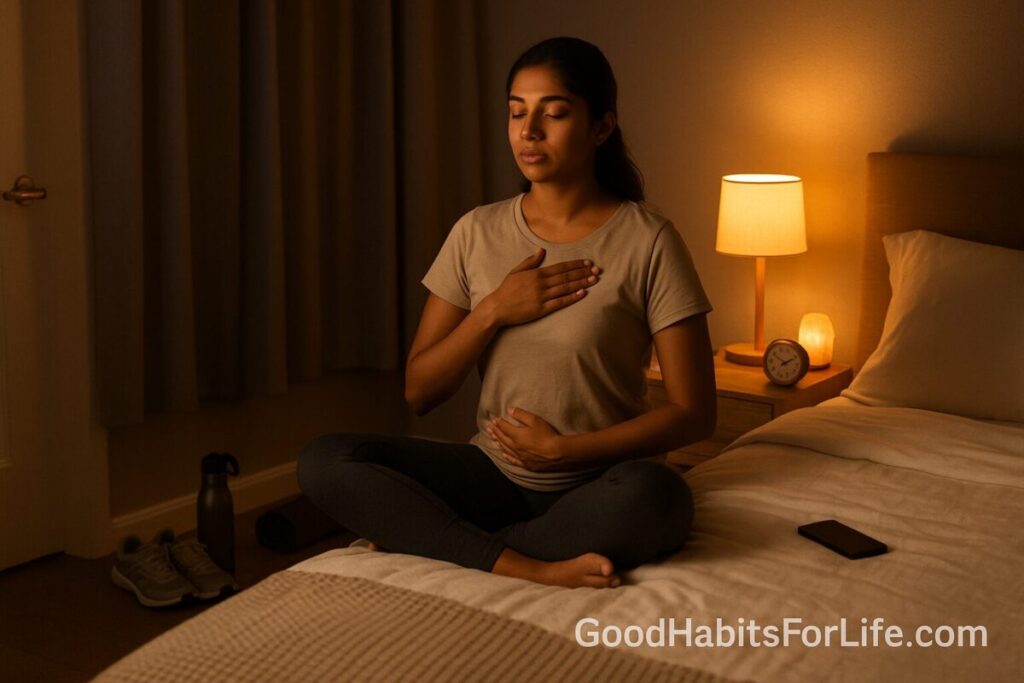
Wind-Down Rituals: Light, Breath, Story: Zone 2 + NEAT (2025)
Wind-Down Rituals: Light, Breath, Story: Zone 2 + NEAT
Table of Contents
🧭 What & Why
A wind-down ritual is a short, repeatable sequence that lowers cognitive and physiological arousal so your brain can switch from “wake” to “sleep.” Three levers have the strongest evidence and the best cost/benefit:
-
Light: Evening light delays melatonin and bedtime; even moderate light during sleep impairs cardiometabolic regulation. Expert recommendations use melanopic equivalent daylight illuminance (melanopic EDI): target ≤10 lux mEDI in the 3 hours before bed and ≤1 lux mEDI during sleep; by day, aim for ≥250 lux mEDI at the eye.
-
Breath: Slow, paced breathing (~0.1 Hz ≈ 6 breaths/min) increases vagal activity and reduces pre-sleep arousal, improving sleep onset and quality in trials.
-
Story: Low-stimulus reading or a gentle audiobook redirects rumination (a core insomnia driver) and supports the “permission to switch off” that cognitive behavioral therapy for insomnia (CBT-I) formalizes.
Consistent Zone 2 (moderate-intensity) exercise earlier in the day and a higher baseline of NEAT (non-exercise movement) are linked to better sleep quality and daytime energy across populations. Together, they make sleep easier and more stable from week to week.
✅ Quick Start (Tonight)
Follow this 25–35-minute sequence 60–90 minutes before lights-out:
-
Dim & Shift Light (5 min):
-
Switch to warm lamps, lowest setting. Enable “night mode” on screens or, better, park devices. Aim for a cozy, dim room.
-
-
Warm-Down Hygiene (5–10 min):
-
Teeth/face, set out tomorrow’s clothes, fill water. Zero decisions after this point.
-
-
Slow Breathing (5–10 min):
-
Sit or lie down. Inhale 4 s, exhale 6 s (≈6 breaths/min). Repeat 30–60 cycles. If attention wanders, gently return to the count.
-
-
Story (10–15 min):
-
Paper book or sleepy audiobook at low volume. Fiction or gentle non-fiction; nothing urgent or work-related.
-
-
Lights Out:
-
Room as dark as practical (mask/blackout). Keep a warm, low-level nightlight only if needed for safety.
-
Timing tips
-
If sensitive to late exercise, finish Zone 2 ≥3–4 hours before bed.
-
Keep bed/wake times within a 60-minute window, even on weekends.
🛠️ 7-Day Starter + 30-60-90 Roadmap
7-Day Starter (lock the ritual)
-
Day 1–2: Audit light. Replace bright overheads with warm lamps; pre-set phone to night mode after sunset. Practice 4-6 breathing for 5 minutes; read for 10 minutes.
-
Day 3–4: Extend breathing to 8–10 minutes. Add a simple audiobook backup if you’re restless.
-
Day 5–6: Add a 5–10-minute “worry capture” an hour before wind-down (brain dump + one next action) to reduce rumination.
-
Day 7: Review: Which part felt best? Fix your order and duration so the ritual is identical nightly.
30-60-90: Layer movement & stability
-
Days 1–30 (Base):
-
Zone 2: 3×/week, 20–40 min each (talkable pace; can talk but not sing).
-
NEAT: Daily step target +2k above your current baseline (e.g., from 5k → 7k).
-
Wind-down: 20–30 min sequence every night.
-
-
Days 31–60 (Build):
-
Zone 2 to 4×/week; add one short interval/tempo session if desired but keep it earlier in the day.
-
NEAT: build toward 8–10k steps/day average (or steady movement snacks every hour).
-
Wind-down unchanged; start tapering evening screen time >60 min pre-bed.
-
-
Days 61–90 (Refine):
-
Maintain Zone 2. Add 1 strength session/week (benefits sleep & metabolic health).
-
Lock a consistent sleep window (e.g., 23:00–07:00; shift by ≤15 min/week if needed).
-
Keep light targets: bright days, very dim evenings, near-dark nights.
-
🧠 Techniques & Frameworks
Light management (circadian)
-
Daylight dose: At least 30–60 min outdoors in the morning/midday (or sit by a bright window).
-
Evening cap: Start dimming 3 hours before bed; aim ≤10 lux mEDI at the eye; avoid bright overheads.
-
Night: Use ≤1 lux mEDI; eye mask or blackout curtains help; if you must get up, use warm, low-level path lights.
Breathing protocols (autonomic)
-
0.1 Hz breathing: Inhale 4 s, exhale 6 s, 5–10 min.
-
Box (if you prefer): 4-4-4-4; gentler but less vagal-centric than 0.1 Hz.
-
Cueing: Count in your head, or use a metronome/app (no phone? Use a ticking watch).
Story/attention (cognitive)
-
Fiction > problem-solving: Choose calm narratives; avoid thrillers or workbooks.
-
Audiobook guardrails: Sleep timer 10 min; low, steady volume; no cliff-hangers.
-
Rumination breaker: If thoughts race, switch to imagery (e.g., “name five blue things in a quiet harbor”) to redirect attention.
Exercise & timing
-
Zone 2 definition: Moderate intensity where you can talk but not sing; typically RPE 3–4/10.
-
Timing: Finish moderate or vigorous bouts ≥3–4 h pre-bed if you’re sensitive; many adults tolerate moderate evening exercise 2–4 h before lights-out without harm.
-
NEAT all day: Short walks after meals, stairs, standing calls, light chores—movement snacks beat long sitting blocks.
👥 Audience Variations
-
Students/Teens: Keep devices out of reach; set a device “parking spot”. Use a 10-minute fiction sprint rather than social feeds.
-
Professionals: Add a “shutdown complete” note at work to reduce after-hours problem-solving.
-
Parents: Make a family dim-light rule post-dinner; pair child bedtime story with your own audiobook immediately after.
-
Seniors: Seek more daytime light (walks near noon) and keep evening lighting warm; mind bathroom safety lighting at night (use floor-level, amber path lights).
⚠️ Mistakes & Myths to Avoid
-
Myth: “Blue-blocking glasses alone fix evenings.” They help some, but overall light level and spectrum matter; dimming is non-negotiable.
-
Mistake: “Reading in bed for an hour.” If you’re awake >20–30 min, get up, keep lights dim, continue your story in a chair, then return to bed sleepy.
-
Myth: “Any exercise close to bedtime ruins sleep.” Moderate evening sessions often do not harm sleep; vigorous sessions close to lights-out are likelier to.
-
Mistake: Skipping wind-down on weekends; regularity is the secret sauce.
-
Myth: “NEAT is trivial.” It meaningfully lifts daily movement load and supports sleep/metabolic health.
💬 Real-Life Examples & Scripts
-
One-liner ritual (20 min): “Dim → Wash → Breathe (4-6) → 10-min story → Lights out.”
-
Worry capture script (3 min): “What’s looping? → Write it → Choose one next action for tomorrow → Close notebook.”
-
If you wake at 3 a.m.: “Stay calm. Mask on. 4-6 breathing for 3 minutes → Harbor imagery → If awake after ~20 min, move to chair, audiobook 10 minutes, return.”
-
Post-dinner NEAT: “Plate down → 8-minute loop around the block → kitchen reset.”
🧰 Tools, Apps & Resources (pros/cons)
-
Lux/Light meter apps: Quick check of room brightness (pro: easy; con: variable accuracy).
-
E-ink reader / paper books: No glare; set warm front-light low (pro: low stimulation; con: device still needed).
-
Audiobook apps with sleep timer: Hands-free wind-down (pro: eyes rest; con: choose mellow content).
-
Breathing timers (metronome watch/phone): Keeps 4-6 pace (pro: precise; con: phone temptation—use airplane mode).
-
Wearables/step trackers: Track NEAT/Zone 2 (pro: feedback; con: don’t chase numbers at night).
-
CBT-I programs/apps: Evidence-based for persistent insomnia; consider if sleep trouble lasts >3 months.
🔑 Key Takeaways
-
Dim early, dark at night, bright by day—light is a powerful sleep drug.
-
Slow breathing and simple stories lower arousal and stop rumination.
-
Zone 2 + NEAT stabilize sleep over weeks; time intense efforts away from bedtime.
-
Consistency beats intensity—repeat the same 20–30-minute ritual nightly.
❓ FAQs
1) How dark is “dark enough” at night?
Aim for ≤1 lux melanopic EDI. If you need light for safety, use warm, low-level path lighting and keep it brief.
2) Is 4-7-8 better than 4-6?
Any slow, comfortable pattern helps. ≈6 breaths/min (e.g., 4-6) best targets vagal tone for many.
3) Can I exercise in the evening?
Many people tolerate moderate evening exercise 2–4 hours pre-bed. If you notice racing heart or heat at lights-out, move workouts earlier.
4) Do I need blue-blocking glasses?
Optional. Prioritize dimming total light and short-wavelength reduction in the last 3 hours before bed.
5) What if reading wakes me up?
Switch to a gentle audiobook with a 10-minute timer, or use imagery exercises instead.
6) How many steps for NEAT?
There’s no magic number; trending toward 8–10k/day or adding movement snacks hourly is a practical target.
7) I wake at night—should I breathe again?
Yes. Do 2–5 minutes of 4-6 breathing; if still awake after ~20–30 minutes, get out of bed briefly and keep lights dim.
8) How long until I notice changes?
Many feel improvements within 1–2 weeks of consistent light hygiene and wind-down; fitness changes build across 4–12 weeks.
📚 References
-
Brown TM, et al. Recommendations for daytime, evening, and nighttime indoor light exposure (melanopic EDI thresholds). PLoS Biology (2022). https://journals.plos.org/plosbiology/article?id=10.1371/journal.pbio.3001571
-
Hartstein LE, et al. High sensitivity of melatonin suppression to light within typical indoor levels. J Pineal Res (2022). https://pmc.ncbi.nlm.nih.gov/articles/PMC8933063/
-
Mason IC, et al. Light exposure during sleep impairs cardiometabolic function. PNAS (2022). https://www.pnas.org/doi/10.1073/pnas.2113290119
-
CDC. Measuring Physical Activity Intensity (Talk Test). https://www.cdc.gov/physicalactivity/basics/measuring/index.html
-
WHO. 2020 Guidelines on Physical Activity and Sedentary Behaviour. https://www.who.int/publications/i/item/9789240015128 (open summary: https://pmc.ncbi.nlm.nih.gov/articles/PMC7719906/)
-
Alnawwar MA, et al. Effect of physical activity on sleep quality and insomnia. (Review) (2023). https://pmc.ncbi.nlm.nih.gov/articles/PMC10503965/
-
Tsai HJ, et al. Efficacy of paced breathing for insomnia: enhances vagal activity and improves sleep quality. Psychophysiology (2015). https://pubmed.ncbi.nlm.nih.gov/25234581/
-
Kuula L, et al. Effects of presleep slow breathing and music on polysomnography. Sci Reports (2020). https://www.nature.com/articles/s41598-020-64218-7
-
NHS. Fall asleep faster and sleep better. https://www.nhs.uk/every-mind-matters/mental-wellbeing-tips/how-to-fall-asleep-faster-and-sleep-better/
-
AASM. Disconnect from devices at night. (Press/Resource) (2023). https://aasm.org/over-three-fourths-of-americans-lose-sleep-due-to-digital-distractions-sleep-experts-urge-a-change/
-
Levine JA. Non-exercise activity thermogenesis (NEAT). Best Pract Res Clin Endocrinol Metab (2002). https://mayoclinic.elsevierpure.com/en/publications/non-exercise-activity-thermogenesis-neat-2
⚖️ Disclaimer
This guide is educational and not a substitute for personalized medical advice. If you have persistent insomnia, sleep apnea symptoms, or a medical condition, consult a qualified clinician.