
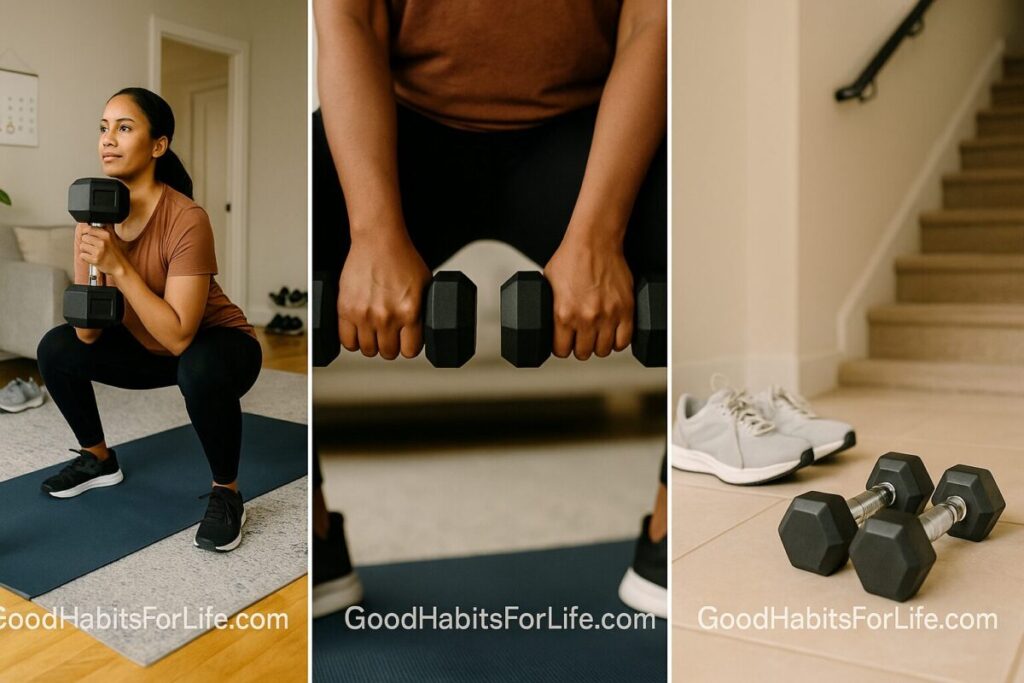
Beginner Strength: Two Dumbbells, Three Days: Zone 2 + NEAT (2025)
Beginner Strength: 2 Dumbbells, 3 Days (2025)
Table of Contents
🧭 What & Why: Strength + Zone 2 + NEAT
Definitions
-
Beginner strength plan: Three short, full-body sessions using only two dumbbells. Focus on fundamental patterns (squat, hinge, push, pull, carry, core).
-
Zone 2 cardio: Easy-to-moderate steady pace where you can speak in full sentences; typically ~60–70% of age-predicted HRmax or RPE 4–6/10. Builds aerobic base, mitochondrial efficiency, and recovery capacity.
-
NEAT (Non-Exercise Activity Thermogenesis): All movement outside formal workouts—walking, chores, taking stairs. NEAT meaningfully boosts daily energy expenditure and health.
Benefits (evidence-aligned)
-
Strength work improves muscle, bone, insulin sensitivity, and functional capacity (carry groceries, climb stairs).
-
Zone 2 supports heart health, fat oxidation, and endurance—without frying your recovery.
-
NEAT reduces sedentary time, assisting weight management and metabolic health.
Together, they create a sustainable “move more, lift smart” system that fits real life.
✅ Quick Start Today (20-minute setup)
-
Pick your dumbbells. If unsure, choose a pair you can press overhead for 6–8 smooth reps (RPE ~7). Adjustable dumbbells are perfect.
-
Clear a 2×2 m space and set your timer app to: 40s work / 60–90s rest (or 8–10 controlled reps).
-
Book three sessions into your calendar (e.g., Mon-Wed-Fri or Tue-Thu-Sat), 40 minutes each.
-
Add Zone 2 slots (30–45 min) on 2–3 non-lifting days: brisk walk, stationary bike, or easy jog.
-
Turn on NEAT: Set step target 7,000–10,000/day. Add 5-minute “movement pings” each hour you’re seated.
-
Start a simple log: note weight used, reps, RPE, sleep hours, and steps.
🛠️ Weekly Template (2 dumbbells, 3 sessions)
Structure: Full-body A / B / C rotation. Rest 48 hours between strength days if possible.
Tempo: 2 seconds down, 1 second up; pause briefly to keep control.
Load: Start light. Keep 1–3 reps “in reserve” (RIR).
Sets/Reps: 3 sets × 8–10 reps unless noted. Rest 60–90s.
Session A (Hinge–Push–Carry + Core)
-
Dumbbell Romanian Deadlift
-
Dumbbell Floor or Bench Press
-
One-Arm Suitcase Carry (20–30 m/side × 3)
-
Half-Kneeling Pallof Press (10–12/side)
Session B (Squat–Row–Hinge + Calves)
-
Goblet Squat
-
One-Arm Dumbbell Row (bench or hip-hinge)
-
Hip Hinge Good Morning (light) or Glute Bridge (12–15 reps)
-
Standing Calf Raise (12–15 reps)
Session C (Lunge–Push–Pull + Core)
-
Reverse Lunge (8–10/leg)
-
Overhead Press (seated if needed)
-
Rear-Delt Fly or Chest-Supported Row (10–12)
-
Dead-Bug or Plank (30–45s)
Optional finishers (5–8 minutes):
-
Farmer Carry intervals: 30s carry / 30–45s rest × 4–6
-
Low-impact cardio: stepper or brisk walk.
Zone 2 & NEAT
-
Zone 2: 2–3×/week for 30–45 minutes. Use the talk test or HR ~60–70% HRmax.
-
NEAT: Hit 7k–10k steps/day. Use stairs, 5-minute walking calls, park farther, tidy in short bursts.
Sample Week
| Day | Plan |
|---|---|
| Mon | Session A + 5–10 min carry/finisher |
| Tue | Zone 2 (30–45 min) + NEAT focus |
| Wed | Session B |
| Thu | Zone 2 (30–45 min) + mobility 10 min |
| Fri | Session C |
| Sat | Optional easy walk/hike; hit steps |
| Sun | Rest, light mobility, prep next week |
📈 30-60-90 Beginner Roadmap
Weeks 1–4 (Foundation – “Show up”):
-
Learn form; keep RPE 6–7.
-
Goal: complete all sessions + 2 Zone 2 days weekly; average ≥7,000 steps/day.
-
Progression: When you can do 3×10 with perfect form, add 1–2 kg (2–5 lb) per dumbbell or +2 reps next week.
Weeks 5–8 (Build – “Small upgrades”):
-
Increase one variable at a time: reps → sets (to 4) → load.
-
Add 1 extra Zone 2 session if recovery is good.
-
Track protein (~1.2–1.6 g/kg/day) and sleep (7–9 h).
Week 9 (Deload – “Freshen up”):
-
Reduce volume by ~30–40% (fewer sets, same form). Keep steps high.
Weeks 10–12 (Dial-in – “Own the moves”):
-
Push main lifts to RPE 7–8 occasionally.
-
Introduce one variant you enjoy (e.g., split squat instead of reverse lunge).
-
Reassess dumbbell sizes and step goal (perhaps 8k–12k).
🧠 Techniques & Frameworks that Work
-
RPE/RIR: Aim RPE 6–8 (leave 1–3 reps in reserve). Keeps progress steady and joints happy.
-
Micro-progressions: +2 reps before +2.5 kg; or add a 4th set only when reps feel crisp.
-
Grease the Groove (NEAT): Short, frequent movement bouts—two flights of stairs, 5-minute walks—beat one heroic session.
-
Autoregulation: If sleep <6 h or stress is high, cut a set or swap Zone 2 for a walk.
-
Form anchors: Neutral spine in hinges; knees track over mid-foot in squats/lunges; ribs down for presses.
👥 Audience Variations
Students: 35-minute sessions between classes; use campus stairs for NEAT; backpack carries = farmer carry alternative.
Busy professionals: Calendar block early mornings; walking calls for Zone 2; keep dumbbells by desk for mini-sets.
Parents: Nap-time workouts; stroller walks (Zone 2); involve kids in timer “beep” games for NEAT.
Seniors/newer movers: Start with chair sit-to-stand, supported split squat, light RDL with hip hinge stick; keep RPE 5–6; prioritize balance and carries.
⚠️ Mistakes & Myths to Avoid
-
Chasing exhaustion: Sweaty ≠ effective. Aim for controlled reps, not collapse.
-
Skipping lower body: Squats/hinges drive most functional gains.
-
No log = no progress: Record sets, reps, load, RPE.
-
Too hard Zone 2: If you can’t speak full phrases, you’re drifting to Zone 3.
-
All or nothing: Missed session? Do 1–2 core moves + 15-minute walk. Consistency wins.
💬 Real-Life Examples & Scripts
-
Calendar script: “Blocked 40 min Mon/Wed/Fri for ‘Strength A/B/C.’ Non-negotiable like a meeting.”
-
Buddy text: “I’m doing a 12-week 2-dumbbell plan. Walk & talk Tue/Thu Zone 2?”
-
At-home cueing: “Charger lives across the room—10 extra steps every check.”
-
Auto-habit: “Start coffee → 10 goblet squats with the light dumbbell.”
🧩 Tools, Apps & Resources
-
Dumbbells: Adjustable sets save space and scale easily.
-
Timer & logging apps: Strong, Hevy, or a simple notes app.
-
HR monitoring: Any wrist tracker or chest strap; if none, use the talk test.
-
Mobility: 5–10 minutes after Zone 2 (calves, hips, thoracic spine).
Pros/Cons: -
Apps/logs improve consistency (pro), but can distract if you chase numbers every set (con).
-
HR straps improve Zone 2 precision (pro), but aren’t required (con).
🔑 Key Takeaways
-
Three concise full-body sessions + steady Zone 2 + high NEAT = a durable, beginner-friendly system.
-
Progress gently (reps → sets → weight) with RPE 6–8.
-
Keep form, sleep, protein, and steps front and center.
-
Track enough to learn, not to obsess.
❓FAQs
How heavy should my dumbbells be?
Choose a load you can press overhead for ~6–8 smooth reps. If a set feels like RPE 9–10, drop weight.
How do I know I’m in Zone 2 without a heart-rate monitor?
Use the talk test: you can speak full sentences but not sing. Breathing is faster, not labored.
Can I replace Zone 2 with HIIT?
Keep HIIT minimal early on. Zone 2 builds your base, aids recovery, and pairs well with strength for beginners.
What if lunges hurt my knees?
Swap to split squats or step-ups; shorten range; check knee tracking. Strengthen hamstrings/glutes with RDLs and bridges.
Will I gain muscle on three days per week?
Yes, beginners typically progress well on 3×/week full-body if nutrition, sleep, and progression are in place.
How many steps do I really need?
Aim for 7,000–10,000/day. More is fine if recovery is good. Spread steps throughout the day.
What if I only have one dumbbell?
Do unilateral versions (one-arm press/row, goblet squat, suitcase carry). Alternate sides.
How long until I see results?
Most beginners notice strength/energy improvements in 3–6 weeks, visible changes by 8–12+ weeks.
Do I need special shoes?
Flat, stable shoes (or socks on a safe surface) work well for squats and hinges.
How do I avoid plateaus?
Track lifts, sleep, and steps; add reps or weight when sets feel easy; deload every 8–10 weeks.
📚 References
-
World Health Organization. Guidelines on Physical Activity and Sedentary Behaviour (2020). https://www.who.int/publications/i/item/9789240015128
-
U.S. Department of Health and Human Services. Physical Activity Guidelines for Americans, 2nd ed. (2018/2020 update). https://health.gov/paguidelines
-
American College of Sports Medicine. ACSM Position Stands & Guidelines (resistance training for healthy adults). https://www.acsm.org
-
National Strength and Conditioning Association. Basics of Resistance Training. https://www.nsca.com
-
American Heart Association. Target Heart Rates (using age-predicted HRmax & zones). https://www.heart.org
-
Levine JA. Non-exercise activity thermogenesis (NEAT): environment and biology. Nutr Rev. 2004;62(7 Pt 2):S82–S97. https://doi.org/10.1111/j.1753-4887.2004.tb00094.x
-
Schoenfeld BJ. The mechanisms of muscle hypertrophy and their application to resistance training. J Strength Cond Res. 2010;24(10):2857–2872.
-
National Institute on Aging. Exercise & Physical Activity: Strength, Balance, Flexibility. https://www.nia.nih.gov/health
-
UK NHS. Strength and Flexibility Exercises. https://www.nhs.uk/live-well/exercise/
-
Seiler S. What is Best Practice for Training Intensity and Duration Distribution in Endurance Athletes? Int J Sports Physiol Perform. 2010;5(3):276–291.
Disclaimer: This guide is educational and not a substitute for personalized medical advice; consult your clinician before starting or changing exercise routines, especially if you have health conditions.