
Know Your Numbers: BP, Resting HR, HRV: Dopamine Detox (2025)
Know Your Numbers: BP, Resting HR & HRV (2025)
Table of Contents
🧭 What this guide covers & why it matters
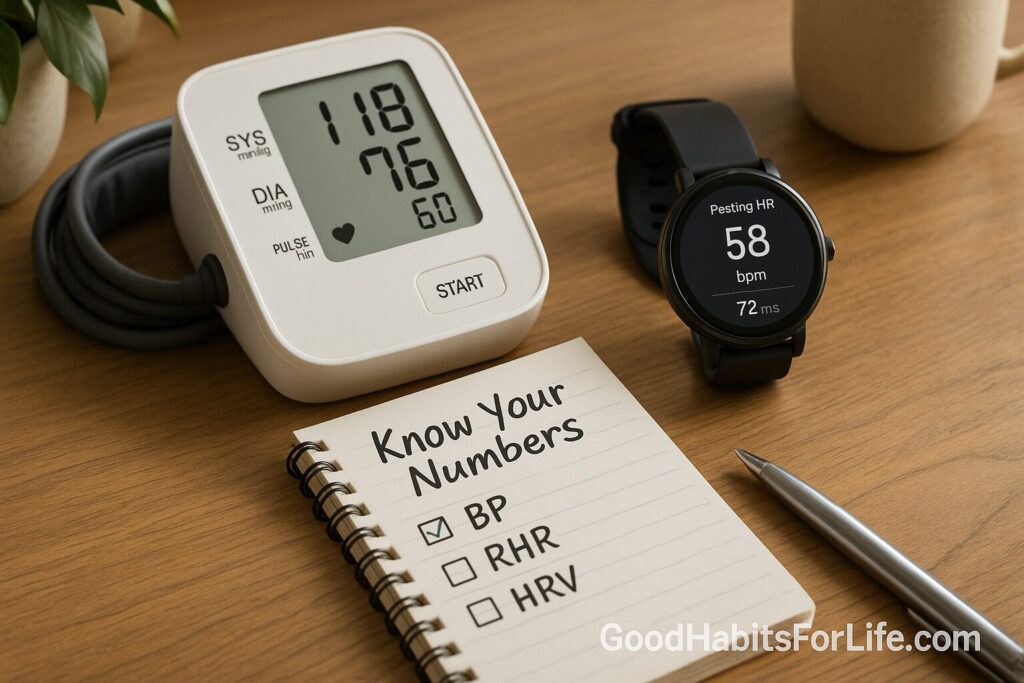
Your daily choices show up in three easy-to-track signals:
-
Blood Pressure (BP): force of blood on artery walls (systolic/diastolic). High BP damages vessels, raising risk of heart disease, stroke, kidney disease, and cognitive decline.
-
Resting Heart Rate (RHR): beats per minute at rest. Lower (within normal) generally indicates better cardiorespiratory fitness.
-
Heart Rate Variability (HRV): variation in time between heartbeats—an indirect window into autonomic balance and recovery.
Why track? Because what you measure, you can improve—and small shifts predict long-term risk. Early detection + lifestyle tweaks prevent costly problems later. Global and U.S. guidelines emphasize home monitoring and earlier intervention. apps.who.intAmerican College of Cardiology
✅ The numbers to know (targets & how to read them)
Blood Pressure categories (adults)
| Category | Systolic (mmHg) | Diastolic (mmHg) |
|---|---|---|
| Normal | <120 | <80 |
| Elevated | 120–129 | <80 |
| Stage 1 Hypertension | 130–139 | 80–89 |
| Stage 2 Hypertension | ≥140 | ≥90 |
| Hypertensive crisis | ≥180 | ≥120 |
Note: A single high reading isn’t a diagnosis; confirm with repeat home measurements or ambulatory monitoring and speak to your clinician. American College of Cardiology
Resting Heart Rate (adults)
-
Typical: ~60–100 bpm at rest
-
Athletic/very fit: can be 40–60 bpm
-
Persistently high (e.g., >90–100) can signal low fitness, stress, illness, medications—discuss with a clinician. www.heart.orgCleveland Clinic
HRV (big picture)
-
HRV is measured in milliseconds (ms) using ECG or validated wearables.
-
Higher HRV usually reflects better recovery/resilience; lower HRV can reflect stress, fatigue, or illness—but “normal” varies a lot by person and age. Track your trend, not someone else’s number. Cleveland Clinic
Clinical note: Many guidelines target <140/90 mmHg as a treatment goal worldwide; some U.S. guidance uses 130/80 for diagnosis and risk management—work with your clinician, especially if you have diabetes, kidney disease, or are pregnant. PMCAmerican College of Cardiology
🛠️ Quick start: measure correctly today
-
Get a validated upper-arm cuff. (Check device validation lists; avoid wrist cuffs unless instructed.)
-
Set up your space. No caffeine/exercise/smoking for 30 minutes; empty bladder; sit back-supported, feet flat, arm at heart level.
-
Rest quietly 5 minutes, then measure.
-
Take two readings 1 minute apart; record the average. Morning and evening are ideal for 3–7 days when establishing a baseline.
-
Log RHR & HRV on waking (before coffee/phone). Most wearables surface RHR and daily HRV automatically.
Save results in a note/app. Bring a 7–14-day log to your next checkup. www.heart.org
📅 30–60–90 Day Habit Plan
Days 1–30 — Baseline & setup
-
Measure BP 4–7 mornings and 4–7 evenings this month (two readings each time).
-
Capture RHR daily on waking and HRV (if your device supports it).
-
Start two easy levers: walk 30 min/day and add 2 servings of vegetables.
-
Checkpoint: Average BP category? RHR trend? HRV stable, up, or down?
Days 31–60 — Improvements
-
Add 2–3 sessions/week of moderate-vigorous exercise (jog, cycle, swim).
-
Sleep: target 7–9 hours; consistent schedule.
-
Sodium: aim <2,300 mg/day (ideally ~1,500 mg if feasible); cook more at home.
-
Stress reset: 10 minutes/day of breathwork or a quiet walk.
-
Checkpoint: Re-average BP; expect small improvements in RHR, steadier HRV.
Days 61–90 — Lock-in & review
-
Introduce strength training 2 days/week.
-
Alcohol: cut back or abstain (helps BP and HRV).
-
Follow-up: share your 90-day log with your clinician; discuss targets/meds if needed. Health
🧠 Techniques & frameworks that work
-
Habit stacking: After brushing teeth at night, sit and take BP.
-
Cue → Routine → Reward: Put the cuff on the table (cue), measure (routine), mark a streak (reward).
-
Closed-loop feedback: Pick one lever per week (e.g., 10,000 steps, extra vegetables) and watch what happens to RHR/HRV.
-
Sodium swap list: canned beans (rinsed), fresh/frozen veg, herbs/spices instead of salt blends; check labels (<5% DV sodium per serving = low).
-
Calm breathing (4-6 breathing): inhale 4 sec, exhale 6 sec for 5 minutes to nudge HRV upward acutely—great before bed or meetings. (HRV improves with fitness, sleep, stress management.) Cleveland Clinic
👥 Variations by audience
-
Students/Teens: Track RHR and sleep consistency; curb late-night screens to stabilize HRV. Avoid energy drinks before exams.
-
Professionals: Bookend days with walk breaks; add a no-email after 9 pm rule for sleep/HRV.
-
Parents/Caregivers: Batch-cook low-sodium meals; push stroller walks.
-
Seniors: Sit-to-stand strength work; measure BP slowly to avoid dizziness; discuss targets and meds with your clinician.
-
Athletes: Expect lower RHR and higher HRV; watch for HRV dips + RHR spikes as overtraining flags.
⚠️ Mistakes & myths to avoid
-
Measuring over clothes or with the wrong cuff size.
-
Talking/fidgeting during readings.
-
Chasing single numbers: look at averages and trends.
-
Assuming HRV must match others’: it’s individual.
-
“Dopamine detox” myth: You can’t detox dopamine; instead, schedule stimulation breaks (screen curfews, silent walks, one “low-dopamine” hour daily) to reduce compulsive scrolling and improve sleep—both help RHR/HRV. Harvard Health
💬 Real-life examples & scripts
-
Doctor message (copy/paste):
“Hi Dr. __, I tracked BP at home for 7 days: AM avg 129/77, PM avg 131/79. Resting HR averages 72 bpm; HRV trend stable. I’ve reduced sodium and added 30 min walks. What next steps do you recommend?” -
Family script:
“I’m doing a 90-day ‘Know Your Numbers’ challenge—two quick BP checks in the evening. Can we keep the living room quiet for five minutes while I measure?” -
Work script:
“I’m blocking 15:00–15:15 for a walk break to hit my step goal—it helps my BP and focus. You’ll see it on my calendar.”
🧰 Tools, apps & resources
-
BP monitors (upper arm): Omron, Withings, Qardio—look for validated devices and correct cuff size.
-
Pros: accurate, memory, app sync. Cons: cost; batteries.
-
-
Wearables for RHR/HRV: Apple Watch, Garmin, Fitbit, Oura, WHOOP.
-
Pros: passive tracking, trends. Cons: HRV accuracy varies vs. ECG; focus on trends.
-
-
Apps/logs: Apple Health/Google Fit, AHA tracking sheets, simple spreadsheets.
-
Education: AHA home BP guides; WHO hypertension guideline summaries; Cleveland Clinic explainer on HRV. www.heart.orgPMCCleveland Clinic
📌 Key takeaways
-
Measure right (position, rest, two readings).
-
Know the targets: BP categories; RHR 60–100 (lower with fitness); HRV is personal—watch trends. American College of Cardiologywww.heart.org
-
Act weekly on what you see (sleep, steps, sodium, stress).
-
Log 90 days and review with your clinician.
-
Forget fads—consistent basics beat “detoxes.” Harvard Health
❓ FAQs
1) How often should I check BP?
For a baseline, take morning & evening readings for 3–7 days (two readings each time), then once or twice weekly unless your clinician advises otherwise. www.heart.org
2) Which arm should I use?
Either is fine; choose the arm with the higher reading and stick to it for consistency. www.heart.org
3) Is a wrist cuff OK?
Upper-arm cuffs are preferred for accuracy; use wrist cuffs only if an upper-arm cuff doesn’t fit and follow instructions carefully. www.heart.org
4) What’s a “good” HRV?
There’s no universal “good” number. HRV declines with age and varies widely—track your own baseline and changes over time. Cleveland Clinic
5) My resting HR is 55 bpm—is that too low?
If you’re fit and asymptomatic, 50s can be normal. If you feel dizzy, fatigued, or have symptoms, seek care to rule out bradycardia or medication effects. Cleveland Clinic
6) Do I need meds if I’m Stage 1?
Not always. Many people try 3–6 months of lifestyle changes first unless they’re high-risk—decide with your clinician using risk tools. American College of Cardiology
7) Can I “dopamine detox” to fix my numbers?
No. You can’t detox a neurotransmitter. But reducing overstimulation (screen breaks, better sleep) can indirectly improve RHR/HRV and BP habits. Harvard Health
8) Does alcohol matter for BP?
Yes. Cutting back—or abstaining—supports BP control and recovery metrics like HRV. Health
📚 References
-
American College of Cardiology (ACC). 2017 Guideline for High Blood Pressure in Adults: Ten Points to Remember. https://www.acc.org American College of Cardiology
-
AHA. Hypertension Guideline Highlights (2017). PDF. https://www.heart.org www.heart.org
-
WHO. 2021 Guideline for the Pharmacological Treatment of Hypertension. https://apps.who.int apps.who.int
-
AHA. How to Measure Your Blood Pressure at Home (Letter-size guide, 2025). PDF. https://www.heart.org www.heart.org
-
AHA. Target Heart Rates (includes RHR basics). https://www.heart.org www.heart.org
-
Cleveland Clinic. Heart Rate Variability (HRV) — What It Means. https://my.clevelandclinic.org Cleveland Clinic
-
ESC/North American Society of Pacing & Electrophysiology. HRV: Standards of Measurement (1996 Task Force statement). PDF. https://www.escardio.org escardio.org
-
Harvard Health Publishing. Dopamine fasting: Misunderstanding science spawns a maladaptive fad. https://www.health.harvard.edu Harvard Health
-
Cleveland Clinic. What To Know About Your Heart Rate. https://my.clevelandclinic.org Cleveland Clinic
-
AHA/ACC update news (2025): alcohol & sodium guidance; prevention focus. Health.com report. https://www.health.com Health
Disclaimer: This guide is for general education and does not replace personalized medical advice—please consult your clinician for diagnosis and treatment.