
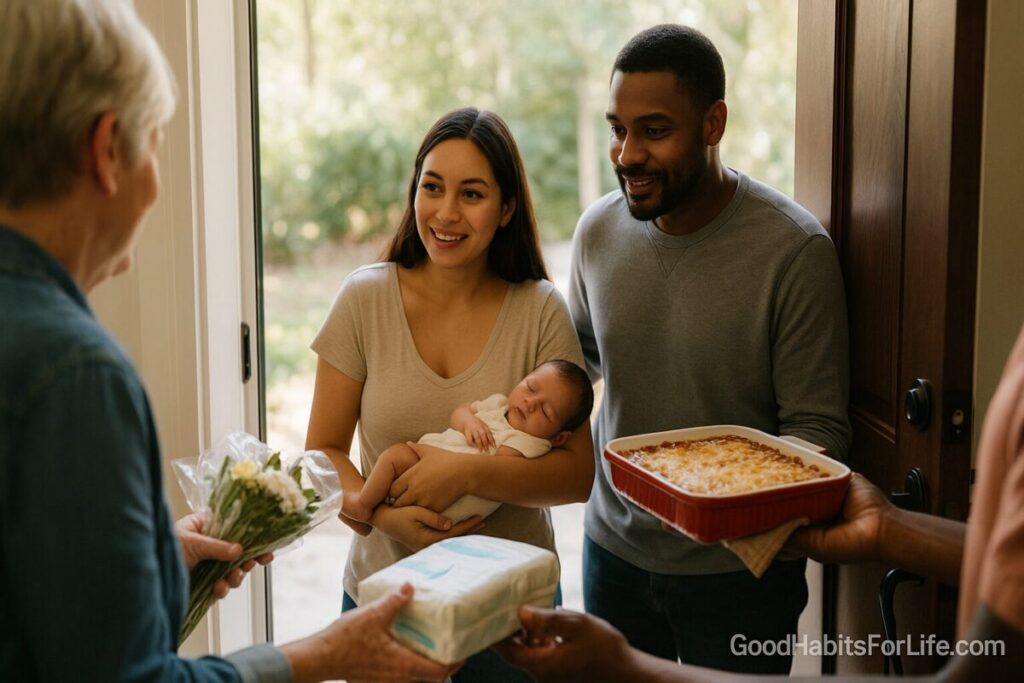
Baby Welcome: Thanking the Village
Baby Welcome: Thanking the Village
Table of Contents
🧭 What & Why
Welcoming a baby is a whole-village moment. Partners, grandparents, neighbors, co-workers, nurses, doulas, teachers, and community groups often show up with meals, rides, babysitting, and emotional support. “Thanking the village” is the habit of acknowledging these specific contributions—promptly and personally—so people feel seen and the support loop stays strong.
Why it matters
-
Better wellbeing: Practicing gratitude is linked to higher life satisfaction and lower depressive symptoms in many populations. For new parents, even brief gratitude exercises can help buffer stress during a major life transition.
-
Stronger support network: Social support lowers the risk of postpartum depression and improves recovery and infant outcomes; closing the loop with thanks encourages ongoing, healthy support.
-
Modeling for family: Expressing thanks teaches older siblings and shapes family culture from day one.
✅ Quick Start: Do-This-Today List
-
Start a single “Thank-You Tracker.” Create a note (phone/Notes/Sheets) with four columns: Name, What they did, Best contact, Status.
-
Capture everything for the last 30 days. Gifts, meals, rides, school pickups, work flexibility, medical care, prayers/blessings, messages.
-
Batch a 15-minute sprint. Send five fast micro-thanks (SMS/WhatsApp/DM). Example: “You made our first week easier with that dal + rotis. We felt so cared for. 🙏”
-
Pin two photos (baby + the gift/mealtime moment) to reuse in messages/cards.
-
Choose your “thank-you modes.” Text today; plan hand-written notes / small treats for close helpers.
-
Set two calendar blocks this week (15–20 min each) to finish the top priority names (medical staff, primary helpers, employer/manager).
🗓️ 7-Day Starter Plan
Goal: 80% of your thank-yous sent in a week—without overwhelm.
| Day | Focus | Actions |
|---|---|---|
| 1 | List & triage | Build tracker; star “major helps.” Add addresses/emails. |
| 2 | Messages | Send 10 quick texts/voice notes with one shared photo. |
| 3 | Cards batch #1 | Handwrite 5 cards (closest helpers); seal & stamp. |
| 4 | Work & childcare | Email manager/HR and caregivers with specific appreciation. |
| 5 | Health pros | Thank your OB/midwife/pediatric team; include baby photo + short outcome line. |
| 6 | Community | Post a subtle public thank-you (no private details) and DM admins/mods. |
| 7 | Deliveries | Drop 2 doorstep treats or e-gift small vouchers (coffee/fruit shop). Update tracker. |
🗺️ 30-60-90 Gratitude Roadmap
-
Days 1–30: Foundation
-
Finish core list.
-
Save “template replies” in your phone.
-
Create a photo album “Thank-You Picks” (12–20 shots).
-
-
Days 31–60: Deepen
-
Send longer notes to 5 “anchors” (the people who did the most).
-
Print 4–6 photos for grandparents/godparents.
-
Do one reciprocal act (babysit, errand, cook-back).
-
-
Days 61–90: Sustain
-
Schedule a low-key Baby Welcome Tea or park meet—no gifts.
-
Start a quarterly gratitude habit: one card, one favor, one donation.
-
Record Thank-You Milestones in baby’s memory book.
-
Checkpoints at day 30, 60, 90: update tracker % complete; note 1–2 people to follow up; list one act you’ll pay forward.
🧠 Techniques & Frameworks (G-R-A-T-I-T-U-D-E)
Use this 10-point micro-framework to write effortless, heartfelt thanks:
G — Greet by name.
R — Recall the moment (“that Tuesday night biryani drop-off”).
A — Acknowledge the effort or sacrifice.
T — Tie it to a benefit (“we finally slept”).
I — Include a small detail (baby’s yawn / sibling’s smile).
T — Thank plainly (“thank you” once, clearly).
U — Uplift (“you made us feel supported”).
D — Deliver a tiny return (photo, recipe, sample, discount code you have).
E — Extend the bridge (“tea next month?”).
Make it easy to send
-
Keep 3 message lengths (“tweet-size,” “short note,” “card”).
-
Use batching: write 5 cards while baby naps; queue 10 DMs with one shared photo.
-
Personalize one line only—leave the rest template.
👥 Audience Variations & Situations
Single parents
-
Accept help as a community win. Thank with warmth + a future plan (“movie night at ours once we’re sleeping again”).
Working professionals
-
Thank your manager and team for flexibility. Note one clear outcome: “Your WFH approval let us stabilize feeds the first week.”
Multicultural or interfaith families
-
Use culturally resonant closings (e.g., “Shukriya,” “Dhanyavaad,” “Gracias,” “Shalom,” “Salaam”) and/or inclusive blessings if you wish.
Grandparents & seniors
-
Print photos or record a 20–30-second voice note; large font cards help.
Long-distance friends
-
Send a short video thank-you; mention time zones and future call window.
Adoptive / foster / NICU journeys
-
Keep thanks sensitive to privacy. You can express deep appreciation without sharing medical or legal details.
Community groups & neighbors
-
Use a public thank-you (group message / society board), plus 1–2 private DMs to lead volunteers.
⚠️ Mistakes & Myths to Avoid
-
Myth: “It only counts if it’s a hand-written card.” Truth: sincerity beats format. A timely, thoughtful SMS is better than a perfect card months late.
-
Mistake: Waiting for the perfect photo. Use any warm snapshot; people love seeing baby’s eyes/feet/fuzzy hat.
-
Myth: “If we missed someone, it’s rude to thank later.” Late thanks still land. Start with “I’ve been meaning to say…”
-
Mistake: Over-sharing. Keep medical/legal details private unless you want them public; focus on the person’s contribution.
-
Myth: “We must spend money.” Words + a photo + a doorstep note are more than enough.
-
Mistake: Bulk copy-paste with zero personalization. Add one custom line (the recall/benefit) to avoid sounding generic.
💬 Real-Life Scripts (Copy-Paste)
1) Neighbor who cooked
“Hi Aunty Meera, that Tuesday dal and rotis were perfect. We ate hot, slept early, and felt so cared for. Thank you for feeding our little family in week one. 💛”
2) Friend who organized a meal train
“Rohit, you quietly coordinated an army of meals so we could focus on feeds and rest. Your spreadsheet superpowers = more sleep for us. Thank you!”
3) Grandparents
“Maa & Papa, your presence made our home peaceful. The 2 a.m. rocking, the laundry, the patient cuddles—everything. We’re grateful beyond words. Tea + cuddle session soon?”
4) Employer/manager
“Thank you for approving flexible hours and a staged return. It let us stabilize nights and bond as a family. I’ll share a handover plan for next week.”
5) Nurse/doula/midwife
“Dear Sister Alka, your calm voice during latching and your 3-am check-ins changed everything. Baby’s gaining well; we’re more confident because of you. Thank you.”
6) School parent who took older sibling
“Neha, that pickup + playground time made big-brother feel special. He came home beaming. Thanks for giving him stability while we settled the baby.”
7) Religious/spiritual wording (optional)
“Your prayers and blessings lifted us. We felt held by community. Thank you for keeping our family in your duas/intentions. 🌟”
8) Public group note (WhatsApp/Society/Slack)
“Village update: We’re running on gratitude (and chai). Thank you for meals, rides, messages, and patience. If we missed anyone, know that your kindness counted.”
Card closing lines
“With gratitude, [Names]” • “Warmly thankful” • “From sleepy, happy hearts” • “Humbled and grateful”
🧰 Tools, Apps & Resources
Tracking & batching
-
Google Sheets/Notion/Trello: One list for names, gifts, addresses, status. Pros: free, sharable. Con: needs initial setup.
-
Calendar blocks (15–20 min): Name them “Thank-You Sprint.” Pros: finishes the job. Con: easy to skip without alerts.
Creating cards & messages
-
Canva: Free templates; print or e-send. Pros: beautiful, fast. Con: can over-design (keep simple).
-
Postable/TouchNote (where available): Mail physical cards from your phone. Pros: convenient. Con: per-card cost.
-
Phone voice notes: Ultra-personal, fast. Pros: warmth. Con: not searchable later.
Photos
-
Shared album (Google Photos/Apple Photos): Save 3 weekly photos tagged “TY.” Pros: quick reuse. Con: privacy settings matter.
Free images for a simple digital card or post
-
Pexels / Pixabay: Free, royalty-free photos; search “newborn,” “family,” “gratitude.” Pros: license-free. Con: avoid stock-y feel—add one personal line/photo too.
Delivery ideas (budget-friendly)
-
Handwritten postcard, doorstep flowers/fruit, homemade cookies, recipe card, small plant, donation in their honor.
📌 Key Takeaways
-
Gratitude is a habit, not a one-off task. One tracker + short sprints = done.
-
Match the thanks to the help; personalize one line.
-
A 7-Day Starter + 30-60-90 plan prevents backlog and keeps relationships warm.
-
Photos and voice notes make simple messages feel special.
-
Keep privacy, sincerity, and timeliness front and center.
❓ FAQs
1) Is a text enough?
Yes. A timely, specific text beats a delayed card. Add one personal detail.
2) What if I missed someone and it’s been months?
Send a “late but heartfelt” note. People understand newborn chaos.
3) Do I need to thank medical staff?
If you want to—yes. A short message to the ward/clinic or a review helps and lifts morale.
4) How do we thank when the help was group-based?
Post a group note and DM the organizer(s). For volunteers, keep names private unless they opt in.
5) We received gifts we won’t use—what now?
Still thank the giver for the thought; re-gift/donate later if appropriate (no need to announce).
6) What about faith-based thanks if our circle is mixed?
Use neutral gratitude language publicly and personalized faith language privately as you prefer.
7) Budget is tight—ideas?
Texts, voice notes, printed 4×6 photos, or a shared album link are low-cost and loved.
8) I’m overwhelmed—can my partner do half?
Absolutely. Split the tracker by relationships (family/work/neighbors) and batch on alternate days.
9) Is it okay to include the baby’s photo?
Yes if you’re comfortable; prefer private messages and avoid posting identifying details publicly.
10) Can I automate this?
Partly—use templates and calendar prompts, but keep one personalized line per person.
📚 References
-
Harvard Health Publishing. Giving thanks can make you happier. https://www.health.harvard.edu/healthbeat/giving-thanks-can-make-you-happier
-
Greater Good Science Center (UC Berkeley). What is Gratitude? https://greatergood.berkeley.edu/topic/gratitude/definition
-
American Psychological Association. Gratitude and well-being. https://www.apa.org/monitor/2011/11/gratitude
-
World Health Organization. Maternal mental health. https://www.who.int/teams/mental-health-and-substance-use/maternal-mental-health
-
Centers for Disease Control and Prevention. Depression Among Women. https://www.cdc.gov/reproductivehealth/depression/index.htm
-
ACOG. Optimizing Postpartum Care. https://www.acog.org/clinical/clinical-guidance/committee-opinion/articles/2018/05/optimizing-postpartum-care
-
Dennis C-L & Dowswell T. Psychosocial and psychological interventions for preventing postpartum depression. Cochrane Review. https://www.cochranelibrary.com/cdsr/doi/10.1002/14651858.CD001134.pub3/full
-
Shorey S. et al. Effectiveness of peer support on postpartum depression: a meta-analysis. J Affect Disord. https://pubmed.ncbi.nlm.nih.gov/
-
Emmons RA, McCullough ME. Counting blessings versus burdens: an experimental investigation of gratitude and subjective well-being. J Pers Soc Psychol. https://psycnet.apa.org/record/2003-04340-007
-
NHS. Postnatal depression and perinatal mental health. https://www.nhs.uk/mental-health/conditions/post-natal-depression/overview/
(Note: Access to some journals may require a subscription.)
📝 Disclaimer
This guide offers general information for family life and wellbeing. It is not medical advice; if you’re concerned about postpartum mental health, please consult a qualified clinician.