
Art of Thanks: Create a Visual Gratitude Map: Zone 2 + NEAT (2025)
Art of Thanks: Visual Gratitude Map — Zone 2 + NEAT
Table of Contents
🧭 What & Why
What is a visual gratitude map?
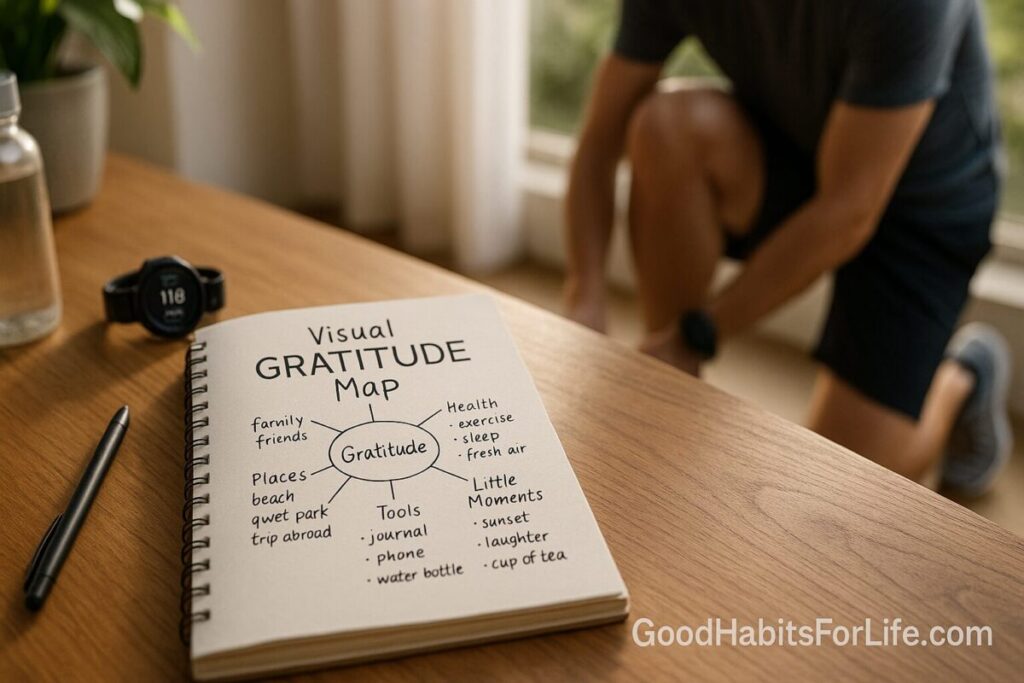
A simple, one-page canvas where you see your thanks—organized into clusters (e.g., People, Places, Health, Tools, Little Moments). Think of it as a living mind-map of appreciation you update daily.
Why pair it with Zone 2 + NEAT?
-
Gratitude practice is linked to higher well-being, better sleep, and prosocial behavior.
-
Zone 2 cardio (roughly 60–70% of max heart rate; “able to talk in sentences”) improves aerobic capacity and mood—great headspace for reflection.
-
NEAT (non-exercise activity thermogenesis—your daily movement outside workouts) helps you stay active without gym time and creates “noticing moments” that feed your gratitude list.
Together, they form a sustainable loop: move → notice → map → repeat.
⚡ Quick Start (Do This Today)
-
Pick your surface: A4 sheet, whiteboard, corkboard, or a Notion/Miro canvas. Title it “Art of Thanks — 2025.”
-
Draw 5 clusters: People • Places • Health/Body • Tools/Tech • Little Moments. Leave space for lines and stickers.
-
Move lightly for 10–15 minutes: Walk or pedal at a comfortable talk-test pace (Zone 2).
-
Notice & capture: Mentally note 3–5 specifics (names, moments, sensations).
-
Map it: After moving, draw/ink those items into the clusters. Add a small icon/date.
-
NEAT anchor: Add 2–3 short motion cues you already do (stairs after lunch, water-break loop, evening tidy-up). Use them as “gratitude prompts.”
-
Evening refresh (2 minutes): Circle one item you’ll revisit tomorrow with a thank-you message or tiny gesture.
🗺️ Build Your Visual Gratitude Map
Layout options
-
Classic Mind-Map: Center title with 5–7 spokes.
-
Grid Board: 2×3 boxes (People, Places, Health, Tools, Moments, “Wildcard”).
-
Journey Line: A winding line across the page; add icons on the path.
Visual keys
-
Color code: People (blue), Places (green), Health (red), Tools (purple), Moments (gold).
-
Icons: 💬 (kind words), 💤 (sleep), ☕ (coffee), 🌿 (outdoors), 👐 (help received).
-
Stickers/dots for frequency: 1 dot = once; 3 dots = recurring.
Evidence-aligned details
Be specific (e.g., “Akhil’s 9 am check-in that calmed me before the call”), time-bound (date stamp), and other-focused (what they did, how it impacted you) to strengthen the gratitude effect.
🛠️ Techniques & Frameworks
The 3×3 Specificity Rule
Add 3 specifics per item: what happened, why it mattered, what you’ll do in return.
Notice–Name–Nudge
-
Notice during Zone 2/NEAT.
-
Name it on the map.
-
Nudge a tiny repay step (thank-you note, compliment, micro-favor).
Talk Test + Heart-Rate Guide (Zone 2)
-
Talk in full sentences = likely Zone 2.
-
HR rough guide: 60–70% of HRmax (HRmax ≈ 220 − age).
-
New to exercise? Start at the easy end and build gradually.
NEAT Ladder (from desk to day)
-
Hourly stand & stretch → hallway lap → stairs after lunch → walking calls → grocery carry → evening tidy-sprint (5 min).
Habit Stack
Attach the map update to an existing routine: after morning walk, add 3 items or before dinner tidy-up, add 1 item.
📅 7-Day Starter Plan (Zone 2 + NEAT)
| Day | Zone 2 Focus (10–20 min) | NEAT Prompt | Map Action |
|---|---|---|---|
| 1 | Easy walk, outdoor if possible | Take stairs once | Add 3 “People” items |
| 2 | Light cycling or walk | Water-break hallway lap | Add 3 “Places” items |
| 3 | Walk with music/podcast off | Stand during a meeting | Add 3 “Little Moments” |
| 4 | Walk after lunch | Park farther (100–200 m) | Add 3 “Tools/Tech” |
| 5 | Gentle treadmill incline | Evening 5-min tidy | Add 3 “Health/Body” |
| 6 | Neighborhood loop + noticing | Carry groceries/light bags | Circle 5 favorites; add dots for repeats |
| 7 | Gratitude walk w/ partner | Sunset stretch on balcony | Write 2 thank-you messages; plan next week |
Checkpoints:
-
If you missed a day: do 5 minutes of movement + add 1 item.
-
If the list feels stale: rotate clusters (e.g., “food,” “music,” “nature”).
👥 Audience Variations
Students: Use the map to track helpful peers, teachers, and campus spaces; do 10-minute library loops between sessions.
Parents: Add “kid wins” (tiny progress counts). NEAT = play cleanup dance; stroller walks as Zone 2.
Professionals: Walking 1:1s or phone calls. Add “workflows/tools that save time.”
Seniors: Prioritize safety; flat paths, stable shoes. Add “body gratitude” (hands, breath, balance).
Teens: Turn clusters into emojis; pair walks with photo-snaps of “today’s good.”
⚠️ Mistakes & Myths to Avoid
-
Myth: “Gratitude must be grand.” → Reality: the small stuff compounds.
-
Mistake: Vague entries (“family”). → Fix: name the person and the moment.
-
Mistake: Forcing toxic positivity. → Keep room for mixed feelings; gratitude isn’t denial.
-
Mistake: Treating Zone 2 like a sprint. → If you can’t speak comfortably, slow down.
-
Mistake: All at once once-a-week. → Micro-updates daily beat marathons.
💬 Real-Life Examples & Scripts
Map entries
-
People: “Shreya shared her meeting notes; saved me 30 min.”
-
Places: “North terrace breeze at 7 pm helped me decompress.”
-
Health: “Left knee felt stable on stairs today.”
-
Tools: “Timer app kept my deep-work honest.”
-
Moments: “Barista remembered my name—felt seen.”
Thank-you scripts (copy-paste)
-
“Your [specific action] made [impact]. Thank you—I noticed and appreciate it.”
-
“I left today lighter because of your [action]. Coffee on me next week?”
-
“Quick note: That [tool/process] you set up saved me X minutes. 🙏”
🧰 Tools, Apps & Resources
-
Paper/Whiteboard: Fast, visual, sticky-note friendly.
-
Notion, Obsidian, Apple Notes: Easy tagging and daily templates.
-
Miro/FigJam: Great for collaborative maps.
-
Fitness trackers: Heart-rate view helps hold Zone 2.
-
Timers (Pomodoro/interval): 10–20-minute Zone 2 blocks; 2-minute map update.
Pros/Cons
-
Paper = tactile & visible; harder to search.
-
Digital = searchable & portable; easier to forget without widgets.
-
Trackers = feedback; avoid obsessing over numbers.
✅ Key Takeaways
-
A visual gratitude map turns fleeting thanks into a visible habit system.
-
Zone 2 + NEAT create reliable noticing time and better recall.
-
Keep entries specific, dated, and other-focused.
-
Use the 7-day plan to install the routine; maintain with tiny daily updates.
-
Pair gratitude with a repay nudge (message, compliment, small favor).
❓ FAQs
How long should Zone 2 be for this practice?
10–20 minutes is plenty to reflect and notice; extend gradually if comfortable.
How do I know I’m in Zone 2 without a tracker?
Use the talk test: you can speak in sentences. If you’re breathless, slow down.
What if I don’t feel grateful today?
Log a neutral observation (“cool morning breeze”), appreciate effort (“showed up for the walk”), or note future gratitude (“call mom tomorrow”).
Paper or digital?
Whichever you’ll actually see daily. Many start on paper, then archive to digital monthly.
Can I do this seated?
Yes—pair with NEAT breaks (stand, stretch, hallway lap). Movement helps, but the map works even on low-mobility days.
Is it okay to repeat items?
Yes—use dots/stickers for repeats. Recurrence shows what consistently supports you.
What if I already journal?
Great. The map complements journaling by giving you an at-a-glance system view.
Can families or teams share one map?
Yes—use color codes per person; do a 10-minute weekly gratitude huddle.
📚 References
-
Emmons, R.A., & McCullough, M.E. (2003). Counting blessings versus burdens. Journal of Personality and Social Psychology. PubMed
-
Greater Good Science Center. How Gratitude Changes You and Your Brain. University of California, Berkeley. Link
-
American Psychological Association (APA). Gratitude. Link
-
World Health Organization. Guidelines on Physical Activity and Sedentary Behaviour (2020). Link
-
American Heart Association. Target Heart Rates. Link
-
American College of Sports Medicine. The Talk Test & Exercise Intensity. Link
-
Levine, J.A. (2002). Non-exercise activity thermogenesis (NEAT). Best Practice & Research Clinical Endocrinology & Metabolism. ScienceDirect
-
Mayo Clinic Health System. Move more, sit less: Make your day NEAT. Link
-
National Center for Complementary and Integrative Health (NIH). Mindfulness Meditation: What You Need to Know. Link
-
Wood, A.M., Froh, J.J., & Geraghty, A.W.A. (2010). Gratitude and well-being: A review and theoretical integration. Clinical Psychology Review. ScienceDirect
Disclaimer: This guide is educational and not a substitute for professional medical or mental-health advice; consult a qualified professional about exercise or health conditions.