
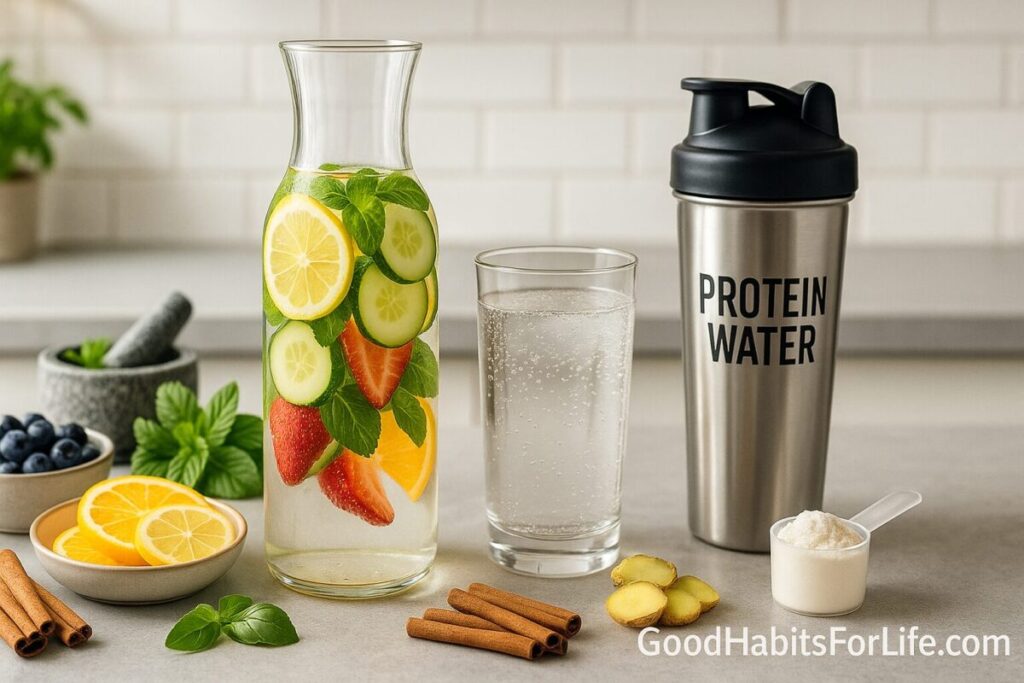
Flavor Your Water: Fruit, Herbs, and ZeroSugar Hacks: Protein-Forward Plan (2025)
Flavor Your Water: Fruit & Herb, Zero-Sugar Protein Plan
Table of Contents
🧭 What & Why
What this is: A practical, zero-sugar system for flavoring water (still or sparkling) with fruit, herbs, and spices—plus a protein-forward twist so one or two of your daily bottles also help you meet protein goals.
Why it works:
-
Hydration supports energy, cognition, and temperature regulation. Many adults under-drink; pleasant flavor nudges intake upward.
-
Swapping sugary drinks for flavored water cuts added sugars tied to weight gain and metabolic risk.
-
Protein water helps close the common protein gap, especially when you’re busy, without adding sugar.
Targets (guidance, not rules):
-
Fluids from beverages and foods total roughly ~2.0 L/day for women and ~2.5 L/day for men, higher with heat, exercise, pregnancy/lactation, or illness.
-
Daily protein baseline: ~0.8 g/kg body weight; athletes often aim 1.2–2.0 g/kg. Protein water can help you reach (not exceed) your personal target.
Always individualize for climate, activity, and medical needs.
✅ Quick Start: Today’s 10-Minute Setup
-
Pick a base: 1 L bottle (BPA-free) or a 750 mL shaker for protein water.
-
Wash & slice: ½ lemon (rounds), 6–8 cucumber coins, 6–8 mint leaves.
-
Infuse: Add to bottle, fill with cold water, steep 10–20 min (or overnight in the fridge for stronger flavor).
-
Protein bottle (optional):
-
Add 10–20 g whey isolate or collagen peptides to 700–1000 mL cold water.
-
Add 2–3 tbsp lemon juice + a few mint leaves or a ginger coin. Shake hard.
-
-
Batch ice: Freeze a tray of “flavor cubes” (berries, ginger, mint).
-
Place & cue: Keep one bottle at your desk; one in your bag/car. Set 3 timers (mid-morning, mid-afternoon, early evening).
🧠 30-60-90 Protein-Forward Hydration Plan
Goal: Make flavored hydration automatic and fold in protein on autopilot.
Days 1–30 (Foundation)
-
Daily: 2 flavored waters (1 L total) + free plain water.
-
Protein water: 1 bottle/day with 10–15 g isolate.
-
Flavor rotations: Citrus-mint, berry-basil, cucumber-lime, ginger-lemon.
-
Tracking: Tick off 3 cues/day (phone reminders).
-
Checkpoint: Did you hit ≥1.5–2.0 L most days?
Days 31–60 (Consistency)
-
Daily volume: 2–2.5 L total fluids (climate-adjust).
-
Protein water: 15–20 g once daily or split into two 10 g minis.
-
Add sparkling (if you like) for 1 bottle; use a straw during citrus meals to protect enamel.
-
Batch Sunday: Wash/slice 3 flavor kits in airtight jars for Mon–Wed.
Days 61–90 (Personalization)
-
Dial taste: Explore herb-forward combos (rosemary-grapefruit*, thyme-orange).
-
Training days: Add sugar-free electrolytes or a pinch of salt (⅛ tsp) + citrus in 1 bottle if sweating heavily.
-
Protein: Adjust bottle protein so total daily intake meets—not wildly exceeds—your target.
-
Checkpoint: Hydration feels easy; energy and focus up; sugary drinks down.
* Grapefruit can interact with some medications—check the FAQ and references.
🛠️ Flavor Formulas & Zero-Sugar Hacks
Infusion ratio: For 1 L water, use 1 small handful fruit/veg + 6–10 leaves herbs or 2–3 thin spice slices. Chill 1–12 h. Strain if storing beyond the day.
Classic Sets
-
Citrus-Mint Cooler: ½ lemon + ½ lime rounds + 8 mint leaves.
-
Berry-Basil Spritz: 8–10 sliced strawberries + 6 basil leaves (sparkling option).
-
Cucumber-Lime Spa: 8 cucumber coins + ½ lime + pinch sea salt (heavy-sweat days).
-
Ginger-Lemon Wake-Up: 6–8 ginger coins + ½ lemon + cinnamon stick (optional).
Herbs & Spices (big flavor, zero sugar)
-
Ginger, cinnamon, clove, star anise (warm, spicy).
-
Mint, basil, rosemary, thyme (green, aromatic).
-
Citrus peels (zesty; avoid pith for bitterness). Lightly muddle, don’t pulverize.
Protein-Forward Pairings (10–20 g isolate in 700–1000 mL)
-
Lemon-Mint Whey: 15 g whey isolate + 2 tbsp lemon juice + mint + ice.
-
Berry-Collagen: 15 g collagen peptides + crushed frozen berries + squeeze of lime.
-
Cucumber-Lime Clear Whey: 20 g clear whey isolate + lime juice + cucumber coins.
Tip: “Clear” whey isolates dissolve better in cold water and stay juice-like.
Fast Zero-Sugar Boosters
-
Citrus juice (1–3 tbsp), apple cider vinegar (1–2 tsp), or unsweetened tea cubes.
-
Salt + acid (pinch of salt + citrus) brightens flavor—great on hot days.
-
Stevia/monk fruit (optional): 1–2 drops if you want sweetness without sugar.
Storage & Safety
-
Scrub produce; refrigerate ≤4 °C; drink within 24–48 h.
-
Discard if cloudy, fizzy, off-smell, or slimy.
-
Rinse bottle daily; deep-clean weekly (bottle brush + hot soapy water; air-dry).
📚 Techniques & Frameworks that Stick
-
Habit stacking: “After my morning email, I take 10 sips.”
-
Two-bottle rule: One infused, one plain—both visible.
-
Pre-commit kits: Three small jars with pre-sliced sets = 3 days of no-excuse flavor.
-
Environment design: Keep bottle within arm’s reach; move it with you.
-
Minimums & maximums: Minimum 1 L flavored; maximum 20 g protein per bottle unless advised otherwise.
Simple Comparison Table (Protein Options)
| Protein type | Taste/texture in water | Typical scoop (g protein) | Pros | Watch-outs |
|---|---|---|---|---|
| Clear Whey Isolate | Light/juice-like | 20 g | Fast mixing; complete protein | Dairy allergy |
| Regular Whey Isolate | Slight creamy | 20–25 g | High leucine; muscle support | Chalky if very cold |
| Collagen Peptides | Neutral/very light | 10–20 g | Dissolves easily; skin/joint support claims | Not a complete protein |
| Soy Isolate | Neutral to beany | 20 g | Plant-based; complete protein | Taste; potential GI for some |
🧩 Audience Variations
-
Students/teens: Make “study spritzers” (citrus-mint, ginger-lime). Use clear whey only if appropriate and needed; otherwise stick to flavored water.
-
Parents: Batch family pitchers; avoid honey for under-1s; watch grapefruit for meds.
-
Professionals: Desk carafe + travel tumbler; set calendar hydration nudges.
-
Seniors: Favor room-temp and herb-forward (less acidic). Review meds before using grapefruit or high-potassium electrolytes.
-
Athletes/manual workers: Use one bottle with sugar-free electrolytes; protein water post-session to meet totals.
⚠️ Mistakes & Myths to Avoid
-
Myth: “Sparkling water dehydrates.” ➜ Plain sparkling hydrates similarly to still.
-
Myth: “Lemon water detoxes your body.” ➜ Your liver/kidneys do detox; lemon just makes water tastier.
-
Mistake: Over-acidic sipping all day. ➜ Enjoy citrus with meals, rinse mouth after, or rotate to herb/cucumber combos.
-
Mistake: Treating protein water like an extra without counting it. ➜ It counts toward daily protein; track it.
-
Mistake: Leaving fruit in a warm bottle all day. ➜ Keep chilled; refresh produce.
💬 Real-Life Scripts & Routines
-
Morning (2 min): “Before coffee, fill 1 L with lemon-mint; drop in two frozen berry cubes.”
-
Work cue: “After each meeting, 6 sips.”
-
Gym days: “Post-workout: 15–20 g clear whey + lime in 750 mL.”
-
Restaurant swap: “Sparkling water with lime, please.”
-
Family pitcher: “1.5 L cold water + orange rounds + 2 cinnamon sticks; fridge door shelf.”
🧰 Tools, Apps & Resources
-
Bottles: 750 mL–1 L with wide mouth + measurement lines.
-
Shaker or mini frother: Prevents clumps in protein water.
-
Ice cube trays with lids: Build flavor cubes every Sunday.
-
Apps/Timers: Use phone alarms or habit apps (3 cues/day).
-
Counter caddy: Keep knife, board, citrus squeezer together to remove friction.
🔑 Key Takeaways
-
Make water tasty, visible, and easy.
-
Use fruit/herbs/spices for zero-sugar flavor; rotate to keep novelty.
-
Add 10–20 g protein to one bottle if it helps you meet your daily protein target.
-
Mind dental care with acidic flavors and food safety with infusions.
-
Track habit cues, not perfection.
❓ FAQs
1) Is sparkling water as hydrating as still?
Yes. Plain sparkling hydrates similarly to still water. If you choose citrus-flavored options, enjoy with meals and rinse after to protect enamel.
2) How many calories are in fruit-infused water?
Very few—typically <10–20 kcal/L, depending on how much fruit you use and whether you eat it afterward.
3) How much protein should I add to a bottle?
Start with 10–15 g per 700–1000 mL. Some prefer 20 g post-workout. Count this toward your daily protein.
4) Can kids have infused or protein water?
Infused water is fine for most kids. For protein powders, check pediatric needs and avoid adult supplements unless advised by a clinician.
5) Is stevia/monk fruit okay?
Small amounts can make transitions easier. If sweetness keeps creeping up, dial it back to retrain taste.
6) Do I need electrolytes?
Not for light daily activity. For long/hot sessions with heavy sweat, a sugar-free electrolyte mix or a pinch of salt + citrus can help. People with kidney/heart conditions or on certain meds should check with a clinician.
7) Is lemon water bad for teeth?
Acidic drinks can erode enamel over time if sipped all day. Enjoy with meals, rotate to herb/cucumber waters, use a straw, and rinse with plain water.
8) Can I use grapefruit?
Only if you’re not on medications that interact (e.g., some statins and antihypertensives). When in doubt, skip it or ask a pharmacist.
9) Which protein—whey, collagen, or plant?
For muscle protein synthesis, whey or soy isolate (complete proteins) are best. Collagen dissolves easily but isn’t complete; it’s fine for a light boost.
10) Does coffee dehydrate me?
Moderate coffee does not meaningfully dehydrate regular caffeine users. It still “counts” toward fluids, though plain water remains your best base.
References
-
Harvard T.H. Chan School of Public Health. Water – The Nutrition Source. https://www.hsph.harvard.edu/nutritionsource/water/
-
European Food Safety Authority (EFSA). Scientific Opinion on Dietary Reference Values for water. EFSA Journal. 2010;8(3):1459. https://www.efsa.europa.eu/en/efsajournal/pub/1459
-
World Health Organization. Guideline: Sugars intake for adults and children. 2015. https://www.who.int/publications/i/item/9789241549028
-
American Heart Association. Added Sugars. https://www.heart.org/en/healthy-living/healthy-eating/eat-smart/sugar/added-sugars
-
National Academies (Food & Nutrition Board). DRIs for Protein. https://www.ncbi.nlm.nih.gov/books/NBK56068/
-
Jäger R, et al. International Society of Sports Nutrition Position Stand: protein and exercise. J Int Soc Sports Nutr. 2017;14:20. https://jissn.biomedcentral.com/articles/10.1186/s12970-017-0177-8
-
Killer SC, et al. No evidence of dehydration with moderate daily coffee intake. PLOS ONE. 2014;9(1):e84115. https://journals.plos.org/plosone/article?id=10.1371/journal.pone.0084115
-
American Dental Association (MouthHealthy). Sparkling Water and Your Teeth. https://www.mouthhealthy.org/all-topics-a-z/sparkling-water-and-teeth
-
University of Minnesota Extension. Infused Water Safety. https://extension.umn.edu/preserving-and-preparing/infused-water
-
U.S. FDA. Grapefruit Juice and Some Drugs Don’t Mix. https://www.fda.gov/consumers/consumer-updates/grapefruit-juice-and-some-drugs-dont-mix
-
World Health Organization. Salt reduction. https://www.who.int/news-room/fact-sheets/detail/salt-reduction
Disclaimer: This article is general information and not medical or nutrition advice; consult your clinician or dietitian for personal guidance, especially if you have kidney, liver, heart, or metabolic conditions or take prescription medicines.