
Chronic Illness: GoodEnough Gratitude: Zone 2 + NEAT (2025)
Chronic Illness Gratitude: Good-Enough + Zone 2 & NEAT
Table of Contents
🧭 What & Why
What is “good-enough gratitude”?
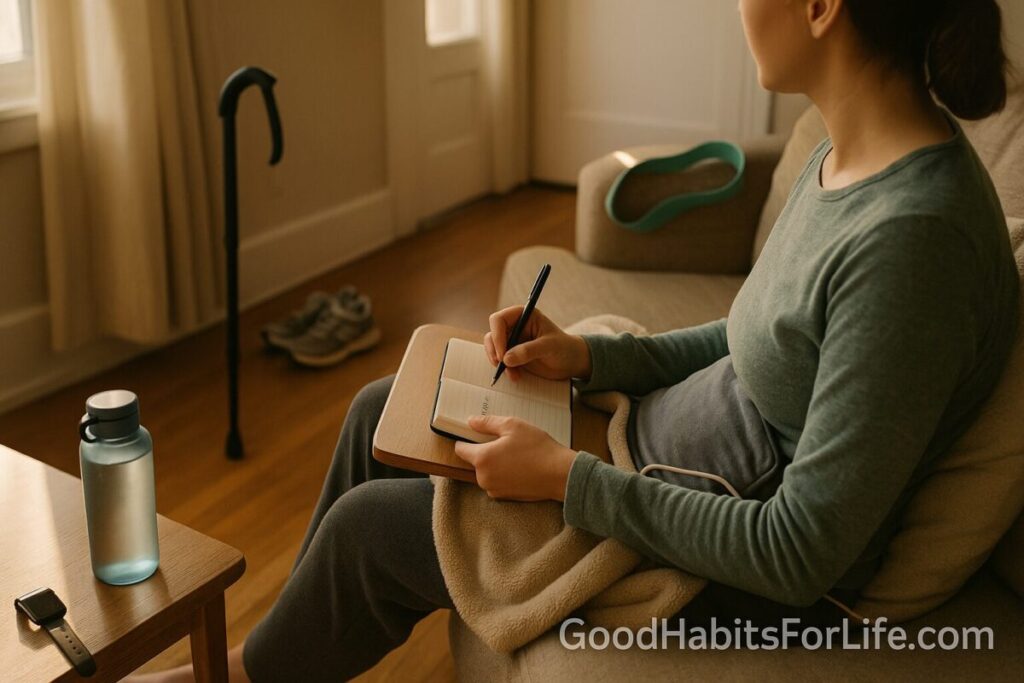
A kind, flexible gratitude practice designed for life with chronic illness. Instead of forcing three perfect entries every day, you capture one small, honest thing—even “my heating pad,” “a friend texted,” or “a 6/10 day, not a 4/10.” This removes pressure, supports mood, and strengthens resilience.
Why it helps: Research links gratitude with improved well-being, sleep, and coping. For people navigating symptoms, a light-touch practice lowers cognitive load and avoids toxic positivity by welcoming mixed emotions alongside thanks.
What are Zone 2 and NEAT?
-
Zone 2: Easy aerobic work where you can talk in full sentences (roughly 60–70% of max heart rate; RPE 2–3/10). Examples: relaxed walk, easy spin, gentle swim.
-
NEAT (Non-Exercise Activity Thermogenesis): All the calories you burn outside of intentional workouts—standing up, pottering around, light chores, gentle mobility, walking to the gate, etc.
Why they help: Light, tolerable movement supports circulation, insulin sensitivity, mitochondrial function, and mood. For many chronic conditions, small, consistent movement often works better than intense, sporadic sessions. NEAT is especially powerful because it’s low strain and easily sprinkled through the day.
Important: If you experience post-exertional malaise (PEM), orthostatic intolerance, or frequent flares, keep intensity below symptom threshold, prioritize pacing, and discuss plans with your clinician.
✅ Quick Start Today (10–15 minutes)
-
1-Line Gratitude (2 min)
-
Write one sentence: “Today I’m grateful for ___ because ___.”
-
On very hard days: “One tiny relief was ___.”
-
-
Talk-Test Walk (5–10 min)
-
Stroll at a pace where you can speak sentences comfortably (Zone 2).
-
Indoors works (hallway loops), or march in place with support.
-
-
NEAT Sprinkles (3 min total)
-
Set a timer to stand, stretch, or walk 1 minute every hour you’re awake (as able).
-
Use doorframe calf raises, seated shoulder rolls, wall angels.
-
-
Stop-Point Check
-
Ask: “If I stop now, will I still feel okay later?” If unsure, stop 1–2 minutes early.
-
🛠️ 30-60-90 Day Habit Roadmap
Days 1–30: Stabilize & Simplify
-
Gratitude: 1 line/day, 5 days/week. Accept “misses.”
-
Zone 2: 8–12 min, 2×/week max. End while you can still comfortably talk.
-
NEAT: Find your baseline steps (e.g., 1–3k/day). Add +200–300 steps/day or 3–5 gentle movement breaks spread across the day.
-
Pacing: Use a daily energy budget (spoons). Leave 20–30% buffer.
-
Checkpoint: Zero push-crash weeks? If yes, move forward; if no, hold/scale down.
Days 31–60: Build Consistency
-
Gratitude: Optionally add a weekly “thanks to future-me” entry (what you did that helped).
-
Zone 2: 10–15 min, 2–3×/week. Keep everything conversational.
-
NEAT: Add +300–500 steps/day or a 2–3 minute “potter lap” after meals.
-
Strength sprinkle (optional): 1–2 sets of 5–8 very easy movements (sit-to-stand, wall push-ups, band rows) once weekly if tolerated.
-
Checkpoint: Mood/energy trending up? Sleep okay? Adjust volume, not intensity.
Days 61–90: Personalize & Protect
-
Gratitude: Add a weekly “silver linings” review (noticing skills/supports, not minimizing pain).
-
Zone 2: 12–20 min, 3×/week or keep 2× and add 1 ultra-light mobility session.
-
NEAT: Aim for your sweet-spot routine (e.g., sit-stand-move cycle 20–8–2: 20 min sit, 8 min stand, 2 min move—adapt freely).
-
Checkpoint: Choose the plan you can keep on bad weeks. Lock that in as your default.
Fallback protocol (for flares): Gratitude: 3 words; Zone 2: skip; NEAT: 60–90 seconds of gentle range-of-motion; Rest without guilt.
🧠 Techniques & Frameworks
-
Pacing & Spoon Theory: Decide daily energy limits. Break tasks into halves or thirds. Stop while you still feel okay.
-
Talk Test / RPE 2–3: If you can chat comfortably, you’re likely in Zone 2. If speaking is choppy, ease back.
-
If–Then Plans (Implementation Intentions):
-
If I open my morning tea, then I’ll write one gratitude line.
-
If I finish a call, then I’ll do 60 seconds of gentle movement.
-
-
Habit Stacking: Attach gratitude to a must-do (medicine, meals, brushing teeth).
-
Minimum Viable Dose: Define a 1-minute version of every habit you can do even during flares.
-
Symptom-First Scheduling: Plan movement where symptoms are typically mildest; never after a demanding errand.
-
Safety Notes: Beta-blockers and dysautonomia can make HR targets unreliable—prefer the talk test and symptom cues.
🧩 Variations by Situation
-
Chronic Pain: Favor short, frequent bouts; prioritize joint-friendly movement (pool walking, recumbent bike, supported mobility). Gentle diaphragmatic breathing before/after may reduce guarding.
-
Chronic Fatigue / ME-CFS / Long COVID with PEM: Keep intensity under threshold; consider 30–90-second movement “snacks” with long rests. Stop at the first sign of symptom rise.
-
Dysautonomia / POTS: Start recumbent/seated cardio (mini-cycle, rowing, swimming as tolerated). Hydration and compression garments may help—ask your clinician.
-
Parents & Caregivers: Do “potter laps” while supervising kids; gratitude as a bedtime whisper with your child.
-
Professionals/Students: Put 1-minute move timers between tasks or lectures; gratitude as the last calendar item.
-
Seniors: Prioritize balance (heel-to-toe stands near a wall) and gentle walking with support; keep Zone 2 short and conversational.
⚠️ Mistakes & Myths to Avoid
-
Myth: “If it doesn’t hurt, it’s not working.”
Truth: For chronic conditions, easy and consistent beats hard and rare. -
Myth: “Gratitude means pretending I’m fine.”
Truth: Real gratitude can coexist with grief, anger, and fatigue. -
Mistake: Chasing numbers (steps/HR) over body signals.
-
Mistake: Using good days to “catch up” → push-crash.
-
Mistake: All-or-nothing streaks; aim for most days, not every day.
🗣️ Real-Life Scripts & Prompts
1-Line Gratitude Prompts
-
“One small mercy today was ___.”
-
“I’m grateful for ___ because it made ___ 5% easier.”
-
“Thank you, body, for ___ (even if imperfect).”
Boundary Script (work/family)
-
“I’m following a pacing plan to prevent symptom flares. I’ll need a 10-minute break every hour; I appreciate your support.”
Medical Team Check-in
-
“I’m trialing short Zone 2 walks and NEAT breaks below symptom threshold. Anything you want me to watch for or modify?”
If–Then Cards
-
If I feel a dip → then I’ll sit, breathe 4-6, and jot one gratitude line.
-
If a meeting ends → then 60 seconds of shoulder rolls + calf raises.
🧰 Tools, Apps & Resources
-
Gratitude apps: Day One, Presently, Five Minute Journal.
Pros: prompts, reminders. Cons: notifications can feel pushy—mute freely. -
Movement trackers: Pedometer++ / Google Fit / Apple Health.
Pros: easy to see NEAT. Cons: don’t chase step goals on tough days. -
Timers: Repeat Alarm, Time Out (desktop micro-breaks).
-
Supports: Folding cane/seat, compression socks (if advised), mini-cycle, resistance bands.
-
Environment: Chair by a sunny window, stable handrail on stairs, clutter-free “pacing path.”
📌 Key Takeaways
-
Start with 1-line gratitude and talk-test movement.
-
Favor NEAT sprinkles and short Zone 2 over big workouts.
-
Pace first; stop while you still feel okay.
-
Build with a 30-60-90 plan; keep a flare fallback.
-
Progress = feeling steadier over weeks, not hitting a perfect number.
❓ FAQs
1) What if I can’t walk outside?
Indoor loops, seated marching, mini-cycle, or gentle mobility all count. Use the talk test and stop early.
2) How many days per week should I do Zone 2?
Start with 2 short days. If recovery is smooth for 2–3 weeks, consider 3 short days or keep 2 and add NEAT.
3) What’s a good NEAT goal?
Find your baseline first. Add +200–500 steps/day or 1–2 extra 1-minute movement breaks. Let symptoms guide pace.
4) Can gratitude feel fake on bad days?
Yes—and that’s okay. Use prompts like “one tiny relief” or “someone who was kind.” Honest, small wins help most.
5) How do I avoid post-exertional malaise?
Keep intensity low, shorten before symptoms rise, space activities with rests, and use a fallback protocol.
6) Are heart-rate zones necessary?
Not if they confuse or vary with meds. The talk test and RPE 2–3 are simpler and safer.
7) Will this help my sleep?
Light, regular movement and evening gratitude can support better sleep for many people; keep late exercise very easy.
8) Do I need special equipment?
No. Comfortable shoes, a timer, and pen/paper are enough. Add simple aids only if they make life easier.
9) What if I miss a week?
Restart at your minimum viable dose (1-line gratitude, 5–8 min Zone 2, a few NEAT breaks). Consistency returns fastest when you restart tiny.
10) Can I combine gratitude with breathing?
Yes—try 4-6 breathing (inhale 4, exhale 6) before writing. It calms and clarifies.
📚 References
-
Emmons, R.A., & McCullough, M.E. (2003). Counting blessings versus burdens. J Pers Soc Psychol. https://pubmed.ncbi.nlm.nih.gov/12585811/
-
Wood, A.M., Froh, J.J., & Geraghty, A.W. (2010). Gratitude and well-being: A review. Clin Psychol Rev. https://pubmed.ncbi.nlm.nih.gov/20172789/
-
World Health Organization. Guidelines on physical activity and sedentary behaviour (2020). https://www.who.int/publications/i/item/9789240015128
-
U.S. Dept. of Health & Human Services. Physical Activity Guidelines for Americans, 2nd ed. https://health.gov/our-work/physical-activity/current-guidelines
-
Garber, C.E. et al. (2011). Quantity and quality of exercise position stand. Med Sci Sports Exerc. https://pubmed.ncbi.nlm.nih.gov/21694556/
-
Levine, J.A. (2002). Non-exercise activity thermogenesis (NEAT). Best Pract Res Clin Endocrinol Metab. https://pubmed.ncbi.nlm.nih.gov/12468415/
-
CDC. Measuring Physical Activity Intensity (Talk Test/RPE). https://www.cdc.gov/physicalactivity/basics/measuring/
-
CDC. ME/CFS: Post-Exertional Malaise. https://www.cdc.gov/me-cfs/
-
APA. Chronic Illness & Mental Health. https://www.apa.org/helpcenter/chronic-illness
-
Harvard Health Publishing. What is Zone 2 cardio? https://www.health.harvard.edu/staying-healthy/what-is-zone-2-cardio
Disclaimer: This content is educational and not a substitute for personalized medical advice—please consult your healthcare professional, especially if you experience post-exertional malaise or unstable symptoms.