
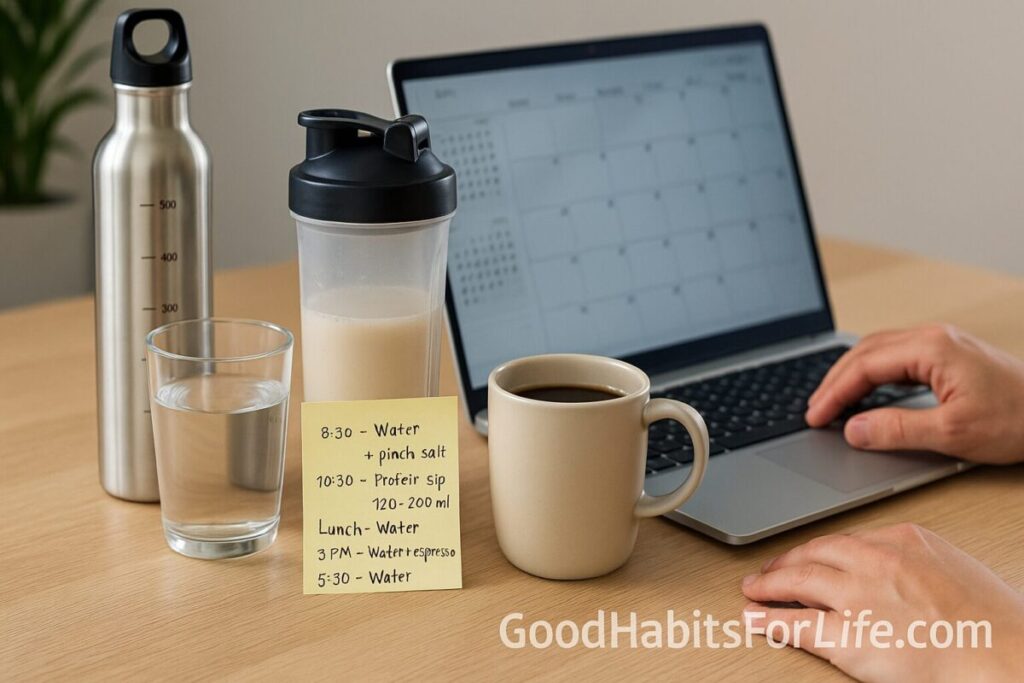
Office Hydration Routine: Sips that Beat Slumps: Protein-Forward Plan (2025)
Office Hydration Routine: Protein-Forward Sips (2025)
Table of Contents
🧭 What This Routine Is & Why It Works
An office hydration routine is a simple, repeatable schedule of sips, cues, and drink choices that maintain steady fluid balance and stable energy at work. Mild dehydration can impair attention, working memory, and mood—exactly the functions you need in meetings and deep-work blocks. Protein-forward sips (think milk, kefir, or a light whey shake) add satiety and help prevent the carb-crash cycle that drives afternoon slumps.
Evidence snapshot
-
Adequate daily fluid intake supports cognition and thermoregulation; most adults do well around 2–3 L/day (total fluids), varying by body size, climate, and activity.
-
Even mild dehydration can reduce cognitive performance and increase perceived effort.
-
Higher-protein beverages improve fullness and reduce subsequent energy intake, which can smooth energy across the day.
-
Moderate coffee intake is not dehydrating and can contribute to hydration when paired with water.
✅ Quick Start: Do This Today
-
Fill a 750–1,000 ml bottle and place it within arm’s reach.
-
Timing beats thirst. Sip 200–250 ml on arrival, 250 ml mid-morning, 250–500 ml at lunch, 250 ml mid-afternoon.
-
Protein-forward anchor: Choose one of these by noon:
-
250 ml milk or fortified soy milk (8–12 g protein)
-
200 ml drinkable yogurt/kefir (8–12 g)
-
300 ml water + 20–25 g whey/plant protein (20–25 g)
-
-
Pair caffeine with water: For each coffee/tea, drink 250 ml water.
-
Check your pee color by 3 pm: aim for pale straw; if darker, add 250–500 ml.
-
Set two cues: calendar ping at 10:45 and 15:30 for a 2-minute “sip & stretch.”
🗓️ 7-Day Starter Plan
Goal: Land on a sustainable baseline (~30–35 ml/kg/day). Example for a 70 kg person: 2.1–2.5 L/day fluids.
| Day | Focus | Target |
|---|---|---|
| Mon | Baseline | 250 ml on arrival + 250 ml mid-AM + 500 ml lunch + 250 ml mid-PM + 250–500 ml commute. |
| Tue | Protein anchor | Add 1 protein-forward drink before 13:00. Note hunger at 16:00. |
| Wed | Caffeine pairing | One cup coffee/tea = +250 ml water immediately after. |
| Thu | Smart refills | Refill bottle before meetings; 150–200 ml sip per hour of calls. |
| Fri | Electrolyte check | If in AC all day or after a sweaty commute, add a light electrolyte (see below). |
| Sat | Habit audit | Review pee color, afternoon energy, snack cravings. Adjust volume by ±250–500 ml. |
| Sun | Prep | Stock protein options; pre-portion protein powder; set Monday reminders. |
Checkpoints:
-
End of Week: Afternoon slumps < 30 min? Cravings reduced? Pee mostly pale straw? If yes, keep. If no, add +250–500 ml during 14:00–16:00 slot or move protein drink earlier.
🧠 Techniques & Frameworks
HPC Triangle: Hydration • Protein • Caffeine
-
Hydration: Small, frequent sips; front-load morning; keep bottle visible.
-
Protein: 20–30 g by early afternoon blunts snack attacks and stabilizes energy.
-
Caffeine: 60–200 mg (1 espresso ≈ 60–80 mg). Pair each serving with 250 ml water. Stop by 14:00–15:00 to protect sleep.
How Much to Drink?
-
Start with 30–35 ml/kg/day total fluids.
-
Add 250–500 ml for: hot climates, long calls, or walking the campus.
-
Use the pee-color heuristic: pale straw = good; apple-juice = drink.
Electrolytes: When & How
-
Useful if you sweat, work long hours in dry AC, or feel crampy/headachy despite drinking.
-
Choose low-sugar options; aim 200–500 mg sodium/L for office needs (far less than sports events).
-
Not needed for every bottle—1 serving/day during long or hot days is enough for most.
Caffeine Timing & Taper
-
Delay first caffeine 60–90 min after waking to align with cortisol rhythms.
-
If sensitive, switch to tea after lunch; decaf still adds to hydration.
Bottle & Visibility
-
Use a marked bottle (250 ml lines) or a smart cap. Keep it in line of sight; visibility increases sipping frequency.
🥛 Protein-Forward Drink Ideas (per ~250 ml)
| Drink | Protein | Sugars | Best Use | Notes |
|---|---|---|---|---|
| Skim/low-fat milk | 8–9 g | 12 g (lactose) | Mid-morning | Calcium + iodine; avoid if lactose-intolerant. |
| Fortified soy milk | 7–9 g | 3–6 g | Any time | Closest plant match to dairy’s protein quality. |
| Kefir/drinkable yogurt | 8–12 g | 8–15 g | Early afternoon | Fermented; choose low-sugar versions. |
| Whey isolate in water (20–25 g powder) | 20–25 g | 0–2 g | Pre-lunch or 15:00 | Very filling; minimal carbs. |
| Skyr/Greek yogurt drink | 12–17 g | 6–10 g | Snack replacement | Thick, satiating; check labels. |
| Pea/rice blend shake (20–25 g powder) | 18–23 g | 1–3 g | Any time | Good plant option; blend for smoothness. |
Tip: If calories matter, select lower-sugar or unsweetened bases; if you need calories for training days, pair with fruit.
🛠️ Audience Variations
-
Students: Pack a 600–750 ml bottle; set alarms between classes; choose shelf-stable protein shakes.
-
Professionals (desk/meetings): Keep a bottle visible on camera; sip 150–200 ml per hour of calls.
-
Parents on the go: Mix a quick whey/plant shake during school runs; keep a small electrolyte sachet in the bag.
-
Seniors: Prioritize warm beverages if cold fluids reduce intake; check meds that increase urination.
-
Teens: Encourage milk/soy milk at lunch; pair gaming sessions with a bottle rule (refill before new session).
⚠️ Mistakes & Myths to Avoid
-
Myth: “Coffee dehydrates you.” ➜ Normal coffee counts toward fluids when paired with water.
-
Mistake: Chugging 1 L at once. ➜ Leads to bathroom runs and doesn’t fix steady-state hydration.
-
Myth: “Electrolytes every day or you’ll cramp.” ➜ Office needs are modest; save electrolytes for heat/sweat.
-
Mistake: Skipping protein until dinner. ➜ Increases snack cravings and afternoon crash.
-
Myth: “Clear pee is the only goal.” ➜ Pale straw is ideal; crystal-clear all day may indicate over-drinking.
🗣️ Real-Life Examples & Scripts
-
Meeting cue: “Before we start, 30-second water top-up?”
-
Snack swap: “I’ll do a 250 ml kefir now and reassess hunger in 20 minutes.”
-
Coffee pairing: “Flat white at 11, plus a glass of water now.”
-
Team nudge: “Hydration break at :45 every hour—stretch + sip.”
🧩 Tools, Apps & Resources
-
Apps: Water Reminder, Waterllama, MyFitnessPal (for protein tracking), Zero (caffeine cut-off reminders via custom alarms).
-
Hardware: 750–1,000 ml marked bottle, collapsible cup, small electrolyte sachets.
-
Desk cues: Sticky note “Sip → Save Draft,” or calendar blocks named “Hydration & Reset.”
📌 Key Takeaways
-
Build a visible, timed sip habit (not occasional chugging).
-
One protein-forward drink before mid-afternoon stabilizes energy.
-
Pair each caffeine serving with 250 ml water; taper after lunch.
-
Use pee color and afternoon energy as your dashboards.
-
Adjust electrolytes only on hot/sweaty or long AC-days.
❓ FAQs
1) How much should I drink at the office?
Start at 30–35 ml/kg/day (total fluids). Adjust by climate, activity, and urine color.
2) Do tea and coffee count?
Yes. They contribute to hydration when consumed in moderation; just add 250 ml water per cup.
3) What’s the best time for a protein drink?
Before 13:00–14:00. Earlier protein reduces afternoon cravings and helps focus.
4) Do I need electrolytes if I sit all day in AC?
Not daily. Consider one light serving if you feel headachy/crampy or after a sweaty commute.
5) Is sparkling water okay?
Yes. If it makes you sip more, great. Watch added sodium if you’re on medical restriction.
6) What if I’m up all night with deadlines?
Use water + light electrolytes, limit caffeine after mid-afternoon, and prioritize recovery sleep next day.
7) Can I overdo water?
Rarely, but yes—avoid excessive volumes in a short time. Aim for steady sips; use pee color as a guide.
8) Lactose-intolerant—protein ideas?
Fortified soy milk, lactose-free milk, or pea/rice blend protein shakes work well.
9) Will hydration help headaches?
For some, yes; dehydration can trigger headaches. If headaches persist, consult a clinician.
10) What about zero-calorie flavored drops?
They’re fine if they help you drink more. Choose no-sugar options and rotate with plain water.
📚 References
-
National Academies of Sciences, Engineering, and Medicine. Dietary Reference Intakes for Water, Potassium, Sodium, Chloride, and Sulfate. https://www.nationalacademies.org
-
EFSA Panel on Dietetic Products, Nutrition and Allergies. Scientific opinion on Dietary Reference Values for water. EFSA Journal. https://efsa.onlinelibrary.wiley.com
-
Adan, A. Cognitive performance and dehydration. J Am Coll Nutr (2012). https://pubmed.ncbi.nlm.nih.gov/22855911/
-
Ganio, M. S., et al. Mild dehydration impairs cognitive performance: a meta-analysis. Med Sci Sports Exerc (2011). https://pubmed.ncbi.nlm.nih.gov/21311362/
-
Leidy, H. J., et al. The role of protein in weight loss and maintenance. Am J Clin Nutr (2015). https://academic.oup.com/ajcn/article/101/6/1320S/4564493
-
Westerterp-Plantenga, M. S., et al. Dietary protein, metabolism, and satiety. Br J Nutr (2009). https://pubmed.ncbi.nlm.nih.gov/19328264/
-
Killer, S. C., et al. No evidence of dehydration with moderate coffee intake. PLoS ONE (2014). https://journals.plos.org/plosone/article?id=10.1371/journal.pone.0084115
-
American College of Sports Medicine. Exercise and fluid replacement: Position stand. Med Sci Sports Exerc (2007/updated guidance). https://pubmed.ncbi.nlm.nih.gov/17634208/
-
Harvard T.H. Chan School of Public Health. The Nutrition Source: Water. https://www.hsph.harvard.edu/nutritionsource/water/
-
CDC. Water and Healthier Drinks. https://www.cdc.gov/healthyweight/healthy_eating/water-and-healthier-drinks.html
Disclaimer
This article is educational and not a substitute for personalized medical or nutrition advice; consult your clinician if you have health conditions or fluid restrictions.