
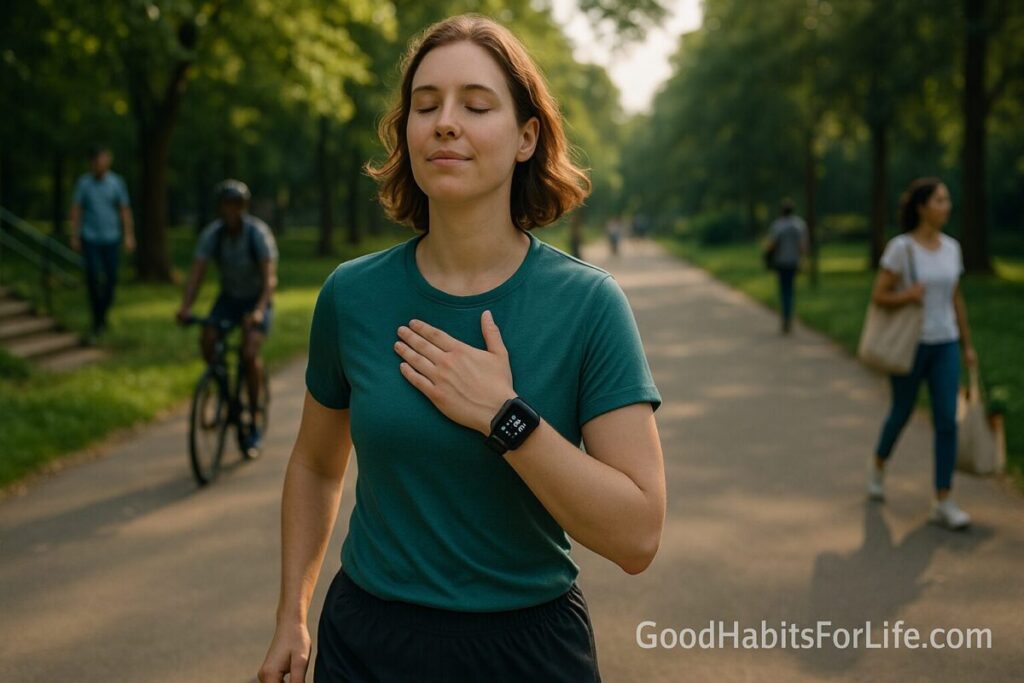
Anxiety & Gratitude: Avoiding Toxic Positivity: Zone 2 + NEAT (2025)
Avoid Toxic Positivity: Gratitude, Zone 2 & NEAT (2025)
Table of Contents
🧭 What & Why: Anxiety, Gratitude, and “Toxic Positivity”
Anxiety is a normal body-brain alarm that can become excessive. Helpful management blends thought skills, social support, and body strategies (sleep, movement, breath).
Gratitude, when grounded in reality, broadens attention, increases prosocial feelings, and is associated with better well-being and sleep. But toxic positivity—pressuring yourself or others to “be positive” while ignoring pain—often worsens distress by adding shame or suppression.
Where movement fits:
-
Zone 2 = easy aerobic work at a conversational pace (roughly 60–70% of max heart rate, near the first ventilatory threshold). It boosts mitochondrial capacity and is sustainable—you finish feeling better than you started.
-
NEAT (Non-Exercise Activity Thermogenesis) = all the calories burned by non-gym movement: steps, standing, chores, fidgeting. It’s a major lever for mood and energy because it’s spread through the day.
Why this combo helps anxiety:
-
Validating emotion + realistic gratitude calms the nervous system without denial.
-
Zone 2 smooths autonomic arousal and improves sleep.
-
NEAT keeps stress chemistry from “sticking” via regular, low-effort motion.
✅ Quick Start: Today’s 15-Minute Routine
Time-boxed routine (no equipment):
-
Name it (2 min). Quiet space; write: “I feel ___ because ___.” Add one helpful reframe: “And I can do ___ next.”
-
Grounded gratitude (3 lines).
-
One support I have is…
-
One small win in the last 24h is…
-
One action I’ll try today is… (link to movement, breath, or outreach)
-
-
Micro-Zone 2 (10 min). Walk outside or on the spot at a pace where you can talk in full sentences; finish feeling like you could go longer.
-
NEAT nudge (set a reminder). Every 50 minutes, stand and move for 2–3 minutes.
Targets for this week:
-
Zone 2: 3 sessions × 20–30 min.
-
NEAT: baseline steps + 2–3k/day (e.g., if you average 4k, aim for 6–7k).
-
Journaling: 3× per week, 3 grounded lines each time.
🧠 Techniques & Frameworks that Work
1) “Name It to Tame It.” Label the specific emotion (“worry,” “tight chest,” “spinning thoughts”). Naming reduces limbic reactivity and guides problem-solving.
2) The “Both/And” Gratitude Rule.
-
Both acknowledge discomfort and note what helps.
-
Example: “I’m anxious about the deadline, and I’m grateful the brief is clear and my teammate can proofread.”
3) RAIN (Recognize, Allow, Investigate, Nurture).
Use RAIN when anxiety spikes. Pair the Nurture step with a short walk or a cup of water + slow breathing.
4) Zone 2 Finder.
-
Talk Test: If you can speak in full sentences but singing feels too hard, you’re there.
-
Heart Rate (optional): ~60–70% of HRmax (estimate HRmax as 220 – age).
-
Feel: Steady, nose-dominant breathing is often possible.
5) NEAT “Tripwires.”
-
Put items in inconvenient places (printer across the room, water bottle away from desk).
-
Use “stairs over lifts”; park further; stand on calls; walk meetings.
6) Cognitive Reframes (quick).
-
Catastrophe → “What’s the most likely outcome?”
-
All-or-nothing → “What would a 60% good version look like?”
🛠️ Habit Plan: 30-60-90 Roadmap
Goal: Reduce anxiety intensity/frequency; avoid toxic positivity; build sustainable movement.
Days 1–30 (Stabilize)
-
Gratitude: 3 lines, 3×/week (keep it real; no silver-lining pressure).
-
Zone 2: 3×/week, 20–30 min (walk/cycle/elliptical).
-
NEAT: +2k steps/day over baseline; stand for 2–3 min each hour.
-
Sleep anchor: consistent wake time ±30 min.
-
Checkpoints (weekly): rate anxiety (0–10), sleep quality, total Z2 minutes, average steps.
Days 31–60 (Build)
-
Gratitude: expand to 5 lines 3×/week; add “one person I appreciate + why.”
-
Zone 2: 3–4×/week, 30–40 min. One session may include 4 × 2-min brisk surges (still mostly Z2).
-
NEAT: +3k steps/day over baseline; add a 10-min walk after lunch.
-
Social buffer: schedule one supportive check-in per week.
-
Checkpoint: note which practices noticeably change mood within 24h.
Days 61–90 (Integrate)
-
Gratitude: 3 lines daily or 5 lines 4×/week; add “future-benefit gratitude” (thanking your future self for actions today).
-
Zone 2: 4×/week, 35–45 min; keep conversation-easy.
-
NEAT: target 7–10k steps/day (individualize); add 5-min evening tidy-walk.
-
Skill deepening: practice RAIN during one stressful moment/day.
-
Checkpoint: choose 2 keystone moves to keep forever.
👥 Audience Variations
Students: Walk campus loops between classes; study with the 50/10 move rule. Gratitude lines: teacher, friend, resource.
Parents/Caregivers: Stroller walks or “playground laps” = Zone 2; gratitude lines: help received, kid micro-wins, time saved.
Professionals: Walking 1:1s; stand for video calls; gratitude lines: colleague support, tool that saved time, clear priority.
Seniors: Use flat, safe routes; consider poles for stability; monitor exertion by talk test; gratitude lines: health care, neighbor, memory.
Teens: Pair Zone 2 with music; mini-journals in phone notes; gratitude lines: friend, song, skill.
⚠️ Mistakes & Myths to Avoid
-
Myth: “Gratitude should make me feel great immediately.”
Reality: It’s a practice that shifts attention over time; it doesn’t erase hard things. -
Mistake: Using gratitude to shut down emotions (“Others have it worse”).
Fix: Validate first, then add perspective. -
Myth: “Only hard workouts help anxiety.”
Reality: Easy, regular Zone 2 and NEAT are potent and sustainable. -
Mistake: Tracking only steps.
Fix: Track how you feel and sleep alongside steps and minutes. -
Myth: “If I miss a day, plan failed.”
Reality: Adjust the next block; consistency beats perfection.
💬 Real-Life Examples & Copy-Paste Scripts
When anxiety hits before a presentation:
-
Name: “I’m anxious about judgment.”
-
Both/And: “I’m nervous and I’ve rehearsed; I can start with my strongest point.”
-
Action: 10-minute walk + 3 slow breaths before entering.
When a friend says “just be positive”:
-
You: “I appreciate the encouragement. I need space to feel this and I’m working on next steps.”
When your inner critic says you’re failing:
-
Reframe: “This is hard, and I’m taking one helpful action now: 10 minutes of Zone 2.”
End-of-day journal (3 lines):
-
Feeling I’m carrying is…
-
Support I used today was…
-
Small win I’m grateful for is…
🔎 Tools, Apps & Resources (pros/cons)
-
Gratitude apps (Day One, Journey, Simplenote):
Pros: prompts, search, private; Cons: notifications can be noisy—tune them. -
Timers/Break reminders (Focus To-Do, native phone timers):
Pros: free/simple; Cons: easy to snooze—pair with visible cues. -
Step trackers/HR monitors (phone pedometer, basic HR strap/watch):
Pros: feedback for NEAT & Zone 2; Cons: HR estimates vary—use the talk test first. -
Walking meetings tools (voice memo apps):
Pros: capture ideas on the go; Cons: wind noise—use earbuds.
📌 Key Takeaways
-
Validate first, then add gratitude—never to erase emotion.
-
Easy, steady Zone 2 + daily NEAT are anxiety-friendly movement anchors.
-
Keep gratitude concrete (people, actions, moments), not forced positivity.
-
Track feelings + sleep + movement to see what truly helps.
-
Use the 30-60-90 roadmap to make calm your default.
❓ FAQs
1) What if gratitude makes me feel guilty?
Try the Both/And frame: acknowledge the hard thing first, then add one useful resource or action. Skip comparison (“others have it worse”).
2) How do I know I’m in Zone 2 without a gadget?
You can talk in full sentences, breathing is steady, and you could continue for 30–45 minutes.
3) Is NEAT just “getting steps”?
Steps are a proxy. NEAT also includes standing, household tasks, gardening, taking stairs, and fidgeting—small moves that add up.
4) How quickly will this help anxiety?
Some people feel calmer the same day; bigger changes usually come from weeks of consistent practice and better sleep.
5) Can I replace therapy or medication with this plan?
No. Movement and gratitude are helpful habits and often complement clinical care; they’re not replacements.
6) I get bored walking—any alternatives?
Easy cycling, elliptical, light rowing, or pool walking keep you in Zone 2. Audio (podcasts, music) helps adherence.
7) What if I’m short on time?
Do 10 minutes now and another 10 later; NEAT “movement snacks” still count.
8) I overheat easily. Any tips?
Choose cooler times, shade, hydration, light clothing; indoors, use fans or an air-conditioned corridor.
📚 References
-
World Health Organization. Guidelines on Physical Activity and Sedentary Behaviour (2020). https://www.who.int/publications/i/item/9789240015128
-
CDC. Physical Activity and Your Health: Anxiety & Mood. https://www.cdc.gov/physicalactivity/basics/pa-health/index.htm
-
American College of Sports Medicine. ACSM’s Guidelines for Exercise Testing and Prescription (overview). https://www.acsm.org
-
Levine, J. A. (2002). Non-exercise activity thermogenesis (NEAT). Nutr Rev. https://academic.oup.com/nutritionreviews/article/60/3/90/1937017
-
Levine, J. A. et al. (2005). Role of NEAT in human obesity. Science. https://www.science.org/doi/10.1126/science.1117487
-
Emmons, R. A., & McCullough, M. E. (2003). Counting blessings vs. burdens. J Pers Soc Psychol. https://psycnet.apa.org/record/2003-06367-003
-
Wood, A. M. et al. (2010). Gratitude and well-being: A review and theoretical integration. Clin Psychol Rev. https://www.sciencedirect.com/science/article/pii/S0272735810001091
-
Gross, J. J., & John, O. P. (2003). Individual differences in emotion regulation: Reappraisal and suppression. J Pers Soc Psychol. https://psycnet.apa.org/record/2003-03522-006
-
National Institute of Mental Health. Anxiety Disorders. https://www.nimh.nih.gov/health/topics/anxiety-disorders
-
Seiler, S. (2009). Intervals, thresholds, and long slow distance: endurance training intensity distribution. Int J Sports Physiol Perform. https://pubmed.ncbi.nlm.nih.gov/19953803/
-
NHS. Anxiety self-help. https://www.nhs.uk/mental-health/conditions/anxiety
-
Greater Good Science Center (UC Berkeley). Gratitude resources & research. https://greatergood.berkeley.edu/topic/gratitude
Disclaimer: This guide is for general education and is not a substitute for professional medical or mental-health advice; consult a qualified clinician for personalized care.