
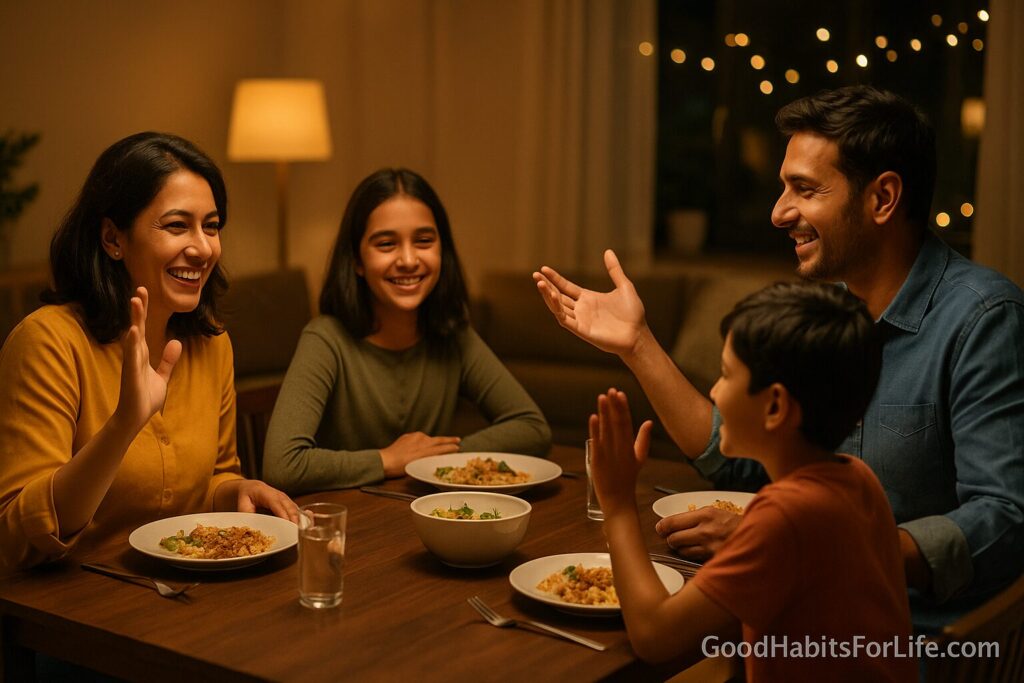
Evening High/Low/Thanks: A Family Ritual
Evening High-Low-Thanks: The 10-Minute Family Ritual
Table of Contents
🧭 What is “High-Low-Thanks”?
“High-Low-Thanks” is a simple, structured evening check-in: each person shares one high (best moment), one low (tough moment), and one thanks (something or someone they’re grateful for). It works around the dinner table, couch, or bedtime—anywhere you can pause together. The goal is connection, emotional vocabulary, and everyday gratitude—not problem-solving in the moment.
🧠 Why it Works (Research in Plain English)
-
Family rituals & routines (like a nightly check-in) are linked with better child adjustment, parenting competence, and family satisfaction. They organize family life and provide stability in stressful times. American Psychological Association+1
-
Shared mealtimes—a common place to do High-Low-Thanks—are associated with stronger communication and lower risks for depression and other mental-health concerns in youth. HealthyChildren.org
-
Gratitude interventions improve mental health and reduce anxiety/depression symptoms across many randomized trials; people who practice gratitude report more positive emotions and better well-being. PMCGreater Good
-
Connection is protective for teens. Family support and positive communication are recognized protective factors for adolescent mental health. A regular, structured check-in builds both. World Health OrganizationPMC
✅ Quick Start (Tonight)
-
Pick a time & place. Dinner table or bedtime works great; 10 minutes max.
-
Set the ground rules. Everyone shares one High, one Low, one Thanks. No interrupting; no fixing during shares.
-
Go clockwise. Use a “talking item” (spoon, toy) to cue the speaker.
-
Listen first. Respond with “Thanks for sharing” or “I hear you.” Save advice for later.
-
Close with a cheer. “Thanks, team!” Optional: one-word mood check (“calm,” “hopeful,” etc.).
🗓️ 7-Day Starter Plan
Day 1 – Launch: Explain the ritual and rules. Each person shares High-Low-Thanks.
Day 2 – Make it easy: Add a 2-minute timer per speaker. Write “prompt cards” (see below).
Day 3 – Feelings words: Put a small feelings wheel on the table to expand vocabulary.
Day 4 – Low with care: When a low is sensitive, say: “Do you want comfort, company, or solutions—C, C, or S?”
Day 5 – Thanks remix: Try specific gratitude: name the person + action + impact (“Thanks, Mom, for helping with math; I felt less stressed”).
Day 6 – Rotate host: A different person facilitates and picks the closing cheer.
Day 7 – Checkpoint: Ask, “What made this work? What should we tweak?” Decide your permanent time.
🛠️ Techniques & Prompts
Prompts you can copy:
-
Highs: “When did you smile today?” “What energized you?”
-
Lows: “What drained you?” “Where did you feel stuck?”
-
Thanks: “Who helped you?” “What small thing felt good (sunset, seat on bus)?”
Frameworks to strengthen the ritual:
-
Rose–Bud–Thorn (win, opportunity, challenge) for a fresh variation once a week. University of Colorado Boulder
-
OARS listening (Open questions, Affirm, Reflect, Summarize): “So your low was the group project—sounds frustrating because the deadline moved?”
-
Emotion coaching: label feelings, validate, then collaborate later (“Makes sense you felt disappointed. Want to problem-solve after dishes?”).
Prompt cards (print or sticky notes):
-
Energy, Surprise, Challenge, Kindness, Learning, Awe.
👨👩👧👦 Variations for Different Ages & Families
-
Young kids (4–8): Use pictures or emoji cards; keep it to 1–2 sentences; celebrate participation.
-
Tweens/Teens: Offer privacy options (“pass” is allowed); ask “Comfort, company, or solutions?” to avoid over-fixing. Protective family communication is especially valuable in adolescence. World Health OrganizationPMC
-
Busy professionals: Do a voice note “round” on a family WhatsApp if dinner doesn’t align; debrief for 5 minutes at bedtime.
-
Single-parent or blended families: Keep the ritual consistent even if the roster changes; the predictability is the “safety.” American Psychological Association
-
Multigenerational homes / grandparents: Invite elders weekly; they model perspective and gratitude.
-
Neurodiverse family members: Offer alternative formats (typing, drawing, scale 1–5); keep turns predictable.
⚠️ Common Mistakes & Myths
-
Myth: “We don’t have time.” → You need 10 minutes; skipping once isn’t failure—get back on schedule tomorrow.
-
Mistake: Turning “Lows” into lectures. Keep listening first; problem-solve later.
-
Mistake: Fishing for only “happy” highs. Real highs can be small wins; lows are welcome and safe.
-
Myth: “Gratitude is fluffy.” → Robust studies show gratitude practices measurably improve mental health and well-being. PMC
-
Mistake: Letting one person dominate. Use a timer or talking item.
💬 Real-Life Scripts (Copy-Paste)
-
Kickoff: “Let’s do High-Low-Thanks. One minute each. Who wants the spoon?”
-
When a low is heavy: “Do you want comfort, company, or solutions?”
-
Validating a teen: “Given what happened, it makes total sense you felt overwhelmed. Thanks for being honest.”
-
When someone passes: “Totally okay. You can jump in later if you want.”
-
Gratitude upgrade: “I’m thankful to Aarav for emptying the dishwasher—saved me 10 minutes.”
🧰 Tools, Apps & Printables
-
Apps: Day One (journaling), Presently/Gratitude (simple prompts), Notion or Google Keep (shared family log).
-
Printables: Feelings wheel; prompt cards (“Energy, Surprise, Challenge, Kindness, Learning, Awe”).
-
Timer: Any 60-second sand timer for kid-friendly turns.
-
Optional: A small “talking item” (wooden spoon, toy).
📚 Key Takeaways
-
A predictable, short ritual creates safety and deeper conversations. American Psychological Association
-
Combining Highs (savoring), Lows (emotional literacy), and Thanks (gratitude) targets three proven well-being levers. PMCGreater Good
-
Keep the tone curious and non-fixing; problem-solve after the ritual if needed.
-
Start tonight; refine in a week; keep what works.
❓ FAQs
1) What if my child says “nothing happened” or “fine”?
Offer prompts (“funniest moment, hardest moment, kindest moment”) or let them pass without pressure; consistency builds trust.
2) Can we do this without dinner together?
Yes. Do it on the couch or at bedtime; mealtimes help but are not required. Family meals are simply a convenient, well-studied context for connection. HealthyChildren.orgPMC
3) Won’t focusing on “lows” make people feel worse?
No—briefly naming tough moments increases emotional literacy and support; you’re not ruminating, you’re witnessing and normalizing.
4) How do we prevent advice-giving?
Use the C-C-S question (“Comfort, company, or solutions?”). If “solutions,” schedule a separate 10-minute problem-solve.
5) What if we miss a day?
Just resume at the next opportunity. Think “trend over perfection.”
6) Is gratitude really evidence-based?
Yes. Meta-analyses and research syntheses show gratitude practices offer small-to-moderate improvements in mental health and well-being. PMC
7) How long should each turn be?
Aim for ~60–90 seconds per person. Large families can split into pairs then share highlights.
8) Are there fun variations?
Try Rose–Bud–Thorn (win, opportunity, challenge) or “High-Low-Buffalo” (something random). University of Colorado Boulder
9) How do we include grandparents or distant family?
Run a weekly video call version; keep the same structure and time limit.
10) Can this help with teen mental health?
It’s not therapy, but regular, positive family communication is a protective factor. If you’re concerned, seek professional support. World Health OrganizationPMC
📚 References
-
Fiese, B. H., et al. A review of 50 years of research on family routines and rituals. (APA press release & summary). https://www.apa.org/news/press/releases/2002/12/rituals American Psychological Association
-
Fiese, B. H., et al. Family routines and rituals (journal PDF). https://www.apa.org/pubs/journals/releases/fam-164381.pdf American Psychological Association
-
American Academy of Pediatrics (HealthyChildren.org). Family Meals: Eat Together, Thrive Together. https://www.healthychildren.org/English/family-life/family-dynamics/Pages/family-meals-eat-together-thrive-together.aspx HealthyChildren.org
-
Diniz, G., et al. (2023). The effects of gratitude interventions: a systematic review and meta-analysis. https://pmc.ncbi.nlm.nih.gov/articles/PMC10393216/ PMC
-
Greater Good Science Center (UC Berkeley). How Gratitude Changes You and Your Brain. https://greatergood.berkeley.edu/article/item/how_gratitude_changes_you_and_your_brain Greater Good
-
Harvard Health Publishing. Giving thanks can make you happier. https://www.health.harvard.edu/healthbeat/giving-thanks-can-make-you-happier Harvard Health
-
World Health Organization. Adolescent mental health – Fact sheet. https://www.who.int/news-room/fact-sheets/detail/adolescent-mental-health World Health Organization
-
Utter, J., et al. (2018). Family meals among parents: associations with connection and communication. https://pmc.ncbi.nlm.nih.gov/articles/PMC6309329/ PMC
-
University of Colorado, Research & Innovation Office. Rose, Bud, Thorn. https://www.colorado.edu/researchinnovation/rose-bud-thorn University of Colorado Boulder
Disclaimer: This article is for general information and is not a substitute for professional mental-health advice.