
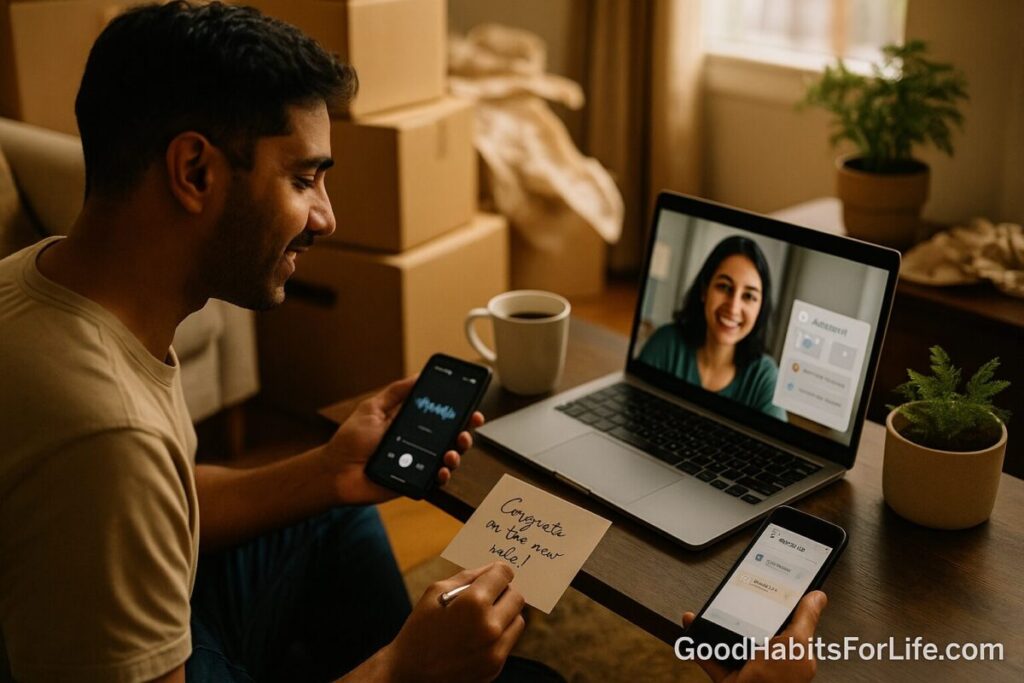
Career Transitions: Keep Your Friendships Warm: AI workflows (2025)
Career Transitions: Keep Friendships Warm (AI Workflows)
Table of Contents
🧭 What & Why: Friendship Through Career Transitions
Career transitions—new role, relocation, graduation, sabbatical, layoff, or starting a business—often scramble our routines. Without an intentional plan, good friendships drift and weak ties go cold. That’s costly for well-being and opportunity: stable, supportive relationships are linked to better health and happiness, while loneliness increases risks for multiple conditions. APACDC
Weak ties (friendly acquaintances and former colleagues) matter too: a large LinkedIn experiment showed they’re especially powerful for landing new jobs—precisely when you’re in transition. SciencePubMedMIT News
Bottom line: protect your inner circle and keep your broader network pleasantly warm with small, consistent gestures—amplified by sensible AI support. Strong social relationships even predict longer life, comparable in impact to major health factors. PLOSPMC
✅ Quick Start: Do-This-Today Checklist
-
List 25 people: 5 close friends, 10 good friends, 10 warm acquaintances/mentors.
-
Tag them A/B/C by closeness (A = weekly touch; B = biweekly; C = monthly).
-
Send 3 micro-check-ins today (voice note or short text).
-
Calendar recurring reminders (lightweight): A weekly, B biweekly, C monthly.
-
Spin up a “Keep-Warm” board (Notion/Sheets): name, last contact, shared topics, next nudge date.
-
Use AI once to draft 3 personalized openers; edit to sound like you.
-
Schedule one 20-minute coffee/phone for this week; one deeper catch-up for next week.
-
Give first: share a resource, intro, kudos, or invite—no asks.
🧱 30-60-90 “Keep-Warm” Plan
Days 1–30: Stabilize
-
Reconnect burst: 3–5 messages/week; prioritize A and B lists.
-
Micro-rituals: Friday “Friend Five” (5 pings), Sunday voice note to one long-distance friend.
-
One IRL/virtual hang per week (20–45 minutes).
-
Career update (opt-in): brief “I’m in transition—here’s my direction; would love to swap notes” to a few trusted contacts.
Checkpoints (Day 30):
-
Contacted all A’s at least 3×, B’s 2×, C’s 1×.
-
Your board shows next dates for everyone.
-
One helpful intro/resource given to at least 5 people.
Days 31–60: Strengthen
-
Theme weeks: alumni, ex-team, city friends, hobby groups.
-
Shared moments: co-work hour, walk-and-talk, game night.
-
Weak-tie warmth: comment thoughtfully on updates; send “saw this and thought of you” links (2–3/week). Evidence supports weak ties for opportunity—tend them. Science
Checkpoints (Day 60):
-
Two group touchpoints hosted/joined.
-
10+ weak ties lightly re-engaged.
Days 61–90: Sustain
-
Cadence lock-in: A weekly, B biweekly, C monthly.
-
Give-ask balance: 3 gives for every ask.
-
Quarterly deep dives: 60-minute catch-ups with 3 people.
-
Gratitude sweep: notes to mentors/helpers.
Checkpoints (Day 90):
-
Network map stable; drifting contacts flagged; new ties added.
-
You feel less isolated, more supported—a measurable protective factor for health. CDC
🧠 Techniques & Frameworks (with AI Workflows)
1) The “Circles & Cadence” Framework
-
Circles: A (inner 5), B (next 10), C (next ~10–25).
-
Cadence: A weekly, B biweekly, C monthly.
-
Focus: warmth > frequency; specificity > generic.
(Note: people typically maintain ~100–200 stable relationships overall; plan realistically.) PLOSPMC
2) Message Triad: Specific → Generous → Open-Ended
-
Specific: “Your Lisbon move looked epic—how’s the onboarding?”
-
Generous: “Happy to review your portfolio / connect you to X.”
-
Open-Ended: “Want a 15-min walk-and-talk next week?”
3) AI Workflows (2025, Human-First)
A. Draft Like You Talk
-
Prompt template:
“You are my writing assistant. Draft a friendly, 60–80 word check-in to [Name]. Context: [shared history / recent life event]. Tone: warm, concise, 1 subtle inside reference. Avoid clichés. End with an easy question and no pressure. Offer help with [specific]. Provide 3 variants.” -
Humanize: add a shared memory, your real voice, and one vivid detail.
B. Contacts → Reminders → Snippets
-
Database (Notion/Sheet): name, relationship, last contact, topics, next date.
-
Automation idea: Weekly, surface 5 due contacts + suggested snippets.
-
Guardrails: never mass-blast; always review copy; stagger sends.
C. Listening Library
-
Build a lightweight doc per friend: “what they’re working on / caring about / celebrating / struggling with.” Update after calls; ask permission if you log anything sensitive.
D. Weak-Tie Nurture
-
Weekly queue: 2 comments on LinkedIn/Alumni Slack + 1 light DM per day. Weak ties drive job mobility; your goal is warmth, not pitch. Science
E. Privacy & Consent
-
Don’t store confidential info without consent; avoid automated DMs that mimic you 1:1; disclose if AI helped write a long note.
🛠️ Audience Variations
-
Students/Graduates: Host monthly peer “career circles” (4–6 people). Keep professors/mentors warm with occasional progress notes and asks for advice.
-
Professionals (New Role/Relocation): First 90 days: rotate 1:1 coffees, join 1 external community, and set a “Friday five” outreach ritual.
-
Parents/Caregivers: Asynchronous touch—voice notes, photo updates, 20-minute walk-and-talks.
-
Seniors/Retirees: Schedule recurring social blocks (cards club, walking group). Small, frequent contact strongly protects health. PMC
-
Teens/Young Adults: Create shared micro-rituals (study sprints, gym pairs). Keep online contact balanced with IRL time.
⚠️ Mistakes & Myths to Avoid
-
Myth: “Real friends don’t need maintenance.” Relationships benefit from small, consistent investments. PLOS
-
Spammy blasts. Avoid “Dear all” updates—choose personal notes.
-
Only contacting when you need something. Keep a 3:1 give-to-ask ratio.
-
Over-automating. AI drafts; you decide and personalize.
-
Neglecting weak ties. They’re often your bridge to new roles and ideas. Science
💬 Real-Life Examples & Copy-Paste Scripts
1) After a Long Silence
“Hey [Name]—I was thinking about our [shared memory]. I’ve been [one-sentence life update]. How are things in your world lately? Up for a quick catch-up next week—totally fine if timing’s hectic.”
2) New Job / City
“Quick hello from [new city/new role]! Settling in and learning fast. If you have any [neighborhood lunches / meetups / people] I should know, I’m all ears. Coffee on me if you’re free in the next couple of weeks?”
3) Layoff / Pivot (Vulnerable + Specific)
“I’ve just been impacted by a layoff and I’m exploring [roles/industries]. If someone comes to mind I should meet, I’d value an intro—and happy to trade feedback or help on your projects too.”
4) Weak-Tie Warmth
“Your post on [topic] resonated—especially the bit about [detail]. Cheering you on. If you ever want to swap notes on [shared niche], I’d love that.”
5) Gratitude & Micro-Recognition
“Just a quick note to say your advice on [X] still helps me weekly. Thank you. If I can ever return the favor, I will.”
📚 Tools, Apps & Resources (quick takes)
-
Contacts/CRM: Notion, Airtable, Google Sheets
-
Pros: flexible, simple; Cons: manual upkeep unless automated.
-
-
Reminders/Calendar: Google Calendar, Apple Reminders, TickTick
-
Pros: native, reliable; Cons: light on relationship context.
-
-
Messaging: WhatsApp/Signal/Telegram, email, LinkedIn DMs
-
Pros: reach people where they are; Cons: easy to over-message.
-
-
Video/IRL: Zoom/Meet, Calendly, Meetup
-
Pros: fast scheduling; Cons: can feel transactional—add warmth.
-
-
Knowledge capture: Obsidian/Notion
-
Pros: searchable memory; Cons: be cautious with private details.
-
🔑 Key Takeaways
-
Relationships need light, regular maintenance, especially during transitions.
-
AI helps with drafting and organizing—but warmth comes from your voice and attention.
-
Protect inner-circle rituals, and keep weak ties warm with low-pressure touches. Science
-
Use a 30-60-90 plan to build momentum you can sustain all year.
-
Give first: share opportunities, kudos, and introductions.
❓ FAQs
1) How often should I reach out during a transition?
Weekly for inner circle, biweekly for good friends, monthly for acquaintances—adjust to preference and reciprocity.
2) Isn’t it awkward to message after months of silence?
Acknowledge the gap and share something specific you appreciate; most people welcome reconnection.
3) What’s a healthy number of “active” connections to maintain?
Plan for a few dozen you can reliably keep warm; people typically sustain roughly 100–200 stable ties overall. PLOS
4) How do I avoid sounding robotic with AI?
Use AI for first drafts only. Add personal details, inside references, and your natural cadence before sending.
5) I moved cities—how can I keep old friendships alive?
Stack habits: monthly video catch-up, shared media (watch-together), postcards, and an annual visit if feasible.
6) How do I keep weak ties warm without being transactional?
React to their updates, send relevant resources, and offer small help—no pitch unless invited. Weak ties often matter for jobs. Science
7) What if a friend doesn’t reply?
Assume busyness. Nudge once in 2–3 weeks; if quiet, reduce cadence and keep the door open.
8) Can this help my health, not just my career?
Yes—social connection is linked to better mental and physical health and reduced mortality risk. CDCPLOS
9) Is group time as valuable as 1:1?
Both help. Small group rituals (study circles, hobby nights) create shared memories and keep multiple ties warm at once.
10) How do I track all this without feeling like a salesperson?
Keep a simple board with dates and topics. The intention is care, not quotas—quality over quantity.
📖 References
-
Rajkumar K., et al. A causal test of the strength of weak ties. Science. 2022. (LinkedIn experiments on job mobility). https://www.science.org/doi/10.1126/science.abl4476 Science
-
MIT News. Weak ties on LinkedIn more likely to land jobs. 2022. https://news.mit.edu/2022/weak-ties-linkedin-employment-0915 MIT News
-
Centers for Disease Control and Prevention. Health Effects of Social Isolation and Loneliness. Updated May 15, 2024. https://www.cdc.gov/social-connectedness/risk-factors/index.html CDC
-
CDC MMWR. Loneliness, Lack of Social and Emotional Support. 2024. https://www.cdc.gov/mmwr/volumes/73/wr/mm7324a1.htm CDC
-
Holt-Lunstad J., et al. Social Relationships and Mortality Risk: A Meta-analytic Review. PLoS Medicine. 2010. https://journals.plos.org/plosmedicine/article?id=10.1371/journal.pmed.1000316 PLOS
-
APA Monitor. The science of why friendships keep us healthy. 2023. https://www.apa.org/monitor/2023/06/cover-story-science-friendship APA
-
OECD. Measuring social connectedness in OECD countries. 2024. https://www.oecd.org/en/publications/measuring-social-connectedness-in-oecd-countries_f758bd20-en.html OECD
-
Harvard Gazette. Harvard Study of Adult Development: relationships & happiness. 2017. https://news.harvard.edu/gazette/story/2017/04/over-nearly-80-years-harvard-study-has-been-showing-how-to-live-a-healthy-and-happy-life/ Harvard Gazette
-
Gonçalves B., et al. Modeling Users’ Activity on Twitter Networks (friendship capacity ~100–200). PLOS ONE. 2011. https://journals.plos.org/plosone/article?id=10.1371/journal.pone.0022656 PLOS
-
Pezirkianidis C., et al. Adult friendship and wellbeing: systematic review. 2023. https://pmc.ncbi.nlm.nih.gov/articles/PMC9902704/ PMC
Disclaimer
This article offers general guidance on relationships and well-being; it is not medical or mental-health advice. If you’re struggling, consider speaking with a qualified professional.